


Best Crypto Cards in China (2026)
China is not a mainstream crypto-card market at all. This guide focuses on the limited offshore card options that still matter for mainland users, cross-border workers, and Hong Kong-adjacent setups once legal risk and practical access barriers are taken seriously.



Verified for China
33 crypto cards available
Local currency: CNY
Crypto is banned in China. Whether your accounts are with ICBC, China Merchants Bank, or any of the Big Four, the reality is the same. The People's Bank of China (PBOC) and seven other regulators have made cryptocurrency trading, mining, and exchange operations illegal since 2021, with the ban reinforced as recently as February 2026.
This page exists not to recommend cards you cannot practically use, but to document the current state of affairs for the 1.4 billion people living under the world's most comprehensive crypto prohibition.
Globally available crypto cards from vendors like Crypto.com, KAST, and RedotPay technically list China as an available country. In practice, mainland Chinese residents face multiple barriers: Chinese banks block crypto-related transactions, most offshore issuers reject mainland Chinese KYC documents, and acquiring cryptocurrency to fund these cards is itself illegal under PRC law.
| Card | Max Rewards | Annual Fee | FX Fee | Card Type | Practical Access |
|---|---|---|---|---|---|
| Crypto.com | up to 8% | CRO stake | 0% | Prepaid | May block mainland CN |
| ether.fi | 3% | $0 | 1% | Credit | Borrow-to-spend for diaspora |
| RedotPay | - | $0 | 1.2% | Prepaid | HK-based, most accessible |
| Kolo | 5% BTC | $0 | 0% | Prepaid | Highest free-tier cashback |
| KAST | 2% points | $0 | 0.5% | Prepaid | Bridge card once overseas documents are in place |
| xPlace | 0.5-2% | $0 | 1% | Debit | Tiered rewards system |
| Jupiter | 4-10% JupUSD | $0 | 1% | Debit | Solana ecosystem |
Per our 2026 China update, RedotPay (Hong Kong-based) is the most realistically accessible option for users with offshore crypto holdings. None of these cards should be considered safe or legal to use from within mainland China. Chinese nationals living abroad with foreign residency face far fewer barriers.
Best Card For Every Need in China
Top 5 Crypto Cards in China
China's February 2026 eight-regulator directive expanding controls on stablecoins and RWA tokenization confirms this page serves one audience: the 10+ million Chinese nationals living abroad, not mainland residents. RedotPay's Hong Kong base makes it the most realistically accessible option - Chinese nationals with HKID get the smoothest KYC process, and the Solana variant suits USDC spending.
Kolo delivers 5% BTC cashback with 0% FX and $0 annual fee ($5/txn cap, $200/mo cashback cap) - the highest free-tier return for diaspora members who want cashback without staking requirements. KAST fits the overseas-student and new-arrival use case once someone lands in Sydney, Vancouver, or London and needs a live card while local bank onboarding, tenancy checks, and campus paperwork are still in progress.
Crypto.com Icy offers 4% cashback with 0% FX and lounge access at airports between overseas hubs - valuable for a diaspora that flies frequently between HK, Singapore, Sydney, and London (requires CRO stake). ether.fi serves diaspora members who accumulated ETH before the 2021 ban and now need liquidity without triggering China's 20% property transfer tax on disposal.
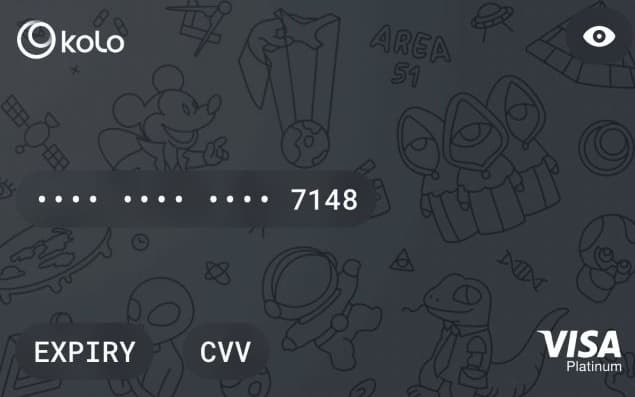
1. Kolo Card
Earn Bitcoin on Every Purchase: 5% BTC Cashback + Visa Platinum + 170+ Countries

2. RedotPay Solana Card
Solana Goes IRL: Spend SOL Directly at 130M+ Merchants
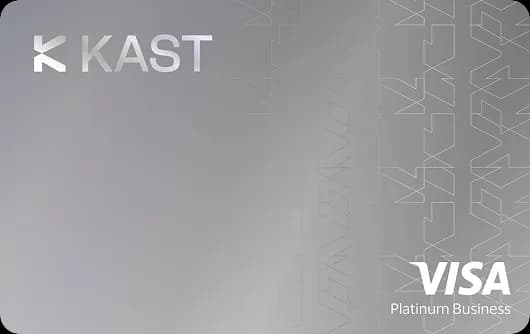
3. KAST K Card
Early Adopter Access: 2% Points + 4% $MOVE on Every Swipe

4. ether.fi Core Card
Zero Barriers: 3% Back on Every Purchase, No Stake Required
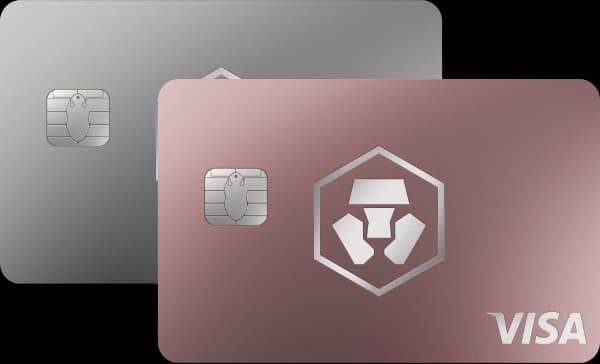
5. Private (Icy White / Rose Gold)
Elite Private Status: 4% Uncapped Cashback + Guests
Crypto Card Regulation in China
China operates the world's strictest anti-crypto regulatory regime. The PBOC (People's Bank of China, Zhongguo Renmin Yinhang, 中国人民银行) leads enforcement, supported by seven co-regulators: the CSRC (China Securities Regulatory Commission, 中国证监会), the NFRA (National Financial Regulatory Administration, 国家金融监管总局, which replaced the former CBIRC in 2023), the Ministry of Finance (财政部), the Supreme People's Court, and others.
Regulatory Timeline: How China Built the World's Strictest Crypto Ban
| Date | Event | Impact |
|---|---|---|
| Sep 2017 | PBOC bans ICOs, orders domestic exchanges to close | Huobi, OKCoin exit mainland. P2P trading moves offshore. |
| 2018-2020 | Mining tolerated, OTC trading persists in grey area | Chinese miners control 65%+ of Bitcoin hashrate |
| May 2021 | State Council targets mining. Inner Mongolia, Xinjiang shut down first | Great Mining Migration begins - hashrate drops 50% |
| Sep 2021 | Ten agencies declare ALL crypto activities illegal | Total ban: trading, mining, exchanges, OTC desks. Huobi delists CNY pairs |
| 2022-2024 | Enforcement escalates. Individual prosecutions increase | P2P traders arrested. Banks freeze accounts flagged for crypto |
| Nov 2025 | 13-agency meeting reinforces crypto crackdown, singles out stablecoins | Yuan-pegged stablecoins flagged for money laundering, fraud, illegal cross-border transfers |
| Dec 2025 | 400,000 mining rigs shut down in Xinjiang amid CCP investigations | Bitcoin hashrate drops 8% day-over-day; mostly temporary disruption |
| Jan 2026 | PBOC approves interest-bearing e-CNY wallets under new framework | World's first interest-bearing CBDC. Digital yuan transitions from "cash" to "deposit money" |
| Feb 2026 | Eight regulators issue directive banning RMB-pegged stablecoins + RWA tokenization | No entity, Chinese or foreign, may issue yuan stablecoins abroad without approval |
Each escalation pushed more crypto users offshore. An estimated 59 million Chinese residents still hold or trade crypto despite the ban, while over 10 million Chinese nationals living abroad form the primary audience for crypto card services.
Crypto card issuers operating globally, such as Crypto.com and Binance, have withdrawn direct services from mainland China. RedotPay, headquartered in Hong Kong, operates under Hong Kong's separate regulatory framework but does not explicitly market to mainland users.
The Hong Kong Exception
Hong Kong maintains a parallel system that operates under entirely different rules. The Securities and Futures Commission (SFC) licensed crypto exchanges for retail trading in August 2023 (OSL and HashKey received the first retail licenses). The HKMA's Stablecoins Ordinance took effect on August 1, 2025, creating a formal licensing regime for stablecoin issuers.
The HKMA received 36 applications and is granting the first batch of licenses in March 2026 - HSBC and Standard Chartered are expected to be among the first approved, giving two of Hong Kong's note-issuing banks a central role in the city's push to become a regulated digital asset hub.
What Hong Kong residents can actually do that mainland residents cannot:
- Trade crypto legally on SFC-licensed exchanges (OSL, HashKey) with HK identity documents
- Hold crypto assets without legal risk under the VASP (Virtual Asset Service Provider) regime
- Use crypto cards from Hong Kong-based issuers like RedotPay with full HKMA compliance
- Fund cards via local banking through HSBC HK, ZA Bank, or Bank of China (HK) - these are separate entities from their mainland counterparts and do not block crypto-related transfers
- Access DeFi protocols without the Great Firewall restrictions that block most Web3 services on the mainland
Beijing tolerates this divergence as a controlled experiment. The Greater Bay Area (linking Shenzhen, Guangzhou, Dongguan, and Hong Kong) creates a unique grey zone where Shenzhen residents with border crossing permits spend weekends in Hong Kong with access to services banned across the border. However, HK services explicitly require HKID verification - a Shenzhen hukou does not qualify.
Any crypto card usage from mainland China carries legal risk. This is not a theoretical warning - money laundering prosecutions reached 3,032 individuals in recent enforcement cycles, with crypto-related crimes totaling 430.7 billion yuan ($59 billion).
Despite the ban, an estimated 59 million Chinese residents still trade crypto (roughly 10% of global crypto users, second only to India), with 63% of trades happening through P2P channels and 45% through encrypted WeChat escrow bots. Authorities are now deploying blockchain forensics to trace on-chain flows and monitor fiat on/off-ramps through Chinese bank accounts.
Tax Treatment of Card Rewards in China
Despite banning crypto trading, China taxes crypto gains. The State Taxation Administration (STA, Guojia Shuiwu Zongju, 国家税务总局) classifies cryptocurrency profits under "property transfer income" at a flat 20% rate on net gains.
Example: You acquired BTC worth CNY 10,000 and it appreciates to CNY 30,000. If you spend CNY 30,000 via a crypto card, you owe 20% on the CNY 20,000 gain = CNY 4,000 in tax. This applies even if the transaction occurs offshore.
If the STA classifies your activity as a business (high-frequency trading, large volumes), progressive rates of 5% to 35% apply instead.
| Cashback Type | When Received | When Spent via Card | Total Tax Burden |
|---|---|---|---|
| BTC cashback | 20% on FMV | 20% on appreciation | Up to 40% |
| USDC cashback | 20% on FMV | approx. 0% gain | 20% |
| Points | Unclear | Unclear | Uncertain |
USDC funding minimizes the tax burden on the spending side, though the initial acquisition of stablecoins is itself illegal under current law. The paradox of China taxing gains on activities it has banned creates significant legal uncertainty.
Annual tax filing is required for taxable income. The tax year follows the calendar year (January-December). Offshore crypto income is reportable under China's worldwide taxation principle for tax residents.
How to Apply from China
Mainland Chinese crypto card applications would require a shenfenzheng (居民身份证, Resident Identity Card), the mandatory national ID for all citizens over 16. The 18-digit ID number (shenfenzheng haoma) is the primary identifier. As of July 2025, China also rolled out a National Online Identity Authentication Platform providing digital ID tokens.
For proof of address: utility bills from State Grid (国家电网) or China Southern Power Grid (南方电网), bank statements from ICBC (工商银行), CCB (建设银行), ABC (农业银行), or BOC (中国银行), or rental contracts.
In practice, most offshore crypto card issuers reject mainland Chinese identity documents during KYC. Users with Hong Kong permanent residency (HKID), foreign passports, or overseas residency documents face fewer barriers. Physical cards cannot reliably ship to mainland Chinese addresses through standard channels.
Spending Tips for China
The Fundamental Problem
Crypto card usage in mainland China is not a spending optimization question - it is a legal compliance question. Every step in the process (acquiring crypto, funding a card, spending through it) violates current PRC law. This section exists for Chinese nationals living abroad or those monitoring policy changes.
Funding Routes for Chinese Nationals Abroad
Getting crypto to fund a card is the first practical challenge for the Chinese diaspora. The routes vary by where you live and what banking access you have.
Route 1: Local bank to CEX (most common). Open an account on a regulated exchange in your country of residence (Coinbase in the US, Kraken in Europe, Independent Reserve in Australia). Fund via local bank transfer. Buy USDC. Withdraw to your card. Total cost: 0.1-0.6% exchange spread + near-zero withdrawal on L2/Solana.
Route 2: Hong Kong banking bridge. Chinese nationals with Hong Kong bank accounts (HSBC HK, Bank of China HK, ZA Bank) can use HK-licensed exchanges like HashKey or OSL. Buy USDC, withdraw to RedotPay or other APAC cards. HK dollar to crypto is legal under HKMA framework. Total cost: 0.2-0.5% spread.
Route 3: Existing offshore crypto. Many diaspora members accumulated BTC/ETH before the 2021 ban while still in mainland China. These holdings can fund cards directly. Convert to USDC on any exchange where you have KYC. No need to move fiat from Chinese banks. Total cost: 0.1-0.3% swap fee.
Route 4: Employer crypto payments. A growing number of tech and Web3 companies pay partial salaries in USDC or USDT. For Chinese nationals working in crypto-friendly jurisdictions (Singapore, Dubai, Portugal), this creates a direct fiat-free pipeline to card funding. Total cost: 0%.
What does NOT work: Sending CNY from mainland Chinese bank accounts to fund offshore crypto. Banks actively monitor and block transactions to known crypto platforms. WeChat Pay and Alipay transfers to offshore accounts trigger compliance reviews. P2P trading through Telegram OTC desks carries criminal prosecution risk.
Card Selection for Chinese Nationals Abroad
- RedotPay (stablecoin-native, free virtual): Best option for those with HK connections
- Kolo (5% BTC, 0% FX, $0): Highest free-tier return, no staking required
- KAST (2% points, 0.5% FX, free): Best bridge card once overseas documents are in place
- Crypto.com Icy (4%, 0% FX, CRO stake): Best for those who already hold CRO
KAST vs Crypto.com vs ether.fi Break-Even Math (Nationals Abroad)
For Chinese nationals living overseas with foreign residency. At 20% tax on gains (if still PRC tax resident).
| Monthly Spend | KAST (2% points, free) | Crypto.com Icy (4%, 0% FX) | ether.fi (3%, 1% FX) |
|---|---|---|---|
| CNY 2,000 | CNY 480/yr | CNY 960/yr | CNY 720/yr |
| CNY 3,000 | CNY 720/yr | CNY 1,440/yr | CNY 1,080/yr |
| CNY 5,000 | CNY 1,200/yr | CNY 2,400/yr | CNY 1,800/yr |
| CNY 8,000 | CNY 1,920/yr | CNY 3,840/yr | CNY 2,880/yr |
Crypto.com leads on raw cashback at the Icy White tier (4%, 0% FX) but requires a $50,000 CRO stake. ether.fi delivers 3% flat with no staking requirement and lets ETH holders borrow against their position instead of selling. KAST is the clearest bridge card once an overseas student or worker has non-PRC documents in hand.
Spending Scenario: CNY 3,000/month (approx. $420, Chinese National Living Abroad)
| Funding Method | Annual Spend | Rewards (2%) | Est. Tax (20%) | Net Rewards |
|---|---|---|---|---|
| BTC (appreciated 200%) | CNY 36,000 | CNY 720 | CNY 144 | CNY 576 |
| USDC (stablecoin) | CNY 36,000 | CNY 720 | approx. CNY 0 | CNY 720 |
CNY 720/year (approx. $100) in rewards. Tax obligations depend on whether you remain a Chinese tax resident.
Why Alipay and WeChat Pay Dominate
China's domestic payment infrastructure is the most advanced in the world. Alipay (支付宝) and WeChat Pay (微信支付) handle over 90% of mobile payments. Physical card payments (including Visa/Mastercard) are used primarily for international transactions or by foreign visitors. UnionPay (银联) is the domestic card network. This means even if crypto cards were legal, the use case within China would be limited to international spending, not daily purchases.
The Digital Yuan (e-CNY) and Why It Matters for Crypto Cards
China's CBDC, the digital yuan (数字人民币, e-CNY), is the government's answer to digital payments innovation. It operates through the existing banking system and is controlled by the PBOC. The e-CNY is the opposite of cryptocurrency in philosophy: centralized, surveilled, and state-issued.
Through November 2025, the e-CNY processed 3.48 billion cumulative transactions worth 16.7 trillion yuan ($2.37 trillion) - an 800% increase from 2023 - across 230 million personal wallets and 18.84 million business wallets.
On January 1, 2026, the PBOC implemented a new framework making the e-CNY the world's first interest-bearing CBDC. Commercial banks now pay interest on digital yuan wallet balances, protected by deposit insurance. This transitions the e-CNY from version 1.0 ("digital cash") to version 2.0 ("digital deposit money"), integrating it into M1 money supply and the reserve requirement framework.
For crypto card users, this matters because interest-bearing e-CNY wallets eliminate one of the few arguments for stablecoin yield products within China.
The e-CNY is also why Beijing has no incentive to relax the crypto ban domestically. The PBOC views private stablecoins (USDC, USDT) as direct competitors to the digital yuan. The February 2026 stablecoin directive explicitly frames them as threats to monetary sovereignty.
The mBridge project - a cross-border CBDC platform now managed by the central banks of China, Thailand, the UAE, Saudi Arabia, and the HKMA after the BIS withdrew its involvement in late 2024 - has settled over $55.5 billion in cross-border payments, with the e-CNY accounting for 95.3% of transaction volume. If mBridge succeeds, the argument for crypto-based cross-border solutions weakens further in regulators' eyes.
For Chinese nationals abroad, this creates a clear split: use the e-CNY for family remittances and mainland-connected payments, use crypto cards for everything else in your country of residence.
Chinese Students Abroad: A Key Demographic
An estimated 700,000+ Chinese students study abroad annually, according to China's Ministry of Education statistics (US, UK, Australia, Canada, Japan, South Korea). Most maintain Chinese bank accounts for family transfers while needing local spending solutions. Crypto cards fill a specific gap: the period between arriving in a new country and establishing local banking (typically 2-8 weeks).
A KAST virtual card can be set up in minutes with a foreign student visa as KYC documentation. It works as a practical first card while local banking is still being established, while also offering 2% rewards on spending that would otherwise go through expensive FX conversion via Chinese bank cards (which typically charge 1-3% cross-currency fees on UnionPay international transactions).
For a student spending $1,500/month, the annual rewards of $360 covers roughly two months of phone bills.
Common Mistakes for Chinese Crypto Card Users
1. Using Mainland Chinese ID Documents for Offshore KYC
Most crypto card issuers reject PRC Resident Identity Cards (shenfenzheng) during verification. Users who submit mainland Chinese documents get rejected, sometimes with the account flagged, making future applications with different documents harder.
Dollar cost: Wasted time (2-4 weeks waiting for rejection) plus potential inability to reapply with the same email. If you opened an account on Crypto.com with PRC ID and got rejected, starting over with a foreign passport on a new email costs you months of missed cashback.
How to avoid it: Always use your foreign residency documentation first. If you have a Hong Kong ID, Singapore work permit, US green card, or any non-PRC identity document, use that for KYC. Save the PRC ID for platforms that explicitly accept it (very few do).
2. Funding Cards Through Chinese Bank Transfers
Chinese banks actively monitor outbound transfers for crypto-related activity. Even routing through intermediate accounts (friend's account, business account) can trigger compliance flags. Banks have frozen accounts for as little as receiving a transfer from a known crypto OTC trader.
Dollar cost: Account freezes can last 6-12 months. During this period, your salary deposits, mortgage payments, and family support transfers are all blocked. One user reported losing access to CNY 200,000+ (approx. $28,000) for 8 months due to a flagged crypto-related inbound transfer.
How to avoid it: Never use mainland Chinese bank accounts to fund crypto purchases. Use local banking in your country of residence. Keep crypto activity and Chinese banking completely separate.
3. Assuming Hong Kong Rules Apply to Mainland China
Hong Kong has licensed crypto exchanges and is developing stablecoin regulation. Some Chinese nationals assume this signals a broader PRC policy shift or that HK services extend to mainland users. They do not. Beijing tolerates Hong Kong's crypto framework as a controlled experiment, not a preview of mainland policy.
Dollar cost: Attempting to use HK-based services from a mainland IP address or with mainland documents can result in account closure and fund freezing. HashKey and OSL explicitly require HK residency verification.
How to avoid it: Treat mainland China and Hong Kong as completely separate jurisdictions for crypto purposes. Only use HK services if you have genuine HK residency (HKID). VPN access to HK platforms from the mainland adds legal risk, not reduces it.
4. Ignoring Worldwide Tax Obligations as a PRC Tax Resident
China taxes worldwide income for tax residents. Chinese nationals living abroad for less than 6 consecutive years may still be PRC tax residents. Crypto card cashback earned in London or Sydney is technically reportable to the State Taxation Administration.
Dollar cost: On $12,000/year in card spending with 3% cashback ($360), the unreported tax liability is CNY 504 (20% of approx. CNY 2,520). The penalty for non-reporting can be 50-500% of the tax owed, turning a $360 cashback into a CNY 2,520 liability.
How to avoid it: Consult a cross-border tax advisor before using crypto cards. The 6-year rule (Chinese nationals abroad for 6+ consecutive years may lose PRC tax residency) is the key threshold. Track your days outside China carefully. Fund cards with USDC to minimize taxable gains on spending.
Supported Exchanges & Wallets in China
No crypto exchanges operate legally in mainland China. The 2021 crackdown was total - Binance, Huobi (now HTX), OKX, and every other major exchange exited mainland operations. P2P trading persists through Telegram groups and OTC desks, but carries genuine criminal prosecution risk.
Our China card selection covers seven issuers available to Chinese nationals abroad that serve Chinese nationals abroad with non-PRC residency documentation:
KAST is the low-cost option that best fits overseas Chinese once they have foreign work or residency documents in place. The 2% rewards and $0 annual fee make it a practical bridge while local banking and payroll rails are still being set up.
RedotPay is particularly relevant given its Hong Kong base. Backed by a $107M Series B and now considering a US IPO at a $4B+ valuation (working with JPMorgan, Goldman Sachs, and Jefferies), RedotPay is the most well-capitalized crypto card issuer in the APAC region. Chinese nationals in Hong Kong (with HKID) get the smoothest KYC process. The Solana variant adds direct SOL spending alongside USDC/USDT.
Crypto.com serves the higher-earning diaspora. Metal card tiers (Ruby Steel at 2%, Jade/Indigo at 3% with lounge access) appeal to Chinese professionals and students in the US, UK, Canada, and Australia.
ether.fi provides borrow-to-spend capability for ETH holders. The 3% cashback plus continued staking yield works for Chinese crypto holders who accumulated positions before the ban and now live abroad.
Kolo (5% BTC cashback, 0% FX, $0 annual fee) delivers the highest free-tier return for Chinese nationals abroad. The $5/txn cap and $200/mo cashback cap bind above approximately $4,000/month in spend. BTC cashback is taxable at receipt under PRC worldwide taxation rules if still a tax resident.
xPlace and Jupiter provide additional options with tiered rewards and Solana ecosystem integration respectively.
Hong Kong access: RedotPay operates from HK. OSL and HashKey hold HK SFC licenses but serve HK residents, not mainland users. The Greater Bay Area creates a unique dynamic where Shenzhen residents with HK border crossing permits may access HK-based crypto services.
China's crypto ban is the most enforced in the world. Unlike other "banned" markets where enforcement is lax, Chinese authorities actively prosecute crypto-related financial activity. The audience for this page is the diaspora and Hong Kong residents, not mainland users.
Monthly Cost Context for Chinese Nationals Abroad
Understanding local costs helps calibrate card spending expectations for the Chinese diaspora in major destination cities.
| Destination | Typical Monthly Costs | Best Card Strategy | Key Consideration |
|---|---|---|---|
| Hong Kong | HKD 25,000-40,000 ($3,200-5,100) | RedotPay (HK-based, high limits) | Octopus/HSBC for local; RedotPay for restaurants/online |
| Singapore | SGD 3,500-5,500 ($2,600-4,100) | KAST (0.5% FX, 2%) | DBS/OCBC for local; crypto card for discretionary |
| Sydney | AUD 4,000-6,000 ($2,600-3,900) | Crypto.com (up to 8%) | Strong AU banking; crypto card supplements |
| London | GBP 2,500-4,000 ($3,200-5,100) | ether.fi (3%, 1% FX) | Use no-FX cards for GBP spending |
| Vancouver | CAD 3,500-5,500 ($2,500-4,000) | KAST (0.5% FX) or Crypto.com | CAD FX fees matter - pick low-FX cards |
Closing Outlook
Three conditions would need to change for mainland Chinese crypto card access to improve:
Condition 1: Hong Kong stablecoin licensing succeeds. This is already underway. The HKMA is granting first stablecoin licenses in March 2026 to HSBC and Standard Chartered. If the licensed regime runs for 12-18 months without major fraud or capital flight, Beijing may gradually expand the experiment. The Greater Bay Area (linking Shenzhen, Guangzhou, and Hong Kong) is the most likely testing ground.
Condition 2: The digital yuan proves insufficient for cross-border payments. The e-CNY is designed for domestic use. If Chinese businesses and travelers need a digital payment solution that works internationally, and the e-CNY cannot fill that gap, regulators may reconsider controlled crypto access for cross-border use cases only.
Condition 3: International regulatory frameworks mature. As the US, EU (MiCA), and other major jurisdictions establish clear crypto regulatory frameworks, China's blanket ban may look increasingly like an outlier that disadvantages Chinese businesses in the global digital economy.
Reality check: Condition 1 is in motion but Conditions 2 and 3 remain distant. The February 2026 directive expanding controls on stablecoins and RWA tokenization signals that Beijing is tightening, not loosening, its mainland stance - even as it allows Hong Kong to move forward.
The interest-bearing e-CNY framework (January 2026) and mBridge's $55.5 billion in cross-border settlements actively reduce Beijing's incentive to consider private crypto alternatives. The PBOC has consistently treated private digital currencies as a threat to monetary sovereignty and capital controls - two pillars that Beijing will not compromise on.
For Chinese nationals, the practical path to crypto card access runs through emigration, not policy reform. The diaspora - students, professionals, entrepreneurs, and retirees spread across 100+ countries - is the audience for this page and for crypto card issuers serving APAC markets.
Written by SpendNode Editorial
Frequently Asked Questions
Is crypto legal in China?
No. China banned all cryptocurrency transactions, mining, and exchange operations. The PBOC and seven other regulators reaffirmed this ban in February 2026, explicitly targeting stablecoins and RWA tokenization. Individual ownership is technically illegal, though enforcement against holders varies.
Can I use a crypto card in mainland China?
In practice, extremely difficult. Chinese banks block crypto-related transactions, most issuers reject mainland Chinese KYC, and acquiring crypto to fund cards is itself illegal. Globally available cards like RedotPay (Hong Kong-based) may be accessible to some users, but this carries legal risk.
How is crypto taxed in China?
Crypto gains fall under property transfer income at a flat 20% rate. If classified as business income, progressive rates of 5-35% apply. Despite the trading ban, the State Taxation Administration (STA) taxes any realized crypto gains by Chinese tax residents, including those earned offshore.
Is Hong Kong different from mainland China for crypto?
Yes. Hong Kong operates a separate regulatory framework with licensed crypto exchanges (OSL, HashKey) and is developing stablecoin licensing. However, Hong Kong crypto services are not available to mainland Chinese residents without Hong Kong residency.
Other Countries
View all 108 countries →


Recent Updates to Best Crypto Cards in China
- Removed unavailable Ledger CL references and corrected Crypto.com, KAST, and ether.fi details across the comparison layers
- Kept the page focused on China's real offshore-access reality instead of treating the market like an ordinary APAC card market
- Removed coca-card from topCardSlugs (not available in China). Swapped Royal Indigo to Icy. Fixed KAST FX to 0.5%. Added Kolo to table, card selection, and exchanges
- Removed Ledger CL from the main China tables and issuer count because it does not pass APAC or GLOBAL availability filters, and replaced it with ether.fi in the break-even comparison
- Updated the digital yuan and mBridge sections with November 2025 to January 2026 developments, including transaction volume, interest-bearing e-CNY wallets, and mBridge participation changes
- Reworked the Hong Kong stablecoin and closing outlook sections after the licensing framework moved from sandbox-stage framing to active approvals in 2025 and 2026
- Added current enforcement and market context, including prosecution figures, estimated user counts, RedotPay IPO context, and corrected fee and data errors in the page tables