
Best Crypto Cards in Kenya (2026)
Kenya sits at the intersection of mobile money and stablecoins, which makes crypto cards interesting not as a novelty but as another bridge into global spending.
Verified for Kenya
44 crypto cards available
Local currency: KES
Equity Bank, KCB, and Co-operative Bank debit cards handle domestic payments but charge 3-5% FX markups on international transactions and get declined by many overseas merchants.
Kenya's globally available crypto cards offer up to 8% rewards, zero FX fees, and something no Kenyan bank can match: a way to hold savings in stablecoins while the shilling depreciates, then spend at fair market rates through a Visa or Mastercard terminal.
Kenya ranks among Africa's highest crypto adoption markets, alongside Nigeria and South Africa. M-Pesa dominates everyday payments with 30+ million active users, but Visa/Mastercard crypto cards fill a gap that M-Pesa cannot: international online purchases, cross-border travel spending, and currency hedging.
The Capital Markets Authority (CMA) has taken a regulatory sandbox approach rather than prohibition, signaling openness to digital assets.
Summary:
Which crypto cards are best in Kenya?
The best crypto cards in Kenya in September 2026 are COCA Visa Card, Rizon Standard Card, Tria Signature Card, Private (Icy White / Rose Gold), Kolo Card, and KAST K Card. The detailed ranking below explains the local tax, fee, and availability trade-offs.
| Crypto card | Base reward | Net after fees | Annual fee | FX fee | Type |
|---|---|---|---|---|---|
| 1% baseup to 8% with a large $COCA stake; $15-$350/mo claim capacity by tier | 1% | Free | 0% | Debit | |
| Varies | - | Free | 1.7% | Crypto Backed Credit | |
| 4.5% base4.5% on the first $1,000/mo, then 1% | 3% | $87 with code | 1% | Debit | |
| 4% baseneeds a $50k CRO stake to hold the tier | 4% | TBD | 0% | Prepaid | |
| 1% base2% for the first 30 days, then 1%; also capped at $1/EUR 1 per transaction ($2/EUR 2 during intro) and $100/EUR 100 per month | 1% | Free | 0% | Prepaid | |
| 1.5% base | 1% | Free | 0.5% | Prepaid |
Our Kenya card selection starts with COCA, which reaches up to 8% with 30,000 COCA staked while its free tier pays 1%, all at $0 annual fee and 0% FX from a non-custodial smart wallet.
Kolo adds 1% ongoing BTC cashback, or 2% for the first 30 days, at $0 and 0% FX. KAST best matches M-Pesa-funded users: 1.5% USD cashback on the first $2,000 per month with no annual fee, although rewards are timelocked for 14 days and can fund a later card purchase.
In a market where M-Pesa charges per-transaction fees and Equity Bank debit cards add 3-5% on foreign purchases, a $0-annual-fee crypto card offers a more direct way to turn mobile-money-funded balances into international spend.
Best Card For Every Need in Kenya
Top 6 Crypto Cards in Kenya
Kenya's 25-35% shilling depreciation over six years means the real value of a crypto card here is the stablecoin hedge as much as the cashback. COCA leads the list: up to 8% for users who stake 30,000 COCA (1% free) with 0% FX from a non-custodial smart wallet, though Legal Notice 134 of 2026 may restrict stablecoin-deposit yield for local accounts.
Kolo is the simple free option at 1% ongoing BTC (2% for the first 30 days, capped at $100/month and $1 per transaction), $0 fee, 0% FX. Rizon Standard takes #2 on what no other card here offers a Kenyan passport: a US-issued Visa Platinum for $1 (code spendnode) with USD account details attached, a natural landing spot for the $4B diaspora corridor's dollars and Nairobi freelancers' client payouts, plus a physical card that ships and ATM cash at a published $1 + 0.65%.
The free tier pays out RizPoints, not cashback, and non-USD spend costs 1.7% + $0.30, so the shilling-spend cashback stays with COCA and Kolo while Rizon carries the dollar side. Tria Signature delivers 4.5% cashback on the first $1,000/mo (then 1%) with a 1% FX fee and 0.5% per payment (about 3% net on shilling spend) at $109/year, so it only pays off for the Nairobi tech professional whose monthly card spend clears the fee.
KAST earns its place because it matches the M-Pesa-to-exchange-to-card workflow better than the rest of the field, which is critical in a market where 80% of payments flow through mobile money.
Crypto.com Icy earns its place through 4% cashback and airport lounge access at JKIA Terminal 1E: tourism is 10% of GDP, the $4B diaspora flies frequently, and Nairobi tech professionals earning $770-3,850/month can absorb the CRO stake.
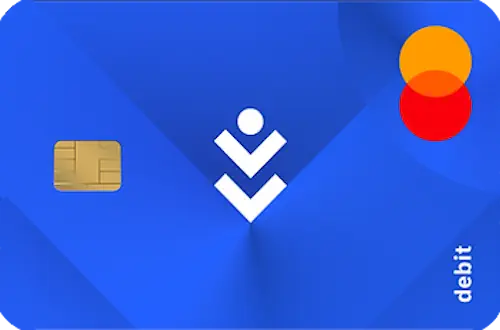
1. COCA Visa Card
Self-Banking: 8% Cashback + 5% APY + 0% FX

2. Rizon Standard Card
A $1 US virtual Visa Platinum for passport holders the traditional card system skips.

3. Tria Signature Card
High-Yield Self-Custody: 15% APY + Visa Signature Perks
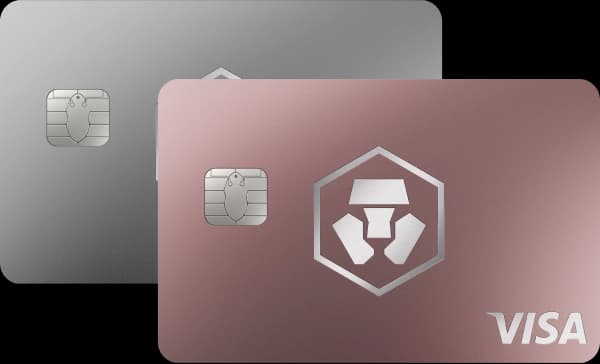
4. Private (Icy White / Rose Gold)
Private Tier: 4% Uncapped Cashback + Lounge Guest
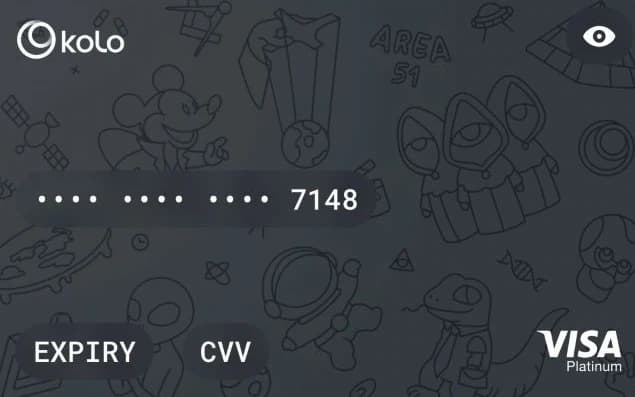
5. Kolo Card
Earn Bitcoin on Purchases: 2% for 30 Days, Then 1% (Capped) + Visa Platinum + 170+ Countries
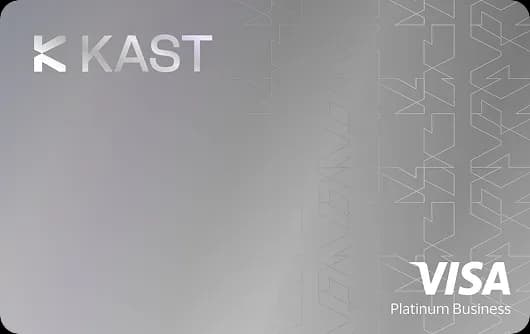
6. KAST K Card
Free USD Cashback: 1.5% on First $2K/Month
Complete list:
All 44 crypto cards available in Kenya in September 2026
This table includes every crypto card we currently track for Kenya. Rows marked Top pick are ranked and reviewed above.
| Crypto card | Max rewards | Annual fee | FX fee | Type | Custody |
|---|---|---|---|---|---|
1 COCA Visa CardTop pick | Up to 8% rewards | Free | 0% | Debit | Self-custody |
2 Rizon Standard CardTop pick | Varies | Free | 1.7% | Crypto Backed Credit | Self-custody |
3 Tria Signature CardTop pick | Up to 4.5% rewards | $87 with code | 1% | Debit | Self-custody |
4 Private (Icy White / Rose Gold)Top pick | Up to 4% rewards | TBD | 0% | Prepaid | Custodial |
5 Kolo CardTop pick | Up to 2% rewards | Free | 0% | Prepaid | Custodial |
6 KAST K CardTop pick | Up to 1.5% rewards | Free | 0.5% | Prepaid | Custodial |
| Up to 10% rewards | Free | 0% | Prepaid | Custodial | |
| Up to 8% rewards | Free | 0% | Debit | Custodial | |
| Up to 8% rewards | TBD | 0% | Prepaid | Custodial | |
| Up to 6% rewards | $200 with code | 1% | Debit | Self-custody | |
| Up to 5% rewards | Free | 1% | Crypto Backed Credit | Self-custody | |
| Up to 5% rewards | TBD | 0% | Prepaid | Custodial | |
| Up to 5% rewards | Free | 1% | Debit | Self-custody | |
| Up to 4% rewards | Free | 1% / 1.8% | Debit | Hybrid | |
| Up to 4% rewards | Free | 0% | Crypto Backed Credit | Self-custody | |
| Up to 3% rewards | $10000 | 0.5% | Prepaid | Custodial | |
| Up to 3% rewards | $199 | 0.5% | Crypto Backed Credit | Self-custody | |
| Up to 3% rewards | $299.9 | 0% | Prepaid | Custodial | |
| Up to 3% rewards | $129 | 1.2% | Prepaid | Custodial | |
| Up to 2.5% rewards | $83.88 | 1.02% | Crypto Backed Credit | Self-custody | |
| Up to 2% rewards | $1000 | 0.5% | Prepaid | Custodial | |
| Up to 2% rewards | Free | 1% | Crypto Backed Credit | Self-custody | |
| Up to 2% rewards | $49.9 | 0% | Prepaid | Custodial | |
| Up to 2% rewards | $999 | 0% | Crypto Backed Credit | Self-custody | |
| Up to 1.5% rewards | Free | 0.5% | Prepaid | Custodial | |
| Up to 1.5% rewards | Free | 1% | Debit | Self-custody | |
| Up to 1.5% rewards | $249 | 0.25% | Crypto Backed Credit | Self-custody | |
| Up to 1% rewards | Free | 1% | Crypto Backed Credit | Self-custody | |
| Up to 1% rewards | Free | TBD | Prepaid | Custodial | |
| Up to 1% rewards | $47.88 | 1.275% | Crypto Backed Credit | Self-custody | |
| Up to 1% rewards | $99 | 0.5% | Crypto Backed Credit | Self-custody | |
| Up to 0.5% rewards | Free | 1% | Crypto Backed Credit | Self-custody | |
| none | Free | 0% | Crypto Backed Credit | Self-custody | |
| none | $30 | 0% | Crypto Backed Credit | Self-custody | |
| none | Free | 0% | Prepaid | Custodial | |
| cashback | Free | 1.75% | Prepaid | Self-custody | |
| cashback | $199 | 0.75% | Prepaid | Self-custody | |
| cashback | Free | 0.5% | Prepaid | Custodial | |
| none | Free | 1% | Prepaid | Self-custody | |
| none | Free | 1% | Debit | Self-custody | |
| Varies | Free | 1.5% | Debit | Custodial | |
| Varies | Free | 1.2% | Prepaid | Custodial | |
| Varies | Free | 1.2% | Prepaid | Custodial | |
| points | Free | 1% | Debit | Self-custody |
Crypto Card Regulation in Kenya
Kenya enacted dedicated crypto legislation in 2025: the Virtual Asset Service Providers (VASP) Act, 2025 was signed into law in October 2025 and took effect on November 4, 2025.
It establishes a dual regulatory framework: the Central Bank of Kenya (CBK) regulates payment-related crypto firms and stablecoin dealers, while the Capital Markets Authority (CMA) supervises exchanges, brokers, and tokenization platforms.
The Act is Kenya's first dedicated crypto-specific legislation.
The National Treasury published draft VASP Regulations 2026 for public consultation in March 2026 (closed April 10). The draft proposed steep capital requirements: KES 500 million (~$3.85 million) for stablecoin issuers, KES 100 million for exchanges, and KES 2.5 million for investment advisers, alongside mandatory physical offices, director background checks, and strict reserve rules.
The Virtual Asset Association of Kenya warned that these thresholds could lock out local startups and push crypto activity offshore. The final regulations, gazetted in July 2026 as Legal Notice No. 134 of 2026, cut the stablecoin-issuer capital requirement by 40% to KES 300 million (~$2.3 million) and set KES 150 million for wallet providers, while keeping KES 100 million for exchanges.
Stablecoin issuers must keep at least 30% of reserves in segregated accounts at Kenyan commercial banks, and licensed exchanges may not offer any stablecoin the CBK has not approved. The gazetting completed the VASP Act's implementation.
Legal Notice No. 134 also bars issuers and licensed providers from paying any interest or yield on stablecoin holdings, directly or through affiliated arrangements. Kenyan users relying on a card's stablecoin savings rate (for example COCA's advertised deposit APY) may see that feature restricted or withdrawn for local accounts if the rule reaches the issuer's structure.
The Kenya Revenue Authority (KRA) overhauled crypto taxation in 2025. The controversial 3% Digital Service Tax on gross crypto transactions was scrapped and replaced with a 10% excise duty on fees charged by virtual asset platforms, a structure that taxes platform revenue rather than individual user transactions. Income tax or capital gains tax still applies to individuals depending on whether virtual assets are held, traded, or received as payment.
Between July 2024 and June 2025, Kenyans received approximately $19 billion in cryptocurrency inflows, making Kenya East Africa's largest digital asset market and one of the most active on the continent, behind only Nigeria.
COCA, Kolo, Tria, Crypto.com, KAST, and RedotPay currently serve Kenyan residents through their broader global coverage. The VASP Act's dual-regulator framework provides long-term regulatory clarity, which is promising for continued card availability.
Tax Treatment of Card Rewards in Kenya
Kenya's tax treatment of crypto is evolving alongside the VASP Act. Progressive personal income tax rates reach 30% on annual income above KES 576,000 (approx. $4,400). Capital gains on property transfers are taxed at 15%. Crypto gains fall under either framework depending on classification: holding and selling triggers CGT, while active trading triggers income tax.
The 3% Digital Service Tax that previously applied to crypto transactions was scrapped in 2025 and replaced with a 10% excise duty on fees charged by virtual asset platforms. This shifts the tax burden from individual users to platform revenue.
For crypto card users, this means no DST on card spending; the excise duty applies to the platform, not the cardholder.
Example: You acquired 0.01 BTC at KES 100,000 and spent it via a crypto card when worth KES 400,000. The KES 300,000 gain could theoretically be subject to income tax (up to 30%) or capital gains tax (15%). Enforcement on individual crypto transactions has been minimal so far, but the KRA's improving digital infrastructure makes future enforcement plausible.
| Cashback Type | When Received | When Spent via Card | Total Tax Burden |
|---|---|---|---|
| BTC cashback | Gray area (income at FMV?) | Up to 15-30% on gain | Uncertain |
| USDC cashback | approx. 0% (negligible gain) | approx. 0% | approx. 0% |
| Points/perks | Not taxed | N/A | 0% |
Stablecoin spending eliminates the tax ambiguity entirely. No gain means no disposal event regardless of how the KRA eventually classifies crypto. Keep records through the iTax system for potential future reporting requirements.
How to Apply from Kenya
Kenyan crypto card applications require a national ID card (Kitambulisho, 8-digit number issued by the National Registration Bureau, NRB) or Kenyan passport for citizens. The Huduma Namba (national integrated identity management system) is being rolled out as a unified digital identity but has faced legal challenges. Foreign residents need a passport plus a work permit or residence permit from the Department of Immigration.
The KRA PIN (Personal Identification Number for tax) may be required by some card issuers. Proof of Kenyan address via utility bill (KPLC/Kenya Power electricity, Nairobi City Water), bank statement (Equity, KCB, Co-operative), or Safaricom M-Pesa statement. Global issuers may require phone verification with a Kenyan number (+254).
Physical cards ship to Kenyan addresses within 10-21 business days. Virtual cards activate immediately for online purchases and Apple Pay/Google Pay use, though Apple Pay is not officially available in Kenya.
Spending Tips for Kenya
Beyond M-Pesa: Where Crypto Cards Add Value
M-Pesa processes over KES 30 trillion annually and handles 80%+ of Kenya's digital payments. It is the dominant payment method at restaurants, shops, taxis, and even government services.
But M-Pesa cannot do what a crypto card does: international online purchases (Amazon, Netflix, Adobe), cross-border travel spending at zero FX, stablecoin-based currency hedging, and Visa/Mastercard acceptance at merchants worldwide. The crypto card complements M-Pesa rather than replacing it.
What Kenyan Bank Cards Actually Cost You
| Bank | Debit FX Markup | Annual Card Fee | International Online | Cashback |
|---|---|---|---|---|
| Equity Bank | 3-5% | KES 500-1,000 | Unreliable | 0% |
| KCB | 3-5% | KES 500-1,000 | Inconsistent | 0% |
| Co-operative Bank | 3-5% | KES 500-1,000 | Inconsistent | 0% |
| NCBA (formerly CBA+NIC) | 2-4% | KES 1,000-2,000 | More reliable | 0% |
| Standard Chartered Kenya | 2-4% | KES 1,000-3,000 | Most reliable | 0% |
Equity Bank and KCB are Kenya's largest banks by customer base but their debit cards are frequently declined by international merchants. Standard Chartered is the most reliable for overseas acceptance but charges the highest fees. A crypto card funded with USDC eliminates both the markup and the acceptance problem.
The Shilling Depreciation Factor
The KES/USD rate has moved steadily: 101 in early 2020, 110 in 2021, 123 in 2022, 155 in late 2023, then recovering somewhat to 128-135 in 2025-2026 after IMF interventions and improved dollar inflows. The shilling's depreciation is less extreme than Nigeria's naira (77%) or Ghana's cedi (60%+), but the 25-35% loss over six years still erodes savings held in KES.
Holding stablecoins and converting to KES only at the moment of purchase through a crypto card preserves purchasing power that a KCB or Equity savings account (paying 3-5% annual interest) cannot match against 8-12% annual depreciation.
Cost of Living by Area
| Area | 1-Bed Rent/Month | Groceries/Month | Card-Eligible Spending |
|---|---|---|---|
| Nairobi (Westlands/Kilimani) | KES 50,000-120,000 | KES 15,000-30,000 | KES 25,000-60,000 |
| Nairobi (Karen/Lavington) | KES 60,000-150,000 | KES 15,000-35,000 | KES 30,000-70,000 |
| Nairobi (Eastlands/Umoja) | KES 12,000-25,000 | KES 8,000-15,000 | KES 10,000-25,000 |
| Mombasa (Nyali) | KES 25,000-60,000 | KES 10,000-20,000 | KES 15,000-35,000 |
| Kisumu | KES 10,000-25,000 | KES 8,000-15,000 | KES 10,000-20,000 |
| Nakuru | KES 8,000-20,000 | KES 7,000-12,000 | KES 8,000-18,000 |
The Nairobi tech professional earning KES 100,000-500,000/month ($770-3,850) is the core crypto card demographic. Westlands, Kilimani, and the Karen/Lavington corridor have the highest concentration of card-accepting merchants.
Silicon Savannah: Kenya's Tech Economy
Nairobi is "Silicon Savannah," Africa's leading tech hub. Safaricom (M-Pesa operator, largest company on the NSE) anchors the ecosystem, but the broader ecosystem includes Flutterwave Kenya (payments), Cellulant (pan-African payments), Twiga Foods ($150M+ raised, B2B food distribution), Sendy (logistics), iProcure (agri-tech), and hundreds of startups operating from hubs like iHub, Nairobi Garage, and Nailab.
Kenya has also attracted Google, Microsoft, Visa, and Mastercard to establish African headquarters or product centers in Nairobi.
This creates a large pool of tech professionals earning in both KES and USD (remote contracts, freelance work on Upwork and Toptal, Andela engineering). Receiving payment in USDC and spending via a crypto card avoids the shilling depreciation and the banking FX markup simultaneously.
Mobile Financial Innovation: M-Shwari, Fuliza, and Beyond
Kenya's mobile money ecosystem extends far beyond basic M-Pesa transfers. M-Shwari (Safaricom + CBA/NCBA) provides savings and microlending through M-Pesa - over 25 million accounts with KES 30+ billion in loans disbursed. Fuliza is an overdraft facility that auto-covers M-Pesa payments when your balance is insufficient - 24 million active users, processing KES 700+ billion annually.
KCB M-Pesa offers loans up to KES 1 million via mobile. Tala and Branch (US-backed fintech lenders) use smartphone data for AI-driven credit scoring.
This financial sophistication means Kenyan users understand tiered products, APY on deposits, and credit scoring, concepts that map directly to crypto card tiers (Crypto.com's staking tiers, Kolo's BTC cashback, COCA's 8% cashback). The transition from M-Shwari's 6-7% annual savings rate to stablecoin-based crypto card rewards is a natural evolution, with the added benefit that stablecoins are not subject to shilling depreciation.
Safari Tourism and the Visitor Economy
Tourism accounts for roughly 10% of Kenya's GDP. The Masai Mara, Amboseli, Tsavo, Lake Nakuru, and Diani Beach attract 2+ million international visitors annually. Nairobi's hotel ecosystem (Hemingways, Fairmont Norfolk, Tribe Hotel, Sarova Stanley) and safari lodges accept international cards.
For incoming tourists: zero-FX crypto cards save 3-5% on every purchase compared to home-country bank cards, and Kenya's tourist infrastructure has strong card acceptance in lodges, hotels, and curio shops.
For Kenyan tourism professionals (guides, lodge operators, travel agents): receiving payment in USD from international booking platforms and holding in USDC avoids the shilling conversion loss. Kenya's annual wildebeest migration (July-October) drives a concentrated spending surge where tourism operators handle large USD volumes.
Card Selection by Use Case
- COCA (up to 8%): $0 annual, 0% FX. The 8% needs 30,000 COCA staked (1% free); non-custodial smart wallet.
- Tria Signature (4.5% on first $1,000/mo then 1%): $109/year, 1% FX + 0.5%/payment, ~3% net. Pays off only above the fee threshold; cashback can take up to three months to arrive.
- Crypto.com Icy (4%): CRO stake. Airport lounge access at JKIA Terminal 1E.
- Kolo (1% BTC ongoing, 2% for the first 30 days, capped $100/mo): $0 annual, 0% FX. Free BTC cashback.
- KAST (1.5% USD cashback on first $2K/mo): $0 annual, 0.5-1.75% FX. Best match for M-Pesa-funded users.
COCA vs KAST vs Kolo Break-Even Math
| Monthly Spend | COCA (up to 8% staked, $0) | KAST (1.5% USD, $2K/mo cap, $0) | Kolo (1% BTC ongoing, $0) | Crypto.com Icy (4%, CRO stake) |
|---|---|---|---|---|
| KES 20,000 | KES 19,200/yr | KES 3,600/yr | KES 2,400/yr | KES 9,600/yr + lounges |
| KES 30,000 | KES 28,800/yr | KES 5,400/yr | KES 3,600/yr | KES 14,400/yr + lounges |
| KES 50,000 | KES 48,000/yr | KES 9,000/yr | KES 6,000/yr | KES 24,000/yr + lounges |
| KES 100,000 | KES 96,000/yr | KES 18,000/yr | KES 12,000/yr | KES 48,000/yr + lounges |
COCA at up to 8% (with 30,000 COCA staked; 1% free at Starter) offers the highest ceiling. KAST at 1.5% USD cashback leads Kolo's 1% ongoing BTC at every displayed spending level and stays simpler for M-Pesa-to-card workflows. The real value for Kenyan users is the KES hedge and FX savings, not cashback alone.
Spending Scenario: KES 30,000/month (approx. $230)
| Funding Method | Annual Spend | Rewards (Kolo 1% BTC) | KES Hedge Value | Total Benefit |
|---|---|---|---|---|
| USDC funded, Kolo card | KES 360,000 | KES 3,600 | KES 30,000+ saved | KES 33,600+ |
| USDC funded, KAST card (1.5% USD cashback) | KES 360,000 | KES 5,400 | KES 30,000+ saved | KES 35,400+ |
| KES (bank card) | KES 360,000 | approx. KES 0 | KES 0 (lost to depreciation + 3-5% FX) | approx. KES 0 |
According to our regional data, KES 3,600-5,400/year in rewards covers about 1-2 weeks of groceries at Naivas or Carrefour Kenya. The FX savings on international purchases (3-5% on KES 360,000 = KES 10,800-18,000) may exceed the rewards.
Online Shopping and International Subscriptions
Kenya's growing middle class relies on international services requiring Visa/Mastercard: Amazon (ships via freight forwarders), AliExpress (direct shipping, popular for electronics), Jumia Kenya (domestic e-commerce, KES pricing), Kilimall (Kenyan e-commerce).
International subscriptions: Netflix (KES 1,100/month), Spotify, Adobe Creative Cloud, Microsoft 365, Showmax (pan-African streaming), Apple services. Education platforms (Coursera, Udemy, LinkedIn Learning) are popular for professional development. A crypto card provides reliable international merchant acceptance that Kenyan bank cards often cannot.
Cross-Border and Safari Tourism
Kenya's tourism economy and regional position create FX spending: Tanzania (KES/TZS, safari circuits crossing the border at Namanga, Zanzibar beach holidays), Uganda (KES/UGX, business travel to Kampala), Rwanda (KES/RWF, growing business destination), UAE (AED, Dubai shopping and business), UK (GBP, large Kenyan diaspora in London), and US (USD, education and family visits).
Kenya's position as the East African Community (EAC) hub means frequent regional travel. Every cross-border purchase through a bank card adds 3-5% FX markup that a zero-FX crypto card eliminates.
The Diaspora: $4B+ in Remittances
Kenya receives over $4 billion in annual remittances (CBK data). Major corridors: US (largest source, concentrated in Texas, Minnesota, Maryland, and California), UK (London, Manchester), Gulf states (UAE, Saudi Arabia, Qatar - labor migration), Canada (Toronto, Calgary), and Australia (growing Kenyan community).
Traditional channels (WorldRemit, Western Union, M-Pesa International) charge 4-8% on the Kenya corridor. On $400/month in remittances, switching to USDC-to-crypto-card saves $192-384 annually, equivalent to a month of groceries in Nairobi's Eastlands.
Education Spending
Kenya has a strong tradition of investing in education. Domestically, private universities (Strathmore, USIU, Daystar) and international schools charge in KES but benchmark to USD. Abroad, Kenyan students attend universities in the UK (popular destinations include the University of London system, Manchester, Edinburgh), US, Canada, Australia, and India.
Annual tuition ranges from $5,000 (India) to $25,000+ (UK/US). For parents funding children overseas, paying tuition and accommodation in foreign currency through a zero-FX crypto card eliminates the 3-5% bank markup that compounds into large sums over a 3-4 year degree program.
Local Payment Infrastructure
M-Pesa (Safaricom) is accepted across Kenya - from Nairobi malls to Turkana county roadside kiosks. Card (Visa/Mastercard) acceptance is concentrated in upper-income areas: Westgate Mall, Garden City, Two Rivers Mall, The Hub Karen, and Sarit Centre in Nairobi. Supermarkets (Naivas, Carrefour, Chandarana Foodplus, Quickmart), hotels, and modern restaurants in Westlands, Kilimani, and Karen accept contactless cards.
Mombasa (Nyali, City Mall, tourist hotels along Diani Beach) and Nanyuki (tourist gateway to Mount Kenya) have decent card acceptance. Outside Nairobi, Mombasa, and tourist areas, M-Pesa dominates and card terminals are rare. Matatus (minibuses), boda-bodas (motorcycle taxis), and informal markets are M-Pesa or cash only.
Supported Exchanges & Wallets in Kenya
Kenya's crypto ecosystem centers on P2P platforms and regional exchanges. Paxful has been widely used since 2018, particularly for gift card trading. Yellow Card (pan-African) provides KES on/off-ramps. LocalBitcoins (now defunct, migrated users to other platforms) was historically popular.
BitPesa (now AZA Finance) was one of Africa's first crypto-to-fiat payment platforms, founded in Nairobi in 2013. Binance P2P serves Kenyan users with KES pairs, though regulatory uncertainty persists. M-Pesa integration with some platforms creates a direct KES-to-crypto on-ramp.
COCA offers up to 8% through a non-custodial smart wallet at 0% FX. That rate requires staking 30,000 COCA; the free Starter tier pays 1%.
Kolo adds free BTC cashback at 1% ongoing, and Tria Signature targets higher spenders with a paid, fee-adjusted USDT offer.
Crypto.com provides metal tiers from Midnight Blue (0%, free) through Icy (4%, CRO stake required), with Icy offering airport lounge access at Jomo Kenyatta International Airport.
KAST provides 1.5% USD cashback on the first $2,000/month at $0 annual with 0.5-1.75% FX, fitting users moving M-Pesa-funded exchange balances into foreign merchants and subscriptions.
RedotPay offers Virtual (free) and Physical ($100) at 1.2% FX. Kenya combines M-Pesa infrastructure, the CMA regulatory sandbox, the Silicon Savannah tech workforce, and growing card acceptance in Nairobi. That stack puts it among East Africa's leading markets for crypto card adoption. COCA offers the highest staked ceiling, KAST fits the M-Pesa workflow, Kolo is the simple free BTC option, and Crypto.com Icy adds premium travel perks.
Written by SpendNode Editorial
Frequently Asked Questions
Can crypto cards replace M-Pesa in Kenya?
No, they serve different purposes. M-Pesa dominates domestic payments. Crypto cards are best for international purchases, e-commerce requiring Visa/Mastercard, travel, and as a KES depreciation hedge. Use both for full coverage.
Which crypto card is best for Kenyan users?
COCA leads the list: up to 8% cashback with $0 annual and 0% FX, but the 8% requires staking 30,000 COCA (the free tier is 1%), and Kenya's Legal Notice 134 of 2026 may restrict stablecoin-deposit yield for local accounts. Tria Signature provides 4.5% on the first $1,000/mo (then 1%, $109/year), about 3% net after its 1% FX and 0.5% per payment, though its cashback can take up to three months to arrive. Kolo pays 1% BTC ongoing (2% for the first 30 days, capped at $100/month and $1 per transaction) at $0. KAST gives 1.5% USD cashback on first $2K/mo at $0 with 0.5-1.75% FX, timelocked 14 days and spendable only toward a later card purchase. FX savings of 3-5% versus Kenyan bank cards may exceed the cashback benefit.
Are crypto gains taxed in Kenya?
The 3% DST on crypto was scrapped in 2025 and replaced with a 10% excise duty on platform fees (not user transactions). Income tax up to 30% or 15% CGT applies to individual crypto gains depending on classification. The VASP Act 2025 (in force November 4, 2025) brought further regulatory clarity, and the implementing VASP Regulations 2026 were gazetted on July 24, 2026. The KRA is building digital asset tracking capabilities.
How do I fund a crypto card in Kenya?
Buy crypto via M-Pesa on platforms like Yellow Card or through P2P exchanges. Transfer crypto to your card wallet. Some globally available cards (KAST, RedotPay) accept direct crypto deposits from any wallet.
Other Countries
View all 112 countries →


Latest Page Changes to the Best Crypto Cards in Kenya Guide
- Draft VASP capital requirements from draft VASP Regulations: KES 500M for stablecoin issuers, KES 100M for exchanges, KES 2.5M for advisers
- Industry pushback from Virtual Asset Association of Kenya on high thresholds
- VASP consultation closed (April 10)