Global off-ramp with high acceptance. RedotPay promo code SPENDV takes 20% off virtual cards, while SPENDP takes 20% off the physical card; new users who register through SpendNode's link also get a $5 welcome bonus. Terms apply.
Prefer mobile? Scan to continue
Opens the mobile signup with your SpendNode link, code SPENDV.
SpendNode Rating for RedotPay
3.3/5
Known for: broad global availability
RedotPay matters because it is available where many competitors are not. That helps the issuer score. So do its simpler entry points. The drag is fee load and weaker product elegance.
This is a practical operator score, not a glamorous one. The product solves access, but it does not solve it as cleanly as the top names.
Issuer Snapshot
Active Products4
User Rating
5.0/5
2 reviews
Editorial vendor score stays separate from user reviews. Methodology
Product Quality
3.2
Trust & Custody
3.1
Fee Transparency
3.3
Operational Reliability
3.4
Market Relevance
4.0
SpendNode ResearchTop-up proxy (not card spend)
RedotPay activity measured by SpendNode
$6.10B in observed top-up activity since Jul 2025, based on the same research ledger used in SpendNode's weekly and monthly crypto card reports.
RedotPay is a global crypto payment provider backed by a $107M Series B (Lightspeed Venture Partners). It offers three base card formats: Virtual ($10), Solana Edition ($10), and Physical ($100), plus an optional paid RedotPay Pro membership that adds cashback. The base cards share $1,000,000 daily spending limits, $100,000 per-transaction limits, 1% crypto conversion fee, 1.2% FX markup, no cashback of their own, and availability in 100+ countries across APAC, LATAM, EEA, and Global markets. RedotPay has a 4.8-star App Store rating from 4,403 ratings.
The RedotPay cards are not rewards cards on their own. They have no built-in cashback, token staking, or loyalty tiers; the only cashback comes from a separate paid RedotPay Pro membership. It is a pure spending utility designed for users who need to move large balances through the Visa network globally. The $107M Series B from Lightspeed Venture Partners signals investor confidence in the underlying infrastructure.
The fee structure is transparent: 1% crypto conversion on every transaction plus 1.2% FX markup on non-local currency spending, totaling 2.2% on international transactions. No hidden fees and no monthly maintenance on the base cards, with the paid Pro membership left as an optional upgrade.
Available crypto cards by RedotPay in November 2026
Option 1
1. RedotPay Physical Card
The Tangible Off-Ramp: Physical Visa + ATM + $1M Daily Limits
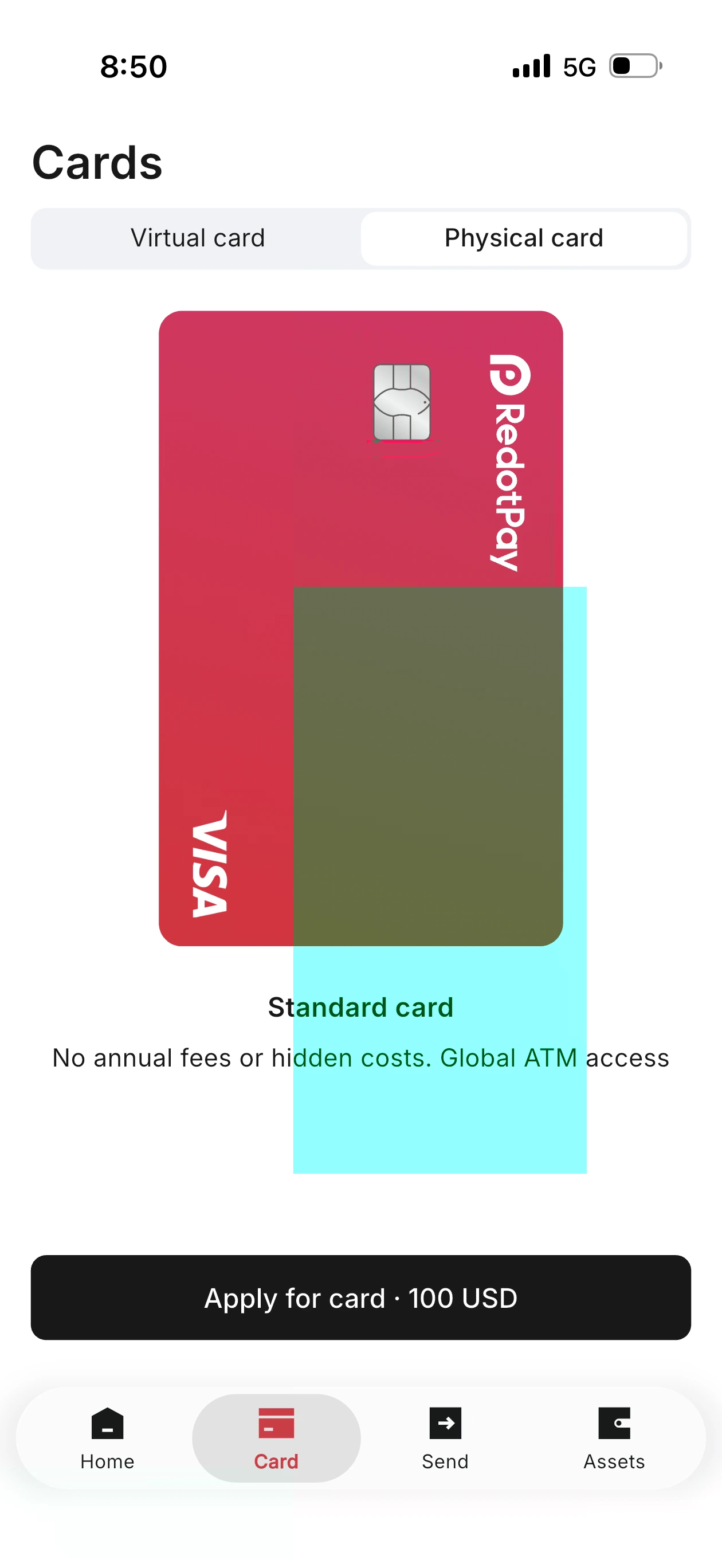
The RedotPay Physical Card adds ATM access and in-store chip payments to RedotPay's high-limit infrastructure. It has a $100 issuance fee and no annual fee, and is built for users who need cash withdrawals alongside digital spending across 130M+ merchants.
+Physical card for in-store and ATM use
+ATM withdrawals up to $50K/month
+Same $1M daily spending limit
+Apple Pay and Google Pay supported
Option 2
2. RedotPay Solana Card
Solana Goes IRL: Spend SOL Directly at 130M+ Merchants
The RedotPay Solana Card brings Solana ecosystem spending to 130M+ merchants worldwide. It offers the same high-volume infrastructure as the standard RedotPay card with SOL as a natively supported spending asset.
+Direct SOL spending without swapping
+Solana-branded card design
+Apple Pay and Google Pay ready
+Same $1M daily limits as standard
Option 3
3. RedotPay Virtual Card
High-Capacity Global Spend: $1M Daily Limit + Instant Visa Payouts
The RedotPay Virtual Card is built for high-volume global spending. With no annual fee and a transparent 1% conversion fee, it supports high-capacity spending via Apple Pay and Google Pay without the wait for a physical card.
+Instant virtual issuance
+1.0% flat conversion fee
+Apple Pay and Google Pay supported
+Broad country availability
Option 4
4. RedotPay Pro Card
Paid Upgrade: 3% Mobile-Wallet Cashback Plus a Fee-Free ATM Tier
RedotPay Pro is a paid membership layered on a RedotPay virtual or physical card. It adds 3% cashback on Apple Pay and Google Pay spend up to $600 a month, and the annual plan unlocks a free physical card, $1,000/month of fee-free ATM withdrawals, and 1% Earn yield.
+3% cashback on Apple Pay and Google Pay spend
+Annual plan waives the physical card fee
+Annual plan adds $1,000/month of fee-free ATM withdrawals
+Optional upgrade on either a virtual or physical RedotPay card
RedotPay Card Promo Codes SPENDV and SPENDP: 20% Off
Use RedotPay promo code SPENDV for 20% off eligible standard virtual card editions, including Solana and XRP designs ($10 down to $8), or SPENDP for 20% off the Physical Card ($100 down to $80). RedotPay Pro is not included. New users who register through SpendNode's RedotPay link also receive a separate $5 USD welcome bonus.
Code
Card
Discount
Standard price
Price with code
SPENDV
Standard virtual editions, including Solana and XRP designs (Pro excluded)
Complete identity verification, then choose an eligible standard virtual edition or the Physical Card.
At the card purchase step, enter SPENDV for a standard virtual card or SPENDP for the physical card.
Confirm the discounted issuance price before completing the order.
The $5 welcome bonus is separate from the card discount and is available to eligible new users who register through SpendNode's link. SPENDV and SPENDP discount standard card issuance, not the optional RedotPay Pro membership.
Want cashback: upgrade any card to RedotPay Pro ($12.90/mo or $129/yr) for 3% Apple Pay and Google Pay cashback plus, on the annual plan, a fee-free ATM tier and 1% yield
RedotPay Pro is an optional paid membership, not a separate card. You add it on top of a virtual or physical card, either during signup or later from the app.
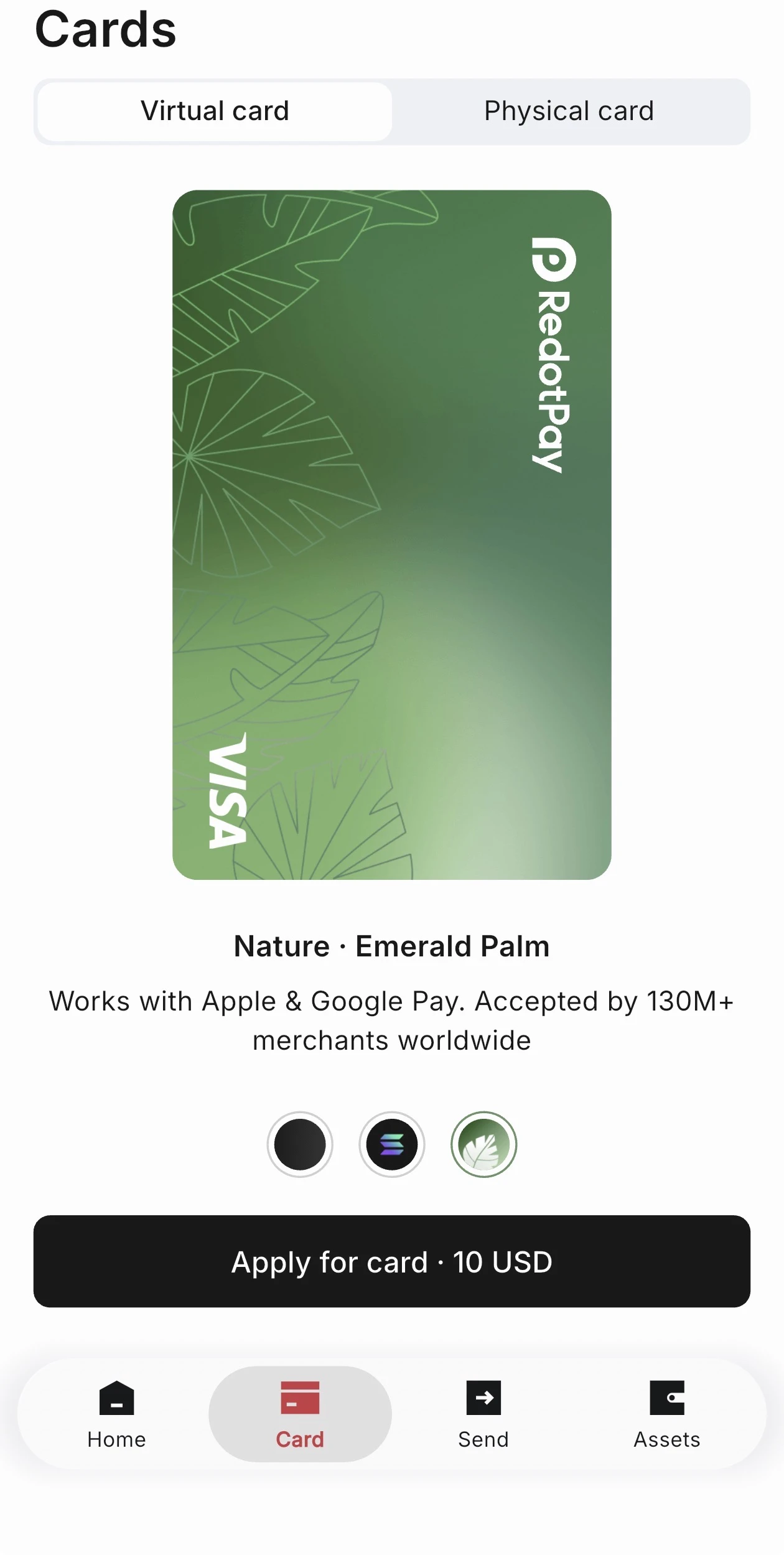
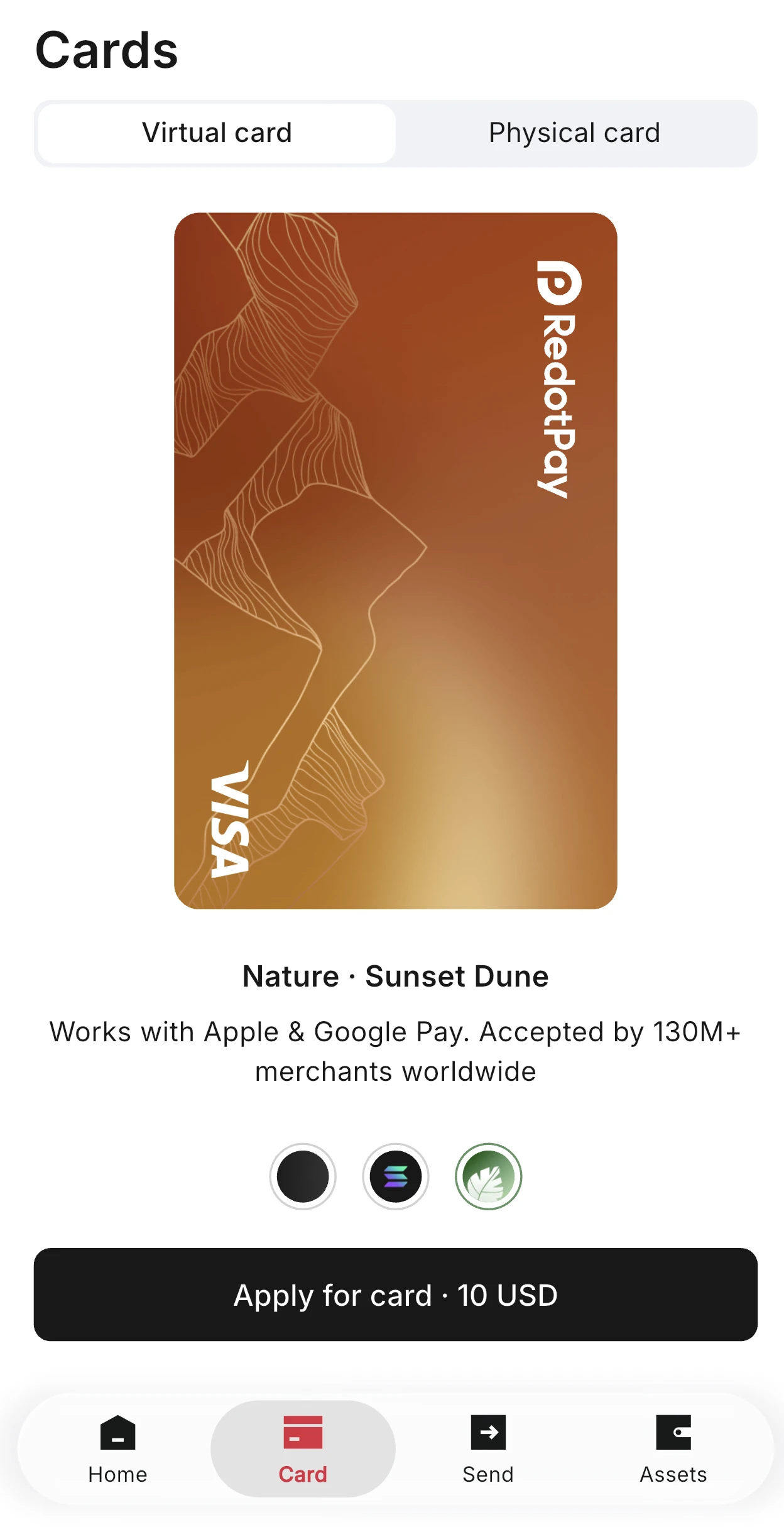
As of March 5, 2026, RedotPay added two new virtual card designs to the Nature collection: Emerald Palm (green tropical) and Sunset Dune (orange desert). Both are cosmetic variations with identical fees and limits.
SpendNode app screenshot
SpendNode app screenshot
Nature Collection designs added in March 2026; cosmetic only, with the same fees and limits.
Fees and Rates
Fee
Amount
Notes
Annual fee
$0
No subscription or maintenance
Crypto conversion
1.0%
On every transaction (card + ATM)
FX markup
1.2%
On non-local currency transactions
Virtual issuance
$10 ($8 with code SPENDV)
One-time
Physical issuance
$100 ($80 with code SPENDP)
One-time
ATM withdrawal
2-3%
Physical card only; 2% to $10K/month, 3% above
ATM daily cap
$3,750
3 withdrawals/day
ATM monthly cap
$50,000
30 withdrawals/month
Card replacement (virtual)
$5 first, $10 after
Per replacement
Cashback
None (base cards)
Optional Pro membership adds 3% on Apple/Google Pay, capped
SpendNode tested FX fee:2.24-2.30% all-in versus mid-market across Virtual, Solana Edition, Physical, and Pro because their underlying purchase fees are identical.
Total Cost Per Transaction
Transaction Type
Conversion
FX Markup
Total
Domestic (base currency)
1.0%
0%
1.0%
International
1.0%
1.2%
2.2%
ATM withdrawal (intl)
1.0%
1.2% + 2-3%
4.2-5.2%
Context: 2.2% total on international spending is competitive for a global prepaid card with no annual fee and no staking requirements. Ledger charges 3.50% (1.75% + 1.75%), BitPay charges 3% FX alone.
But rewards-bearing alternatives like KAST (1.5% USD on first $2K/mo at the free Standard tier, 0.5-1.75% FX), ether.fi (3% cashback on the first $2,000/mo, 0-0.5% FX on public tiers), and MetaMask (1-3% cashback, 0% FX on Metal/$199yr, 1% on Virtual) produce meaningfully better spending economics.
Annual Fee Impact at Different Spending Levels
Monthly Spend
Domestic Only (1%)
International (2.2%)
KAST Standard net (1.5% USD on first $2K/mo, 0.5-1.75% FX on all spend)
$1,000
-$120/yr
-$264/yr
-$30 to +$120/yr (under cap, FX range)
$3,000
-$360/yr
-$792/yr
-$270 to +$180/yr (cap binds at $2K/mo)
$5,000
-$600/yr
-$1,320/yr
-$690 to +$60/yr (cap binds, FX accrues on full spend)
$10,000
-$1,200/yr
-$2,640/yr
-$1,740 to -$240/yr (cap binds, FX dominates)
$0 annual fee. 1% crypto conversion + 1.2% FX = 2.2% on international. ATM fee 2% to $10K/month, 3% above (Physical only). No cashback on the base cards. What you are buying is access and limits, not ROI.
RedotPay sells access, limits, and global reach. Economics are not the appeal.
Rewards and Cashback
The RedotPay cards earn no cashback or staking rewards on their own; cashback is available only through the paid RedotPay Pro membership. This is by design. The product is a pure spending utility optimized for volume and global reach, not for rewards optimization. Every dollar spent costs 1-2.2% in fees with no returns to offset.
How Spending Works
Example: $200 purchase in Bangkok (funded with USDT)
Step 1: Top up your RedotPay balance
Transfer USDT, USDC, BTC, or ETH to your RedotPay custodial wallet
Funds are available immediately
RedotPay also lets users connect a supported Web3 wallet and approve a top-up without copying a deposit address. That reduces address and network-selection mistakes, but it does not make the RedotPay balance self-custodial: once the transfer arrives, the funds remain inside the same custodial account used by the cards. Test wallet and network compatibility with a small amount before relying on this route.
Step 2: Tap Apple Pay at the merchant
Visa network processes the $200 THB-equivalent purchase
Step 3: Conversion and fees
USDT converts to THB at market rate
1% crypto conversion fee: $2.00
1.2% FX markup: $2.40
Total deducted from balance: $204.40
Step 4: Cashback
None on this card. Cashback only comes from the separate paid RedotPay Pro membership
Net cost: -$4.40 (2.2%)
How to Apply for the RedotPay Card
Getting a RedotPay card live takes a few minutes, and the whole flow runs inside the app.
Step 1. Install the RedotPay app and sign up. Download RedotPay on iOS or Android and register with your email or phone number.
Step 2. Complete KYC. RedotPay requires full identity verification despite its low-friction reputation: a government-issued ID and a selfie liveness check. Clean cases clear in about two minutes. Registration is blocked in the United States, mainland China, Russia, Ukraine, Singapore, and sanctioned jurisdictions.
Step 3. Choose your card. Pick the virtual card or its Solana Edition (each $10 to issue), or the physical card ($100). After registering through SpendNode's link, enter promo code SPENDV for 20% off a virtual card ($8) or SPENDP for 20% off the physical card ($80) at the card purchase step. New users who register through the link also receive a separate $5 USD welcome bonus, which can be spent at merchants but not applied toward the card issuance fee. The codes discount the standard cards but not the Pro membership. The virtual and Solana cards issue instantly; the physical card ships to eligible regions. You can hold more than one.
SpendNode app screenshot
SpendNode app screenshot
SpendNode app screenshot
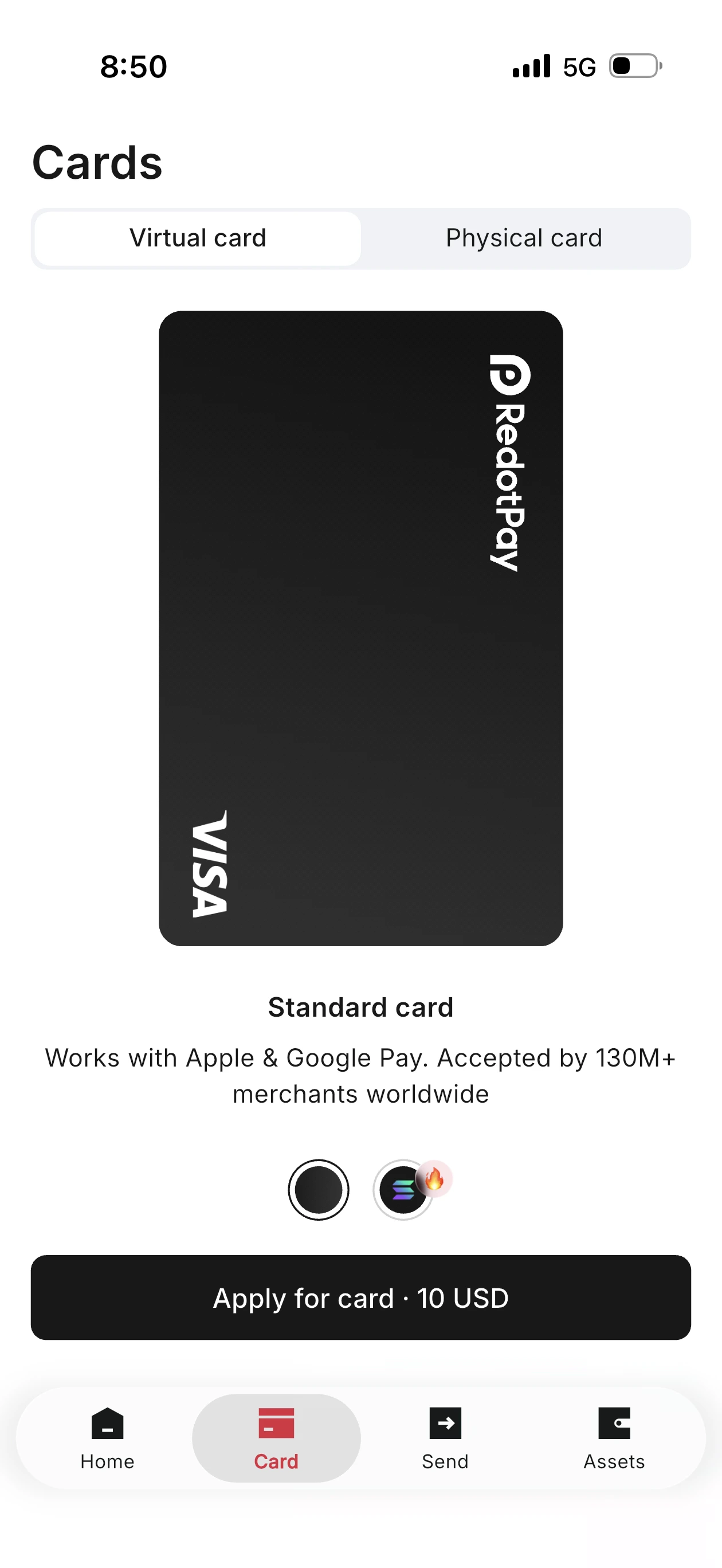
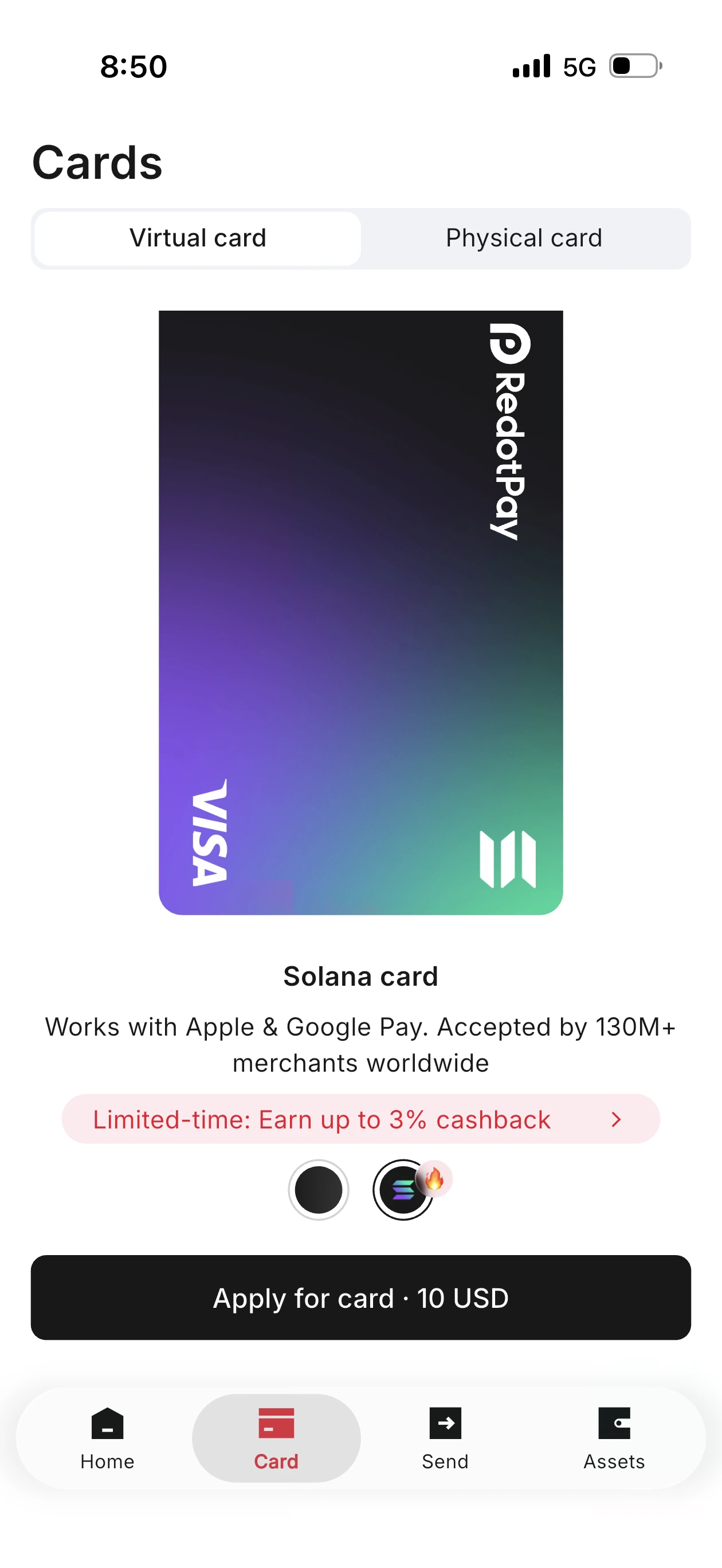
The three RedotPay card formats you choose between at signup: the standard virtual Visa, the Solana Edition, and the physical card.
Step 4. Fund your balance. Deposit any of RedotPay's ten supported assets (USDT, USDC, BTC, ETH, BNB, SOL, XRP, SUI, TRX, or S) into your custodial wallet. Funds are available to spend immediately.
Step 5. Add to Apple Pay or Google Pay and spend. Provision the card to your phone wallet for tap-to-pay. Each transaction carries a 1% conversion fee plus a 1.2% FX markup on non-local spend. To add rewards on top, upgrade to RedotPay Pro for 3% cashback on Apple Pay and Google Pay spend.
Real User Scenarios
Scenario 1: Raj (Bangkok Digital Nomad, $5,000/month, 80% international)
Setup:
RedotPay Virtual Card ($10 issuance)
Holds USDT on platform
Travels across Southeast Asia
No rewards expectations
Monthly math:
Conversion: $5,000 x 1% = -$50
FX fee: $4,000 x 1.2% = -$48 (80% international)
Net monthly cost: -$98 = -$1,176/yr (1.96% effective)
His verdict: "RedotPay works in countries where Wirex and Bybit do not. In Thailand, Vietnam, and Indonesia, the $1M daily limit and Visa acceptance rate are unmatched. The 2.2% cost is the price of global access. ether.fi Core (3% cashback, 0% FX) would earn me $1,800/yr instead of costing $1,176/yr - a $2,976/yr swing - but ether.fi has no APAC presence. For Southeast Asian nomads, RedotPay is often the only option that works."
Scenario 2: Chen (Hong Kong High-Volume, $20,000/month, domestic HKD)
Setup:
RedotPay Physical Card ($100 issuance)
Domestic HKD spending (no FX)
$3,000/month ATM cash withdrawals
USDT as primary holding
Monthly math:
Conversion: $20,000 x 1% = -$200
FX fee: $0 (domestic base currency)
ATM: $3,000 x 2% = -$60
Net monthly cost: -$260 = -$3,120/yr (1.3% effective)
His verdict: "For high-volume HKD spending, the 1% conversion plus the ~2% fee on ATM cash are the costs. No annual fee, no staking required. The $100K per-transaction limit handles my property deposits and business payments that other cards reject."
Scenario 3: Maria (Sao Paulo, $1,500/month)
Setup:
RedotPay Virtual Card ($10 issuance)
Lives in Brazil
Mix of BRL domestic and USD online purchases
Fast in-app KYC
Monthly math:
Conversion: $1,500 x 1% = -$15
FX fee: $1,500 x 1.2% = -$18
Net monthly cost: -$33 = -$396/yr
Her verdict: "In Brazil, most crypto cards are not available or have spotty acceptance. RedotPay verifies quickly and works reliably with Apple Pay everywhere I shop. The fees are higher than I would like, but it is the option that works in my country. KAST has limited LATAM support. RedotPay fills the gap."
RedotPay wins on: Highest spending limits in the market ($1M daily, $100K per-transaction), wide global availability (APAC, LATAM, Africa), and physical-card ATM access in markets many competitors do not serve.
RedotPay loses on: No cashback on the base cards, where the paid Pro membership is the only way to earn, paired with 2.2% combined fees (every competitor above produces positive returns on base spending), a custodial model with no published Proof of Reserves, and no yield on idle balances.
vs Bybit: Bybit offers 2-10% cashback with 0.9% conversion and 0.5% FX (EEA + LATAM). RedotPay's base cards offer no cashback with a 2.2% total fee. Bybit wins on rewards and lower fees. RedotPay wins on global reach and $1M daily limits.
vs KAST: KAST offers 1.5% USD cashback on the first $2,000/month with 0.5-1.75% FX (Global). RedotPay's base cards offer no cashback with higher limits. KAST wins on rewards within the cap. RedotPay wins on per-transaction limits ($100K vs $15K) and $107M Series B backing.
vs Wirex: Wirex One offers 0.5-8% cashback in USD with 0% FX (35 countries). RedotPay's base cards offer no cashback with 2.2% fees. Wirex is strictly superior in shared markets. RedotPay wins in countries Wirex does not serve.
Who Should Use RedotPay?
Use RedotPay if:
You need the highest transaction limits in crypto ($1M daily, $100K per-transaction)
You operate in emerging markets (APAC, LATAM, MEA)
Volume and global reach matter more than cashback rewards
You need instant Visa settlement for business or OTC operations
You need ATM cash access on a physical card in hard-to-serve markets
Skip RedotPay if:
You spend under $5,000/month and want rewards: KAST (1.5% USD on first $2K/mo), ether.fi (3% CB), MetaMask (1-3% CB)
You are in Europe only: Wirex (0% FX), Gnosis Pay (up to 5% cashback), or Plutus (3-9% PLU)
The 2.2% fee drag on every transaction concerns you
You need cashback to offset spending costs
Our take: RedotPay handles the high-volume work in crypto cards. The base cards earn no cashback, and the optional Pro membership aside, you pay 2.2% on every international transaction. What you get is the highest spending limits in the market ($1M daily, $100K per-transaction), wide global reach, fast verification, and a 4.8-star platform backed by $107M in venture capital.
For high-volume users, OTC desks, and global operators who need Visa rails that work everywhere at any volume, RedotPay is the infrastructure play. For everyday spending under $5,000/month in established markets, the fee drag makes rewards-bearing alternatives the smarter choice.
Is RedotPay Safe?
Your funds on RedotPay:
Custodial product - your crypto is held by RedotPay
In bankruptcy, you are an unsecured creditor
No published Proof of Reserves or insurance fund
Your card functionality:
Card stops immediately
Pending transactions may not settle
No rewards at stake (RedotPay has no loyalty program)
Mitigation strategy:
Keep minimum balance needed for near-term spending
Do not use RedotPay as long-term storage
Withdraw unused funds to self-custody regularly
The $10 virtual card entry price means low sunk cost
Stability indicators (as of March 2026):
$107M Series B funding (Lightspeed Venture Partners)
100+ country availability
4.8-star App Store rating (4,403 ratings)
No major security incidents reported
Active development (App 2.0, Solana partnership, Nature card designs)
No published Proof of Reserves (transparency gap)
Is RedotPay a Scam?
RedotPay is backed by a $107M Series B led by Lightspeed Venture Partners, one of the most established venture capital firms in tech. This is the largest funding round among crypto card startups and provides substantial operational runway.
The platform operates globally with active users in APAC, LATAM, EEA, and emerging markets. This geographic footprint requires regulatory compliance across multiple jurisdictions.
RedotPay has a 4.8-star App Store rating from 4,403 ratings - one of the strongest scores among dedicated crypto card apps in our directory. The rating volume provides a useful signal that the app is actively used, though it is not a substitute for assessing fees and custody risk.
Three Visa card variants (Virtual, Solana Edition, Physical) are all operational and verified through in-app testing. The $1M daily and $100K per-transaction limits are confirmed and functional.
Fast in-app KYC (ID and selfie) is required for all cards, a standard compliance step for a regulated card program operating across many jurisdictions.
Active product development continues with the Solana Edition partnership (February 2026), Nature collection card designs (March 2026), and App 2.0 rollout.
What to be aware of
RedotPay does not publish Proof of Reserves - there is no third-party verification of asset backing.
Custody is fully centralized with no self-custody option.
The base cards earn zero cashback, so with 2.2% combined fees every transaction has a net cost.
The card issuer is not prominently disclosed in marketing materials.
The company was founded in 2023 and has a shorter operating history than established competitors.
No insurance fund or deposit protection is advertised.
SpendNode Verified: The editorial team reviewed RedotPay's issuer identity, product terms, and live card flow per our methodology. Verification is not an endorsement or guarantee.
Countries and Availability
RedotPay covers 100+ countries, with its strongest reach across APAC, LATAM, Africa, and other emerging markets where local banking is thin. It does not support registration in the United States, mainland China, Russia, Ukraine, Singapore, or sanctioned jurisdictions. The physical card carries an additional delivery-restriction list (much of the Gulf and parts of MENA, including the UAE, Saudi Arabia, Qatar, Kuwait, Pakistan, and Egypt), so in those markets the virtual card is the only option. Check RedotPay's in-app unsupported-countries list before applying.
RedotPay is available in 93 countries as of November 2026. We count a country here when at least one active RedotPay card variant lists it, so individual product pages may be narrower.
Available Regions
Africa
Cameroon (CM), Cote d'Ivoire (CI), Egypt (EG), Ghana (GH), Kenya (KE), Morocco (MA), Mozambique (MZ), Nigeria (NG), Rwanda (RW), Senegal (SN), South Africa (ZA), Tanzania (TZ), Tunisia (TN), Uganda (UG)
Americas
Argentina (AR), Bolivia (BO), Brazil (BR), Canada (CA), Chile (CL), Colombia (CO), Costa Rica (CR), Dominican Republic (DO), Ecuador (EC), El Salvador (SV), Guatemala (GT), Jamaica (JM), Mexico (MX), Panama (PA), Paraguay (PY), Peru (PE), Trinidad and Tobago (TT), Uruguay (UY)
Asia
Bahrain (BH), Bangladesh (BD), Cambodia (KH), Georgia (GE), Hong Kong (HK), India (IN), Indonesia (ID), Israel (IL), Japan (JP), Jordan (JO), Kazakhstan (KZ), Kuwait (KW), Malaysia (MY), Maldives (MV), Mongolia (MN), Nepal (NP), Oman (OM), Pakistan (PK), Philippines (PH), Qatar (QA), Saudi Arabia (SA), South Korea (KR), Sri Lanka (LK), Taiwan (TW), Thailand (TH), Turkey (TR), United Arab Emirates (AE), Uzbekistan (UZ), Vietnam (VN)
Europe
Austria (AT), Belgium (BE), Bulgaria (BG), Cyprus (CY), Czech Republic (CZ), Denmark (DK), Estonia (EE), Finland (FI), France (FR), Germany (DE), Greece (GR), Hungary (HU), Iceland (IS), Ireland (IE), Italy (IT), Latvia (LV), Lithuania (LT), Luxembourg (LU), Malta (MT), Netherlands (NL), Norway (NO), Poland (PL), Portugal (PT), Romania (RO), Slovakia (SK), Spain (ES), Sweden (SE), Switzerland (CH), United Kingdom (GB)
Oceania
Australia (AU), Fiji (FJ), New Zealand (NZ)
Major Restricted Markets
These major markets are not currently listed for this vendor. Confirm eligibility with the issuer before applying, especially where card tiers have different country rules.
Americas
United States (US)
Asia
China (CN), Singapore (SG)
Our Verdict on RedotPay
RedotPay sells throughput, and almost nothing else. A $10 virtual card carries a $1,000,000 daily limit and $100,000 per transaction across 100+ countries, numbers no rewards-oriented competitor approaches, with a $107M Lightspeed-led Series B behind the infrastructure.
The price of that reach is constant: 1% conversion on every purchase plus 1.2% FX abroad puts international spending at 2.2%, and the base cards pay no cashback at all; the only rewards path is the optional Pro membership at $12.90 a month. Someone moving serious balances through Visa in markets other cards skip gets the most capable tool available; grocery-reward optimizers are in the wrong store.
Card funding flows measured onchain. Spend clears off-chain for this vendor, so top-ups are the closest measurable proxy and are never mixed with card-spend figures.
Top-up volume (Oct 2026)
$510.3M
Top-up transactions
710.5K
Active wallets
Per-chain only
Month over month
n/a
RedotPay Crypto Card Monthly Top-Up Volume: monthly onchain top-up volume, transaction counts and trend, measured from blockchain settlement data.
Month
Top-up volume
Top-up transactions
Nov 2026partial
through Nov 8
$140.1M
192.0K
Oct 2026
$510.3M
710.5K
Sep 2026
$496.9M
582.3K
Aug 2026
$519.9M
752.8K
Jul 2026
$371.3M
404.8K
Jun 2026
$443.9M
594.0K
May 2026
$411.2M
543.4K
Apr 2026
$380.1M
471.6K
Mar 2026
$359.1M
410.7K
Feb 2026
$317.7M
364.2K
Jan 2026
$330.2M
342.7K
Dec 2025
$314.1M
352.0K
Our read: September recorded at least $496.9M in recognized assets sent to verified RedotPay collectors, down 4.4% from August on the same nine-chain scope. Tron contributed $248.8M, BNB Chain $123.0M and Ethereum $84.6M. Bitcoin remains outside the mapped funding proxy.
How this is measured: Recognized-asset transfers into verified RedotPay deposit collectors across Arbitrum, Base, BNB Chain, Ethereum, Optimism, Polygon, Solana, TON and Tron. Card spend clears off-chain, so this measures funding rather than swipes. The August 2026 figure is a directly observed lower bound; Bitcoin is not yet included. History through July uses the older six-chain indexed series. Active wallets are counted per chain, so no combined total is shown.
Chains: Arbitrum, Base, BNB Chain, Ethereum, Optimism, Polygon, Solana, ton, Tron - Source: Direct chain data, Dune indexed tables, and public chain explorers; queries by www.spendnode.io - Updated 2026-11-09 - Methodology
Are RedotPay crypto cards available in the United States?
No. RedotPay crypto cards are not available in the United States.
What are the core fees for RedotPay?
RedotPay applies a 1% crypto conversion fee and a 1.2% foreign exchange markup on all retail spending.
Is the RedotPay Card a credit card?
It depends on the jurisdiction. In practice you spend a balance you have loaded with crypto, with no APR and no credit check, so it behaves like a prepaid card. Note that RedotPay's own Hong Kong terms classify the card as a credit card with an assigned credit limit; the legal categorisation varies by country and does not change how you fund or spend it. For genuine crypto-backed credit lines, see Gemini, ether.fi, Nexo, and Avici.
Does RedotPay have a promo code or discount?
Yes. SpendNode's RedotPay codes are SPENDV for 20% off virtual cards ($10 down to $8) and SPENDP for 20% off the physical card ($100 down to $80). Enter the code at the card purchase step in the app after signing up through SpendNode's RedotPay link. New users who register through that link also receive a separate $5 USD welcome bonus. It can be spent at merchants but not applied toward the card issuance fee, so you can receive it alongside the SPENDV or SPENDP discount. RedotPay Pro membership has separate pricing and is not discounted.
Are the SPENDV and SPENDP RedotPay promo codes still working in November 2026?
Yes. Both codes are still working as of November 9, 2026 - we re-verify them daily. SPENDV takes 20% off virtual cards ($8 instead of $10), and SPENDP takes 20% off the physical card ($80 instead of $100). New users who register through SpendNode's link also receive a separate $5 welcome bonus, spendable at merchants but not toward the card issuance fee.