


SpendNode Rating for Ledger
Ledger benefits from one of the strongest brands in crypto custody, but the card side of the house does not yet feel as strong as the wallet side.
This is a respectable issuer score built on trust carryover and product relevance. It stops short of the leaders because the card offering is still not the main reason people think of Ledger.
Issuer Snapshot
Editorial vendor score stays separate from user reviews. Methodology
Product Quality
3.3
Trust & Custody
4.1
Fee Transparency
3.5
Operational Reliability
3.4
Market Relevance
3.7
On This Page
What Is Ledger?
The Ledger CL Card (Crypto Life) is a Visa debit card powered by the CL platform via Baanx (with UAB Monavate as EEA account provider) that integrates with Ledger Live, offering 1% cashback paid monthly (BTC or USDC in the US, BTC or USDT in other regions), 2% card spend fee on crypto-funded transactions, and 1.75% FX.
10 supported funding assets (BTC, ETH, SOL, XRP, LTC, UNI, USDC, USDT, BXX, EURT), hardware-secured funding, native BTC yield via Lombard/Figment, and crypto-backed credit lines at 0% interest. Available across the US, EEA, UK, Canada, Switzerland, and select LATAM markets (Colombia, Mexico, Brazil).
Our break-even analysis covers every hardware-linked crypto card, and Ledger has protected billions of dollars in crypto through its hardware wallets. The CL Card solves the last-mile problem: how to spend your crypto at merchants without compromising the security that made you choose Ledger in the first place.
The architecture is split. Your long-term holdings stay in cold storage on your Ledger hardware device. A smaller spending balance sits in a "hot wallet" managed through Ledger Live. When you tap the card, Baanx (the card issuer) converts your hot wallet balance to fiat. The key difference from exchange cards: your main portfolio never leaves your hardware wallet.
The Ecosystem: One Card, Hardware-First
Ledger CL Card - $0 annual fee Visa debit card. 1% cashback paid monthly (BTC or USDC in US, BTC or USDT elsewhere). 2% card spend fee on crypto-funded transactions, 1.75% FX. 10 supported assets. Integrated with Ledger Live for instant top-ups from cold storage. Native BTC yield via Lombard/Figment. Crypto-backed credit lines at 0% interest. Available in US, EEA, UK, Canada, Switzerland, Colombia, Mexico, Brazil.
No tiers. No staking. No subscription. The card is designed for one type of user: the security-conscious HODLer who wants a spending rail.
Available crypto cards by Ledger in September 2026
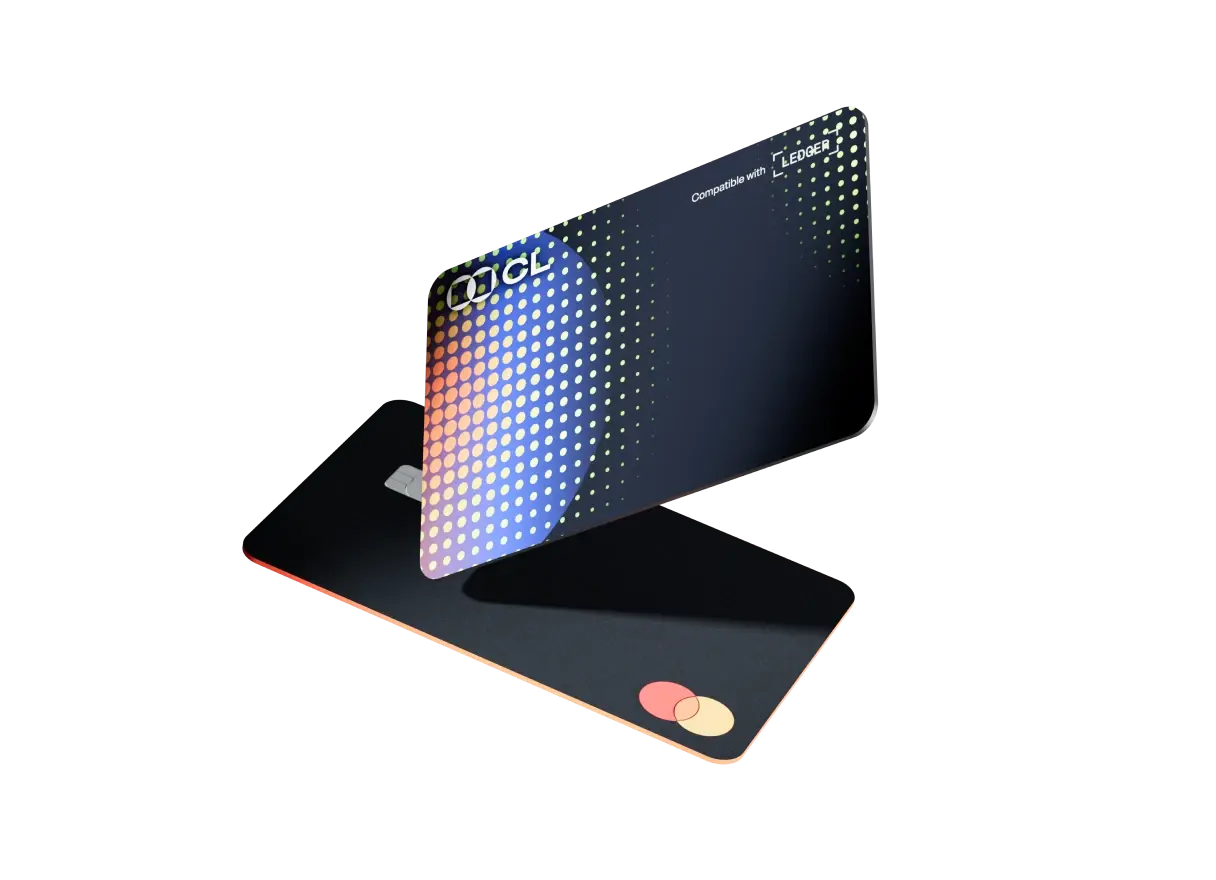
1. Ledger CL Card
Safe Off-Ramp for Hardware Wallets: 1% BTC Back
Fees and Rates
Advertised:
- $0 annual fee
- 1% cashback in BTC or USDC
Actual costs you will encounter:
$0 annual fee. 2% card spend fee on crypto-funded transactions + 1.75% FX on cross-currency. 1.5% ATM (plus flat fees). 1% cashback paid monthly (US: BTC or USDC, other regions: BTC or USDT). Fiat-funded domestic spending: +1.0% net profit. Crypto-funded domestic: -1.0% net loss. International crypto-funded: -2.75% net loss.
At $3,000/month fiat-funded domestic: $360/year. 10 supported funding assets. Crypto-backed credit lines at 0% interest (up to 50% LTV). BTC yield via Lombard/Figment adds additional return on idle BTC in Ledger Live. The optimal strategy is fiat funding only.
The 2% Problem
| Fee | Cost | Notes |
|---|---|---|
| Annual fee | $0 | No subscription |
| Card spend (crypto-funded) | 2% | When spending crypto via the card |
| Crypto to fiat (manual) | 1.75% | Manual conversion in Ledger Live |
| FX fee | 1.75% | On all non-base currency transactions |
| ATM fee (domestic UK) | €2.50 flat | Per withdrawal |
| ATM fee (foreign) | €3.00 + 1.5% | Per withdrawal |
| Transfer out | 0.4-0.5% | Depending on asset |
| Cashback | +1% | BTC or USDC (US), BTC or USDT (other regions) |
Rewards and Cashback
Net Reward by Spending Type
| Transaction Type | Cashback | Card Spend | FX Fee | Net per $100 |
|---|---|---|---|---|
| Domestic (fiat balance) | +$1.00 | $0 | $0 | +$1.00 |
| Domestic (crypto spend) | +$1.00 | -$2.00 | $0 | -$1.00 |
| International (fiat) | +$1.00 | $0 | -$1.75 | -$0.75 |
| International (crypto) | +$1.00 | -$2.00 | -$1.75 | -$2.75 |
The math is unfavorable for crypto spending. The 2% card spend fee alone exceeds the 1% cashback, meaning every crypto-funded purchase costs you a net 1.0%. Add the 1.75% FX fee for international spending and the card costs 2.75% per transaction.
The optimal strategy: Fund the card with fiat via Ledger Live, not crypto. This eliminates the 2% card spend fee and makes the 1% cashback profitable on domestic transactions.
Hardware-Secured Spending
The Ledger CL Card's technical architecture provides security advantages:
- Ledger Live integration: Top up your card wallet directly from Ledger Live
- Hardware authorization: Large transfers from cold storage to card wallet require physical Ledger device confirmation
- Card platform: CL (Crypto Life) via Baanx, with UAB Monavate as EEA account provider
- Supported assets: BTC, ETH, SOL, XRP, LTC, UNI, USDC, USDT, BXX, EURT (10 funding assets)
- BTC Yield (new 2026): Earn native BTC yield via Lombard and Figment directly in Ledger Live while funds remain available for card funding
- Visa network: Accepted at 80M+ merchants worldwide
- Regions: US, EEA, UK, Canada, Switzerland, LATAM (Colombia, Mexico, Brazil)
The security model differs from exchange cards. With Bybit or Binance, your entire portfolio sits on the exchange. With Ledger, only the amount you explicitly transfer to the card wallet is exposed.
Countries and Availability
Ledger is available in 37 countries as of September 2026. We count a country here when at least one active Ledger card variant lists it, so individual product pages may be narrower.
Available Regions
Americas
Brazil (BR), Canada (CA), Colombia (CO), Mexico (MX), United States (US)
Europe
Austria (AT), Belgium (BE), Bulgaria (BG), Croatia (HR), Cyprus (CY), Czech Republic (CZ), Denmark (DK), Estonia (EE), Finland (FI), France (FR), Germany (DE), Greece (GR), Hungary (HU), Iceland (IS), Ireland (IE), Italy (IT), Latvia (LV), Liechtenstein (LI), Lithuania (LT), Luxembourg (LU), Malta (MT), Netherlands (NL), Norway (NO), Poland (PL), Portugal (PT), Romania (RO), Slovakia (SK), Slovenia (SI), Spain (ES), Sweden (SE), Switzerland (CH), United Kingdom (GB)
Major Restricted Markets
These major markets are not currently listed for this vendor. Confirm eligibility with the issuer before applying, especially where card tiers have different country rules.
Africa
Egypt (EG), Kenya (KE), Nigeria (NG), South Africa (ZA)
Americas
Argentina (AR), Chile (CL)
Asia
China (CN), Hong Kong (HK), India (IN), Indonesia (ID), Japan (JP), Malaysia (MY), Philippines (PH), Singapore (SG), South Korea (KR), Taiwan (TW), Thailand (TH), Turkey (TR), United Arab Emirates (AE)
Oceania
Australia (AU), New Zealand (NZ)
Real User Scenarios
Scenario 1: Erik (Security-First HODLer, $3,000/month, fiat-funded)
Setup:
- Ledger CL Card (free)
- 1% BTC cashback
- Holds 2 BTC in cold storage on Ledger Nano X
- Funds card with fiat via bank transfer
- All domestic spending
Monthly math:
- Cashback: $3,000 x 1% = $30 in BTC
- Conversion fee: $0 (fiat-funded)
- FX fee: $0 (domestic)
- Net monthly value: $30 = $360/year
BTC yield stack:
- 0.5 BTC in Ledger Live BTC yield (approx. 3-5% via Lombard)
- Estimated annual yield: 0.015-0.025 BTC
Erik keeps 90% in cold storage and 10% liquid for spending. The 1% BTC cashback (paid monthly) goes straight to cold storage. Combined with the BTC yield feature, his Ledger ecosystem is earning while his keys stay safe. The 2% card spend fee means he only funds with fiat, never sells crypto through the card.
Scenario 2: Priya (International Traveler, $2,000/month, 50% international)
Setup:
- Ledger CL Card (free)
- 1% cashback
- Travels between EEA and Asia
- Funds with crypto (crypto-heavy portfolio)
Monthly math:
- Domestic cashback: $1,000 x 1% = $10, minus 2% card spend = -$20.00 = -$10.00
- International cashback: $1,000 x 1% = $10, minus 2% card spend = -$20.00, minus 1.75% FX = -$17.50 = -$27.50
- Net monthly cost: -$37.50 = -$450/year loss
The fees destroy any cashback value on international crypto spending. Priya switched to Wirex Standard for travel (0% FX) and keeps the Ledger card for domestic fiat-funded purchases only. With the 2% card spend fee on crypto and 1.75% FX on cross-border, her net loss is even worse than the 1% cashback can offset. The Ledger card is a security tool, not a rewards tool.
Scenario 3: Jake (US-Based BTC Maximalist, $1,500/month, domestic only)
Setup:
- Ledger CL Card (free)
- 1% BTC cashback
- Fiat-funded (bank transfer)
- Holds 5 BTC on Ledger hardware
- Uses BTC yield feature
Monthly math:
- Cashback: $1,500 x 1% = $15 in BTC
- All fees: $0 (fiat, domestic)
- BTC yield on 1 BTC in Ledger Live: approx. 0.003-0.005 BTC/month
- Net monthly value: $15 + BTC yield
In the US, Jake's options for a hardware-linked card are limited. Coinbase offers better cashback (4%) but it is custodial. For him, the peace of mind of hardware-secured funds is worth the lower cashback rate. The 1% BTC (paid monthly in BTC or USDC for US users) goes straight to his hardware wallet.
Ledger vs Other Cards
| Feature | Ledger CL | Gnosis Pay | MetaMask | Coinbase |
|---|---|---|---|---|
| Security Model | Hardware wallet | Safe Smart Account | MPC wallet | Exchange custodial |
| Cashback | 1% BTC/USDC | 1-5% GNO | 1-3% crypto | Up to 4% BTC |
| FX Fee | 1.75% | 0% | 0% | 0% |
| Card Spend Fee | 2% | 0% | 0% | 0-3% (spread) |
| Regions | US, EEA, UK, CA, CH, LATAM | EEA, UK | EEA, UK, LATAM | US only |
| BTC Yield | Yes (Lombard/Figment) | No | No | No |
| Card Network | Visa | Visa | Mastercard | Visa / Amex |
| Best For | Hardware wallet users | DeFi-native Europeans | Multi-chain wallets | US regulated safety |
After reviewing the competition:
Ledger wins on:
- Hardware-grade security (physical device authorization)
- Widest regional availability among self-custody cards (US, EEA, UK, Canada, Switzerland, LATAM)
- BTC yield integration directly in Ledger Live
- Crypto-backed credit lines at 0% interest
- 10 supported funding assets (including SOL, XRP, LTC)
- Largest existing user base (7M+ hardware wallets sold)
Ledger loses on:
-
Highest fees among self-custody cards (2% card spend + 1.75% FX)
-
Lowest net reward when spending crypto (-1.0% after card spend fee)
-
No smart contract programmability (unlike Gnosis Pay)
-
Card wallet is custodial through Baanx/Monavate (not true end-to-end self-custody)
-
vs Gnosis Pay: Gnosis Pay offers 0% fees with 1-5% GNO cashback (EURe, Gnosis Chain, EEA/UK). Ledger charges 2% card spend + 1.75% FX with 1% BTC. Gnosis Pay is economically superior. Ledger wins on regional availability (US, Canada, LATAM) and hardware security integration.
-
vs Coinbase: Coinbase offers up to 4% BTC on Amex with FDIC insurance (US only, custodial). Ledger offers 1% BTC with hardware security (US+EEA+UK+Canada+Switzerland+LATAM, partially self-custodial). Coinbase wins on rewards and fiat safety. Ledger wins on custody model and multi-region access.
-
vs MetaMask: MetaMask offers 1% cashback (Virtual) or 3% (Metal, $199/year) with 1% cross-border on Virtual, 0% on Metal. MPC custody, 48 countries. Ledger offers 1% with 2% card spend + 1.75% FX. MetaMask wins on rewards. Ledger wins on hardware security.
Who Should Use Ledger?
Ideal user profile:
- Already owns a Ledger hardware wallet
- Prioritizes security above rewards and fees
- Funds the card with fiat (avoiding 2% card spend fee)
- Domestic spending primarily (avoiding FX fee)
- US-based user who wants self-custody adjacent card (limited US alternatives)
- Interested in BTC yield integration
Who should avoid:
- Rewards maximizers (1% net is only achievable with fiat funding - use Coinbase 4% or Plutus 3-9%)
- International travelers (1.75% FX is the highest among crypto cards - use Wirex 0% or Kraken 0%)
- Users who want true self-custody end-to-end (card wallet is custodial via Baanx/Monavate - use Gnosis Pay)
- Users who primarily spend crypto, not fiat (2% card spend fee makes crypto spending unprofitable)
- Price-sensitive users (most expensive fee structure in the category)
Our take: The Ledger CL Card is a security product first and a spending card second. Its value is not in cashback or low fees - it has neither. Its value is in connecting the world's most trusted hardware wallet to the Visa network with 10 supported assets, crypto-backed credit lines, and native BTC yield.
Fund it with fiat, spend domestically, earn 1% BTC cashback (paid monthly), and keep 90%+ of your portfolio in cold storage where it belongs. For hardware wallet users who want a spending rail without surrendering their keys to an exchange, this is the only option. For everyone else, cheaper and more rewarding alternatives exist.
Is Ledger Safe?
Licensing:
- Ledger: French company (Paris HQ), not directly a regulated financial institution
- Baanx: CL platform operator, handles card operations
- UAB Monavate: EEA account provider (issues the card in EEA markets)
- Regional partners: Banking partners in US, UK, Canada, Switzerland, and LATAM for fiat settlement
What is protected:
- Card transactions under Visa Zero Liability
- Cold storage funds (hardware wallet - you hold the keys)
- UK: Baanx regulated by FCA
- EU: Operating under MiCA-compliant framework
What is NOT protected:
- Crypto in the card hot wallet (custodial through Baanx)
- BTC yield (managed through third-party DeFi protocols - Lombard, Figment)
- Cashback rewards (BTC/USDC, subject to market conditions)
- Conversion and FX fees are non-refundable
What Happens If Ledger (the Company) Fails?
Your cold storage (hardware wallet):
- Completely safe. Your Ledger Nano is a standalone device. Even if Ledger goes bankrupt, your private keys are on the device. You can restore your wallet using your seed phrase in any BIP-39 compatible wallet.
- Expected recovery: 100% - Ledger never had access to your cold storage funds
Your Ledger CL Card:
- Card stops working if Baanx terminates the partnership or Ledger ceases card operations
- Hot wallet balance on Baanx is at risk (custodial)
- BTC yield position may need manual unwinding from DeFi protocols
Your card wallet (Baanx-managed):
- This is the risk. Funds transferred from cold storage to the card wallet are held by Baanx
- In Baanx failure, standard FCA/EU resolution processes apply
- Mitigation: Keep only 1-2 months spending in the card wallet
What if Baanx fails specifically?
- FCA-regulated, so structured wind-down process
- Fiat balances may be protected under e-money regulations
- Crypto balance is unsecured creditor claim
- Card functionality stops immediately
Mitigation strategy:
- Keep minimum balance in card wallet (1-2 months spending)
- The vast majority of assets stay in cold storage (zero counterparty risk)
- Withdraw BTC cashback to cold storage immediately
- The BTC yield feature adds DeFi protocol risk - use only with amounts you are comfortable exposing
Ledger stability indicators (2026):
- Founded 2014 (12 years)
- World's leading hardware wallet manufacturer
- 7M+ devices sold
- Secured $500M+ in funding
- Baanx: FCA-regulated, multiple years operating
Is Ledger a Scam?
-
Ledger has been manufacturing hardware wallets since 2014, making it the world's leading hardware wallet company with 7M+ devices sold and $500M+ in funding raised. The company is headquartered in Paris, France.
-
The CL Card is operated by Baanx via the CL (Crypto Life) platform, with UAB Monavate as the EEA account provider. Baanx is FCA-regulated in the UK. UAB Monavate holds a Bank of Lithuania license (#92) for EEA operations.
-
Cold storage security is fully self-custodial. Your long-term crypto holdings stay on your Ledger hardware device. Ledger has never had access to your cold storage private keys. If Ledger ceases to exist, your seed phrase restores your wallet on any BIP-39 compatible software.
-
The card wallet is custodial through Baanx/Monavate. This is an important distinction - while your savings are self-custodial in cold storage, the spending balance transferred to the card wallet is held by Baanx. This is not end-to-end self-custody.
-
10 supported funding assets (BTC, ETH, SOL, XRP, LTC, UNI, USDC, USDT, BXX, EURT) can be used to fund the card, with native BTC yield via Lombard and Figment available within Ledger Live.
-
The card is available across 8 markets (US, EEA, UK, Canada, Switzerland, Colombia, Mexico, Brazil) - the widest geographic availability among self-custody-adjacent crypto cards.
What to be aware of
- Ledger is not directly a regulated financial institution - card operations are handled by Baanx and Monavate.
- The "self-custodial" label applies to cold storage only; the card wallet is fully custodial through Baanx.
- The 2% card spend fee on crypto-funded transactions makes crypto spending net negative after the 1% cashback.
- The 1.75% FX fee is the highest in the self-custody card category.
- BTC yield via Lombard/Figment carries DeFi protocol risk (smart contract bugs, liquidation).
- Ledger experienced a customer data breach in 2020 (email addresses and personal information exposed, not crypto assets).
SpendNode Verified: The editorial team reviewed Ledger's issuer identity, product terms, and live card flow per our methodology. Verification is not an endorsement or guarantee.
Sources and Verification
Written by Aleksandar Dukic
Frequently Asked Questions
Is Ledger crypto card available in the United States?
Yes. Ledger crypto card is available in the United States.
Can I earn yield on my Ledger Card balance?
While the card rewards are 1% cashback, Ledger Live now supports native BTC yield, allowing you to earn on your assets while they are available for card funding.
Is the Ledger CL Card a credit card?
No. The Ledger CL Card is a Visa debit card, not a credit card. It draws funds from your Ledger Live wallet with no APR and no credit check. However, the CL platform does offer crypto-backed credit lines at 0% interest with up to 50% LTV - borrow against your crypto collateral without selling. This is a separate feature from the debit card spending.
User Reviews
Reviews are moderated and may take a moment to appear.
App Store (15.0K ratings)
Source: Apple App Store - Updated Jul 2026