

Coinbase Crypto Cards Review 2026
Compare Coinbase crypto cards and review issuer terms, fees, and availability.

SpendNode Rating for Coinbase
Coinbase scores well because the operator is established, the product is legible to normal users, and the ecosystem actually feels live rather than theoretical.
The issuer benefits from scale, reliability, and broad market recognition. It gives some of that back on custody posture and the usual platform-dependence tradeoff.
Issuer Snapshot
Editorial vendor score stays separate from user reviews. Methodology
Product Quality
4.0
Trust & Custody
3.7
Fee Transparency
3.9
Operational Reliability
4.3
Market Relevance
4.4
On This Page
What Is Coinbase?
The Coinbase Card is a dual-product US card ecosystem offering a prepaid Visa debit card (not a traditional credit card) with rotating crypto rewards, alongside an American Express credit card with up to 4% BTC back for Coinbase One members, both with zero fees and FDIC-insured USD balances.
Coinbase is the most widely-recognized name in US crypto. As a publicly traded company on the NASDAQ (COIN), it operates under rigorous financial oversight that no offshore exchange can match. The card program reflects this philosophy: zero hidden fees, FDIC-insured fiat balances, and a dual-product lineup that serves both casual users and high-net-worth investors.
The Ecosystem: Visa Debit + Amex Credit
-
Coinbase Card (Visa Debit) - Free prepaid Visa for all US users. Rotating crypto rewards (variable rate), spend from 50+ assets, issued by Pathward, N.A. Available in all US states except Hawaii.
-
Coinbase One Card (Amex Credit) - American Express credit card for Coinbase One members ($49.99/year). Up to 4% BTC back based on assets held. Stainless steel (17g). Full Amex protection suite. Issued by First Electronic Bank via Cardless, Inc.
Available crypto cards by Coinbase in September 2026
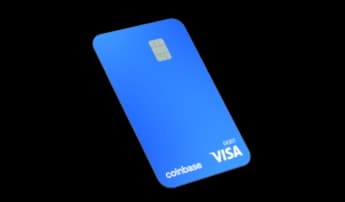
1. Coinbase Card (Prepaid Visa)
Safe & Simple: US Regulated Prepaid Visa with Rotating Crypto Rewards

2. Coinbase One Card (Amex)
Elite US Credit: Tiered BTC Rewards + Full Amex Protection Suite
Fees and Rates
Advertised:
- $0 annual fee (both cards)
- 0% FX fee
- 0% ATM fee (Visa debit)
- Up to 4% rewards
Actual costs you will encounter:
Conversion Spread (The Hidden Cost)
Coinbase does not charge a flat conversion fee, but applies a spread when converting crypto to fiat at point of sale. This spread varies by asset:
| Asset | Typical Spread | Cost per $100 |
|---|---|---|
| USDC | 0% | $0 |
| BTC | 0.5-1.5% | $0.50-1.50 |
| ETH | 0.5-1.5% | $0.50-1.50 |
| SOL | 1.0-2.0% | $1.00-2.00 |
| Altcoins | 1.5-3.0% | $1.50-3.00 |
The USDC hack: Convert to USDC before spending. USDC-to-fiat conversion is free on Coinbase, making the card functionally a zero-fee bank account. This is the most efficient way to use either Coinbase card.
Coinbase One Membership Cost
The Amex credit card requires Coinbase One ($49.99/year). The break-even at 2% base rate is $2,500/year in spending to cover the membership. At 4% tier: $1,250/year. For most active users, the membership pays for itself through card rewards alone, before counting the zero trading fees (first $500/mo, spread applies), 3.5% USDC rewards, the 5% staking boost, and $10/month in Base gas credits.
ATM Reality
- Coinbase fee: $0
- ATM operator fee: $2-5 typical
- Daily limit: $1,000, max 6 withdrawals
- Effective cost: 1-2.5% on $200 withdrawal (operator fee only)
Fees and ROI framework
$0 annual fee on Visa debit. Coinbase One ($49.99/year) required for Amex credit. Break-even on Amex at 2% base: $2,500/year. At 4% tier: $1,250/year. True cost is conversion spread: 0% on USDC, 0.5-1.5% on BTC/ETH, 1.5-3.0% on altcoins. The USDC-first strategy makes both cards functionally zero-fee. At $3,000/month USDC spending with 4% reward, net value is $1,440/year.
Rewards and Cashback
Coinbase runs two distinct reward structures across its dual-card lineup.
Visa Debit Card (free, all US users):
- Rotating crypto rewards - Coinbase promotes a featured asset at a promotional rate (typically 2-4%) that changes periodically
- Reward paid in the featured asset at time of promotion
- Rate is variable and not guaranteed - check the app for the current active promotion before spending
- No tier system, no staking, no membership required
Amex Credit Card (Coinbase One members, $49.99/year):
- Up to 4% back in BTC, tiered by assets held on Coinbase
- Base tier starts at 2% for Coinbase One members (under $10K held)
- Higher tiers: 2.5% from $10K, 3% from $50K, 4% from $200K in assets on Coinbase
- Flat 5% BTC back on flights, hotels, and cars booked through the Coinbase One Card Travel portal, outside the monthly cap
- Reward paid in BTC, accumulating directly to your Coinbase account
- Amex protection suite (Purchase, Travel, Warranty) adds meaningful non-cash value on top of cashback
The USDC-first strategy is the key lever on the Visa debit side. Because USDC-to-fiat conversion is free on Coinbase but other crypto assets carry a 0.5-3% conversion spread, converting your crypto holdings to USDC before spending eliminates the only meaningful cost. At 4% promotional rewards on $3,000/month of USDC spending, the card generates $1,440/year in net rewards with zero offsetting fees.
Net annual return examples (at a 4% promotional rate):
- $1,000/month: approximately $480/year
- $3,000/month: approximately $1,440/year
- $5,000/month: approximately $2,400/year
Technology: USDC and Just-in-Time Conversion
The Coinbase ecosystem is built around USDC, the leading regulated stablecoin (co-founded by Coinbase via Circle):
- Zero-fee pipeline: USD to USDC conversion is free on Coinbase
- USDC spending: 0% conversion spread (functionally a bank card)
- Crypto spending: JIT conversion sells the exact amount needed at point of sale
- 50+ assets: Spend from BTC, ETH, SOL, and 50+ more
- Apple Pay / Google Pay: Both cards supported
The Amex credit card operates differently: it is a traditional credit card. You spend on credit, pay the balance monthly, and earn BTC rewards. Your crypto remains invested while you spend.
Countries and Availability
Coinbase is available in 1 country as of September 2026. We count a country here when at least one active Coinbase card variant lists it, so individual product pages may be narrower.
Available Regions
Americas
United States (US)
Major Restricted Markets
These major markets are not currently listed for this vendor. Confirm eligibility with the issuer before applying, especially where card tiers have different country rules.
Africa
Egypt (EG), Kenya (KE), Nigeria (NG), South Africa (ZA)
Americas
Argentina (AR), Brazil (BR), Canada (CA), Chile (CL), Colombia (CO), Mexico (MX)
Asia
China (CN), Hong Kong (HK), India (IN), Indonesia (ID), Japan (JP), Malaysia (MY), Philippines (PH), Singapore (SG), South Korea (KR), Taiwan (TW), Thailand (TH), Turkey (TR), United Arab Emirates (AE)
Europe
Austria (AT), France (FR), Germany (DE), Italy (IT), Netherlands (NL), Poland (PL), Portugal (PT), Spain (ES), Switzerland (CH), United Kingdom (GB)
Oceania
Australia (AU), New Zealand (NZ)
Coinbase vs Other Cards
| Feature | Coinbase | Gemini | Crypto.com | Uphold |
|---|---|---|---|---|
| Max Cashback | 4% (Amex, tiered) | 4% (category) | 8% ($1M stake) | 4% (promo, variable) |
| Staking Required | None | None | $500-$1M CRO | None |
| Card Types | Visa Debit + Amex Credit | Mastercard Credit | Visa Prepaid | Mastercard Debit |
| FDIC Insurance | Yes (USD, $250K) | Yes (USD, $250K) | No | Yes (USD, $250K) |
| Purchase Protection | Yes (Amex only) | No | No | No |
| Travel Insurance | Yes (Amex only) | No | No | No |
| Regions | US only | US only | Global (95+) | US, UK |
| Best For | Safety-first US users | BTC stackers | Global lifestyle | International travelers |
Here is how it stacks up:
Coinbase wins on:
- Strongest regulatory protection (NASDAQ, FDIC, NYDFS)
- Only crypto card with Amex Purchase/Travel Protection
- Dual card system (debit + credit)
- USDC zero-fee spending pipeline
- 110M+ user base and institutional trust
Coinbase loses on:
- US only (no international availability)
- Conversion spread on non-USDC spending
- No lifestyle perks (no lounge, no streaming rebates)
- Variable reward rates (not guaranteed)
- Amex acceptance lower than Visa in some regions
Competitor Comparison
- vs Gemini: Gemini offers up to 4% BTC on Mastercard credit (no membership required). Coinbase offers up to 4% BTC on Amex credit ($49.99/year membership). Gemini wins on simplicity (no membership). Coinbase wins on Amex protections (Purchase, Travel, Warranty) and dual-card flexibility.
- vs Crypto.com: Crypto.com offers 2-8% CRO with staking ($500-$1M). Global availability (95+ countries). Coinbase requires no staking and is US-only. Crypto.com wins on lifestyle perks and global reach. Coinbase wins on regulatory safety (FDIC, NASDAQ) and zero staking.
- vs Uphold: Uphold offers true 0% FX and precious metals spending (US + UK). Coinbase offers FDIC insurance and Amex protections (US only). Uphold wins on FX savings for travelers and precious metals. Coinbase wins on regulatory trust and dual-card options.
Who Should Use Coinbase?
Ideal user profile:
- US resident who prioritizes regulatory safety
- Already uses Coinbase for crypto trading/holding
- Comfortable with USDC as spending strategy
- Wants FDIC-insured fiat balances
- Values Amex protections (Purchase, Travel, Warranty)
- Spends $2,000+/month
Who should avoid:
- Non-US residents (not available)
- Users who want maximum cashback without complexity (use Gemini for flat 4% categories)
- Users who want zero-fee crypto spending (spread applies on non-USDC - use Kraken for true 0%)
- Self-custody advocates (fully custodial - consider Gnosis Pay or MetaMask)
- Users who want lifestyle perks (no lounge/rebates - use Crypto.com)
Where it lands: Coinbase is the most regulated crypto card available. FDIC insurance, NASDAQ listing, and SEC audits provide a level of protection no other crypto card matches. The dual card system (Visa debit for everyday, Amex credit for protection) covers all spending scenarios. The USDC-first strategy eliminates conversion costs entirely. For US residents, this is the safest default.
Real User Scenarios
Scenario 1: Mike (USDC-First User, $3,000/month spend)
Setup:
- Coinbase Visa debit card (free)
- Converts all crypto to USDC before spending
- 4% rotating reward active (variable)
Monthly math:
- Cashback: $3,000 x 4% = $120 in crypto
- Conversion spread: $0 (spending USDC)
- FX fees: $0
- Net monthly value: $120 = $1,440/year
His verdict: "By converting to USDC first, I get the full reward rate with zero spread. It is functionally a 4% cashback bank card with FDIC insurance. No other crypto card offers this combination of safety and return."
Scenario 2: Sarah (Coinbase One Amex, $5,000/month spend, frequent traveler)
Setup:
- Coinbase One membership ($49.99/year)
- Amex credit card at 3% BTC tier ($50K-$200K in assets on Coinbase)
- 40% international spending
- Uses Amex Purchase Protection and Travel Insurance
Monthly math:
- BTC cashback: $5,000 x 3% = $150 in BTC
- Coinbase One cost: -$4.17/month
- FX fees: $0
- Amex travel insurance value: approx. $20/month (estimated)
- Net monthly value: $165.83 = $1,990/year
Amex Protection value:
- Purchase Protection (theft/damage 90 days): Used once for $300 laptop damage claim
- Extended Warranty: Added 1 year to $800 appliance
- Car Rental Insurance: Saved $180 on a week rental
- Annual protection value: approx. $480 in claims/savings
Her verdict: "No crypto debit card offers Purchase Protection or Travel Insurance. The Amex suite alone justifies the $50/year membership. The 3% BTC on top is exceptional."
Scenario 3: David (Casual User, $1,500/month, spending BTC)
Setup:
- Coinbase Visa debit card (free)
- Spends directly from BTC (does not convert to USDC)
- 4% rotating reward active
Monthly math:
- Cashback: $1,500 x 4% = $60
- BTC conversion spread: $1,500 x 1.0% = -$15
- Net monthly value: $45 = $540/year
His verdict: "The spread eats into my rewards when spending BTC directly. Converting to USDC first would save me $180/year. Worth the extra step."
Lesson: Always convert to USDC before spending on Coinbase. The spread on crypto is the only real cost.
Is Coinbase Safe?
Regulatory Status (2026)
United States:
- NASDAQ-listed (COIN) - public company with SEC-audited financials
- NYDFS BitLicense holder (approved 2017)
- FinCEN MSB registration
- State licenses: All 50 states + territories (except Hawaii for card)
- FDIC insurance: USD balances protected up to $250,000 via partner banks (Pathward, Metropolitan Commercial Bank)
Card issuers:
- Visa debit: Issued by Pathward, N.A. (Member FDIC), powered by Marqeta
- Amex credit: Issued by First Electronic Bank via Cardless, Inc.
What is protected:
- USD balances: FDIC insured up to $250,000
- Card transactions: Visa Zero Liability / Amex Fraud Protection
- Amex credit card: Purchase Protection, Extended Warranty, Travel Insurance, Car Rental Insurance
- Company financials: Publicly audited quarterly (SEC filings)
What is NOT protected:
- Crypto balances (not FDIC insured, though Coinbase holds $320B+ in custody)
- USDC balances (not FDIC insured, though Circle maintains 1:1 reserve audits)
- Crypto reward value (BTC/crypto rewards fluctuate with market)
- Conversion spread costs (not disclosed upfront per transaction)
What Happens If Coinbase Fails?
Your USD balance:
- FDIC insured up to $250,000 via partner banks
- Expected recovery: 100% within days (standard FDIC process)
- This is unmatched deposit protection - no other crypto card offers FDIC-insured fiat balances
Your crypto balance:
- Coinbase holds $320B+ in custody across institutional and retail accounts
- As a NASDAQ-listed company, bankruptcy would be a structured process under US law
- In bankruptcy, crypto holders are unsecured creditors
- Expected recovery: 70-90% (better than offshore exchanges due to US legal framework)
- Coinbase has stated that customer crypto is segregated from corporate assets
Your card functionality:
- Visa debit: Would stop working if Coinbase cannot fund Pathward settlement
- Amex credit: Issued by First Electronic Bank - could potentially continue independently
- Pending rewards would likely be lost
Comparison to offshore exchanges:
- FTX (offshore, unregulated): Users lost 100%, recovering 70% after 3+ years
- Coinbase (US, NASDAQ, FDIC): Fiat 100% protected, crypto segregated, US legal protections
- Risk level: The lowest in the crypto card industry
Mitigation strategy:
- Keep large USD balances (FDIC protected)
- Withdraw BTC rewards to self-custody regularly
- The USDC-first spending strategy means minimal crypto on platform
Coinbase stability indicators (2026):
- Founded 2012, NASDAQ-listed since 2021
- $320B+ in custody
- SEC-audited quarterly financials
- 110M+ verified users
- No major security breaches
- Partner of choice for US government crypto custody
Is Coinbase a Scam?
Coinbase is not a scam. This is the strongest scam-check answer for any vendor we cover - the operator is a publicly traded US company and every part of the card program is wrapped in US regulatory oversight:
1. NASDAQ-listed public company. Coinbase trades on NASDAQ under the ticker COIN and files SEC-audited quarterly financials. That is the single strongest trust signal available for any financial product. A scam cannot survive quarterly audits and a shareholder base.
2. Full US regulatory stack. Coinbase holds a NYDFS BitLicense (approved 2017), is registered with FinCEN, and is state-licensed across all 50 US states and territories. Each is verifiable in public registers.
3. FDIC-insured fiat balances - unique among crypto cards. USD balances are FDIC-insured up to $250,000 via partner banks Pathward, N.A. and Metropolitan Commercial Bank - the same banks that issue the Visa debit and Amex credit cards. In a Coinbase failure, the FDIC process returns the USD within days. Every other custodial exchange card on this site relies on e-money segregation at best; this is the strongest deposit protection layer of any crypto card.
4. Long track record, real scale. Founded 2012. 110M+ verified users. $320B+ in custody. No major security breaches across 13+ years and every major crypto cycle. Customer crypto is segregated from corporate assets, and as a public US company, that claim is tested in court under bankruptcy law rather than taken on faith.
5. Real Visa and Amex networks with full protection suites. The Visa debit carries Visa Zero Liability. The Amex credit carries Purchase Protection, Extended Warranty, Travel Insurance, and Car Rental Insurance - the full Amex suite, which exists on no other crypto card.
6. The one "hidden" cost is disclosed in plain text. Coinbase applies a conversion spread on non-USDC crypto at point of sale, and the page publishes the spread table plus the USDC-first workaround that eliminates it. Scam programs hide spreads; Coinbase publishes them and tells you how to avoid them.
What to be aware of
- US-only. No international availability, and Hawaii is excluded from the Visa debit.
- Spread on non-USDC crypto is real. If you do not use the USDC-first path, you lose a meaningful share of your rewards to the 0.5-3% spread.
- Crypto balances are not FDIC-insured. Only USD is. Crypto holders would be unsecured creditors in bankruptcy - a better position under US law than an offshore collapse, but not full protection.
- The Amex credit card requires Coinbase One at $49.99/year. Break-even at the 2% rate is $2,500/year spend; at 4% tier it is $1,250/year. Below those thresholds the credit card is not economic.
- Rotating Visa debit rewards are variable, not guaranteed. Check the app for the current active promotion before relying on a specific rate.
- No lifestyle perks. No airport lounges, no streaming rebates - this is a pure payments and rewards card, not a lifestyle product.
SpendNode Verified: The editorial team reviewed Coinbase's issuer identity, product terms, and live card flow per our methodology. Verification is not an endorsement or guarantee.
Sources and Verification
All card details on this page were verified from issuer materials reviewed offline.
Written by Aleksandar Dukic
Frequently Asked Questions
Are Coinbase crypto cards available in the United States?
Yes. Coinbase crypto cards are available in the United States. The prepaid Visa is unavailable in Hawaii, and the Coinbase One Amex excludes US territories.
What is the difference between the Debit and Credit cards?
The Coinbase Card is a prepaid Visa debit card (issued by Pathward, N.A.) available to all US Coinbase users with rotating crypto rewards. The Coinbase One Card is an American Express credit card (issued by First Electronic Bank) exclusively for Coinbase One members ($49.99/yr), offering tiered BTC rewards up to 4% and Amex purchase/travel protection.
Are there any fees on the Coinbase Card?
No transaction fees, no annual fee, no FX fee, and no ATM fee from Coinbase. However, a spread applies when converting crypto to fiat at point of sale. ATM operators may charge their own fees.
How do Coinbase One Card reward tiers work?
BTC back rates are tiered by Assets on Coinbase (AOC, the 30-day average of your daily end-of-day balance): 2% under $10,000, 2.5% from $10,000, 3% from $50,000, and 4% from $200,000. The 2.5%, 3%, and 4% tiers are capped at $10,000 in purchases per month combined (then 2% thereafter). Travel booked through Coinbase One Card Travel earns 5% outside the cap.
Is the Coinbase Card a credit card?
Coinbase offers both. The standard Coinbase Card is a prepaid Visa debit card (no credit line, no credit check). The Coinbase One Card is an American Express credit card available exclusively to Coinbase One members, with tiered BTC rewards and full Amex purchase protection.
User Reviews
Reviews are moderated and may take a moment to appear.
Latest Page Changes to the Coinbase Review
- The Coinbase One Card added a travel portal: flights, hotels, and car rentals booked through Coinbase One Card Travel earn a flat 5% bitcoin back, outside the $10,000 monthly rewards cap and with no balance requirement. Coinbase also published the exact asset tiers for card rewards: 2% under $10,000 held, 2.5% from $10,000, 3% from $50,000, and 4% from $200,000
App Store (1.8M ratings)
Source: Apple App Store - Updated Jul 2026