
weekly report
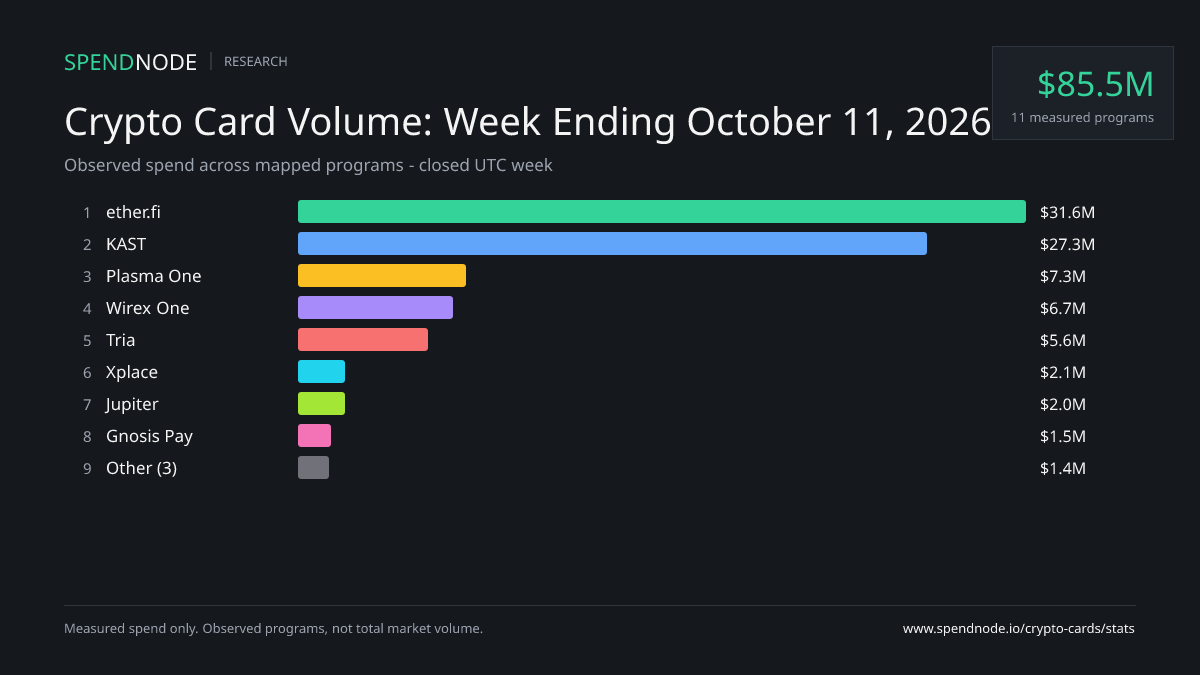
Crypto Card Volume: Week Ending October 11, 2026
11 measured programs · Published 2026-10-12
$85.5M
-0.7% WoW
SpendNode Research
Independent card-volume data with the measurement boundaries attached. Compare programs, inspect settlement chains, and download the weekly and monthly datasets behind the analysis.
Latest frozen weekly close
SpendNode observed $85.5M across 11 mapped card programs. 7 of 11 recorded higher volume than in the preceding UTC week.
This is observed activity across mapped programs, not total crypto card market volume. The snapshot is frozen; material corrections are logged and dated.
$347.1M
Observed measured spend
Sep 2026 - 11 programs
+13.6%
Comparable monthly growth
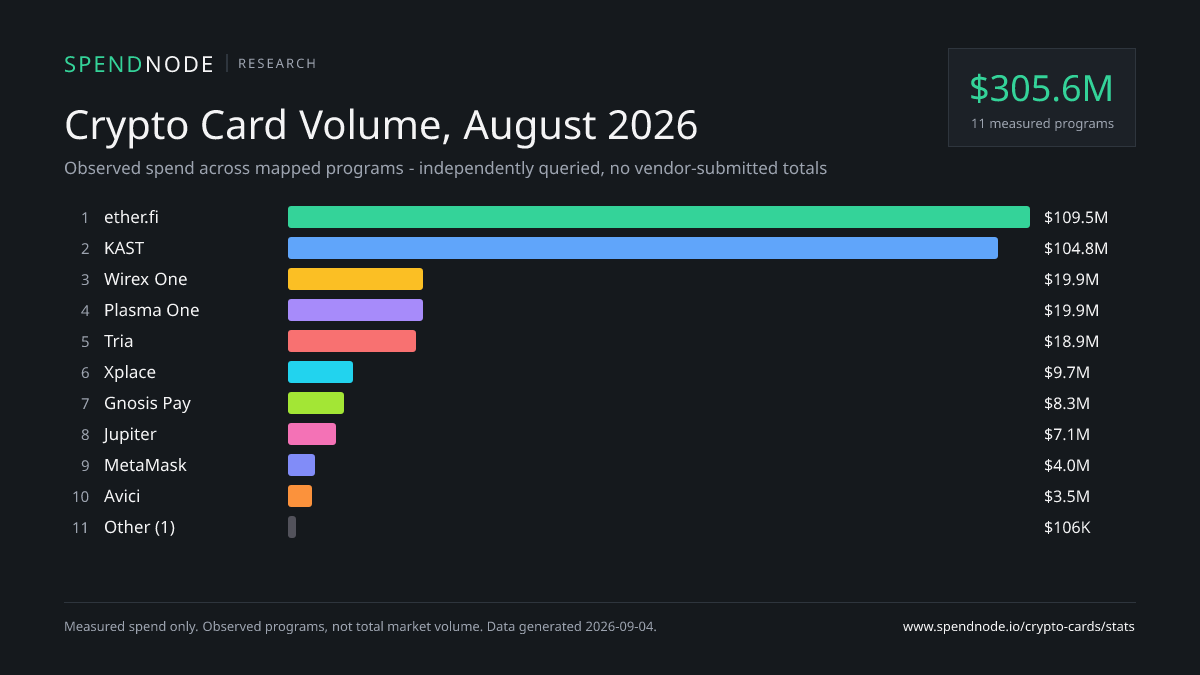
$305.6M to $347.1M
11
Measured programs
Spend or settlement-based series
11
Observed chains
Across the latest measured month
The $347.1M figure is the sum of eleven observed programs, not total crypto card market volume. The growth rate uses seven programs with matching July and August coverage.
Monthly history
Switch to the growth index to compare trajectories without letting the largest programs flatten smaller series.
| # | Measurement basis | Chains | |||
|---|---|---|---|---|---|
| 1 | ether.fi | $128,777,081 | 17.6% | Measured card spend | Optimism |
| 2 | KAST | $113,812,862 | 8.6% | Settlement-based card spend | Arbitrum, Base, Ethereum, Polygon, Solana |
| 3 | Plasma One | $25,635,096 | 28.9% | Measured card spend | Plasma |
| 4 | Wirex One | $24,635,757 | 23.8% | Measured card spend | Arc |
| 5 | Tria | $21,916,895 | 16.1% | Measured card spend | Arbitrum, Base, Optimism, Polygon |
| 6 | xPlace | $10,268,899 | 6.4% | Measured card spend | Solana |
| 7 | Jupiter | $7,626,016 | 8.0% | Measured card spend | Solana |
| 8 | Gnosis Pay | $7,581,973 | 9.0% | Measured card spend | Gnosis |
| 9 | Avici | $3,375,503 | 3.5% | Observed current-program settlement spend | Arbitrum, Avalanche, Base, Optimism, Polygon, Solana |
| 10 | MetaMask | $3,372,938 | 15.8% | Gross authorization-time wallet debits | Base, Linea, Solana |
| 11 | Peanut | $70,994 | 32.9% | Settlement-based card spend | Arbitrum |
Use this data
Charts and figures on this page are free to republish with attribution to SpendNode and a link to this page. Weekly and monthly reports keep stable URLs, and material corrections are logged and dated rather than made silently. Press and data questions: hello@spendnode.io.
Kept separate
These flows measure funds entering card infrastructure, not confirmed purchases. They are useful indicators but are never added to measured spend.
| Program | Observed funding | MoM | Basis |
|---|---|---|---|
| RedotPay | $496,856,191 | 4.4% | Top-up proxy (not card spend) |
Settlement footprint
This is the chain distribution inside SpendNode's eleven measured programs. It is not crypto card market share by chain.
Optimism
3 programs
$129.8M
Solana
5 programs
$109.8M
Plasma
1 program
$25.6M
Arc
1 program
$24.6M
Ethereum
1 program
$21.6M
Base
4 programs
$10.2M
Arbitrum
4 programs
$8.3M
Polygon
3 programs
$7.6M
Gnosis
1 program
$7.6M
Linea
1 program
$1.9M
Avalanche
1 program
$318
Research archive
Frozen reports retain stable URLs. Downloadable data and branded charts remain attached to each edition.
weekly report
11 measured programs · Published 2026-10-12
$85.5M
-0.7% WoW
weekly report
11 measured programs · Published 2026-10-05
$86.1M
+0.4% WoW
weekly report
11 measured programs · Published 2026-10-05
$85.7M
+8.2% WoW
$347.1M
+13.6% MoM
weekly report
11 measured programs · Published 2026-09-21
$79.2M
+3.2% WoW
weekly report
11 measured programs · Published 2026-09-14
$76.7M
-4.0% WoW
weekly report
11 measured programs · Published 2026-09-07
$79.9M
+11.8% WoW
$305.6M
+10.9% MoM
Latest monthly findings
Finding 01
SpendNode measured $347.1M of card spending across 11 programs in September, up 13.6% from August on a matching basis. Ether.fi led at $128.8M and KAST followed at $113.8M. Plasma One, Wirex One, and Tria each exceeded $20M, while seven of the 11 measured programs finished higher month over month.
Finding 02
Ether.fi and KAST supplied $28.3M of the $41.4M net increase and represented 69.9% of observed spending. Optimism carried $129.8M and Solana $109.8M across the mapped programs. These chain totals describe SpendNode's observed set, not total crypto card market share.
Finding 03
Activity did not move in lockstep with value. Plasma One settlement events rose 76.3% while active settling wallets declined 5.6%; xPlace events rose 36.8% while average observed event value fell 22.2%. Ether.fi's events rose 9.5% and active Optimism accounts rose 8.0%, while spending increased 17.6%.
Finding 04
RedotPay received $496.9M across 582,320 recognized-asset top-ups, down 4.4% from August under the same nine-chain scope. That series measures card funding rather than purchases and remains separate from measured spending. Bitcoin and unmapped routes are excluded rather than estimated.
SpendNode tracks card-payment activity that can be tied to a specific crypto card program with a reproducible onchain method. Depending on the program, that may be a decoded card-spend event, a merchant settlement, or an issuer settlement batch. The measurement label beside every program explains which one applies.
The headline figure is observed measured spend, not the size of the entire crypto card market. It excludes programs we cannot measure reliably and does not combine card spending with money merely loaded onto a card account.
Measured card spend and top-up proxies answer different questions. Spend shows value associated with purchases or their settlement. A top-up proxy shows value moving into card infrastructure before a purchase occurs. Top-ups can be retained, withdrawn, or spent later, so adding the two would double count activity and overstate the market.
Transaction and wallet counts also depend on the settlement architecture. A program that emits one event per purchase can support purchase and active-wallet analysis. KAST, by contrast, settles through issuer batches. Its volume is measurable, but its 32 August transactions are settlement batches rather than 32 purchases, and they reveal no cardholder count.
A program is published only after its addresses, contracts, event logic, asset filters, date boundaries, and known exclusions are documented. Test transactions, direct chain queries, public explorers, and independent external datasets can all be used as controls. A matching number alone is not enough if the underlying flow cannot be explained.
Coverage changes are treated as methodology changes. When a new collector or chain is discovered, SpendNode either rebuilds the comparable history or withholds the growth percentage until both periods use the same basis.
There is no complete public registry of crypto card settlement addresses. Each program in this dataset has a documented mapping assembled from direct chain research, SpendNode queries, public explorers, or a combination of those sources. We publish the working method because other researchers should be able to inspect the same evidence and test our conclusions.
It often starts with a real purchase. We hold cards from most of the programs we track, so we can buy something, note the exact amount and timestamp, and then look for the corresponding chain activity. A single reconciled transaction is worth more than address guessing: one test purchase settled as two liquidations on different chains that summed to the receipt amount to the cent, and that single match exposed the program's settlement architecture.
From the anchor purchase we work outward. Whose contract emitted the event? Is the card debiting the user's wallet at authorization time, settling merchant batches daily, or moving issuer-level lump sums? Those are three different measurements, and the label next to each program records which one it is. Where the contract source is verified we decode it properly, including the failure flags: some card contracts emit a status bitmap per batch, and entries the contract itself marked as failed are excluded from our totals.
Programs also rotate their settlement addresses without notice, and a tracker can mistake a rotation for a collapse in volume. One recovery method is repeat-sender tracing: take wallets that verifiably used the old address and examine where those same wallets send funds later. Convergence on a new address is treated as a discovery lead, then checked against transaction structure, assets, timing, and independent controls before the new route is accepted.
A few principles guide every program, while the exact checks depend on its settlement architecture:
We want more independent work on stablecoin payments. Public settlement rails offer a practical way to improve payment-data and stablecoin literacy, but only when measurement boundaries remain visible. If you rebuild one of our mappings and get a different result, find a settlement route we missed, or want to suggest another program, write to hello@spendnode.io. Verified corrections are applied with a dated revision note, and contributors can be credited if they wish.
Blockchain data is public, but classifying it is research. Card programs rotate settlement addresses, migrate chains, add issuers, and mix payment flows with treasury transfers or account funding. We preserve those boundaries in the program methodology and revise historical figures when stronger evidence changes the correct interpretation.
The downloadable files contain the same program-week and program-month values used by this dashboard and its reports. Researchers and publishers citing the data should include the measurement label, reporting period, and access date, and should avoid describing the observed total as total market volume.