
Key findings
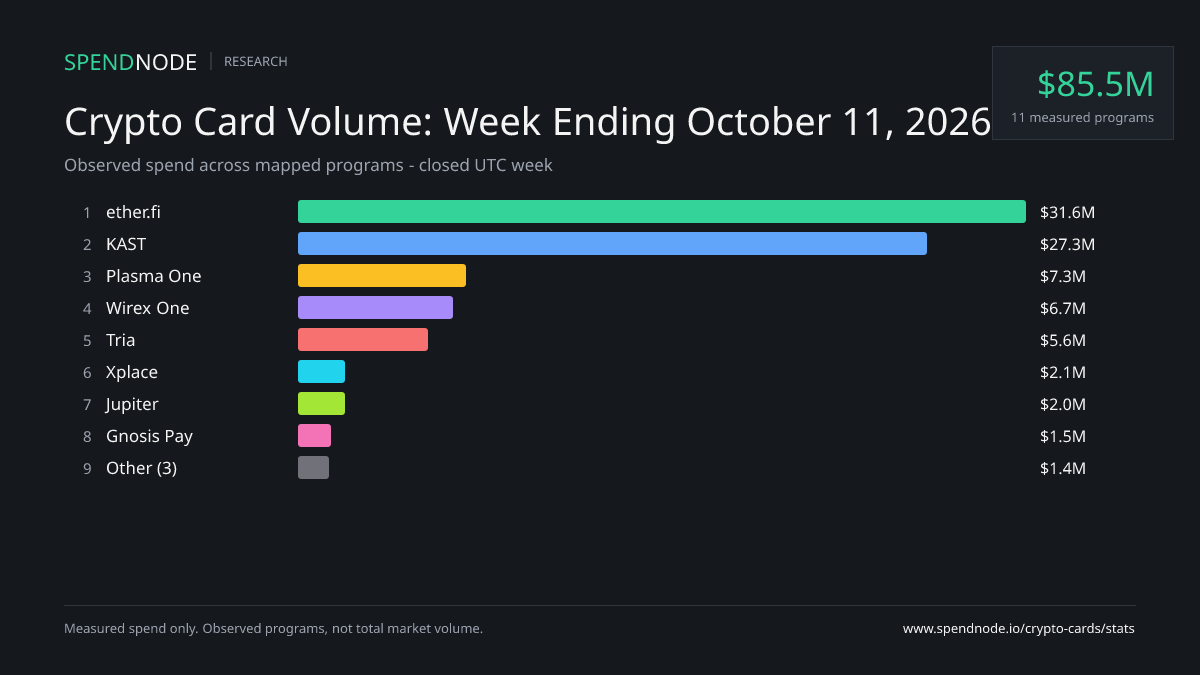
- SpendNode observed $85.50 million of crypto card spending across 11 mapped programs in the seven days through October 11, down 0.66% from the immediately preceding UTC week.
- The last three weekly closes have stayed in a narrow $85.50 million to $86.06 million range, even though the mix of programs and settlement chains changed materially.
- Seven programs grew, three declined, and Peanut was unchanged at zero. Ether.fi's $1.49 million decline was larger than the combined net gain from the rest of the measured set.
- Plasma One led programs above $1 million with 8.6% growth to $7.28 million, while its observed event count fell 75.8% after the preceding week's spike.
- Ether.fi remained first at $31.62 million and KAST remained second at $27.32 million. Together they represented 68.9% of observed spending.
The weekly close
Observed spending reached $85,498,821 between October 5 at 00:00 UTC and October 12 at 00:00 UTC. The comparison uses the same 11 programs and measurement rules as the October 4 close, so the 0.66% decline does not reflect a coverage change.
Seven programs added a combined $1.32 million. Plasma One supplied $578,517, followed by Tria at $207,193, Wirex One at $161,889, KAST at $158,827, and Jupiter at $137,997. Avici and MetaMask supplied the remainder.
Three programs declined by a combined $1.88 million. Ether.fi accounted for $1.49 million, while XPlace declined by $214,897 and Gnosis Pay by $181,151. Peanut recorded no accepted Arbitrum settlements in either week.
This was the third consecutive close near $86 million. The September 27, October 4, and October 11 totals are separated by only $564,293 from highest to lowest, but that stable headline masks different movements underneath.
Multiplying this week's observed total across 52 weeks gives about $4.45 billion. That figure shows the scale of the measured set; it is not a forecast or an estimate of the entire crypto-card market.
Measured crypto card spending held near $86 million for a third week as broader gains nearly offset lower ether.fi activity.
Ether.fi stayed first as average value fell
Ether.fi declined 4.5% to $31.62 million even as observed spend events increased 1.3% to 412,894. Average observed value per event fell from $81.21 to $76.57, leaving ether.fi first by $4.30 million over KAST.
During the week, ether.fi announced a planned branded dollar stablecoin built on Ethena's white-label platform. The companies did not publish a launch date or reserve composition. The announcement is relevant to the card's future funding and settlement design, but this report does not attribute the week's onchain movement to that news.
KAST increased 0.6% to $27.32 million across seven issuer batches. Six Solana batches carried $23.68 million, while one Ethereum batch carried $3.64 million. One week earlier, the non-Solana batch settled $4.22 million on Base.
KAST's batches are not individual purchases. Ether.fi and KAST together represented $58.94 million, or 68.9% of observed spending, down from 70.0% one week earlier.
Plasma One reversed the event-count spike
Plasma One grew 8.6% to $7.28 million, the fastest increase among programs above $1 million. Observed settlement events fell from 153,230 to 37,060 and active wallets from 20,923 to 12,504 after both counts jumped in the preceding week.
Average observed value per event rose from $43.73 to $196.44. The reversal shows why event and wallet counts cannot be read as customer acquisition without additional evidence: volume increased while both counts moved sharply lower.
Jupiter rose 7.3% to $2.03 million with an almost unchanged 21,754 observed events. Average observed value per event increased from $86.95 to $93.28, while active wallets edged down 0.8% to 9,104.
Avici recorded the largest percentage increase at 11.8%, reaching $558,898 entirely through its observed Solana route. Its five current EVM routes recorded no accepted stablecoin outflows during the window.
Wirex and Tria extended their climb
Wirex One increased 2.5% to $6.73 million. Card-debit events rose 3.2% to 111,388 and active wallets increased 3.8% to 11,499, while average observed value per event eased from $60.85 to $60.42. No unsupported currency codes appeared in the comparison week.
Tria grew 3.8% to $5.65 million across its current four-chain settlement lane and the still-active legacy Base route. Deduplicated events increased 3.1% to 60,911 and active wallets rose 4.7% to 22,223.
MetaMask increased 2.0% to $800,432 across its observed Base, Linea, and Solana deployments. Twenty-eight Base entries involving unsupported EURC were excluded rather than assigned an assumed rate.
XPlace declined 9.4% to $2.06 million as observed events fell 18.8% and active wallets fell 22.0%. Gnosis Pay declined 11.1% to $1.45 million ahead of the announced December 20 closure of its direct consumer card.
KAST moved its non-Solana batch to Ethereum
Optimism remained the largest settlement chain at $31.76 million, or 37.1% of observed spending. Solana followed at $28.55 million, or 33.4%. Plasma and Arc represented 8.5% and 7.9%.
Ethereum contributed $3.64 million after recording zero one week earlier, while Base declined from $5.92 million to $1.89 million. Most of that switch came from KAST routing its one non-Solana batch through Ethereum instead of Base.
The chain table records where mapped value settled onchain. It is not blockchain market share for all crypto cards, and issuer-batch routing can move its columns without an equivalent change in purchases.
Measurement notes
This report covers a closed seven-day UTC period. It combines purchase-level wallet debits, card-settlement events, and issuer settlement batches only where each program's public methodology labels the basis. Event counts are compared within programs and are not treated as interchangeable across different settlement designs.
Later offchain refunds and chargebacks may not return through the same onchain route, so several series are gross rather than net. KAST's seven transactions are issuer settlement batches, not seven card purchases. MetaMask's identified Monad rail and Avici's unidentified retired route remain outside coverage.
Separately, SpendNode observed $190.70 million across RedotPay's mapped top-up routes from October 1 through October 11. That figure measures recognized account funding, not spending, and is excluded from every total and ranking in this report.
The preceding week and this report are frozen snapshots. Their downloadable CSV, JSON, and chart files keep stable URLs. If stronger evidence changes a published result, SpendNode will label and date the correction rather than silently rewriting the weekly close.
Suggested citation: SpendNode Research, "Crypto Card Volume: Week Ending October 11, 2026," published October 12, 2026, https://www.spendnode.io/crypto-cards/stats/weekly/2026-10-11/.