
Key findings
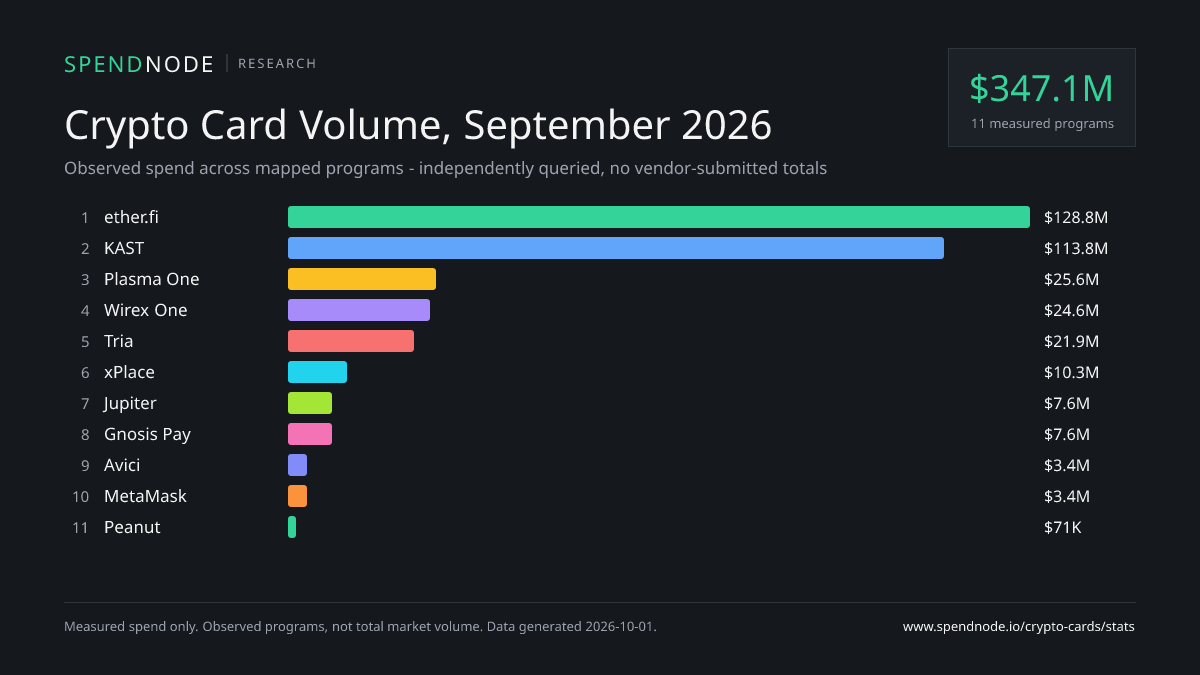
- SpendNode observed $843.9 million of crypto-card money flows onchain in September 2026: $347.1 million of measured card spending across 11 programs, plus $496.9 million of card funding at RedotPay. The two stages are measured and totalled separately; this is observed activity, not total market size.
- Measured spending rose 13.6% from August on a matching 11-program basis, and growth accelerated: the original seven-program comparison set grew 13.5% in September after 10.9% in August. Seven of the 11 programs grew. The simple annualized run rate is about $4.17 billion, a statement of scale rather than a forecast.
- Ether.fi's lifetime measured card spend reached $923.1 million since November 2024. At its September pace it is on course to cross $1 billion during October, which would make it the first program in this dataset to do so.
- Ether.fi and KAST still represented 69.9% of observed spending, and Optimism and Solana carried 69.0% of the chain mix, in the same month the oldest program in the dataset, Gnosis Pay, announced its consumer card will close in December.
- Plasma One grew 28.9% to $25.6 million, the fastest percentage increase among programs above $1 million, while its settlement-event count rose 76.3% and active settling wallets declined 5.6%.
The month in one page
September was the largest measured month in this series, and growth came on an unchanged program set. All 11 measured-spend programs now have a matching August baseline, so the 13.6% increase reflects movement inside the observed set rather than a larger coverage map. The measured total rose by $41.4 million to $347.1 million, and growth was quicker than August on a like-for-like basis: the original seven-program set grew 13.5% after 10.9% a month earlier, the only two complete matched intervals this series has produced so far.
Growth also broadened. Seven programs finished higher, led in dollars by ether.fi and KAST. Plasma One led in percentage terms among programs above $1 million, while Wirex One and Tria both crossed $20 million.
The product market was less uniform than the volume line. Ether.fi replaced its card tiers with a four-level membership system, xPlace cut cashback for Basic and newly purchased paid memberships, and Gnosis Pay announced that its direct consumer card will close in December. September was also a hard month for security: Payy confirmed an exploit it later attributed to a $1.9 million bridge loss, and Bitget, whose card sits in the wider market this report covers, disclosed an exchange hack it later put at $387.5 million. Away from the vendors, the payment networks kept building: SoFi took stablecoin settlement live on Mastercard's network for a card program expected to process more than $25 billion annually, and the Federal Reserve proposed its first stablecoin rules under the GENIUS Act.
Growth broadened across the measured set
The same 11 programs measured in August reached $347.1 million in September, up from $305.6 million. Ether.fi supplied the largest dollar increase, rising 17.6% to $128.8 million. KAST followed at $113.8 million, up 8.6%. Their combined $28.3 million increase represented 68.2% of the net growth.
Plasma One added $5.8 million and Wirex One added $4.7 million. Tria, xPlace, and Jupiter supplied another $4.2 million between them. Those gains more than offset declines at Gnosis Pay, MetaMask, Avici, and Peanut.
| Program | September volume | August volume | Net change | Change |
|---|---|---|---|---|
| ether.fi | $128.8M | $109.5M | +$19.2M | +17.6% |
| KAST | $113.8M | $104.8M | +$9.0M | +8.6% |
| Plasma One | $25.6M | $19.9M | +$5.8M | +28.9% |
| Wirex One | $24.6M | $19.9M | +$4.7M | +23.8% |
| Tria | $21.9M | $18.9M | +$3.0M | +16.1% |
| xPlace | $10.3M | $9.7M | +$0.6M | +6.4% |
| Jupiter | $7.6M | $7.1M | +$0.6M | +8.0% |
| Gnosis Pay | $7.6M | $8.3M | -$0.7M | -9.0% |
| Avici | $3.38M | $3.50M | -$0.12M | -3.5% |
| MetaMask | $3.37M | $4.01M | -$0.63M | -15.8% |
| Peanut | $0.07M | $0.11M | -$0.03M | -32.9% |
Program totals are rounded for display. KAST transactions are issuer settlement batches, not individual card purchases.
SpendNode observed $843.9 million across two onchain crypto-card ledgers in September: $347.1 million in measured card spending and $496.9 million in RedotPay funding. The report separates them because funding and spending are different stages of the same money.
At September's pace, the measured set runs at about $4.17 billion annualized. That is a simple multiplication of one month, published as a scale anchor rather than a forecast, and it covers only the programs SpendNode can observe onchain.
Activity and value moved at different speeds
Ether.fi recorded 1.59 million spend events, up 9.5%, and 48,709 active Optimism accounts, up 8.0%. Spending rose faster at 17.6%, lifting the average observed event from about $76 to $81. Onchain data establishes the change in value and activity, but not what users bought.
Plasma One showed the reverse pattern. Its measured volume rose 28.9%, while settlement events increased 76.3% to 262,698. Active settling wallets declined 5.6% to 24,804, and the average settlement event fell from about $133 to $98. These are settlement events from user accounts, not necessarily one event per retail purchase.
Wirex One reached $24.6 million across 409,035 gross merchant POS and ePOS settlements from 15,035 active wallets. Volume, events, and wallets increased by 23.8%, 23.1%, and 29.6%, respectively. Fifteen events carrying the unsupported TGB currency code were excluded rather than assigned an assumed exchange rate.
Tria reached $21.9 million even as active observed accounts declined 2.6%. Its transactions increased 6.7% and average observed value rose 8.9%. xPlace moved differently: volume rose 6.4%, events rose 36.8%, and average event value fell 22.2% to about $87.
The xPlace cashback cut did not produce an immediate volume decline
xPlace reduced cashback on September 14 for Basic and newly purchased paid memberships. Credit Mode moved to 0.5% to 2%, depending on membership, and Cash Mode moved to 0%. Paid memberships bought before the cutoff retained their prior rates for up to 12 months.
Measured September spend still rose 6.4% to $10.3 million, while events increased 36.8%. That does not prove the reward change helped or failed to hurt spending. Grandfathered memberships, transaction timing, new accounts, seasonality, and other product behavior all sit inside the same monthly total.
The useful finding is narrower: there was no immediate month-level contraction in the observed settlement series during the first partial month under the new rates. A longer post-change window is needed before drawing a behavioral conclusion.
Gnosis Pay entered its final consumer-card quarter
Gnosis Pay announced on September 21 that its direct consumer card and web app will close on December 20, 2026. New applications stopped, while Safe balances remain self-custodial and continue to have a withdrawal route after card spending ends.
The timing carries its own weight: Gnosis Pay is the oldest program in this dataset, with a measured series reaching back to December 2023, and it is leaving in the same month the measured market set a record. The contrast says nothing causal about either fact, but it marks a generational turnover in the programs this report tracks.
September measured volume declined 9.0% to $7.6 million. Transactions fell 11.7% and active wallets declined 1.6%. The closure announcement arrived late in the month, so the chain data cannot attribute the monthly decline to that decision.
The series remains in this report while the card is operational. Its December close will need a clearly bounded final measurement and should not be interpreted as an ordinary demand trend once spending stops.
Spending remained concentrated on two programs and two chains
Ether.fi and KAST generated $242.6 million, or 69.9% of the observed total. That share was slightly below August's 70.1%, even though both programs grew. The concentration ratio therefore eased because the rest of the measured set expanded a little faster in aggregate.
Ether.fi also reached a milestone of scale: its lifetime measured card spend since November 2024 now totals $923.1 million. At the September rate of $128.8 million per month, it would cross $1 billion during October, which would make it the first program in this dataset with ten figures of cumulative measured spending.
Optimism carried $129.8 million, or 37.4% of measured spend, primarily through ether.fi. Solana carried $109.8 million, or 31.7%, led by KAST and supplemented by xPlace, Jupiter, Avici, and MetaMask. Together they represented 69.0% of the observed chain mix.
KAST's $113.8 million requires special interpretation. Its 30 transactions are issuer settlement batches from observed program accounts, not 30 purchases. Solana carried $88.7 million, Ethereum $21.6 million, and Base $3.6 million. The accounts do not reveal how many cardholders made the underlying purchases.
These chain shares describe the 11 mapped programs only. They are not estimates of total crypto card market share by blockchain, and they can change when a large program changes settlement rails or becomes independently measurable.
Card funding stayed separate from card spending
RedotPay received $496.9 million across 582,320 recognized-asset top-ups on nine mapped chains, down 4.4% from August under the same scope. Tron contributed $248.8 million, BNB Chain $123.0 million, and Ethereum $84.6 million.
This is money entering observed card infrastructure, not proof that the same value was spent. The direct total excludes Bitcoin and unmapped routes, so it remains a lower bound for recognized funding rather than a company-wide total. Funding and spending are kept as separate ledgers because they can represent different stages of the same money; no ranking or growth figure in this report combines them.
Shown side by side with the split explicit, the two ledgers put September's observed crypto-card money flows at $843.9 million: $347.1 million measured as spending and $496.9 million measured as funding. The sum is not spending, unique economic activity, or total market size. Trackers that blend the two stages report larger single numbers; SpendNode publishes both parts and labels them, because a top-up and a purchase are different events.
Two September developments bear directly on this series. RedotPay said it passed a clean Big Four financial audit on September 28. It is a first-party claim: neither the auditing firm nor the report itself has been published, so it stands as a disclosed assertion rather than verifiable evidence. Earlier in the month it also added card deposits from PayPal, Wise, and Revolut, a funding-rail expansion whose fiat legs sit outside this onchain series.
September changed the product map
Several developments changed how users evaluate cards even where no matching spending series exists:
| Date | Development |
|---|---|
| Sep. 1 | Ethena Pay entered beta with a self-custodial secured Visa across 49 published countries |
| Sep. 1 | COCA's Monthly Claim Capacity terms took effect, replacing earning allowances with claim metering; on Sep. 21 it also cut the staking needed for loyalty tiers by 30% |
| Sep. 9 | Wirex said it is building GBP and AUD onchain settlement for its card, a future change to a rail this report measures |
| Sep. 10 | ether.fi published Core, Luxe, Pinnacle, and VIP membership qualification and reward schedules |
| Sep. 14 | xPlace reduced cashback for Basic and newly purchased paid memberships |
| Sep. 21 | Gnosis Pay announced its direct consumer card will close on December 20 |
| Sep. 23 | Jupiter's card began funding from any token in one transaction |
| Sep. 26 | Plasma One added 10% cashback on Eight Sleep for Platinum members |
| Sep. 30 | MEXC's 0% purchase-fee launch window closed; its stated 1% transaction fee now applies. The program still has no observable settlement rail, so it remains outside measured volume |
Entries are dated product developments. The table does not claim that any event caused a measured volume change.
Two security incidents in one month
September was the second consecutive month in which security events touched the card market, and this time there were two.
Payy confirmed an exploit on September 25 with third-party validation underway, and its September 30 post-mortem attributed the loss to a flaw in a Noir proof verifier and put the damage at $1.9 million in USDC taken through its bridge. Payy's card program is not part of SpendNode's measured set, so no spending series exists to read the incident against.
Bitget confirmed a major exchange hack on September 24, initially estimated at $351.6 million and revised to $387.5 million on September 25. Withdrawals resumed on a phased schedule from September 26, SlowMist's findings pointed to a zero-day in a third-party tool, and by September 30 investigators reported North Korea-linked actors routing the funds through cross-chain services. Bitget operates a card in the wider market this report covers, although its exchange flows are not part of the measured spending set.
Neither incident appears in the measured series, and this report draws no volume conclusion from either. The pattern worth recording is structural, and it extends August's Rain incident: card programs inherit the security surface of the exchanges, bridges, provers, and settlement providers they are built on.
The rails kept consolidating
August's infrastructure story did not pause. In September the clearest single number came from SoFi and Mastercard, which took stablecoin settlement live for SoFi's card program, expected to process more than $25 billion annually, announced September 23. Where August's Mastercard news was an acquisition, September's was a national bank putting a live card program onto the new rail.
The regulatory rail moved the same week: on September 25 the Federal Reserve proposed its first stablecoin rules under the GENIUS Act, the framework that will govern the settlement asset most cards in this report spend. In the UK, the FCA opened its crypto authorisation gateway on September 30, the application route that will shape which card programs can serve UK residents.
| Date | Development |
|---|---|
| Sep. 22 | Apple and Google posted senior stablecoin and blockchain roles; many cards in this report spend through their mobile wallets |
| Sep. 23 | SoFi went live with stablecoin settlement on Mastercard for a card program expected to process $25B+ annually |
| Sep. 25 | Federal Reserve proposed first stablecoin rules under the GENIUS Act |
| Sep. 28 | Citi partnered with Coinbase on institutional stablecoin payments |
| Sep. 30 | Binance Pay went live at PayPay merchants across Japan |
| Sep. 30 | FCA opened its crypto authorisation gateway for UK firms |
Dated to each first-party announcement; entries are developments, not measured volume events.
Stablecoin supply grew, led by assets outside USDT and USDC
Total tracked stablecoin supply rose from $307.29 billion on September 1 to $310.71 billion on October 1, an increase of $3.42 billion or 1.11%, based on DeFiLlama's daily UTC snapshots.
USDT added $0.49 billion and USDC added $0.44 billion. Other tracked stablecoins supplied the remaining $2.49 billion, or 72.8% of the net increase. The mix matters because card programs increasingly support several settlement assets, but supply growth is not evidence of card demand by itself.
| Stablecoin supply | Sep. 1 | Oct. 1 | Net change | Change |
|---|---|---|---|---|
| All tracked | $307.29B | $310.71B | +$3.42B | +1.11% |
| USDT | $183.35B | $183.84B | +$0.49B | +0.27% |
| USDC | $73.70B | $74.14B | +$0.44B | +0.60% |
| Other tracked stablecoins | $50.24B | $52.73B | +$2.49B | +4.95% |
Chain-level supply moved unevenly. Tron added $1.88 billion and Solana added $0.47 billion, while Ethereum declined by $1.02 billion and BNB Chain declined by $0.34 billion. Base added $0.12 billion.
| Stablecoin supply by chain | Sep. 1 | Oct. 1 | Net change | Change |
|---|---|---|---|---|
| Ethereum | $148.10B | $147.08B | -$1.02B | -0.69% |
| Tron | $92.06B | $93.94B | +$1.88B | +2.04% |
| BNB Chain | $17.20B | $16.86B | -$0.34B | -1.99% |
| Solana | $15.87B | $16.34B | +$0.47B | +2.98% |
| Base | $4.93B | $5.06B | +$0.12B | +2.50% |
Source: DeFiLlama daily UTC snapshots. Changes calculated by SpendNode Research from the frozen September close.
What August's watchlist produced
The August edition committed to six September watch items. Their outcomes:
- Ethena Pay opened its beta on September 1 as expected; no measurable settlement rail has been established yet.
- COCA's Monthly Claim Capacity system took effect September 1 as published, and COCA followed it with a 30% loyalty-tier staking cut on September 21.
- MEXC completed its first full operating month without an observable settlement rail, and its 0% purchase-fee window closed September 30. It remains unmeasured.
- Avici did not sustain its post-incident rebound: September volume finished 3.5% below August, with no repeat of the late-August settlement pause in the daily series.
- MetaMask's Monad rail remained outside coverage; complete archive data was still unavailable.
- First-time comparability for Wirex One, MetaMask, Avici, and Peanut arrived as planned and is reflected in this month's matched 11-program basis.
Watching October
- Ether.fi's $1 billion lifetime milestone: at the September pace, cumulative measured spend would pass $1 billion during October. If it does, we will date the crossing from the daily series.
- Gnosis Pay: the final consumer-card quarter has started. We will keep the measured series active until spending stops and label the terminal month rather than treating it as an ordinary trend.
- xPlace: October will be the first full calendar month after the September 14 cashback change, though grandfathered memberships will still complicate interpretation.
- Plasma One's settlement pattern: September's combination of 76.3% more events, fewer active wallets, and a smaller average settlement needs a second month before it reads as a trend.
- Pulsar Money: Pulsar Money joined the catalog on October 1 with Free and Pro virtual Visa plans. It is not included in September volume because no independently measurable spending rail has been established.
- Payy: the post-mortem attributes a $1.9 million USDC bridge loss to a Noir verifier flaw; the remaining questions are user restitution and the result of independent validation.
Methodology and corrections
SpendNode measures program-specific onchain activity across 11 programs. Depending on the program, the unit may be a purchase event, wallet debit, user-account settlement, or issuer settlement batch. Each row states its basis because transaction and wallet counts are not directly comparable across every program.
The September window is September 1 at 00:00 UTC through October 1 at 00:00 UTC, using an inclusive start and exclusive end. Exact raw event identities were deduplicated where adjacent collection fragments were merged. Unsupported currencies and assets were excluded rather than assigned estimated values.
This edition excludes MetaMask's identified Monad rail because complete archive data was unavailable, an unidentified retired Avici settlement route, RedotPay Bitcoin funding, later offchain refunds or chargebacks that do not return onchain, and programs without a reliable observable spending path.
The report is a frozen snapshot published October 2, 2026. We do not silently rewrite closed reports. A material correction will carry a visible dated note, while the live tracker and later reports continue with newly closed periods.
The numerical tables and downloadable CSV and JSON datasets are available under CC BY 4.0. Cite as: SpendNode Research, "State of Crypto Cards: September 2026," published October 2, 2026.
Previous edition: State of Crypto Cards: August 2026. Weekly closes: September 6, September 13, and September 20.