

Pulsar Money Crypto Cards Review 2026
Compare Pulsar Money crypto cards and review issuer terms, fees, and availability.

Prefer mobile? Scan to continue
Opens the mobile signup with your SpendNode link.

SpendNode Rating for Pulsar Money
Pulsar Money combines a working Visa Platinum, matching USD and EUR balance routes, broad published card availability, and a points system that refunds eligible purchases in USDC.
SpendNode completed KYC, received the card, and made a successful purchase. The free plan, both major mobile wallets, and 76-country coverage provide real utility, but Free rewards are only 0.5% on the first $500 and 0.25% afterward. Pro improves the first band but adds a subscription and weakens sharply beyond $1,000. Detailed disclosures help transparency; mixed custody, claim-based rewards, provider dependence, and a short operating record limit trust and product quality.
Issuer Snapshot
Editorial vendor score stays separate from user reviews. Methodology
Product Quality
3.7
Trust & Custody
3.4
Fee Transparency
4.2
Operational Reliability
3.6
Market Relevance
3.5
On This Page
Pulsar Money is a stablecoin-funded financial app with virtual USD and EUR balances, a Wirex-provided Visa Platinum card, Apple Pay and Google Pay, and Free and Pro reward plans. SpendNode completed identity verification, issued the live card, and made a successful purchase in October 2026.
What Is Pulsar Money?
Pulsar Money brings card spending, stablecoin funding, bank-transfer details, swaps, rewards, and optional DeFi features into one mobile app. The card spends from an available USD or EUR balance. You can fund USD with USDT or USDC and EUR with EURC at 1:1 without a Pulsar funding fee.
The company behind the app is Pulsar Money SRL, registered in Romania under CUI 50067481. Pulsar describes itself as the software and integration layer, not a bank, card issuer, electronic money institution, crypto-asset service provider, or custodian. Regulated and provider-operated features sit under separate terms shown before activation.
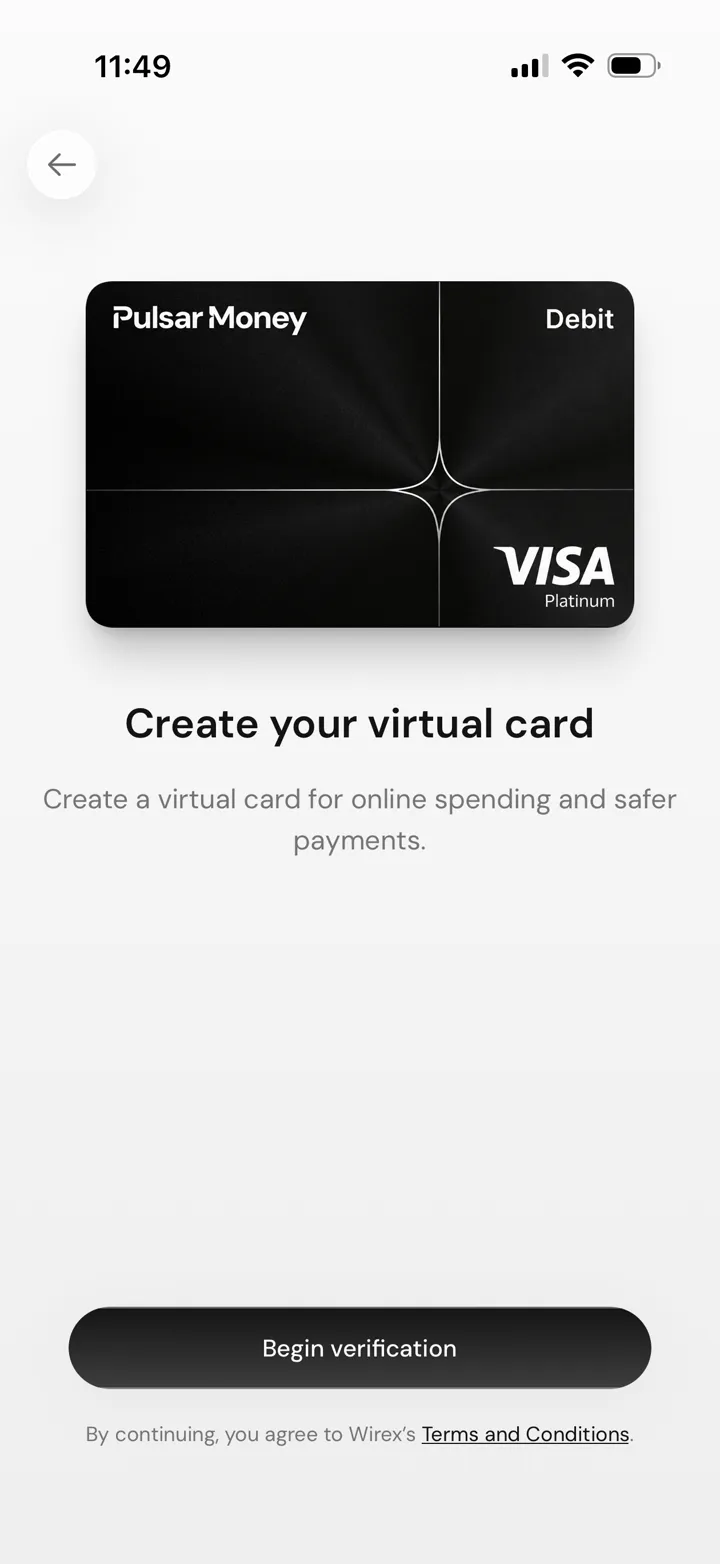
The card flow reviewed by SpendNode uses Wirex terms and produced a virtual Visa Platinum debit card. The exact Wirex Group entity and card agreement can depend on the applicant's country and the terms presented in the app.
SpendNode app screenshot
The provider is disclosed before verification. Pulsar presents the Visa Platinum card and Wirex terms before opening the identity-check flow.
Available crypto cards by Pulsar Money in October 2026
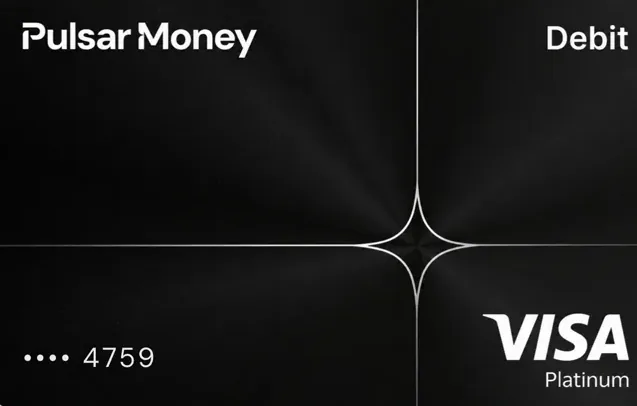
1. Pulsar Free Card
Free Virtual Visa With Tiered Pulsar Points and 1:1 Stablecoin Funding
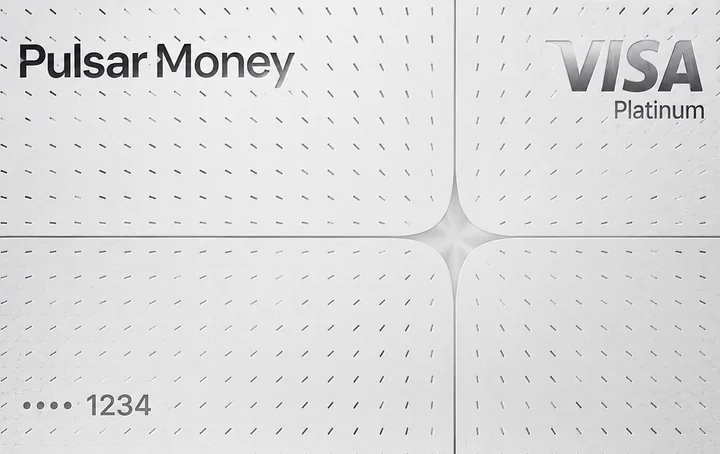
2. Pulsar Pro Card
Up to 4% in Pulsar Points With Higher Monthly Reward Bands
The Pulsar Card Lineup
Pulsar currently offers two plans:
| Plan | Price | Ordinary first reward band | Selected merchants | Main extras |
|---|---|---|---|---|
| Free | $0 | 0.5% on first $500/month | Standard points | 100 gas-sponsored swaps/month |
| Pro | $9.99/month or $99.99/year | 2% on first $1,000/month | Up to 4% through double points | 500 gas-sponsored swaps, partner offers, priority support, 0% Invest fees |
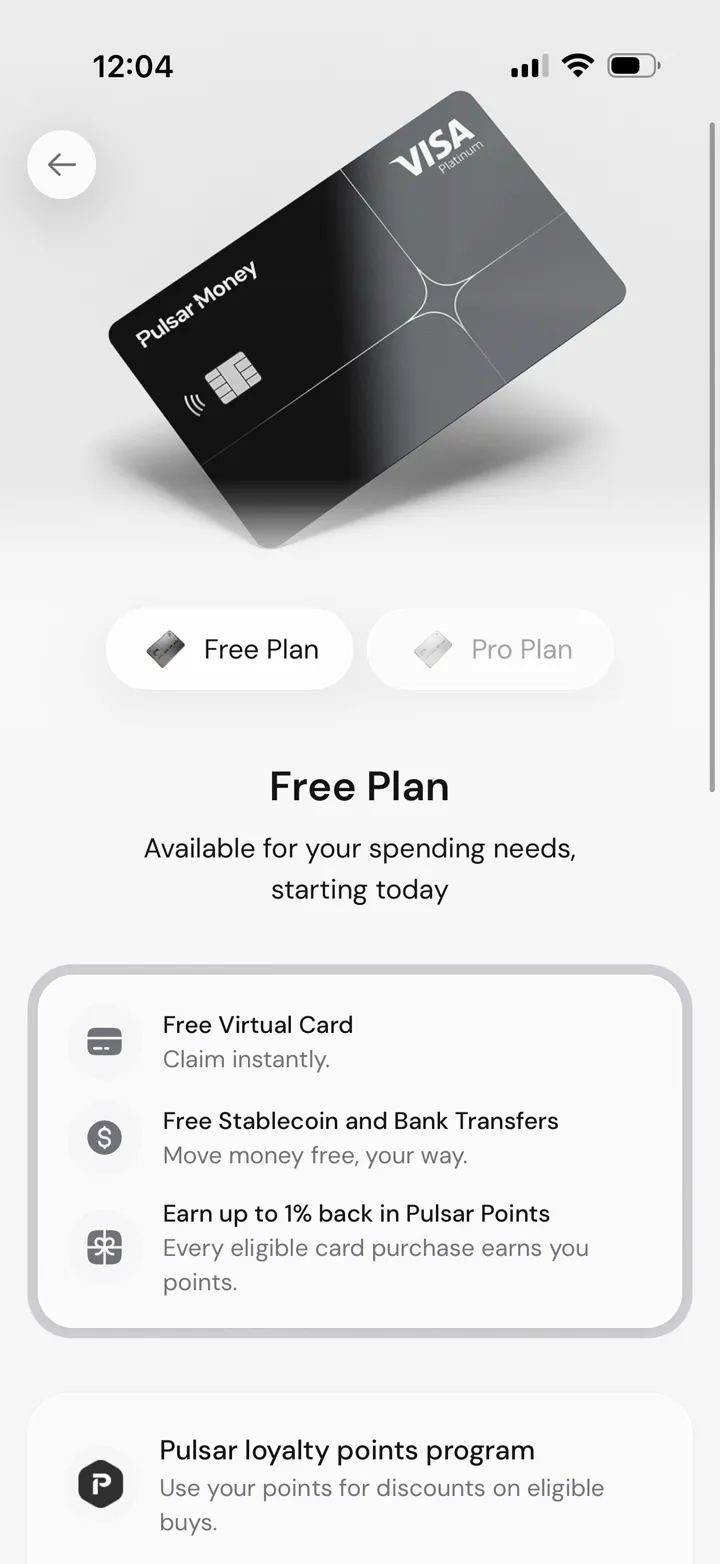
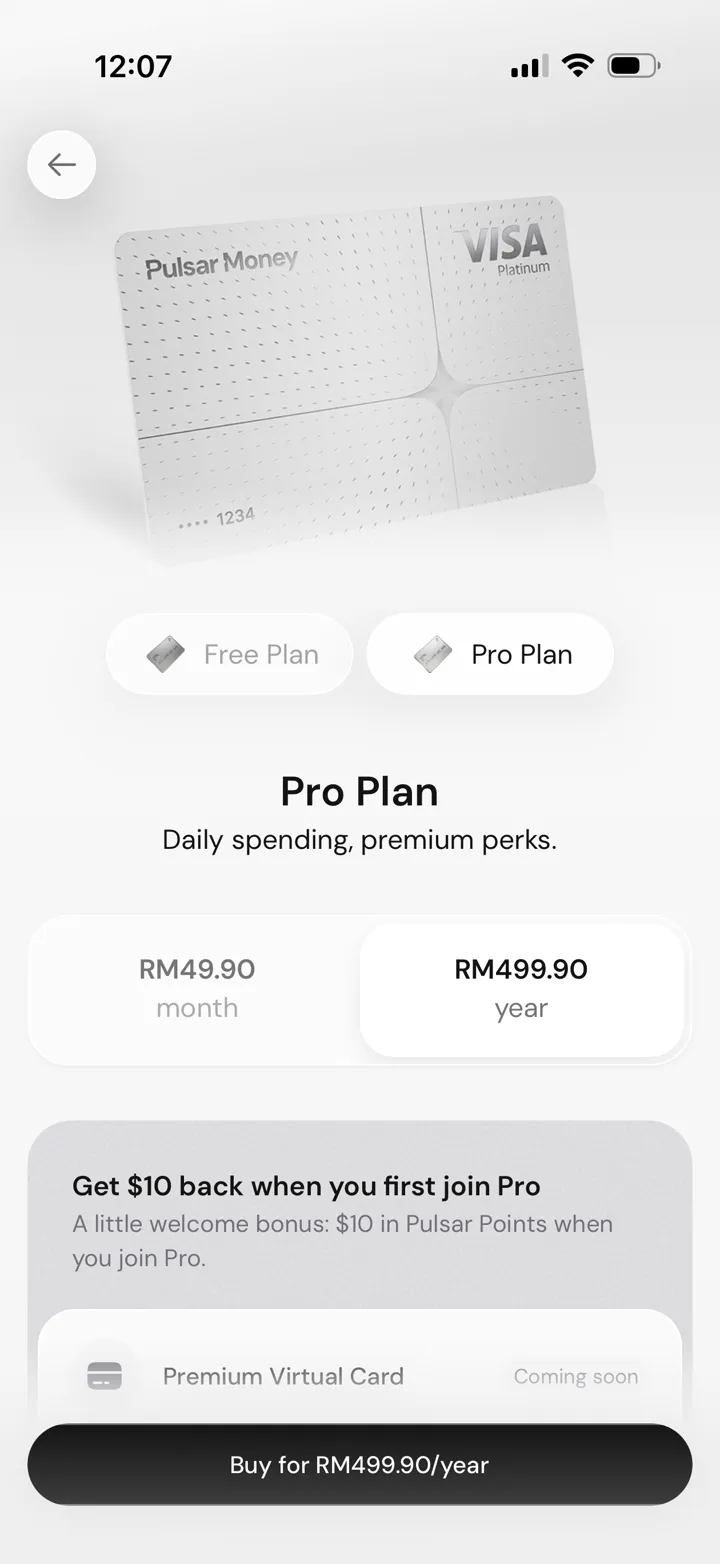
Free is a live virtual Visa plan with its own black card design. Pro is also a live paid subscription with higher reward bands and benefits. In the app reviewed by SpendNode, the separate silver Premium Virtual Card shown inside Pro was still labeled "Coming soon." The subscription does not depend on that later card design to provide its current points rates and plan benefits.
SpendNode app screenshot
Free covers the working card basics. The plan includes the virtual card, stablecoin and bank-transfer tools, and tiered Pulsar Points without a subscription.
SpendNode app screenshot
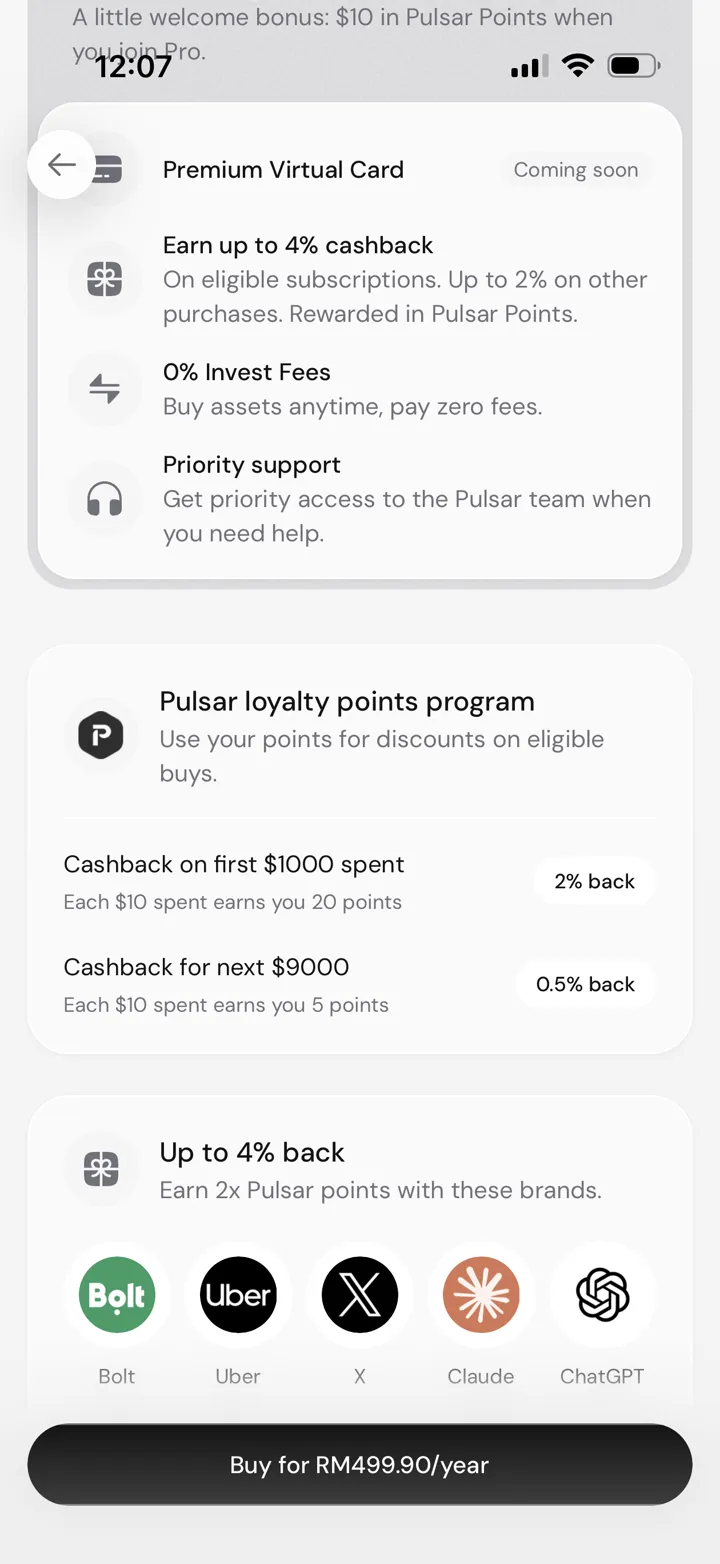
Pro is purchasable now. The Malaysian account displayed RM49.90 monthly or RM499.90 annually and a $10 reward in Pulsar Points when first joining Pro. The dedicated Premium Virtual Card is the item marked coming soon.
Pulsar Invite Code 9HVX3
Use invite code 9HVX3 when creating a Pulsar Money account to skip the queue:
- Open SpendNode's Pulsar Money link and install the app.
- Create the account and complete the initial profile steps.
- Scroll to Have an invite code? and tap Enter Code.
- Enter 9HVX3 exactly to skip the queue, then continue with verification.
The download link opens Pulsar's official store handoff. The code is entered manually inside the app, so the download link alone does not skip the queue.
How to Apply for a Pulsar Card
- Download Pulsar Money from the official download page.
- Create your account and enter invite code 9HVX3 under Have an invite code?.
- Add the personal details requested in the app.
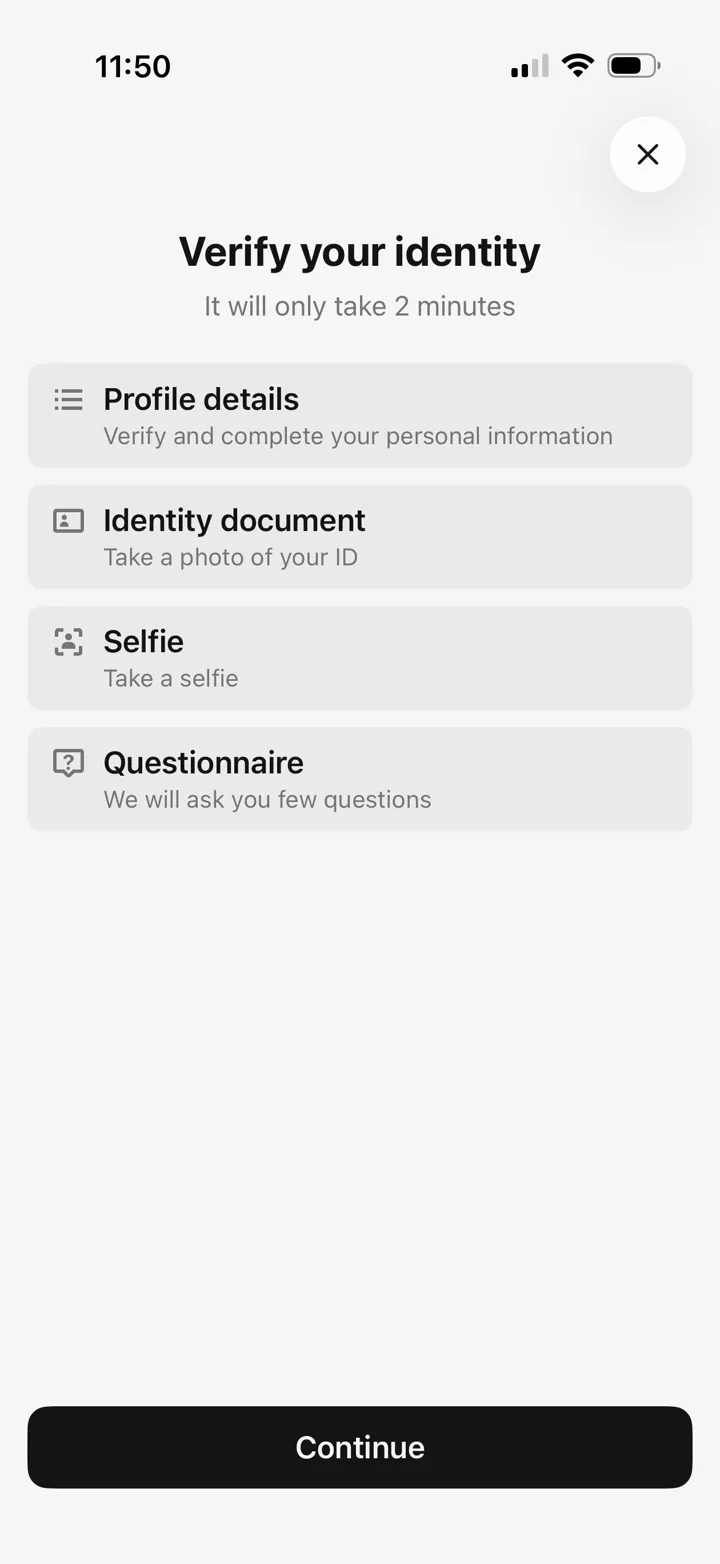
- Complete identity verification with an identity document, selfie, and compliance questionnaire.
- Open the Card section and review the Wirex terms, fees, limits, and provider disclosures assigned to the account.
- Issue the virtual card and set an appropriate daily spending limit.
- Fund the matching USD or EUR balance, then add the card to Apple Pay or Google Pay.
SpendNode app screenshot
Four checks are shown up front. Card access requires KYC rather than a wallet-only signup.
SpendNode app screenshot
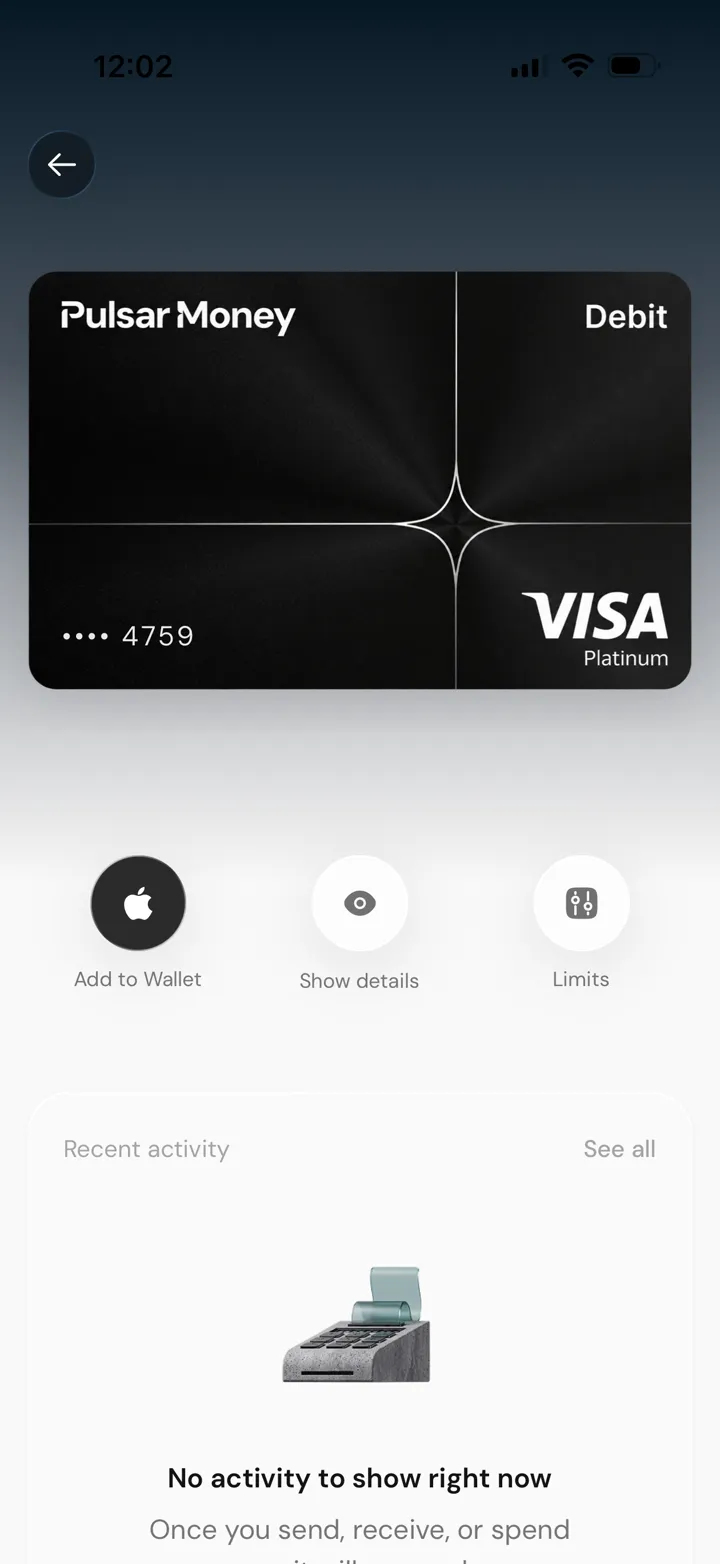
The issued card is usable from the app. The reviewed account exposed Apple Wallet setup, card details, a daily-limit control, and recent activity.
How Spending Works
Pulsar separates the display currency from the underlying funding route. A USD balance can be funded with supported USDT or USDC, while EUR can be funded with EURC. The card then spends from the available balance associated with the transaction.
Same-currency spending is the cleanest route. A USD purchase paid from USD, or a EUR purchase paid from EUR, carries no Pulsar FX fee. If the merchant currency does not match the spending balance, Pulsar lists a 1% FX fee. Provider or network conversion can still affect the final rate.
Pulsar supports stablecoin deposits over supported EVM networks, Solana, and TRON. The app shows the networks available for each asset. Direct ETH funding and ETH card spending are not currently supported.
Rewards and Cashback
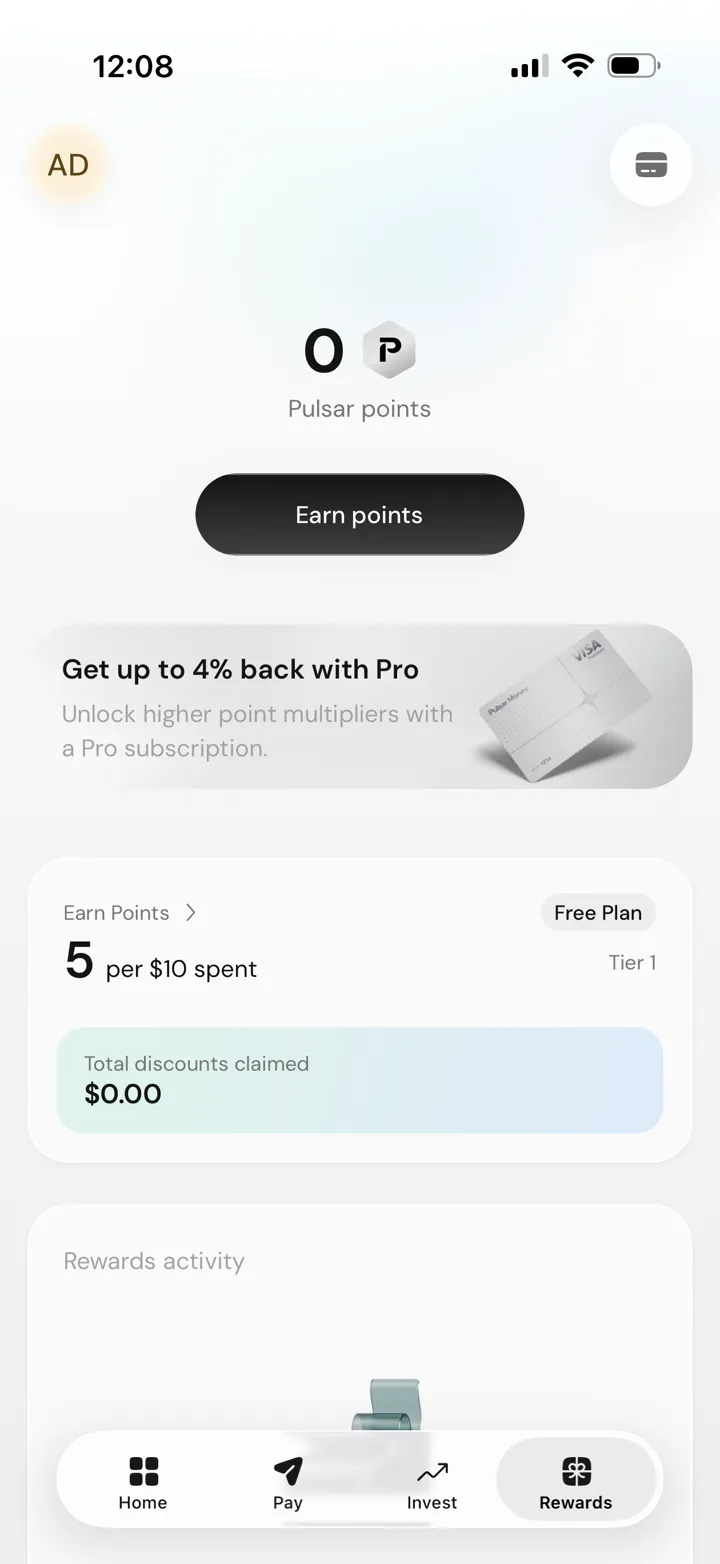
Pulsar calls its reward unit Pulsar Points. The percentage language describes the earning value, but points are not deposited automatically as cash after every purchase. You use them to claim a refund against a completed eligible transaction, and Pulsar sends that refund in USDC.
| Refund selected | Points required per $1 refunded |
|---|---|
| 25% of purchase | 100 |
| 50% of purchase | 100 |
| 75% of purchase | 112 |
| 100% of purchase | 125 |
The 25% and 50% options preserve the cleanest point value. Using points for a 75% or 100% refund consumes more points per dollar.
The purchase must generally be under 30 days old, between $0.50 and $200, completed, not refunded, and not claimed previously. ATM activity, transfers, swaps, peer-to-peer payments, and canceled or declined transactions do not earn standard purchase points.
SpendNode app screenshot
Rewards require a claim. The dashboard tracks earning and lets the user select an eligible purchase for a USDC refund.
Fees and Rates
| Cost | Current Pulsar term |
|---|---|
| Personal account opening | $0 |
| Free plan | $0 |
| Pro | $9.99/month or $99.99/year |
| Virtual-card issuance | $0 |
| Same-currency card spending | 0% Pulsar FX fee |
| Cross-currency card spending | 1% Pulsar FX fee |
| Stablecoin funding | 0% Pulsar funding fee |
| In-app swap | 1.25% |
Gas-sponsored swaps remove an eligible blockchain network charge; they do not remove Pulsar's 1.25% swap fee. Free includes 100 sponsored swaps per month and Pro includes 500 where available.
Pulsar publishes ATM pricing, including a free monthly allowance followed by a percentage charge. The card reviewed by SpendNode is virtual, so that schedule should not be read as confirmation of current cash access for this account.
Is Pulsar Pro Worth It?
Pro changes the first two monthly reward bands materially:
| Monthly eligible spend | Free reward value | Pro ordinary reward value |
|---|---|---|
| First $500 | 0.5% | 2% |
| $500-$1,000 | 0.25% | 2% |
| $1,000-$10,000 | 0.25% | 0.5% |
| Above $10,000 | 0.25% | 0.25% |
Using ordinary rewards only and the annual price of $99.99, Pro reaches approximate reward break-even against Free at about $548 of eligible monthly spending. The monthly $9.99 option reaches break-even at roughly $642 per month. Both calculations assume the reward bands reset monthly and points are redeemed at the 100-points-per-dollar rate.
Selected merchants can move the result in Pro's favor. The reviewed app named Bolt, Uber, X, Claude, and ChatGPT among double-points partners. Those purchases can earn up to 4% inside the applicable first band.
SpendNode app screenshot
Four percent is a merchant rate. Ordinary first-band spending earns 2%; selected partners receive the multiplier that produces the 4% headline.
Funding, Swaps and Transfers
Pulsar supports three practical balance routes:
- Fund USD with USDT or USDC.
- Fund EUR with EURC.
- Receive supported bank transfers into available USD or EUR account details where that service is offered in the user's country.
Card eligibility does not automatically include both bank-account products. Pulsar publishes separate country lists for cards, US ACH details, and EU SEPA details. A country can qualify for the card while lacking one or both bank-transfer services.
Limits and Restrictions
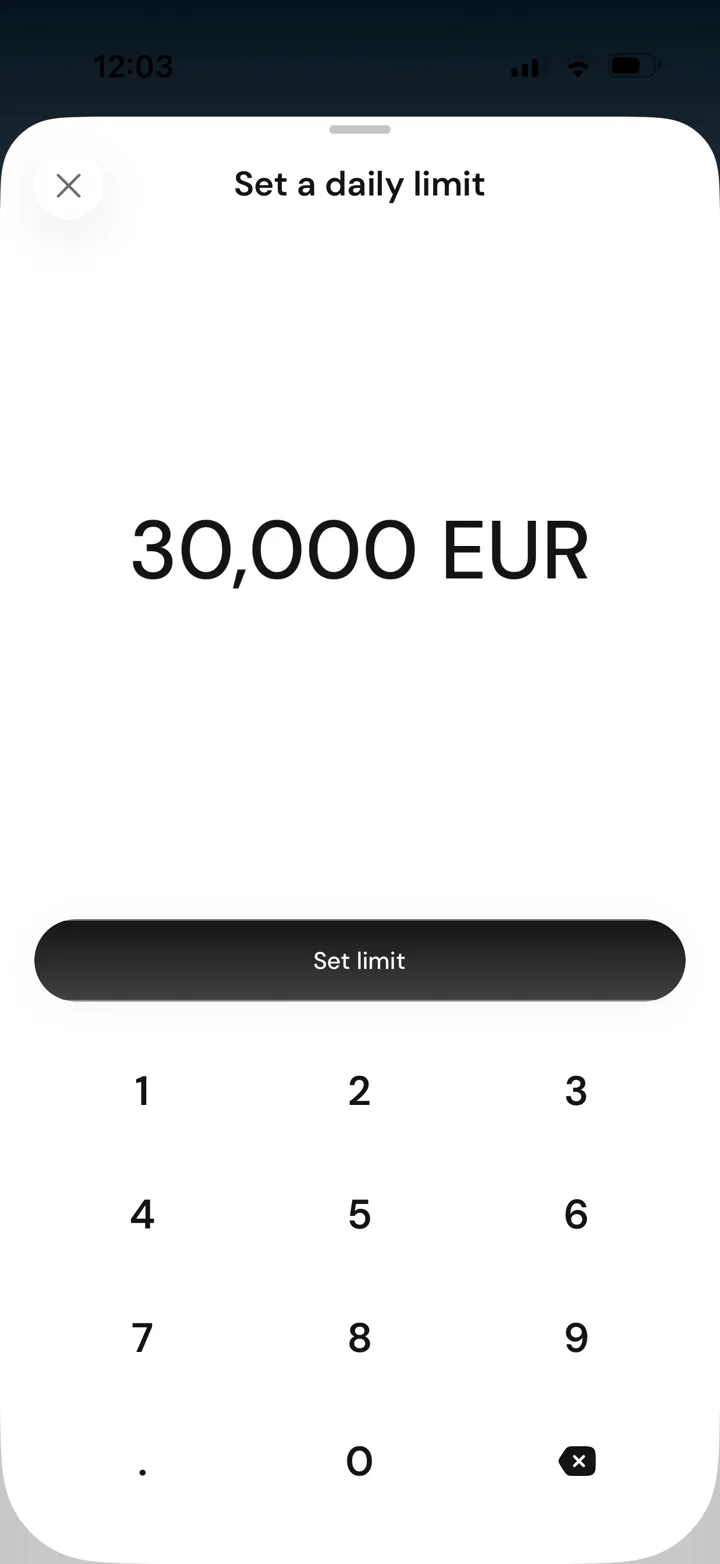
The Malaysian account tested by SpendNode allowed the daily card limit control to be set as high as EUR 30,000. Pulsar's help material also refers to a $30,000 card limit. Treat that as an upper account-level setting, not a guarantee for every applicant.
SpendNode app screenshot
Limits are account-specific. The reviewed account exposed a 30,000 EUR ceiling, but compliance, currency, provider, and transaction controls can produce a lower practical limit.
Countries and Availability
Pulsar Money is available in 76 countries as of October 2026. We count a country here when at least one active Pulsar Money card variant lists it, so individual product pages may be narrower.
Available Regions
Africa
Ghana (GH), Kenya (KE), Nigeria (NG), South Africa (ZA), Uganda (UG)
Americas
Argentina (AR), Brazil (BR), Chile (CL), Colombia (CO), Ecuador (EC), El Salvador (SV), Mexico (MX), Panama (PA), Peru (PE), United States (US)
Asia
Azerbaijan (AZ), Bahrain (BH), Georgia (GE), Hong Kong (HK), Indonesia (ID), Israel (IL), Japan (JP), Kazakhstan (KZ), Macau (MO), Malaysia (MY), Oman (OM), Philippines (PH), Saudi Arabia (SA), South Korea (KR), Taiwan (TW), Thailand (TH), Turkey (TR), United Arab Emirates (AE), Uzbekistan (UZ), Vietnam (VN)
Europe
Andorra (AD), Austria (AT), Belgium (BE), Bulgaria (BG), Croatia (HR), Cyprus (CY), Czech Republic (CZ), Denmark (DK), Estonia (EE), Finland (FI), France (FR), Germany (DE), Gibraltar (GI), Greece (GR), Guernsey (GG), Hungary (HU), Iceland (IS), Ireland (IE), Isle of Man (IM), Italy (IT), Jersey (JE), Latvia (LV), Lithuania (LT), Luxembourg (LU), Malta (MT), Moldova (MD), Monaco (MC), Montenegro (ME), Netherlands (NL), Norway (NO), Poland (PL), Portugal (PT), Romania (RO), Slovakia (SK), Slovenia (SI), Spain (ES), Sweden (SE), Switzerland (CH), Ukraine (UA), United Kingdom (GB)
Oceania
Australia (AU)
Major Restricted Markets
These major markets are not currently listed for this vendor. Confirm eligibility with the issuer before applying, especially where card tiers have different country rules.
Africa
Egypt (EG)
Americas
Canada (CA)
Asia
China (CN), India (IN), Singapore (SG)
Oceania
New Zealand (NZ)
Singapore appears on Pulsar's ACH list but not its card list. Availability also depends on residence, identity verification, compliance checks, and provider coverage. Being listed means residents can apply; it does not guarantee approval.
Security, Custody and Providers
Pulsar's custody model is best described as hybrid. The app can include a user-linked wallet with Privy authentication, while card spending can involve a provider balance or provider-controlled smart account with its own debit and conversion permissions. The exact control model is disclosed in the relevant Feature Schedule and provider terms.
This is more precise than calling the entire product custodial or self-custodial. Wallet assets can remain beneficially owned by the user, while the card balance and regulated payment functions depend on the named provider.
Use a unique password or passkey, keep device biometrics enabled, verify the network before every stablecoin deposit, and maintain only the spending balance needed for near-term use.
Is Pulsar Money Safe?
Pulsar publishes unusually detailed role and feature disclosures for a young app. Its terms distinguish the app operator, card provider, wallet, provider balance, smart account, stablecoins, and DeFi vaults instead of presenting them as one insured account.
Those disclosures do not remove provider or smart-contract risk. Card availability depends on Wirex infrastructure and the assigned issuing arrangement. Stablecoins are not bank deposits, and the separate Earn feature uses DeFi strategies whose principal, liquidity, and return are not guaranteed.
Is Pulsar Money a Scam?
We found no basis to describe Pulsar Money as a scam. SpendNode downloaded the live app, completed its identity process, accepted the card flow, received a Visa Platinum, and completed a successful purchase. Current plan prices, reward bands, fees, card controls, and the $10 Pro points offer were visible in the account.
The product is still early. Users should save the provider terms accepted during activation and test a small purchase before moving a larger balance into the app.
Who Should Use Pulsar Money?
Free fits someone who wants a no-subscription virtual Visa, already receives USDT, USDC, or EURC, and values mobile-wallet spending more than a large cashback rate. It works best when funding and spending remain in the same reference currency.
Pro fits a regular spender who can use the first 2% band every month, shops with the double-points merchants, or values its support, community, partner, and Invest benefits. A light spender who will not redeem points consistently should stay on Free.
Pulsar Money vs Other Cards
Solid starts at a higher card reward and uses a more clearly self-custodial Safe account. Pulsar offers USD and EUR balance routes and publishes broader card-country coverage.
Plasma One offers higher headline rewards and a self-custodial spending model. Pulsar's Free tier has simpler entry economics and does not require a token lock.
Pionex is a custodial exchange card with yield on its USDT card balance. Pulsar separates wallet, account, and provider roles more carefully and supports both USD- and EUR-linked funding routes.
Pulsar Money Verdict
Pulsar's case rests on a free virtual Visa, matching USD and EUR balance routes, stablecoin funding without a Pulsar loading fee, and published country coverage. The cashback number alone misses most of the product.
Free is the sensible default. Pro becomes credible around the mid-hundreds of dollars in monthly eligible spending and improves further when selected double-points merchants overlap with the user's normal expenses. The claim-based points system needs attention, but Pulsar explains enough of the mechanics to calculate the value before paying.
Sources and Verification
- Pulsar Money Pricing and Fees
- Pulsar Points Explained
- Pulsar Pro
- Purchases Eligible for Pulsar Points
- Pulsar Money Supported Countries
- Pulsar Money Terms and Conditions
- SpendNode app review, identity verification, card issuance, plan screens, and successful purchase completed October 1, 2026
Reward calculations assume eligible settled purchases, the published monthly bands, and redemption at 100 points per $1 refunded. Rates, partners, country access, and account limits can change.
Written by Aleksandar Dukic
Frequently Asked Questions
Are Pulsar Money crypto cards available in the United States?
Yes. Pulsar Money crypto cards are available in the United States.
What is Pulsar Money?
Pulsar Money is a mobile financial app for stablecoin-funded USD and EUR balances, card spending, transfers, swaps, rewards, and optional DeFi features. SpendNode completed identity verification, received the live virtual Visa Platinum, and made a successful purchase in October 2026.
Which countries support the Pulsar Money card?
Pulsar publishes a positive list of 76 card-eligible countries and territories across Europe, Asia, the Middle East, Latin America, Africa, Australia, the United Kingdom, and the United States. Card coverage is separate from Pulsar's ACH and SEPA account-detail coverage.
Is Pulsar Money self-custodial?
Pulsar is best classified as hybrid custody. The app can include a user-linked wallet, while card spending can use a provider balance or provider-controlled smart account under the Feature Schedule and provider terms shown during activation.
What is the Pulsar Money invite code?
The SpendNode Pulsar Money invite code is 9HVX3. Open SpendNode's Pulsar Money link, install the app, create an account, tap Have an invite code?, and enter 9HVX3 manually to skip the queue.
Who provides the Pulsar Money card?
The card flow reviewed by SpendNode used the applicable Wirex Group terms and issued a virtual Visa Platinum debit card. The exact provider entity and agreement can depend on the applicant's country and the terms shown before activation.
User Reviews
Reviews are moderated and may take a moment to appear.