


SpendNode Rating for Pionex
Pionex combines a mature trading platform with a practical USDT card, automated bots, balance yield, and broad account availability outside its restricted markets.
The card was verified through the live Pionex app, and the combination of no issuance or annual fee, hourly balance yield, clear in-app limits, and mobile-wallet support strengthens product quality and reliability. Exchange custody and regional programme differences prevent a higher trust or transparency score, while Pionex's established trading business keeps the issuer relevant.
Issuer Snapshot
Editorial vendor score stays separate from user reviews. Methodology
Product Quality
4.2
Trust & Custody
3.5
Fee Transparency
3.8
Operational Reliability
4.2
Market Relevance
4.0
On This Page
Pionex is a custodial cryptocurrency exchange with built-in trading bots and a USDT-funded card inside its mobile app. SpendNode opened and tested the card from Malaysia. Our account received a virtual Mastercard with no issuance or annual fee, a disclosed 1% transaction fee, up to 1% cashback, and 5% annualized yield on the card balance.
What Is Pionex?
Pionex combines an exchange, automated trading tools, Earn products, and card spending in one custodial account. Cardholders move USDT into a separate card balance, then pay online or through a supported mobile wallet.
The exact card is assigned by account and region. Pionex's public material covers Visa, Mastercard, DogPay, Gold, Family, VIP, and corporate programmes with different fees and benefits. Your app is the final source for the network and terms offered to you.
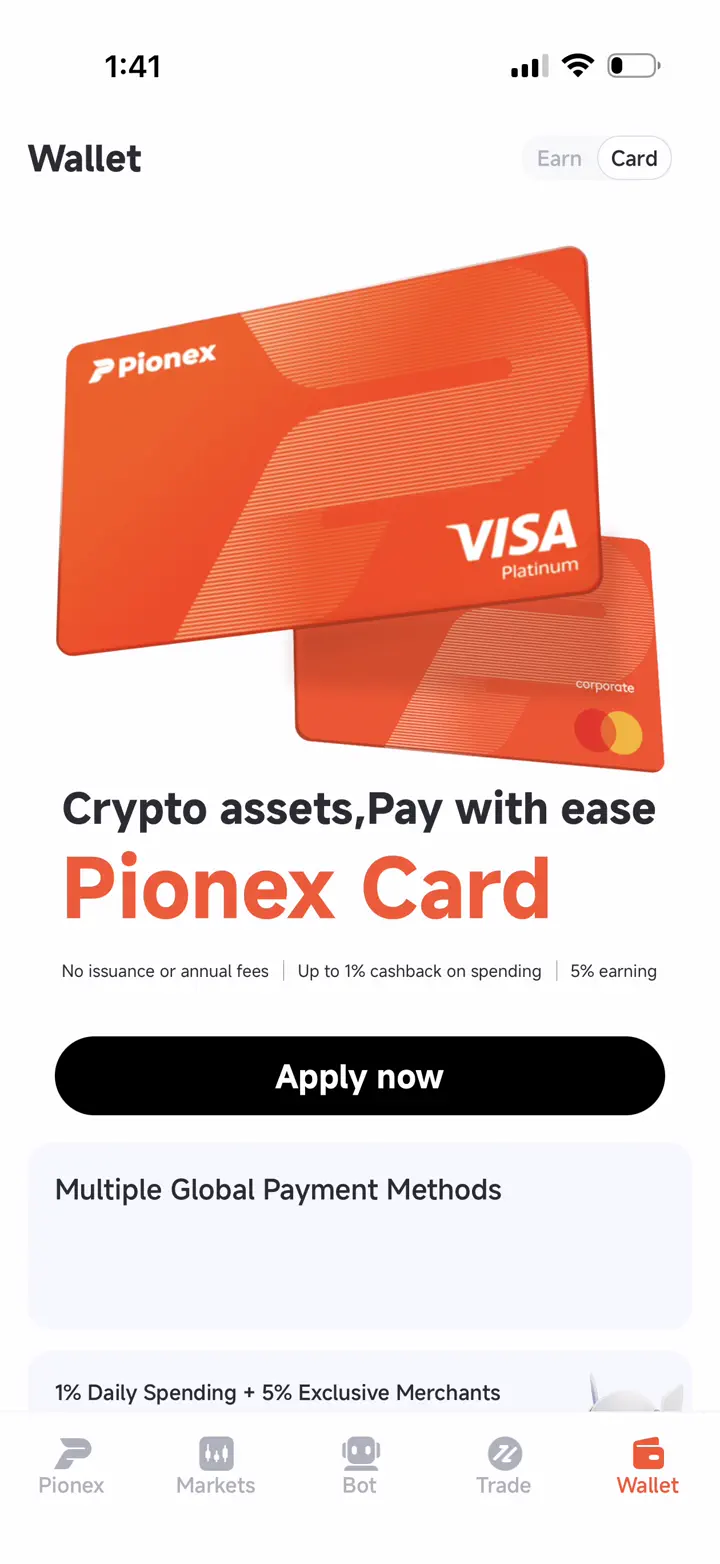
SpendNode app screenshot
What we verified. Pionex markets several card arrangements inside one app. The reviewed account ultimately received a virtual Mastercard even though the application screen also displayed Visa artwork.
Available crypto cards by Pionex in September 2026
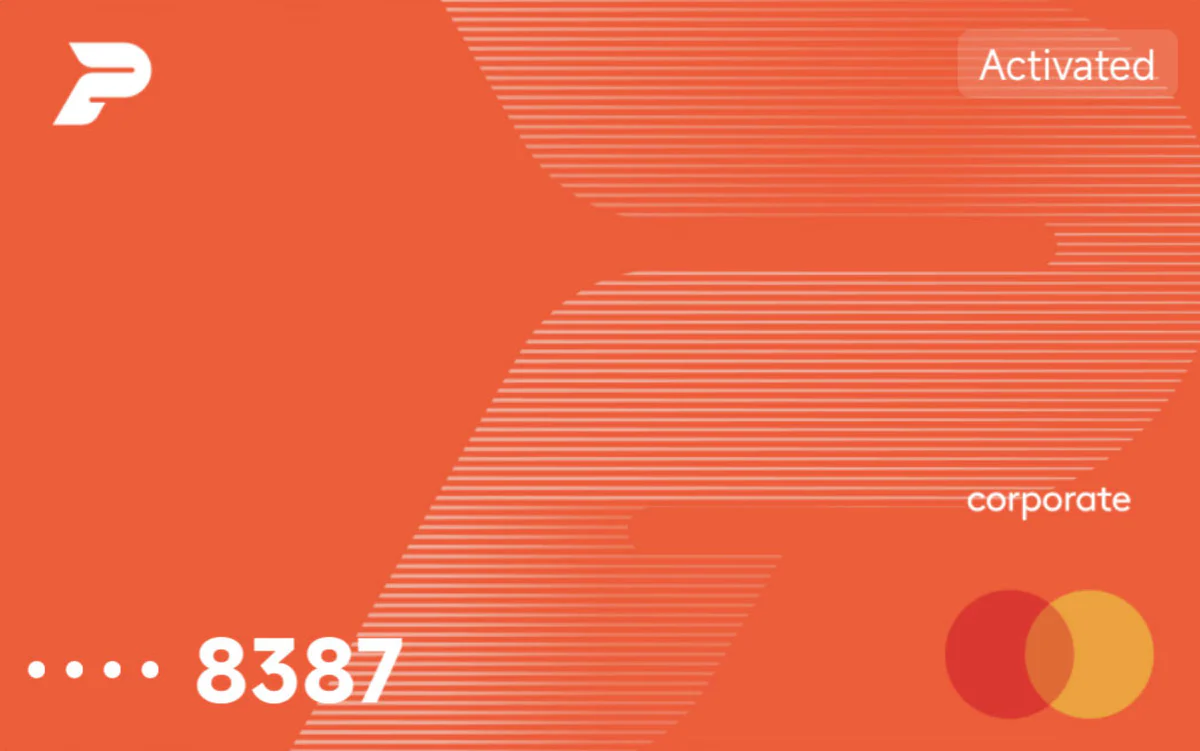
1. Pionex Card
Virtual USDT Mastercard With Up to 1% Cashback and 5% Annualized Yield
Pionex Signup Code 0NFnwXJiZGk
Open SpendNode's Pionex signup link or enter 0NFnwXJiZGk during registration. The current signup arrangement gives referred users up to a 15% rebate on spot trading fees and 10% on manual futures and futures-bot fees.
The code applies to eligible trading fees; card rewards follow the terms shown in your account. Pionex controls eligibility and the rates attached to each account.
How to Use Pionex Signup Code 0NFnwXJiZGk
- Open SpendNode's Pionex signup link. The tracked link passes code 0NFnwXJiZGk into the registration flow.
- Create your Pionex account with your email address or phone number.
- If Pionex displays a referral-code field, confirm that 0NFnwXJiZGk is present before completing registration.
- Finish identity verification. Card access and the exact programme offered are determined after Pionex verifies the account and region.
- Eligible spot and futures trading-fee rebates apply under Pionex's referral terms. The code does not replace or increase the card's own cashback rate.
The Pionex Products Behind the Card
The card is not a standalone wallet. It sits inside the Pionex exchange account alongside trading bots, spot and futures markets, Earn products, and a separate Card balance. Card access and the advertised yield both require accepting Pionex custody.
Pionex also uses the same brand for multiple card programmes. A generic Pionex article may be accurate for a Visa or DogPay account while being wrong for the Mastercard issued to someone else. We treat the in-app card agreement and card number as the controlling evidence.
The Mastercard We Verified
SpendNode completed the application and received a virtual Mastercard with number prefix 5240 1394. It had no issuance or annual fee and showed the following account-level terms:
| Item | SpendNode-reviewed account |
|---|---|
| Funding asset | USDT |
| Issuance fee | $0 |
| Annual fee | $0 |
| Transaction fee | 1% |
| Base cashback | Up to 1% |
| Card-balance yield | 5% annualized, accrued hourly |
| Per transaction | 10,000 USDT |
| Daily spend | 10,000 USDT |
| Monthly spend | 50,000 USDT |
| Physical card | Not offered on this account |
| Mobile wallets | Apple Pay and Google Pay |
Other Pionex Card Programmes
- Visa: a separate fee schedule and physical-card rollout appear in Pionex's help material.
- DogPay Mastercard: a selected-region virtual programme with its own fee and cashback schedule.
- Pionex Gold Card: an invite-only promotional tier with different pricing and reward caps.
- Family Card: a supplementary Visa feature for eligible primary cardholders.
- VIP benefits: selected qualifying users may receive Priority Pass access.
- Corporate card: a separate KYB product for businesses.
Seeing one of these products in an article does not mean it is available to your account.
How to Apply for the Pionex Card
The application sits inside the Pionex app rather than on a separate card website. This was the flow in the Malaysian account SpendNode tested:
- Create and verify a Pionex account. Register through the signup link above, then complete Pionex identity verification.
- Open the Card area. The app shows the card programme available to your account. Do not assume the Visa, Mastercard, DogPay, or physical-card terms shown elsewhere apply until the app identifies your offer.
- Meet the application balance requirement. Our account needed at least 10 USDT in total Pionex assets before it could apply. Pionex says the threshold can vary by region, and some users may be asked for 100 USDT. This is an eligibility balance, not an application charge.
- Submit the card application. Confirm the network, fees, reward terms, and limits shown in the app before accepting. Our account received a virtual Mastercard.
- Activate the spending balance. Move at least 10 USDT into the separate card balance. Trading-account assets are not spent automatically, and the card has no overdraft.
- Add the card to a mobile wallet. The reviewed Mastercard supported Apple Pay and Google Pay. Keep a small balance buffer because merchants can place temporary verification charges.
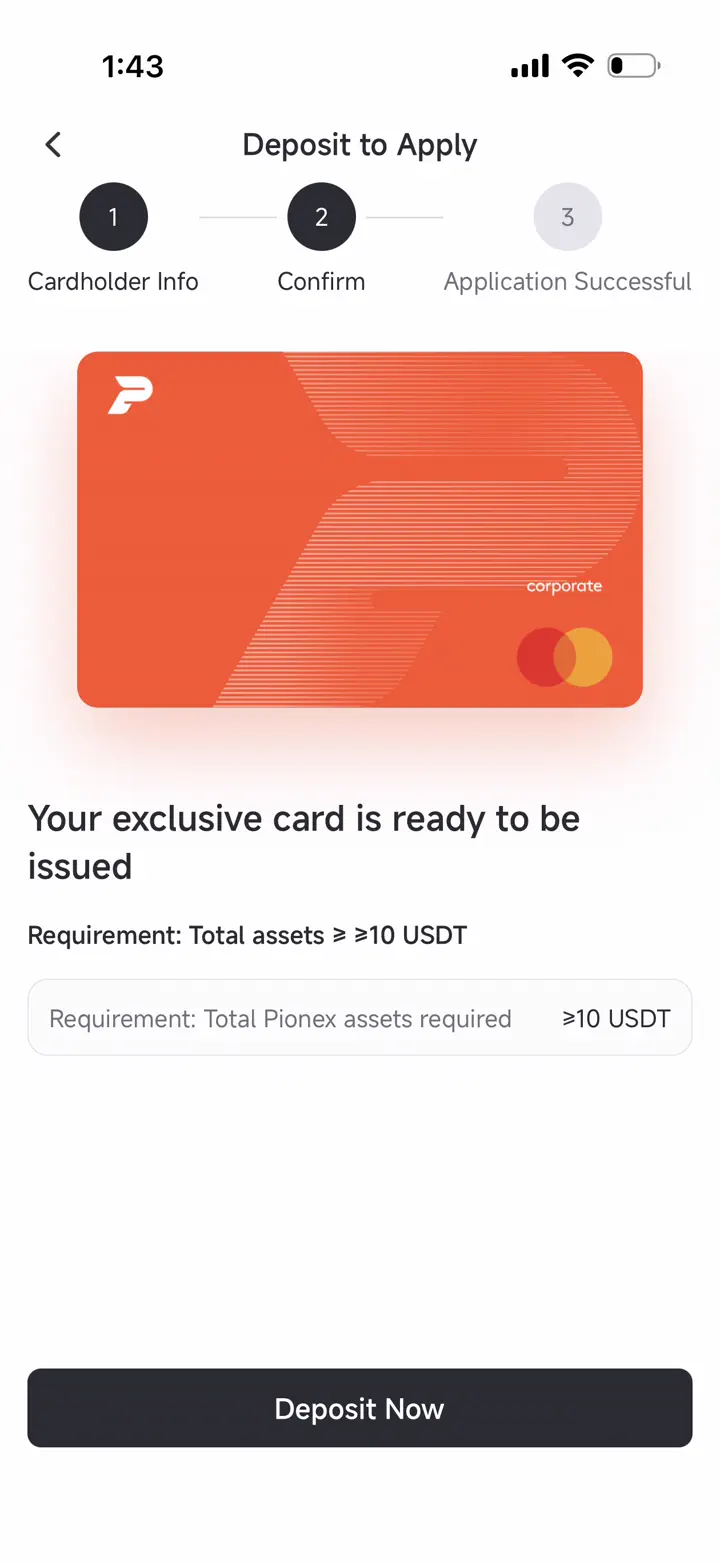
SpendNode app screenshot
Application threshold. Our Malaysian account was asked to hold at least 10 USDT before the card could be issued. The amount remained part of the account balance.
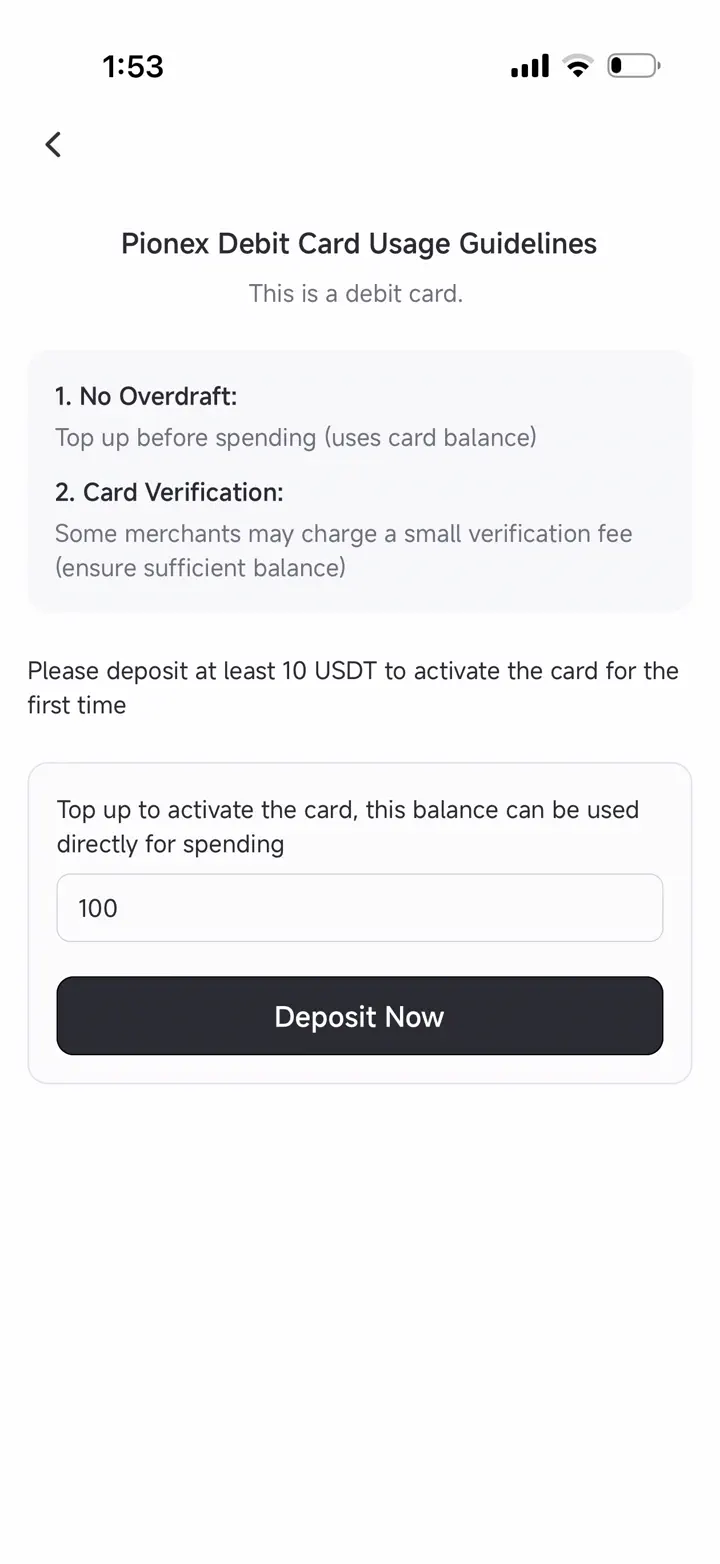
SpendNode app screenshot
Separate spending balance. The app required an initial deposit of at least 10 USDT to activate spending. Merchant verification charges can also require a small balance buffer.
How Spending Works
USDT must be available in the dedicated card balance before a purchase. The payment network converts the merchant charge, Pionex deducts the resulting amount plus the applicable transaction fee, and eligible cashback is credited separately.
Cashback does not reduce the amount authorized at checkout, and a maximum 1% reward does not prove that the conversion itself occurred at the mid-market rate.
Fees and Our MYR Test
Pionex disclosed a 1% transaction fee for the Mastercard issued to our account. It did not itemize a separate FX fee for that card.
SpendNode then made a MYR purchase to measure the total result:
| Test input | Result |
|---|---|
| Merchant charge | MYR 29.30 |
| Card deduction | USD 7.3629 |
| Online reference rate at test | MYR 4.08 per USD |
| Mid-market-equivalent cost | About USD 7.1814 |
| Observed difference | About USD 0.1815 |
| Total observed cost above reference | About 2.53% |
The 2.53% is the all-in result of one Malaysian-account transaction, including the disclosed 1% transaction fee and the remaining conversion difference. It is not evidence that Pionex publishes a 2.53% FX fee, and it should not be applied universally to every network, region, currency, or settlement date.
Cashback and Merchant Offers
Base card rewards are advertised as up to 1% on eligible spending. That wording is not a guarantee that every payment receives 1%. Refunds, reversals, excluded merchant categories, and programme-specific rules can reduce or remove the reward.
The app also presents merchant offers separately. The Trip.com screen we reviewed showed 5% for hotels, 0.5% for flights, and category-specific rates for trains, packages, activities, rentals, and cruises. Payment was estimated to take one to three months.
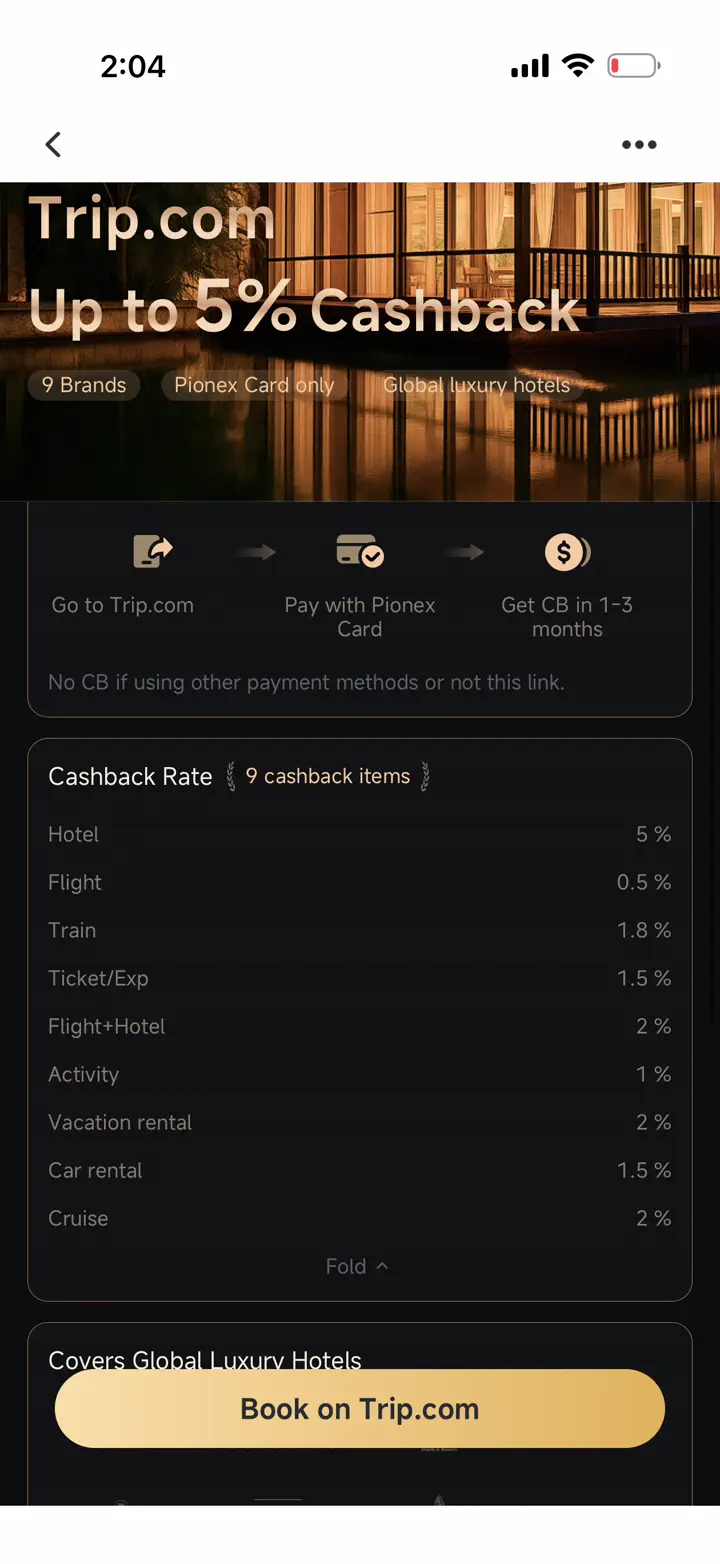
SpendNode app screenshot
Partner offer, not the base rate. The 5% headline applies to qualifying hotel bookings through Pionex's route. Flights showed 0.5%, and other travel categories had their own rates.
The 5% Card-Balance Yield
The reviewed card balance advertised 5% annualized yield, paid hourly. This is the clearest reason an existing Pionex user might keep a spending float on the card instead of topping up immediately before each purchase.
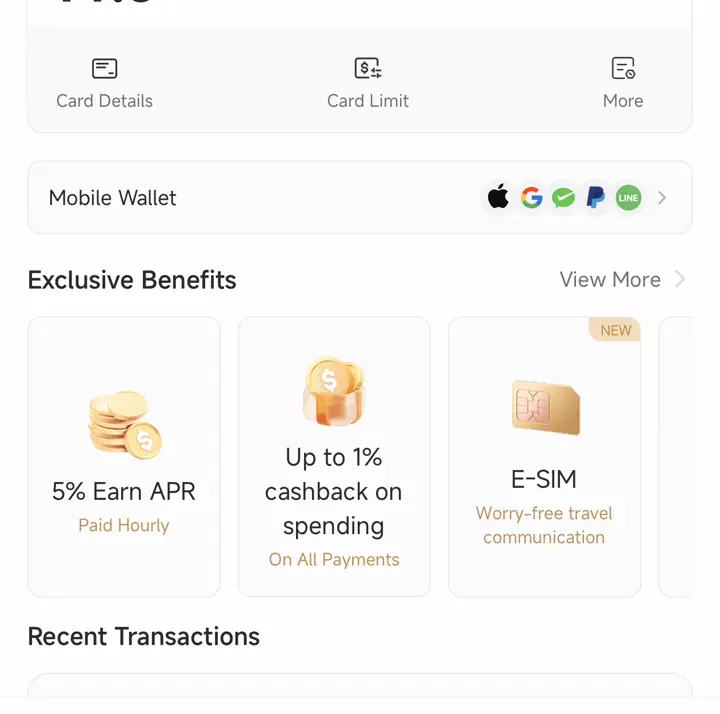
SpendNode app screenshot
Yield and cashback are separate. The 5% applies to the USDT card balance over time. The up-to-1% cashback applies to eligible purchases. Neither converts the custodial balance into a protected bank deposit.
At a constant 5% rate, an average 1,000 USDT card balance would generate about 50 USDT over a year. The rate can change, and the return remains exposed to Pionex as custodian.
Funding Networks
Pionex showed direct USDT deposits over Tron, Ethereum, BNB Smart Chain, Avalanche C-Chain, Plasma, Solana, and TON in our account. Estimated arrival times were generally one minute, except Ethereum at 12 minutes on the captured screen.
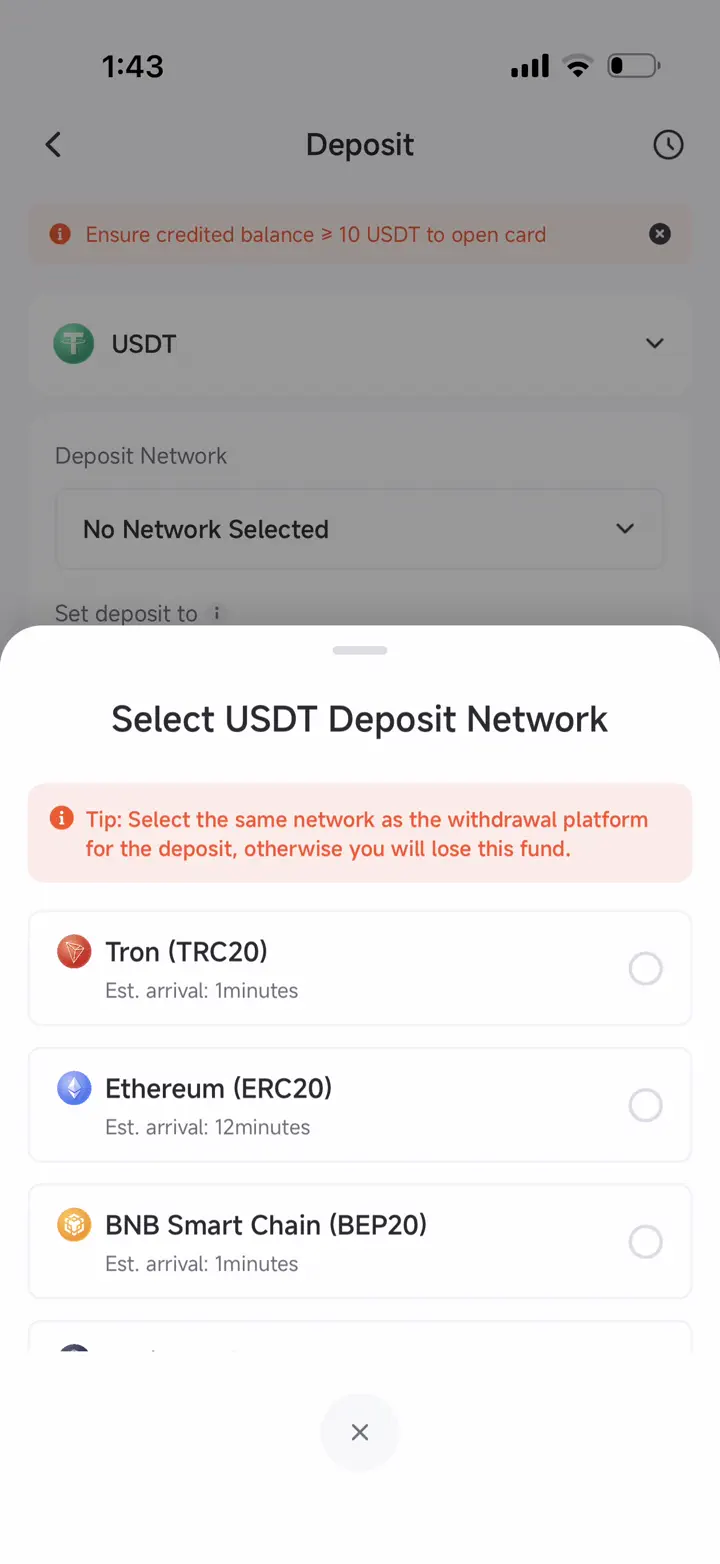
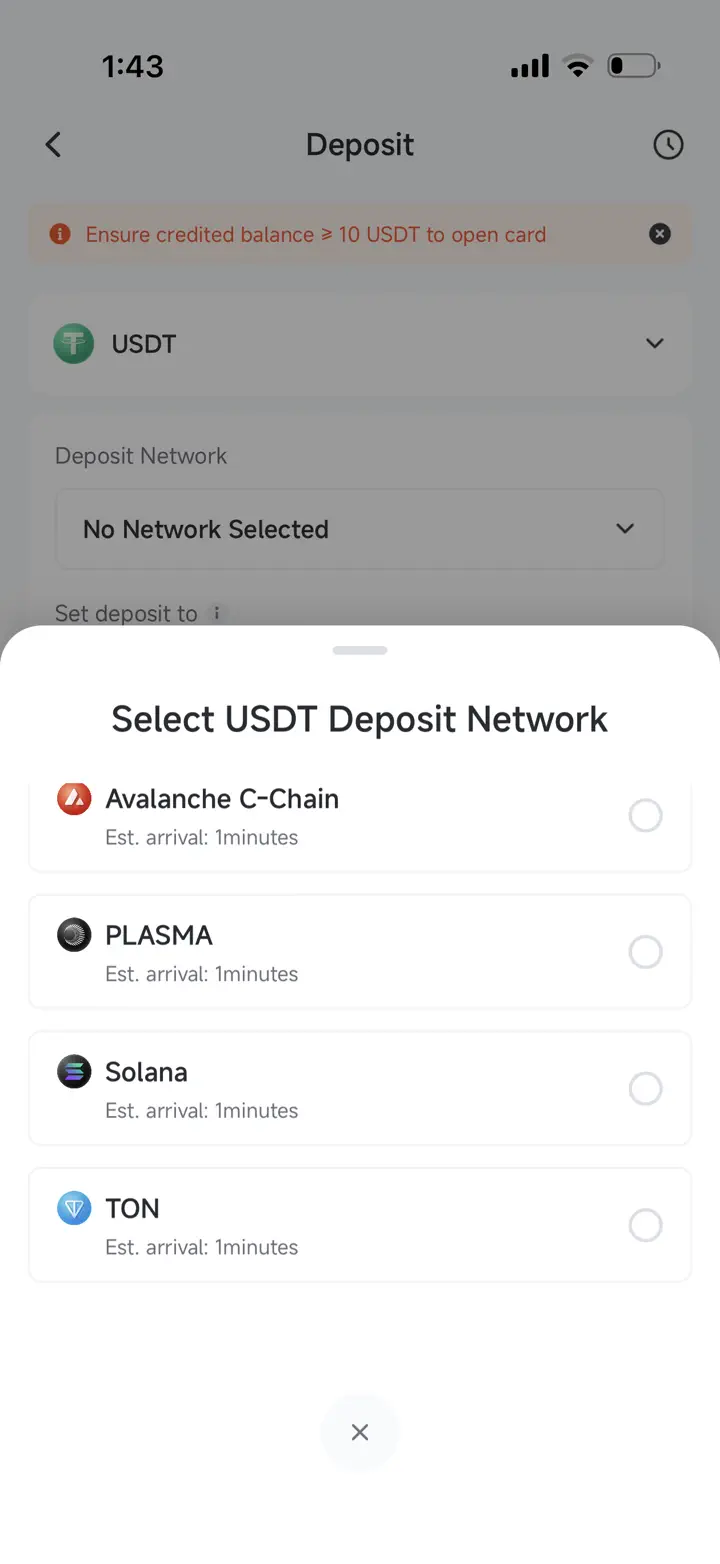
Pionex USDT card-balance deposit networks verified in-app in September 2026. Always use the same network on the sending and receiving sides.
Network support is useful, but it does not make cross-chain deposits reversible. Sending USDT over a chain that does not match the selected receiving network can permanently lose the funds.
Limits and Restrictions
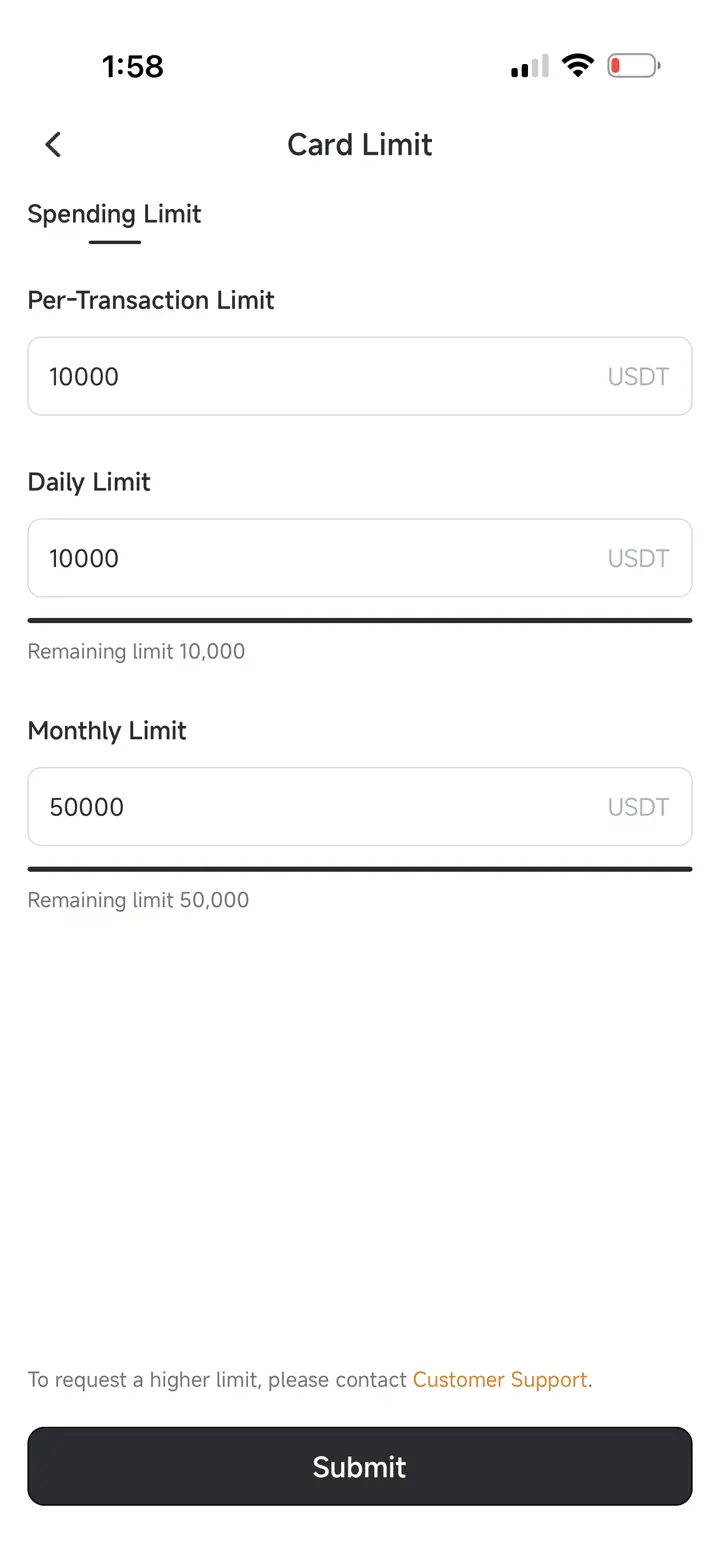
Our account showed 10,000 USDT per transaction, 10,000 USDT per day, and 50,000 USDT per month. Customer Support is the route for requesting a higher limit.
SpendNode app screenshot
Account-level limits. These ceilings do not guarantee merchant approval. Available balance, compliance checks, merchant controls, and card-network rules still apply.
The reviewed Mastercard was virtual-only, so it offered no ATM access. Pionex also blocks or restricts selected merchant countries and merchant categories. A card can therefore be issued successfully and still decline at a particular merchant.
Where Pionex Card Is Available
Pionex does not publish a dependable positive country list for this exact Mastercard programme. Card eligibility is shown after account verification in the app. Exchange KYC availability and merchant acceptance are separate checks and neither proves that a particular card programme will be offered.
The global Pionex service currently lists the United States among unsupported regions for phone registration and KYC, so this card should be treated as unavailable to US residents. Pionex.US is a separate US platform and does not currently provide the card reviewed here.
Pionex vs Other Crypto Cards
MEXC also links card spending to a custodial exchange and charges a transaction fee. Its rewards can be higher for users who qualify through exchange activity; Pionex's stronger everyday feature is yield on the card balance.
RedotPay publishes broader card-access and physical-card options, including ATM use where supported. Pionex was virtual-only on our account but offered the 5% balance yield.
Oobit emphasizes direct tap-to-pay from supported balances and connected wallets. Pionex requires a dedicated custodial USDT card balance and is more tightly connected to trading activity.
Plasma One is the cleaner alternative for users who prioritize self-custody. Pionex is simpler for an existing exchange user, but the spending float remains under Pionex control.
Is Pionex Safe?
Pionex controls the exchange account and card balance. Account protections include identity verification, two-factor authentication, withdrawal controls, and an in-app card freeze. Those controls reduce account-takeover risk but do not make the balance self-custodial or deposit-insured.
Use a unique password, enable an authenticator, set withdrawal whitelists where practical, and keep the card balance proportionate to near-term spending. The 5% yield is not a reason to place emergency savings into an exchange account.
Is Pionex a Scam?
We found no basis to describe Pionex Card as a scam. SpendNode completed the live application flow, received a working Mastercard, funded the card balance, and completed a MYR purchase. The app displayed the applicable fee, cashback, yield, and account limits.
The material caveat is documentation consistency. Pionex operates several card arrangements, and its public pages can describe a different network or fee schedule from the card assigned to an individual account. Confirm the actual agreement in your app before funding it.
Who Should Use Pionex?
Pionex makes the most sense for an existing customer who already receives or holds USDT and values the 5% annualized return on money waiting to be spent. The 10,000 USDT daily limit is generous, and Apple Pay and Google Pay cover ordinary contactless use.
It is weaker as a pure cashback card. The disclosed 1% transaction fee sits against an advertised reward of up to 1%, while our first MYR payment showed additional conversion cost. Users who want self-custody, a guaranteed reward on every purchase, ATM access, or a published country list should choose another card.
Pionex Verdict
Pionex has built a useful spending extension for its exchange account. The yield on the card balance is the differentiator; the cashback is not, because the 1% transaction fee can consume the maximum base reward before exchange-rate effects.
The card is usable, but it is not transparent enough to call zero-FX. Check the network, fee, reward rate, and limits in your own app, then verify the final debit on a small local-currency purchase before routing larger spending through it.
Countries and Availability
Pionex is available in 97 countries as of September 2026. We count a country here when at least one active Pionex card variant lists it, so individual product pages may be narrower.
Available Regions
Africa
Cameroon (CM), Cote d'Ivoire (CI), Egypt (EG), Ethiopia (ET), Ghana (GH), Kenya (KE), Morocco (MA), Mozambique (MZ), Nigeria (NG), Rwanda (RW), Senegal (SN), South Africa (ZA), Tanzania (TZ), Tunisia (TN), Uganda (UG)
Americas
Argentina (AR), Bolivia (BO), Brazil (BR), Chile (CL), Colombia (CO), Costa Rica (CR), Dominican Republic (DO), Ecuador (EC), El Salvador (SV), Guatemala (GT), Jamaica (JM), Mexico (MX), Panama (PA), Paraguay (PY), Peru (PE), Trinidad and Tobago (TT), Uruguay (UY)
Asia
Bahrain (BH), Bangladesh (BD), Cambodia (KH), Georgia (GE), India (IN), Indonesia (ID), Iraq (IQ), Israel (IL), Jordan (JO), Kazakhstan (KZ), Kuwait (KW), Malaysia (MY), Maldives (MV), Mongolia (MN), Nepal (NP), Oman (OM), Pakistan (PK), Philippines (PH), Qatar (QA), Saudi Arabia (SA), South Korea (KR), Sri Lanka (LK), Taiwan (TW), Thailand (TH), Turkey (TR), United Arab Emirates (AE), Uzbekistan (UZ), Vietnam (VN)
Europe
Albania (AL), Austria (AT), Belgium (BE), Bulgaria (BG), Croatia (HR), Cyprus (CY), Czech Republic (CZ), Denmark (DK), Estonia (EE), Finland (FI), Germany (DE), Gibraltar (GI), Greece (GR), Hungary (HU), Iceland (IS), Ireland (IE), Italy (IT), Latvia (LV), Liechtenstein (LI), Lithuania (LT), Luxembourg (LU), Malta (MT), Montenegro (ME), North Macedonia (MK), Norway (NO), Poland (PL), Portugal (PT), Romania (RO), Serbia (RS), Slovakia (SK), Slovenia (SI), Spain (ES), Sweden (SE), Switzerland (CH)
Oceania
Australia (AU), Fiji (FJ), New Zealand (NZ)
Major Restricted Markets
These major markets are not currently listed for this vendor. Confirm eligibility with the issuer before applying, especially where card tiers have different country rules.
Americas
Canada (CA), United States (US)
Asia
China (CN), Hong Kong (HK), Japan (JP), Singapore (SG)
Europe
France (FR), Netherlands (NL), United Kingdom (GB)
Sources and Verification
- Pionex Card Review
- Pionex Digital Wallet Setup
- Pionex Card Global Cashback Guidelines
- Pionex Visa Card Fee Schedule
- Pionex Mastercard Fee Schedule
- Pionex Unsupported Phone and KYC Regions
- SpendNode in-app screenshots, account terms, card issuance, and MYR transaction test completed September 21, 2026
The MYR transaction is one observed result from a Malaysian account. It measures the all-in difference against the stated online reference rate at the time of testing and should not be generalized to every Pionex card programme, currency, or settlement date.
Written by Aleksandar Dukic
Frequently Asked Questions
Is Pionex crypto card available in the United States?
No. Pionex crypto card is not available in the United States.
What is Pionex?
Pionex is a custodial cryptocurrency exchange with built-in trading bots, spot and futures markets, Earn products, and a USDT-funded card. SpendNode verified the card from Malaysia in September 2026.
Does Pionex have a promo code?
Yes. Join through SpendNode's Pionex link or enter code 0NFnwXJiZGk at signup. The current offer gives referred users up to a 15% rebate on spot trading fees and 10% on manual futures and futures-bot fees.
Is Pionex promo code 0NFnwXJiZGk still working in September 2026?
Yes. SpendNode verified code 0NFnwXJiZGk in September 2026. Register through SpendNode's Pionex link or enter the code during signup. The current benefit is the stated trading-fee rebate.
Is Pionex Card Visa or Mastercard?
SpendNode verified a Mastercard with number prefix 5240 1394. Pionex assigns different card programmes by account and region, and some public Pionex material covers Visa products. The network shown on the card issued in your app is the one that applies to you.
User Reviews
Reviews are moderated and may take a moment to appear.