


SpendNode Rating for Solid
Solid pairs a Safe-smart-account savings vault with a free virtual Visa issued by Rain, paying 3% USDC cashback from day one and up to 5% through points tiers. We opened an account, cleared KYC, and had a live card the same morning in our August 2026 test from Malaysia.
The custody architecture (Safe, Turnkey, Check Point) and honest in-app fee disclosure score well; the platform is young, the card is virtual-only, and headline yield marketing (up to 6%) ran above the observed 4.4%, which keeps reliability and relevance mid-pack for now.
Issuer Snapshot
Editorial vendor score stays separate from user reviews. Methodology
Product Quality
4.0
Trust & Custody
4.2
Fee Transparency
4.0
Operational Reliability
3.6
Market Relevance
3.8
On This Page
What Is Solid?
Solid (solid.xyz) is a non-custodial DeFi savings and spending platform built on Safe smart accounts with passkey authentication via Turnkey. It combines a stablecoin yield vault (SoUSD, built on BoringVault infrastructure), a free virtual Visa card issued by Rain, and a points-based rewards program paying 3% to 5% USDC cashback. The card is available in 49 countries, including the US across 30+ states; savings works worldwide.
Solid inverts the usual crypto card pitch. Most card apps are spending products with a savings feature bolted on. Solid is a savings product first: you deposit USDC or USDT, the money moves into a yield vault, and the card exists so that the balance never has to stop working to be useful.
The app has three surfaces:
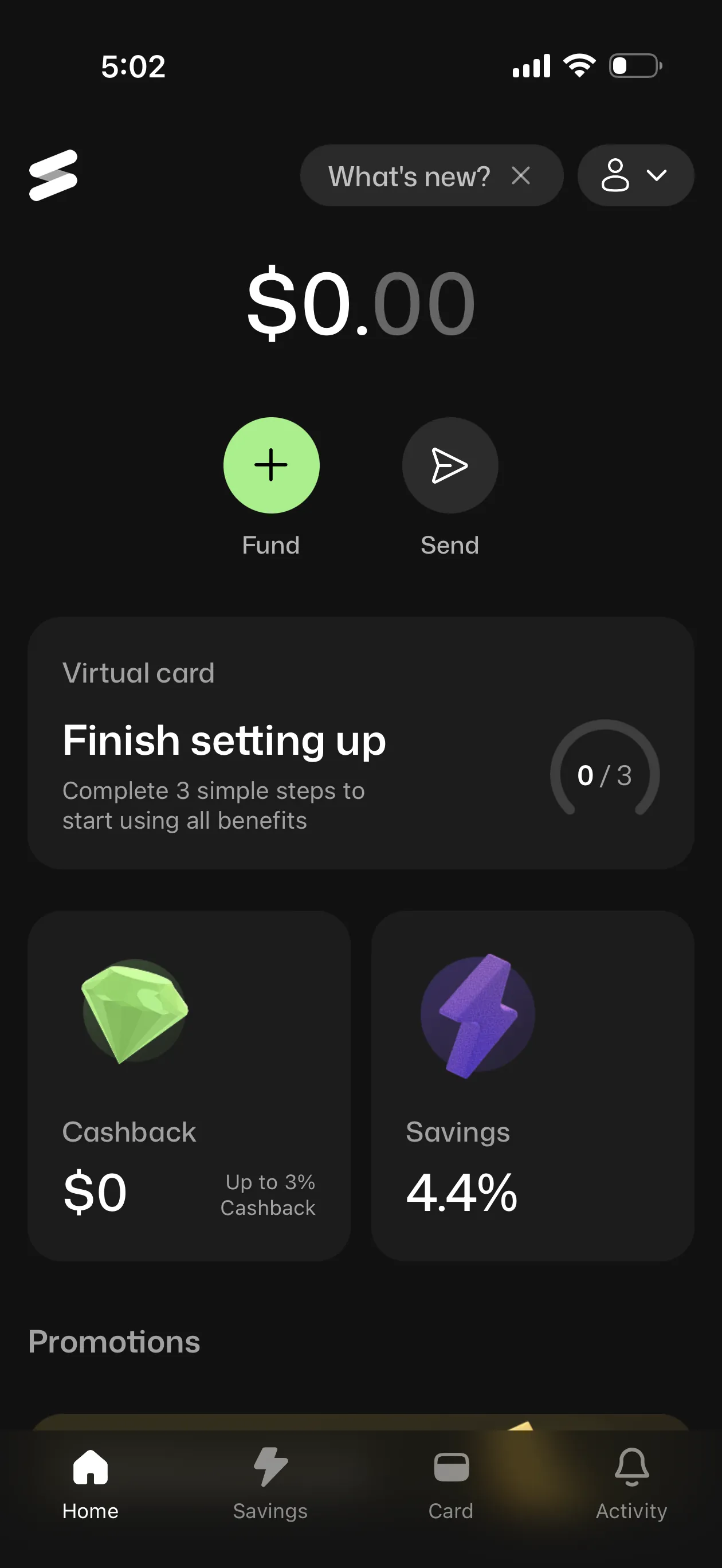
- Savings - Deposits convert to SoUSD, a vault share token whose value grows as the underlying DeFi strategies earn. The marketing says up to 6%; the live rate in our app read 4.4% APY.
- Card - The Solid Card, a free virtual Visa issued by Rain, spendable at 200M+ Visa merchants, with Apple Pay and Google Pay. Cashback is 3%, 4%, or 5% in USDC depending on your rewards tier.
- Rewards - The points ledger that sets your tier. Points accrue every hour on saved balances, on every dollar of card spend and in-app swaps, and from referrals.
SpendNode app screenshot
The Solid home screen - Cashback and Savings sit side by side as the two core tiles. Note the Savings tile: 4.4% live, against the "up to 6%" marketing. The card setup flow runs directly from this screen.
Custody changes where the risk sits. Your funds remain in a Safe smart account that only you can authorize, secured by device passkeys through Turnkey rather than a seed phrase. Solid cannot move the assets without your approval. The same Safe contract stack secures DAO and DeFi treasury funds; Solid puts it behind biometric login.
We tested Solid first-hand from Malaysia in August 2026: account creation with a passkey took under a minute, KYC cleared quickly, and the virtual Visa went live the same morning, ready for Apple Pay. Deposits, the 4.4% savings rate, and the card fee schedule in this review are what we saw in the app, not just what the website claims.
Available crypto cards by Solid in September 2026
1. Solid Card
Free Non-Custodial Visa - 3% USDC Cashback From Day One, Up to 5% via Points Tiers
Solid Card Promo Code 75LP9: Get $25 in FUSE
Use Solid Card promo code 75LP9 by signing up through SpendNode's Solid link. The code is applied automatically. Eligible new users receive $25 worth of FUSE after activating the free virtual Solid Card and spending $150 across at least three different merchants within 30 days. Purchases excluded from cashback do not qualify toward the spend or merchant count.
| Offer detail | Current Solid Card offer |
|---|---|
| Solid Card promo code | 75LP9 |
| Welcome bonus | $25 in FUSE |
| Card requirement | Activate the free virtual Visa |
| Spending requirement | $150 across at least 3 different merchants |
| Time limit | Within 30 days |
| Payout | To Solid Savings about 30 days after qualification |
| How it is applied | Automatically through SpendNode's link |
How to use the Solid Card promo code
- Open SpendNode's Solid signup link.
- Create your Solid account with promo code 75LP9 attached automatically.
- Complete identity verification and activate the free virtual Visa.
- Spend $150 on eligible purchases across at least three different merchants within 30 days.
- Receive $25 worth of FUSE in Solid Savings approximately 30 days after qualification. Solid converts the USD amount to FUSE at payout.
How the Savings Engine Works
Solid's yield is not an interest rate a company pays you. When you move funds from Wallet to Savings, you mint SoUSD, a token representing shares in a vault. The exchange rate is total assets divided by total shares: as the vault earns, each SoUSD is worth more. There is no staking step, no lockup, and no reward-claiming ritual. The share price simply drifts upward.
Under the hood, capital routes into BoringVaults, a set of curated DeFi strategies (lending markets, staking) built on ERC-4626 with extra safety layers: asynchronous redemptions, withdrawal queues, automated risk-based rebalancing, and permissioned operations that can pause automatically if abnormal risk is detected. Withdrawals from yield positions use a two-step process to block draining attacks.
Solid's FAQ adds one caveat: the app abstracts gas and signatures, but you still sign transactions and may pay gas when minting or redeeming SoUSD. Solid covers gas on eligible on-chain actions for deposits above $10.
Security monitoring is outsourced to a name you would not expect in a DeFi app: Check Point, the NASDAQ-listed cybersecurity firm, continuously watches Solid's onchain activity for exploit attempts, abnormal contract behavior, and contagion risk across vaults and bridges. Turnkey handles key management, and Fuse Network supports transaction and data integrity.
The Card
The Solid Card is a free virtual Visa issued by Rain on the Visa Platinum tier. There is no order step and no issuance fee: verify your identity in about 2 minutes and the card activates in-app, with one-tap Apple Pay and Google Pay provisioning on mobile and manual card-detail entry on the web app at app.solid.xyz.
SpendNode app screenshot
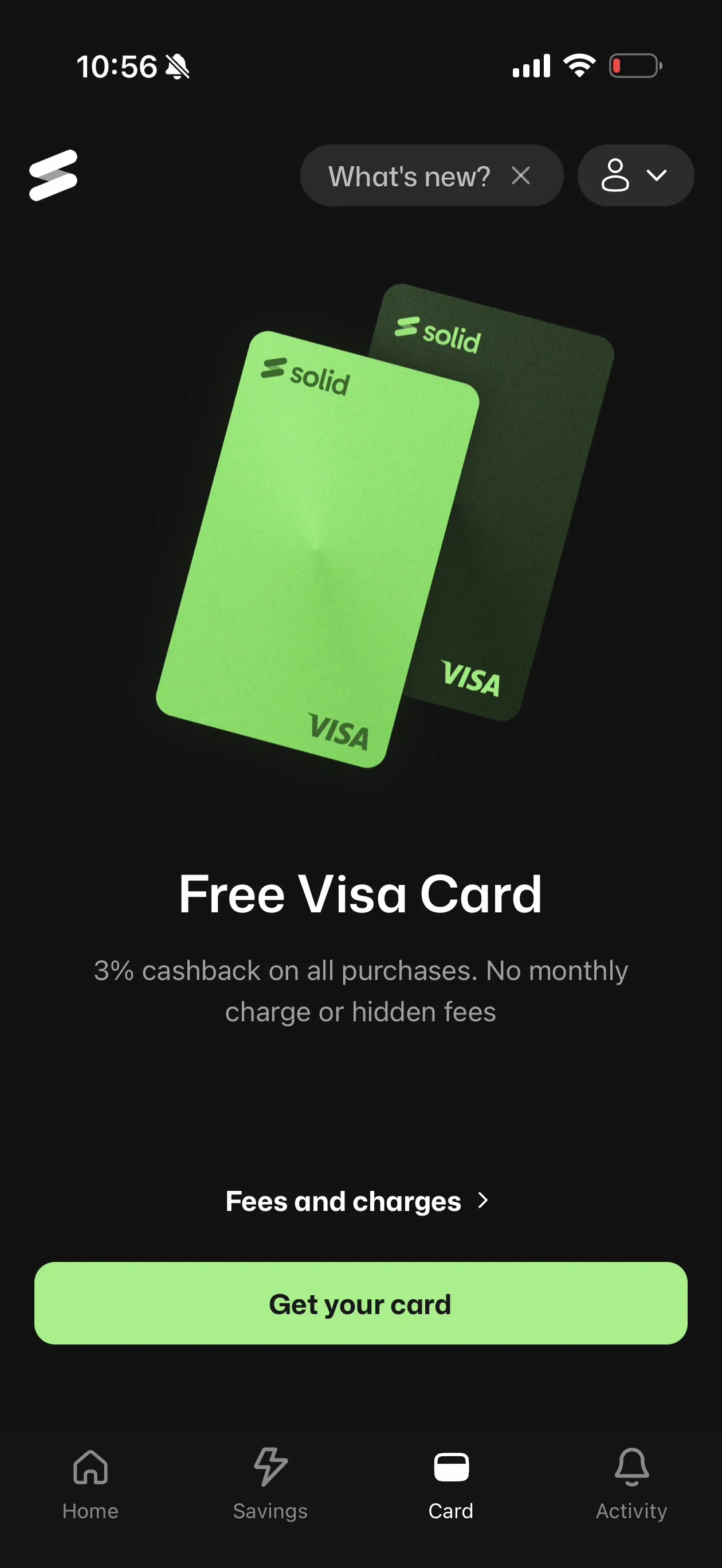
The card pitch in-app - "3% cashback on all purchases. No monthly charge or hidden fees." The 3% is the Core tier rate; the caps and the 1% FX fee live one tap deeper, on the Fees and charges sheet.
The card has two spending modes:
- Savings Mode spends directly from your balance.
- Borrow Mode borrows against your savings, so your SoUSD position keeps compounding yield while you spend. Transactions authorize against your collateral.
Borrow Mode is included with the free card, but Solid's public documentation does not publish its borrowing cost, loan-to-value ratio, or repayment terms. Check those in-app before relying on it.
The Solid Card is therefore a crypto-backed payment card: transactions authorize against an available balance or collateral rather than an unsecured credit line.
The three rewards tiers are the same card with different earn rates, not separate products you choose between - everyone starts in Core and grows from there:
Core (every member). 3% USDC cashback capped at $50/month. The default tier from day one, no threshold.
Prime (5,000,000 points). 4% cashback, $100/month cap, priority support. About 3 weeks away with $10,000 held in Savings.
Ultra (35,000,000 points). 5% cashback, $200/month cap. In practice a large-depositor tier: $70,000 in Savings reaches it in about 3 weeks, $10,000 in about 5 months.
The full card mechanics, transaction flow, fee math, and tier break-even analysis live in the Solid Card review.
Cashback is paid in USDC, credited roughly 14 days after each transaction settles, with the exact amount visible per purchase in transaction details. Refunds, reversals, and cash advances are excluded, and reversed purchases claw back their cashback.
The Points Ladder
Tiers are earned, not bought. Four accrual streams feed the ladder:
| Action | Points |
|---|---|
| Save | 1 point per hour for every $1 in a Solid vault (USDC, ETH, FUSE) |
| Spend | 1 point per $1 spent on the card |
| Swap | 1 point per $1 swapped in the app |
| Invite friends | 10% of their daily points |
SpendNode app screenshot
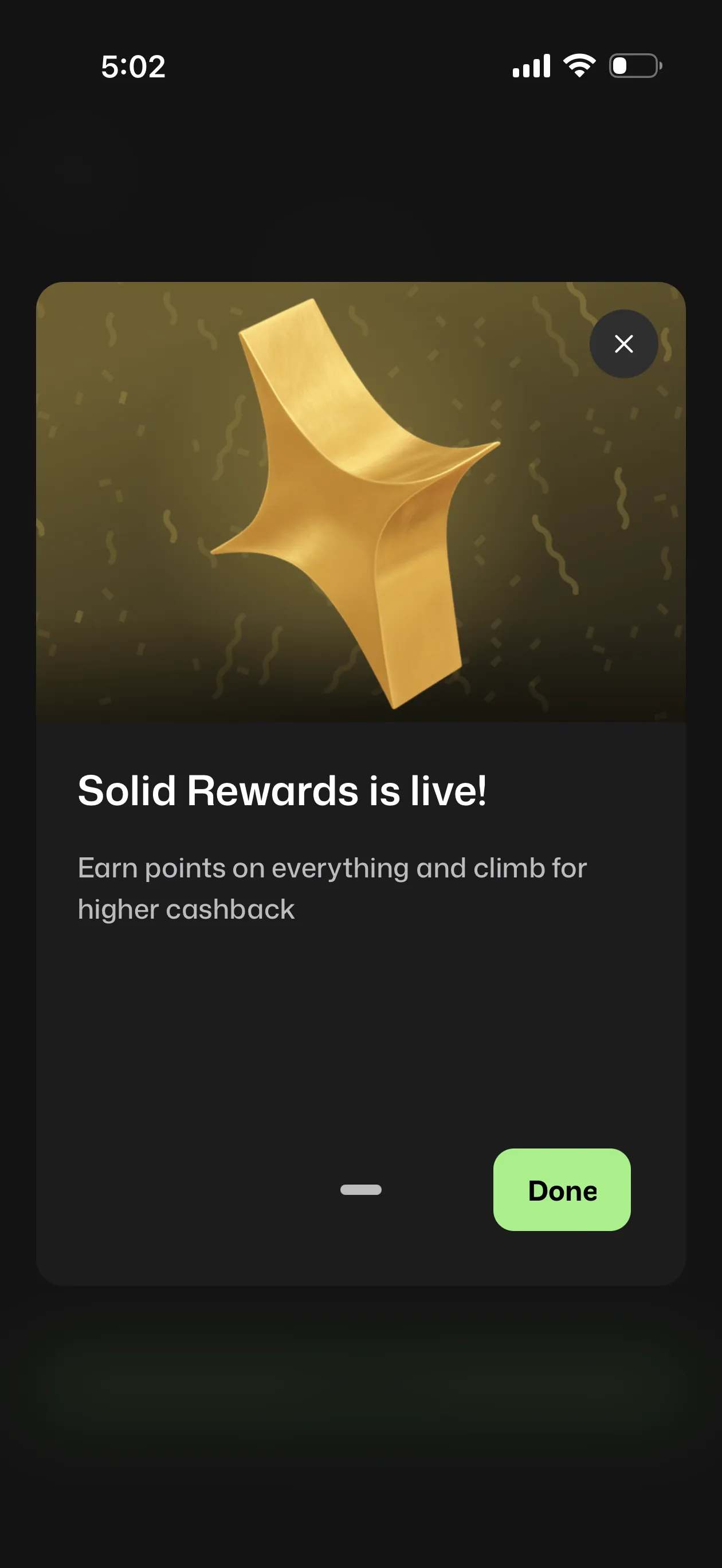
Solid Rewards launch modal - The points program is new: this is the in-app announcement from our August 2026 test. You must opt in on the Rewards screen before points start accruing.
The hourly save rate is the dominant force. One dollar saved earns 24 points a day; one dollar spent earns 1 point once. That means $10,000 in Savings generates about 240,000 points daily and reaches Prime (5M) in roughly 3 weeks, while a $2,000/month card spender earning points from spend alone would need over 200 years. Solid's tier ladder is a deposit-size ladder with a cashback rate attached.
SpendNode app screenshot
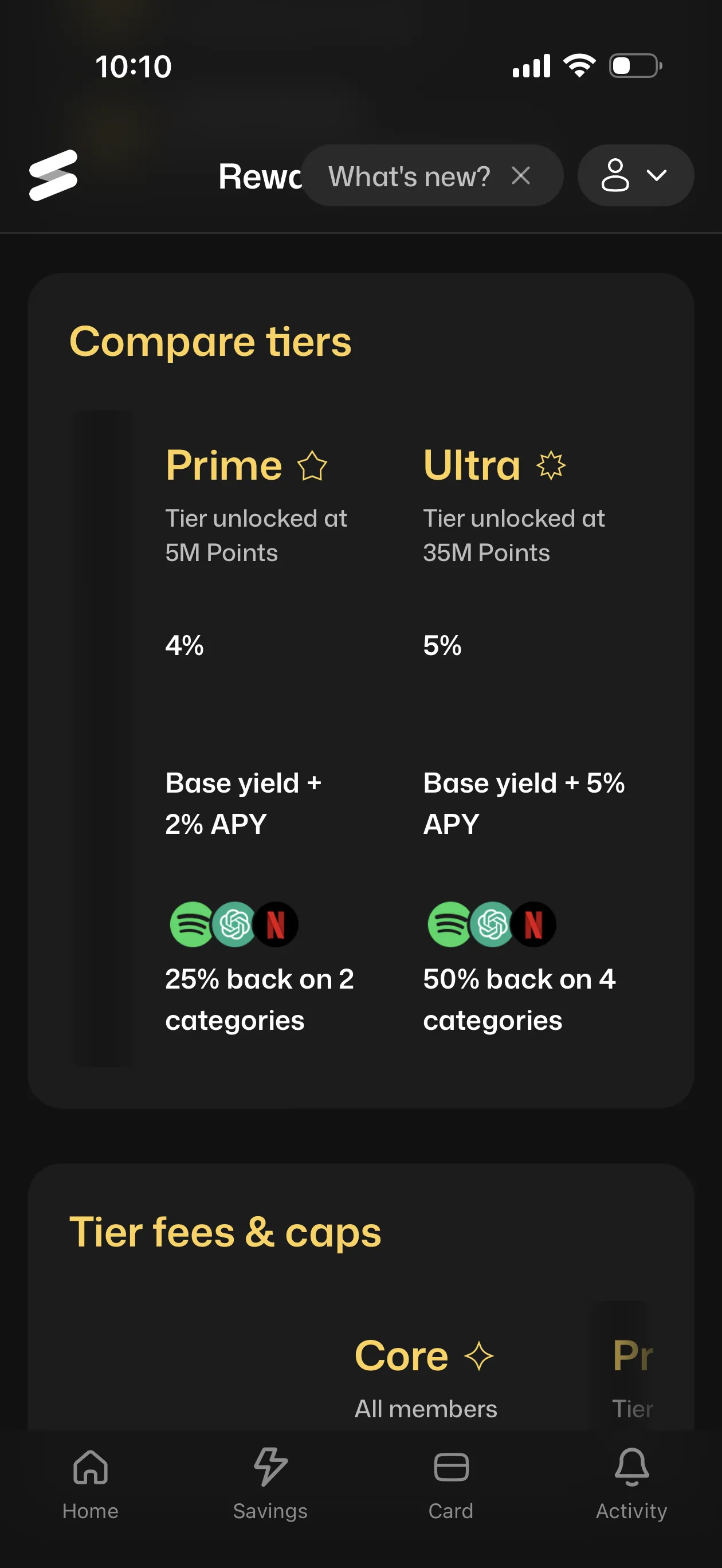
Prime vs Ultra in-app - 4% at 5M points, 5% at 35M. The yield boosts (+2% / +5% APY) and the subscription cashback (25% on 2 categories, 50% on 4, with Spotify, ChatGPT, and Netflix shown) are displayed here but marked coming soon elsewhere in the app. We treat both as announced, not live.
Two announced tier perks are not live yet, and the app itself labels them coming soon: subscription cashback (Prime 25% on eligible services in 2 categories, Ultra 50% in 4, capped at $50 per service per month) and a yield boost (Prime +2% APY, Ultra +5% APY on top of base yield). The Rewards terms confirm coming-soon features "may change or may not launch." Do not build your math on them until they switch on.
Fees and Rates
The fee schedule is short, which is itself notable:
| Item | Core | Prime | Ultra |
|---|---|---|---|
| Unlock | All members | 5,000,000 points | 35,000,000 points |
| Card cashback | 3% | 4% | 5% |
| Monthly cashback cap | $50 | $100 | $200 |
| Card issuance | Free | Free | Free |
| Top-up / maintenance / transaction fee | None | None | None |
| FX fee (non-USD) | 1% | 1% | 1% |
| Savings yield | Up to 6% marketed; 4.4% observed | Same (+2% APY boost coming soon) | Same (+5% APY boost coming soon) |
| Support | Standard | Priority | Priority |
SpendNode app screenshot
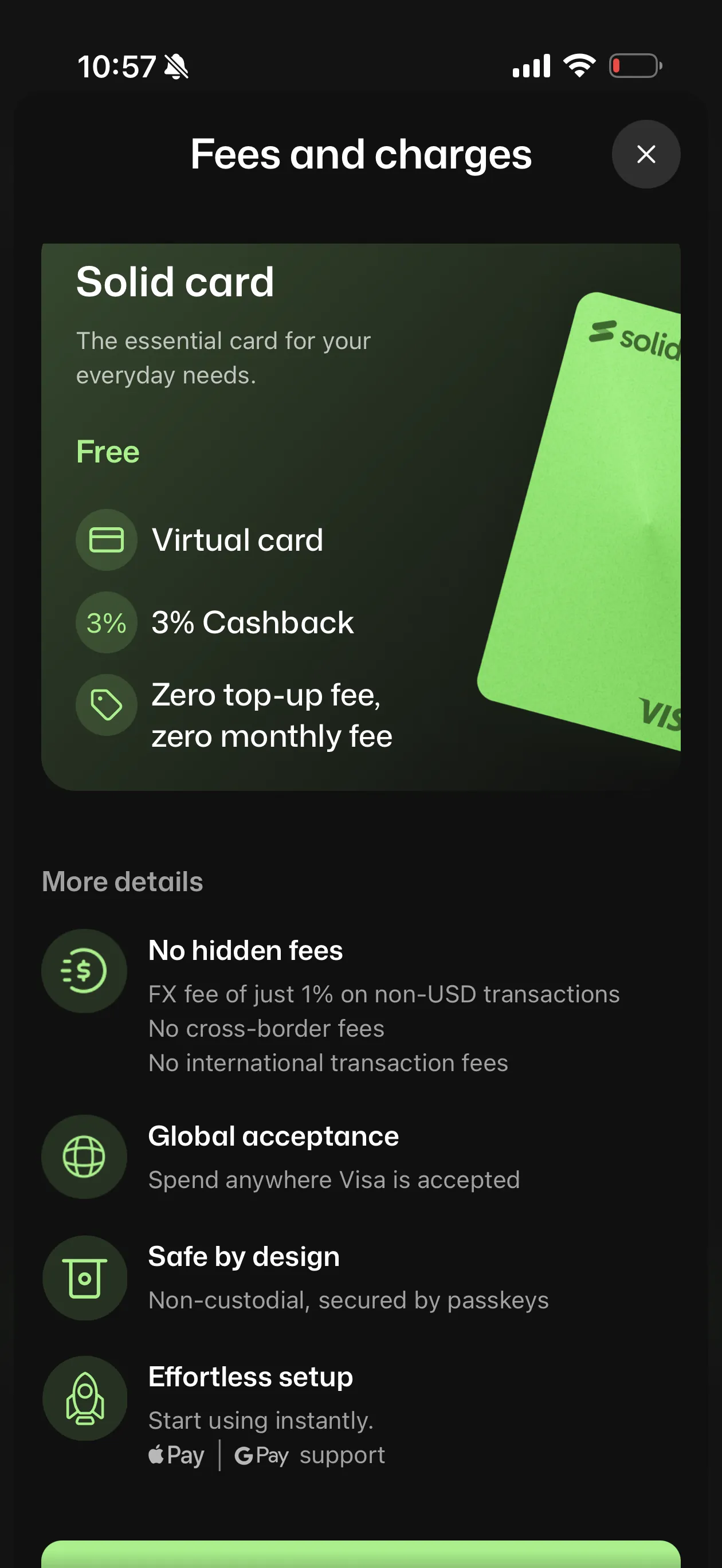
The fee sheet in-app - Non-US users should focus on the 1% FX fee for non-USD transactions. The other listed card fees are zero.
The "no fees, ever" homepage claim needs qualification outside dollarized markets. Non-USD transactions convert at network exchange rates plus a 1% FX fee. Day-to-day spend avoids that fee in the US and dollarized markets such as Ecuador, El Salvador, and Panama.
A Malaysian user spending RM4,300 (about $1,000) a month pays roughly $10 in monthly FX fees. Core cashback on that spend is $30, leaving about $20 before any other costs.
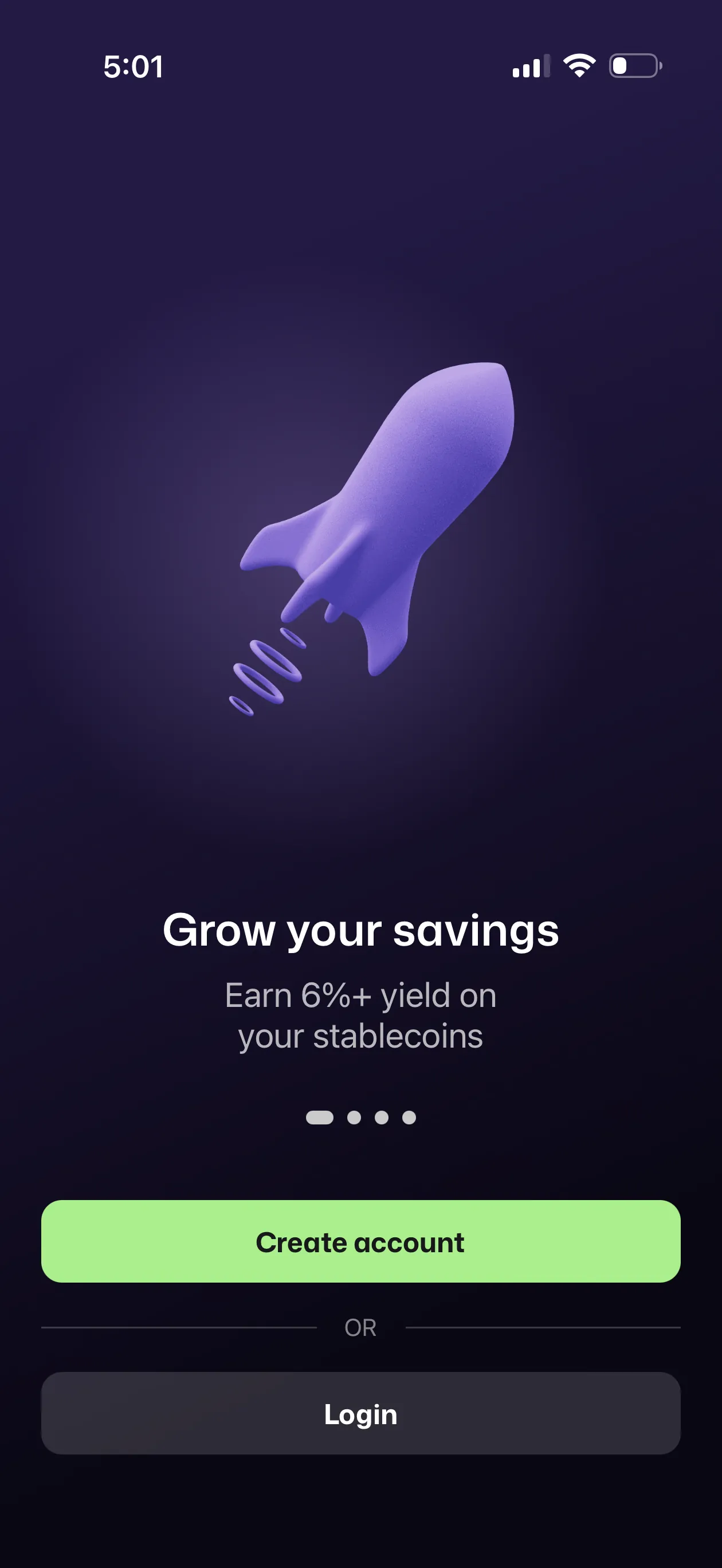
The other advertised-vs-reality gap is yield. Onboarding says "Earn 6%+ yield on your stablecoins"; the marketing site says up to 6%; our app showed 4.4%. Vault yield is variable and Solid's own terms say an "up to" rate is a maximum, not a promise. Judge the product at 4-5%, and treat anything above as upside.
Bank deposits via Virtual Accounts (personal ACH and wire details that auto-convert to your balance) are fee-free, unlimited for first-party transfers, with third-party transfers capped at $4,000. Crypto deposits carry no Solid fee on any network: Ethereum and BSC settle in about 5 minutes, Polygon, Base, Arbitrum, and Fuse in about 20.
How to Apply for the Solid Crypto Card
The onboarding flow is one of the fastest we have tested. Six steps:
Step 1. Download Solid from the App Store or Google Play, or open the web app at app.solid.xyz, via SpendNode's Solid link. Our promo code 75LP9 is applied automatically through the link. After card activation, spend $150 across at least three different merchants within 30 days to earn $25 worth of FUSE. Refunds, reversals, and cashback-excluded purchases do not qualify; payout reaches Solid Savings approximately 30 days after qualification.
Step 2. Pick a username and create a passkey. There is no password and no seed phrase; the passkey lives in your device's secure hardware. Your Safe smart account deploys automatically.
SpendNode app screenshot
The onboarding pitch - "Earn 6%+ yield on your stablecoins." Keep this screen in mind for the fee section: the live rate in our account was 4.4%.
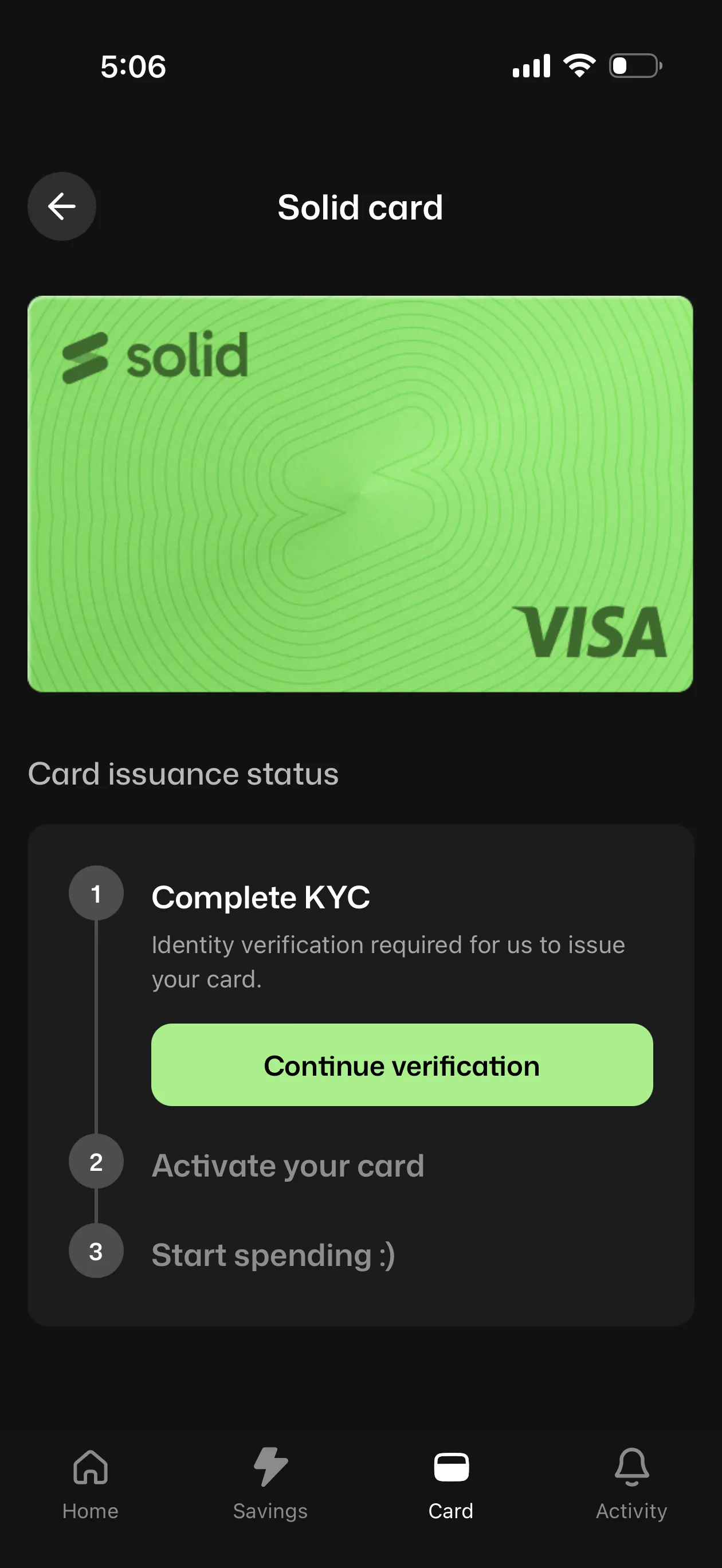
Step 3. From the Card tab, tap Get your card and complete KYC. Solid quotes about 2 minutes for identity verification, which matches our experience.
SpendNode app screenshot
Card issuance status - The three-step flow from KYC to live card. In our Malaysia test the whole chain, from Continue verification to the welcome screen, finished the same morning.
Step 4. The card activates. Add it to Apple Pay or Google Pay with one tap.
Step 5. Fund the wallet: send USDC/USDT from any wallet or exchange on six supported networks, or use your Virtual Account ACH/wire details. Solid recommends at least $10 to start.
Step 6. Move funds from Wallet to Savings to start earning, and opt in to Solid Rewards on the Rewards screen so points start accruing. Funds must sit in Savings, not Wallet, to earn yield and save-points.
Countries and Availability
Solid is available in 49 countries as of September 2026. We count a country here when at least one active Solid card variant lists it, so individual product pages may be narrower.
Available Regions
Africa
Cote d'Ivoire (CI), Egypt (EG), Ghana (GH), Kenya (KE), Morocco (MA), Senegal (SN), South Africa (ZA), Uganda (UG), Zambia (ZM)
Americas
Antigua and Barbuda (AG), Argentina (AR), Bahamas (BS), Barbados (BB), Belize (BZ), Bolivia (BO), Brazil (BR), Cayman Islands (KY), Colombia (CO), Costa Rica (CR), Dominican Republic (DO), Ecuador (EC), El Salvador (SV), Grenada (GD), Guatemala (GT), Guyana (GY), Honduras (HN), Mexico (MX), Panama (PA), Paraguay (PY), Peru (PE), Saint Kitts and Nevis (KN), Saint Lucia (LC), Saint Vincent and the Grenadines (VC), Suriname (SR), Trinidad and Tobago (TT), Turks and Caicos Islands (TC), United States (US), Uruguay (UY)
Asia
Bangladesh (BD), Hong Kong (HK), Japan (JP), Malaysia (MY), Pakistan (PK), Philippines (PH), Singapore (SG), Thailand (TH), United Arab Emirates (AE)
Oceania
Australia (AU), New Zealand (NZ)
Major Restricted Markets
These major markets are not currently listed for this vendor. Confirm eligibility with the issuer before applying, especially where card tiers have different country rules.
Africa
Nigeria (NG)
Americas
Canada (CA), Chile (CL)
Asia
China (CN), India (IN), Indonesia (ID), South Korea (KR), Taiwan (TW), Turkey (TR)
Europe
Austria (AT), France (FR), Germany (DE), Italy (IT), Netherlands (NL), Poland (PL), Portugal (PT), Spain (ES), Switzerland (CH), United Kingdom (GB)
The exclusion list is explicit: cards cannot be issued to residents of Belarus, mainland China, Cuba, India, Iran, Iraq, Israel, Myanmar, Nepal, Nicaragua, North Korea, Russia, Syria, Turkey, Ukraine, Venezuela, or Vietnam. Separately, an issued card cannot be used while physically inside Cuba, Iran, North Korea, Russia, Syria, Ukraine, or Venezuela, regardless of residence.
Savings has no such list: anyone worldwide can open an account, deploy a Safe wallet, and earn vault yield even where the card has not arrived. The in-app country checker under the Wallet tab is the authoritative source, and new countries are added on a rolling basis.
Solid vs Other Cards
-
vs Plasma One: The closest architectural sibling: self-custodial wallet, Rain-issued Visa, yield on idle balance. Plasma One pays cashback in volatile XPL with spend-banded rates; Solid pays flat USDC with hard monthly caps. Plasma One's top tier requires locking 100,000 XPL; Solid's requires holding a large stablecoin balance that stays liquid and keeps earning. Choose Plasma One for chain-token upside, Solid for stable-denomination rewards.
-
vs ether.fi: Both are yield-first platforms with a card attached. ether.fi Cash pays banded ETHFI cashback (3% to a tier cap, then lower) and reaches 90+ countries including Europe, which Solid does not serve. Solid's edge is simplicity: passkey onboarding, no DAO token stack, and a flat rate per tier rather than banding. Europeans need ether.fi; Solid's 49 countries skew LatAm, Africa, and Asia.
-
vs RedotPay: RedotPay is the custodial incumbent in much of Solid's footprint (Asia, LatAm, Africa) with physical cards, ATM access, and a $100k monthly ceiling. Solid counters with self-custody, vault yield, and a higher base cashback rate, but no physical card or ATM path. Cash-heavy users keep RedotPay; savers who spend digitally get more from Solid.
-
vs Gnosis Pay: The other Safe-based self-custodial card, EUR-settled and EEA/UK-only. Zero geographic overlap with Solid's list. The relevant comparison is philosophical: Gnosis Pay proves the Safe card model in Europe, Solid applies it to the Global South plus the US, with yield built in.
Is Solid Safe?
The right way to assess Solid is counterparty by counterparty:
Solid (the protocol and app). Non-custodial by design: funds live in your Safe smart account and nobody at Solid can move them without your authorization. If the company shut down, your assets remain yours onchain; you would need another interface to reach them, and the card would stop working.
Rain (card issuer). A Visa Principal Member that issues for several major crypto card programs, including Plasma One and Avici. If Rain terminated the program, the card dies but the wallet survives; this is the classic crypto-card failure mode, and the self-custody architecture contains it.
BoringVault strategies (yield). Smart-contract risk lives here. Funds allocated to Savings route through audited, whitelisted DeFi protocols with asynchronous redemptions and withdrawal queues; an exploit would put Savings-allocated balance at risk while Wallet balance stays untouched. The 4.4% yield is DeFi yield, not insured interest.
Turnkey (keys) and Check Point (monitoring). Turnkey converts passkey authentication into onchain signatures without keys leaving your device. Check Point runs continuous exploit and anomaly monitoring as a DeFi-native firewall, prevention-focused, able to trigger pauses before damage spreads.
The exposure map: money in Savings carries DeFi strategy risk, pending cashback (up to 14 days of accrual) carries program risk, and money sitting idle in Wallet carries the least risk of all, at the cost of earning nothing. Stablecoin balances are not bank deposits and carry no deposit insurance anywhere in the stack.
Is Solid a Scam?
No. The infrastructure is verifiable and third-party: Safe smart accounts (the same contracts securing billions in DAO treasuries), Turnkey key management, Rain card issuance on Visa rails, Check Point security monitoring, and BoringVault yield infrastructure are all named, established counterparties. KYC is required for the card, and the fee schedule is published in-app.
We opened an account from Malaysia, cleared KYC, and had a live virtual Visa the same morning. The observable rates matched the fine print: 3% Core cashback with a $50 cap, 1% FX on the Fees and charges sheet, and a live 4.4% savings rate below the advertised ceiling of 6%.
The risks are variable DeFi yield, a young platform, cashback caps, and tier perks that are announced but not yet live. None is evidence of a scam, but each affects the product's value.
Who Should Use Solid?
Solid fits stablecoin savers in its 49-country footprint who want their emergency fund or dollar savings earning vault yield while a free card spends against it. The Malaysian freelancer holding $8,000 in USDC, the Brazilian saver protecting against currency swings, the Filipino remittance recipient who spends digitally: these are the profiles the product was clearly built for. The US availability adds a self-custody yield card in a market where most competitors are custodial.
It is a weaker fit if you need a physical card or ATM cash, since the card is virtual-only; if you live in Europe, India, or Turkey, which are outside the map; if your spend runs far above the caps ($1,667/month maxes out Core's $50), where a banded card like ether.fi scales further; or if you want no exposure to DeFi strategy risk at all, in which case a custodial card with segregated fiat is structurally safer for the balance itself.
Solid's cashback sits on top of a savings product. Judge the vault risk and self-custody model first. If both suit you, the free card adds 3% cashback from day one, with 4% and 5% tiers earned over time.
Sources and Verification
- Solid Official
- Solid Help Center
- Solid Referral Rewards Announcement
- Solid Referral Qualification Rules
- Solid Legal - Privacy Policy, Terms and Conditions
Card specs, fees, tier mechanics, and availability verified against Solid's help center and Rewards Terms and Conditions, plus hands-on testing of the full onboarding and card issuance flow from Malaysia, August 2026. Savings yield (4.4% at observation) and coming-soon status of subscription cashback and yield boosts observed directly in-app.
Written by Aleksandar Dukic
Frequently Asked Questions
Is Solid crypto card available in the United States?
Yes. Solid crypto card is available in the United States.
Is Solid a bank, and who holds my money?
No. Solid is a non-custodial DeFi platform: your funds live in your own Safe smart account, secured by passkeys through Turnkey, and nobody at Solid can move them without your approval. The Visa card is issued by Rain. Balances are crypto assets, not bank deposits, and are not covered by deposit insurance.
How do the Solid rewards tiers work?
Everyone starts in Core at 3% USDC cashback, capped at $50/month. Prime (4%, $100 cap) unlocks at 5,000,000 points and Ultra (5%, $200 cap) at 35,000,000 points. You earn 1 point per hour for every $1 held in a Solid vault, 1 point per $1 spent on the card, 1 point per $1 swapped in the app, and 10% of referred friends' daily points. Holding $10,000 in Savings earns roughly 240,000 points a day, reaching Prime in about three weeks.
Does Solid have a promo code or discount code?
Yes. SpendNode's Solid promo code is 75LP9, and it is applied automatically when you sign up through SpendNode's Solid link. A new user earns $25 worth of FUSE after activating the card and spending $150 across at least 3 different merchants within 30 days. The reward is credited to Solid Savings approximately 30 days after qualification.
Is the 75LP9 code for Solid working in September 2026?
Yes. 75LP9 is still a working Solid promo code as of September 23, 2026 - we re-verify it regularly. It applies through our link and pays $25 worth of FUSE after card activation and $150 of eligible spending across at least 3 different merchants within 30 days.
User Reviews
Reviews are moderated and may take a moment to appear.