
Key findings
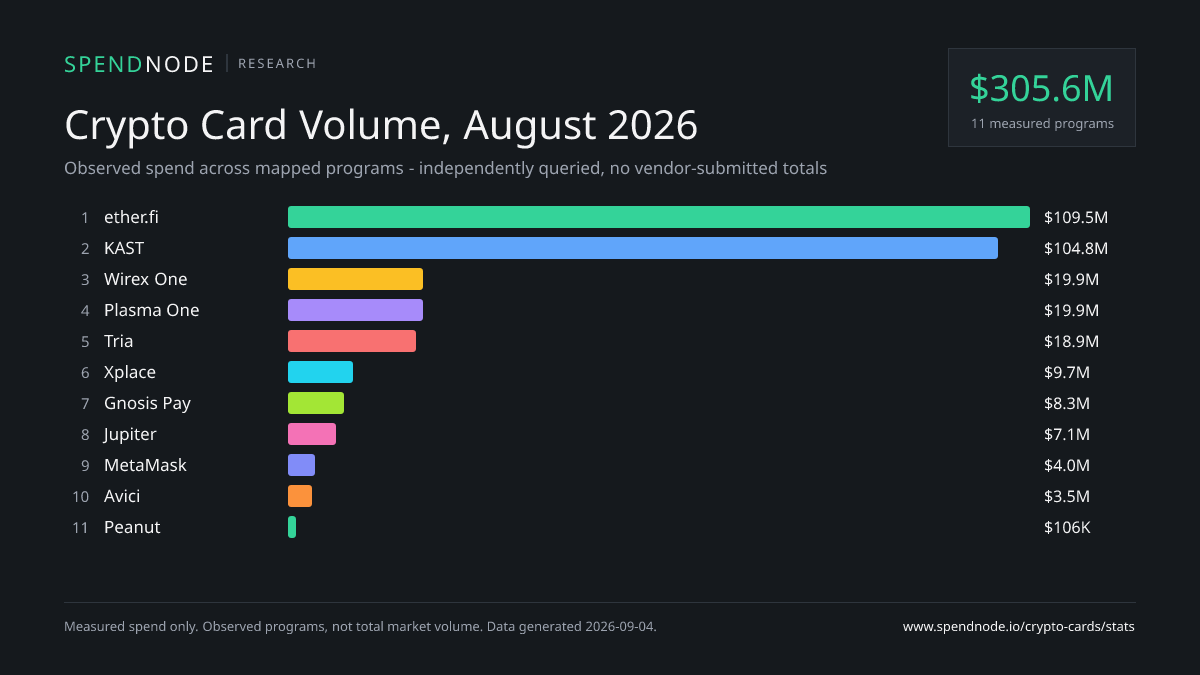
- SpendNode measured $305.6 million of crypto card spending across 11 mapped programs in August 2026, the largest observed total in our dataset. This is observed activity, not total market size.
- The seven programs with matching July coverage grew 10.9%, adding $27.3 million. Ether.fi and KAST supplied $24.4 million, or 89.5%, of that net increase.
- Coverage widened while spending stayed concentrated: four new series entered the measured set, yet ether.fi and KAST still carried 70.1% of everything we can see.
- A vulnerability in a Rain-managed Solana card-balance contract disrupted two programs in late August. Our chain data shows Avici's card settlements nearly paused for one day, then rebounded above the preceding week's range.
- Stablecoin supply rose about $3.25 billion, or 1.06%, during August, and Mastercard closed its BVNK acquisition. The major payment networks are investing directly in the stablecoin rails crypto cards run on.
The month in one page
August was a growth month that ended with a stress test. Measured card spending set a new observed high, the dataset widened as Wirex One, MetaMask, Avici, and Peanut became independently measurable, and MEXC launched a card on the final day of the month. In the last four days, a contract vulnerability at settlement provider Rain pulled two card programs into a security incident documented through public disclosures and onchain activity.
The expanded coverage still shows heavy concentration. Two programs account for roughly seven of every ten dollars we can measure, the two largest settlement chains carry a similar share, and August brought concrete evidence that the largest payment networks are buying and building the underlying stablecoin rails themselves.
Where the growth came from
The seven programs with comparable July and August coverage reached $278.1 million, up 10.9% from $250.8 million. The increase was concentrated rather than uniform. KAST added $15.2 million, ether.fi added $9.2 million, and Plasma One added $4.7 million. Tria grew modestly, while xPlace, Jupiter, and Gnosis Pay finished below July.
KAST produced the largest dollar increase in the comparable group. Its settlement-based volume rose 17.0% to $104.8 million, with Solana carrying $84.5 million. KAST's 32 recorded transactions are issuer settlement batches, so they cannot be compared with per-purchase event counts from other programs.
Ether.fi remained the largest individually measured program at $109.5 million. Volume rose 9.2%, transactions increased 21.3%, and active wallets increased 12.6%. Transactions grew faster than dollar value, lowering the average observed transaction to about $76. That pattern is consistent with broader use at smaller ticket sizes, although onchain data alone cannot establish what users purchased.
Plasma One reached $19.9 million, up 31.0%. Its transaction count grew 36.1% and active wallets grew 59.8%. The faster expansion in wallets than volume indicates that August growth was not driven only by larger existing accounts.
Coverage widened, spending stayed concentrated
Ether.fi and KAST together contributed $214.3 million, or 70.1% of the eleven-program observed total. This concentration reflects the programs SpendNode can currently measure as much as it reflects their scale. A large offchain card program will not appear until a reliable observable settlement path becomes available.
The matched seven-program comparison gives a cleaner view of how concentration moved. Ether.fi and KAST represented 75.7% of comparable spend in July and 77.1% in August. Their combined $24.4 million increase supplied 89.5% of the matched group's $27.3 million net gain.
Ether.fi and KAST generated nearly 90 cents of every net dollar added by the matched group in August, while their combined share rose 1.4 percentage points.
Four series entered the measured dataset this month. They extended coverage below the market leaders without changing the top of the table.
Wirex One entered with $19.9 million across 332,366 gross merchant POS and ePOS settlements from 11,598 active wallets. ATM withdrawals, bank transfers, original credit transactions, and fee events are excluded. Wirex is not included in the 10.9% comparable-growth calculation because July has not yet been valued under the same merchant-only method.
MetaMask recorded $4.01 million across 74,655 successful gross wallet-debit entries on Base, three Linea deployments, and Solana. Failed contract entries were excluded. The identified Monad rail is not included because complete August archive data was unavailable, and cross-chain active-wallet totals are withheld to avoid counting the same user more than once. MetaMask is therefore excluded from the comparable-growth calculation.
Avici's observed current program settled $3.50 million across 21,396 monetary events. Solana accounted for $2.23 million and Base contributed $815,383, with the remainder spread across Polygon, Arbitrum, Optimism, and Avalanche. The direct figure excludes an unidentified retired settlement route, as well as top-ups, withdrawals, exploit drains, and zero-value retries, so it is not presented as total Avici volume.
Peanut added $105,773 across 1,373 gross settlements from the observed Arbitrum factory. The series is intentionally described as a limited observed program: SpendNode has not established that the mapped factory captures every Peanut card cohort or issuing route.
Transaction activity did not move uniformly
Tria's measured volume rose 2.9% while transactions increased 11.4% and active accounts increased 27.1%. Its observed average transaction fell to about $81. Gnosis Pay was nearly flat on volume at $8.3 million, with transactions down 4.2% and active wallets down 5.8%.
XPlace moved in the opposite direction: volume declined 16.4% to $9.7 million even as transactions grew 26.0% and active wallets rose 21.4%. The combination points to a materially smaller average transaction during August. It does not by itself explain why ticket size changed.
Jupiter settled $7.1 million, 5.7% below July. The decline is reported without cause attribution; Jupiter's brief precautionary withdrawal pause, covered in the incident section below, is a separate fact that settlement data cannot connect to the volume movement.
Across the six comparable programs with transaction-level event counts, average observed event value fell in five. Ether.fi, Plasma One, and Tria still grew in dollar volume because their event counts increased faster than their average event values declined. XPlace was the clearest divergence: events rose 26.0%, but average observed value fell 33.6%, leaving total volume down 16.4%.
Five of six comparable transaction-level series recorded a smaller average event in August. Three of them still grew because activity increased faster than ticket size declined.
Optimism and Solana led the observed chain mix
Optimism accounted for $111.2 million, or 36.4% of observed measured spend, driven primarily by ether.fi. Solana followed at $104.6 million, or 34.2%, with KAST responsible for most of that amount and MetaMask, Jupiter, xPlace, and Avici supplying the rest. Together, the two chains carried 70.6% of the observed total.
These percentages describe the eleven programs in this report. They are not estimates of total crypto card market share by blockchain. Program coverage strongly shapes the result: adding another large issuer can change a chain's apparent position without any change in the programs already measured.
Card funding remained much larger than measured spend
RedotPay recorded at least $519.9 million in recognized-asset funding flows across nine mapped chains, reported separately because card funding is not card spending. Solana contributed $26.1 million through stablecoin and native-SOL receipts, while TON USDT added $1.34 million. That directly observed lower bound excludes Bitcoin, so it is not compared with July's older six-chain series.
Cypher's wind-down was captured in its funding activity: $160,499 in August top-ups, down 95.8%, with August 7 the final day for card purchases after its acquisition by Nium.
A top-up records money entering card infrastructure. It does not prove when, where, or whether that money was spent. Combining top-ups with purchase or settlement volume would mix different stages of the payment flow and could count the same value twice.
Rewards: bigger headlines, more conditions
The most visible reward number of the month arrived on its last day. MEXC launched its Global Card on August 31 with a purchase-fee waiver through September 30, after which its stated rate starts at 1%, and cashback tiers of 4%, 6%, and 10% gated by VVIP status and capped at 100 to 800 USDT per month. The 10% headline is real, and so are the conditions attached to it.
The 8% to 10% rates in SpendNode's card catalog consistently depend on token holdings, staking tiers, status levels, monthly caps, or limited campaign windows. August itself recorded few outright reward changes among established programs. Solid confirmed on August 24 that its seven-day 10% cashback week had ended, replacing it with up to 50% cashback on selected AI tools and subscriptions plus tier-based fee reductions. The larger reward-structure changes we track take effect in September and appear in the watchlist below.
We deliberately do not link reward changes to same-month volume movements. Too many variables move at once for that comparison to be honest.
The Rain incident: what the chain data shows
In late August, unauthorized withdrawals hit user card balances held in a Rain-managed Solana card-balance contract. Tria said Rain identified and fixed the vulnerability, disclosed 636 affected users and $431,945, and reported refunds being processed; it noted that self-custodial wallets sat outside the affected contract. Avici said affected Solana card balances were restored in full with an additional 10%, with Rain covering the reimbursements. The affected component was a specific managed contract; nothing in the public record establishes that every program sharing an issuer or settlement provider shared the exposure.
Two details come from our own measurement rather than from disclosures. First, the unauthorized withdrawals used the contract's withdrawal instruction, not its card-settlement path, which is why drained balances never contaminate our spending series: our collectors count settlements and exclude withdrawals by design. Second, the settlement rail itself visibly reacted. Avici's Solana card settlements had run at 418 to 460 per day in the week before the incident. On August 29 they nearly stopped, at 36 settlements worth $1,684. On August 30 they rebounded to 598 settlements worth $105,474, above any prior day that week, before returning to 400 settlements on August 31.
| Date | Settlements | Settled value |
|---|---|---|
| Aug 26 | 428 | $82,036 |
| Aug 27 | 443 | $80,384 |
| Aug 28 | 460 | $71,390 |
| Aug 29 | 36 | $1,684 |
| Aug 30 | 598 | $105,474 |
| Aug 31 | 400 | $44,822 |
Avici card settlements on Solana, from SpendNode's direct collection. The series describes settlement processing, not user card activity, and the data shows the pause without establishing who initiated it.
The data establishes the one-day drop and the next-day spike; a processing pause followed by deferred settlements is the most plausible reading.
For a market that sells self-custody and onchain transparency, this is what an incident response looks like when the rails themselves are public.
Jupiter, whose card also runs on Solana infrastructure, said its card partner briefly paused card-balance withdrawals as a precaution, while card payments continued and no Jupiter accounts were affected. That statement is reported separately from Jupiter's measured monthly decline, which we do not attribute to the incident.
Infrastructure turned strategic
On August 3, Mastercard completed its acquisition of BVNK, the stablecoin payments infrastructure provider, in a deal announced at up to $1.8 billion including up to $300 million of contingent consideration. A major card network now directly owns a stablecoin settlement platform. The same day, INFINIOS went live as the first issuer in Bahrain to settle with Mastercard using stablecoins. Visa, for its part, says it supports more than 130 stablecoin-linked card programs across more than 50 countries and expects that number to roughly double in 2026.
Visa's own figures show both the speed of adoption and the distance left to travel. It reported $5.2 billion of stablecoin-linked card volume in 2025, up 319% year over year, but equal to only 0.04% of Visa's $14.2 trillion in payment volume. In a separate April update, Visa reported a $7 billion annualized stablecoin-settlement run rate, up 50% quarter over quarter across nine supported blockchains. The first figure measures stablecoin-linked card payments; the second measures Visa's stablecoin settlement activity, so they should not be combined.
Visa reported 319% growth in stablecoin-linked card volume in 2025, yet those payments still represented only 0.04% of its network volume.
Every measured card in this report depends on an issuer, processor, settlement provider, chain, or some combination of them. Mastercard and Visa invested further in those rails during August. The Rain incident showed the operational risk when programs share an infrastructure component.
Several smaller August announcements also involved card or stablecoin-payment infrastructure:
| Date | Development |
|---|---|
| Aug 3 | Mastercard closes BVNK; INFINIOS live on Mastercard stablecoin settlement in Bahrain |
| Aug 5 | Hyperbeat promotes a tiered cashback system for its live card product |
| Aug 7 | Cypher's final day for card purchases following its acquisition by Nium |
| Aug 8 | Revolut begins a phased EURR stablecoin test for eligible customers in Denmark, Poland, and Portugal |
| Aug 12 | KuCoin Pay and DCSPay announce QR-payment integration with stablecoin and fiat settlement |
| Aug 24 | Solid confirms its 10% cashback week ended; pivots to AI-subscription rebates |
| Aug 28-29 | Rain incident disclosures from Tria, Avici, and Jupiter |
| Aug 31 | MEXC launches its Global Card |
Dated to each first-party announcement; entries are developments, not measured volume events.
The wider stablecoin picture
Total tracked stablecoin supply rose from $305.57 billion on August 1 to $308.82 billion on September 1, an increase of $3.25 billion or 1.06%, based on DeFiLlama's daily snapshots. Card spending remains a small application on top of that base, and we do not calculate it as a share of raw transfer volume: stablecoin transfers include trading, treasury movements, and contract operations, and BIS research found that treating each transfer event as an independent payment can misclassify nearly six in ten events.
The net increase did not come from the largest stablecoin. USDT supply was nearly flat, while USDC added $1.51 billion and all other tracked stablecoins collectively added $1.91 billion.
| Stablecoin supply | Aug. 1 | Sep. 1 | Net change | Change |
|---|---|---|---|---|
| All tracked | $305.57B | $308.82B | +$3.25B | +1.06% |
| USDT | $183.52B | $183.35B | -$0.17B | -0.09% |
| USDC | $72.05B | $73.56B | +$1.51B | +2.10% |
| Other tracked stablecoins | $50.00B | $51.91B | +$1.91B | +3.82% |
Source: DeFiLlama daily UTC snapshots. Changes calculated by SpendNode Research.
Chain-level supply also moved unevenly. Tron added $1.97 billion, equal to 60.7% of the global net increase in DeFiLlama's snapshots. Base recorded the fastest percentage growth among the five large chains shown below, while Solana and BNB Chain ended the interval lower.
| Stablecoin supply by chain | Aug. 1 | Sep. 1 | Net change | Change |
|---|---|---|---|---|
| Ethereum | $147.57B | $148.21B | +$0.64B | +0.43% |
| Tron | $91.28B | $93.25B | +$1.97B | +2.16% |
| BNB Chain | $17.37B | $17.22B | -$0.16B | -0.91% |
| Solana | $16.12B | $15.91B | -$0.21B | -1.33% |
| Base | $4.75B | $4.95B | +$0.20B | +4.18% |
Source: DeFiLlama chain snapshots. Changes and share-of-growth calculations by SpendNode Research.
Tron's $1.97 billion supply increase equaled 60.7% of the net global increase during August, even as USDT supply across all chains was nearly flat.
For issuer-level context, Circle's latest available figures, reported for the second quarter, put USDC circulation at $73.3 billion, quarterly onchain volume at $14.8 trillion, and its Circle Payments Network at a $14.7 billion annualized run rate. Those are issuer-reported numbers and cover an earlier period than this report.
Watching September
- Ethena Pay, the Rain-managed program with USDe integration, opened its beta on September 1 and becomes a candidate for measurement.
- COCA's Monthly Claim Capacity system took effect with terms published September 1, replacing earning allowances with claim metering. It is the largest documented reward-mechanics change among the programs in this report's September watchlist.
- MEXC's first complete operating month, including what happens when its 0% purchase-fee window closes on September 30.
- Avici's post-incident trajectory, now trackable daily against the August baseline above.
- MetaMask's Monad rail, identified but awaiting archive access, which would extend an already multi-chain series.
- September comparability for Wirex One, MetaMask, Avici, and Peanut, which will have matching-basis history for the first time.
Methodology, coverage, and corrections
Every card-volume figure in this report comes from SpendNode's direct chain collection or SpendNode-authored chain queries, with the measurement basis labelled per program. Vendor statements and institutional figures are attributed and linked where they appear. The full method, including purchase-anchored mapping, contract decoding, rotation tracing, asset allowlists, and valuation rules, is documented on the statistics hub, together with CSV and JSON downloads of this report's dataset. This page is a frozen August snapshot: its figures will not silently change, and any material correction will be logged and dated here.