

Jupiter Crypto Cards Review 2026
Compare Jupiter crypto cards and review issuer terms, fees, and availability.

Prefer mobile? Scan to continue
Opens the mobile signup with your SpendNode link, code YWQQ5GYL.

SpendNode Rating for Jupiter
Jupiter is a capable Solana-native payments product: a free USDC card, QR Pay, and fiat remittance in one app. The draw is the payments stack more than the 2% base cashback.
The operator is still relatively young, and the lineup is more relevant and better understood than at launch. After the launch cashback campaign ended, the card settled at a 2% base rate, so it competes on free USD spending and infrastructure rather than headline rewards.
Issuer Snapshot
Editorial vendor score stays separate from user reviews. Methodology
Product Quality
4.3
Trust & Custody
3.7
Fee Transparency
4.1
Operational Reliability
3.9
Market Relevance
4.2
On This Page
What Is Jupiter?
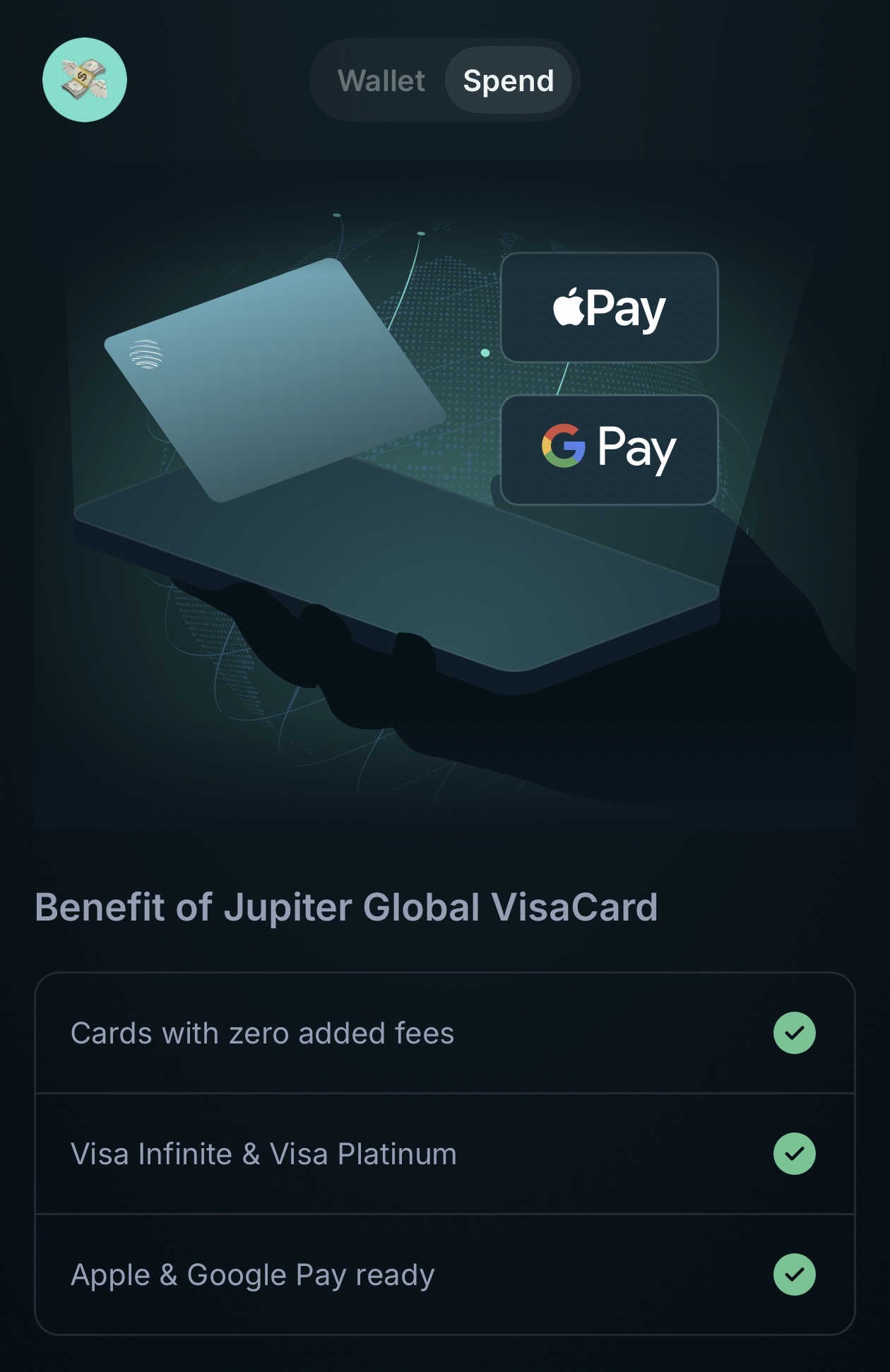
Jupiter Global is the consumer payments arm of Jupiter, Solana's dominant DEX aggregator (not a credit card). Launched January 2026, it combines a virtual Visa Infinite and Visa Platinum debit card issued by Rain or DCS (depending on region), QR Pay at mid-market rates with zero fees, and fiat remittance via virtual USD and EUR named bank accounts with local payouts in 20 currencies. USDC deposits convert 1:1 to USD. Card balance held in USD.
Two issuers: Rain (Americas, Africa, Middle East, APAC, supported US states; 1% FX, no spending limits) and DCS (Singapore, South Korea, Japan, Vietnam, Malaysia, Taiwan, Australia, Thailand, Philippines; 1.8% FX, $50K daily limit).
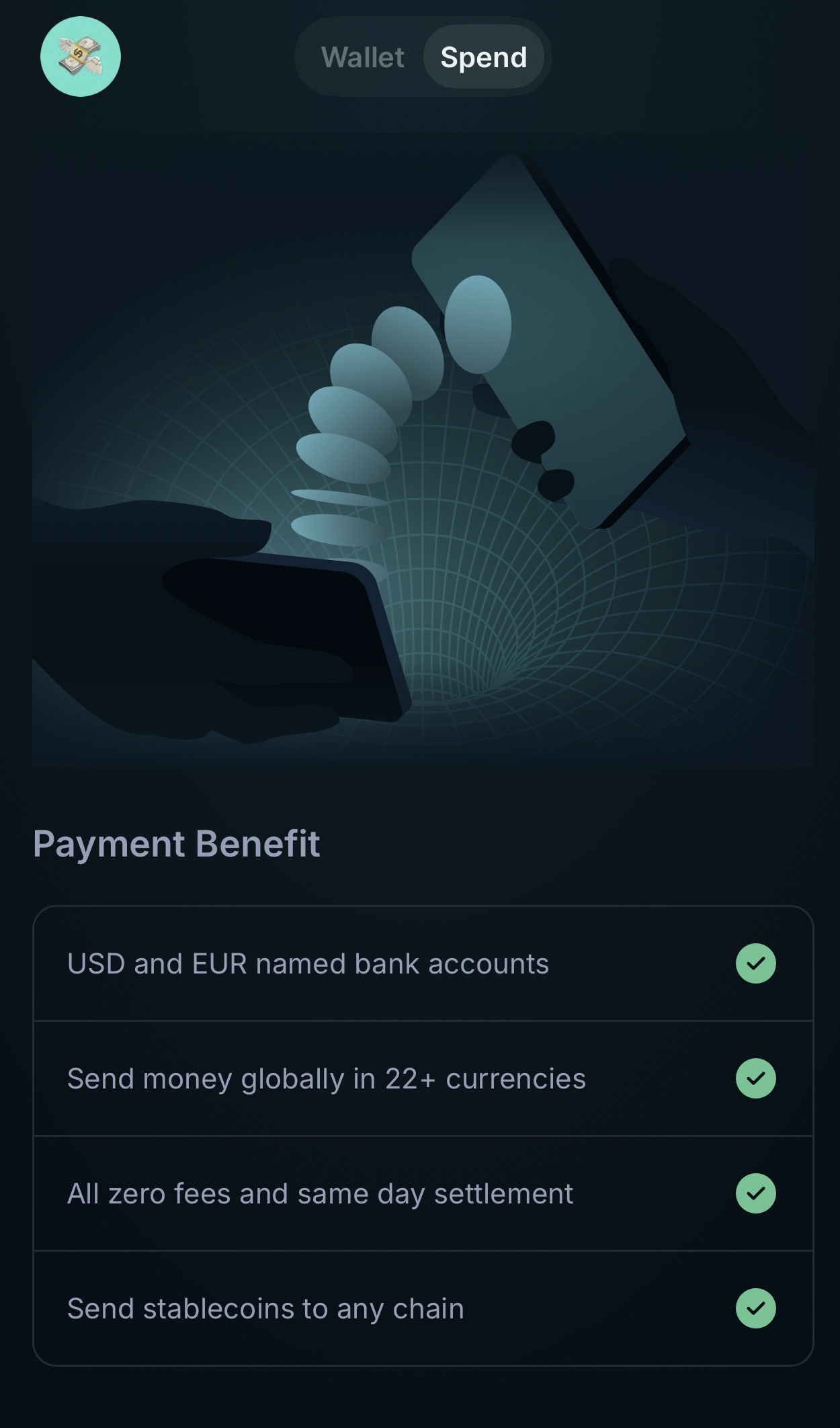
Jupiter is Solana's dominant DEX aggregator - it processes more swap volume on Solana than any other protocol, and the Jupiter app carries a 5.0 App Store rating. In January 2026, the team launched Jupiter Global - a virtual Visa card and payment platform that lets you deposit USDC 1:1 to USD and spend at any Visa merchant worldwide.
At launch, the product stood out mostly because it was unusually complete: card, QR Pay, remittance, named bank accounts, and US availability. From March 2026 it ran a rewards promotion that paid 4% on the base tier with higher referral tiers, and that promotion ran its course and ended June 30, 2026. The current model pays 2% cashback at the base tier on a free card, with a 4% rate you can hold only in months after referring 2 qualifying friends. That keeps Jupiter a genuinely useful free card, but it is no longer a headline-4% card.
The card is issued by two regulated partners depending on your country of residence. Rain covers the Americas (including supported US states), Africa, Middle East, and parts of APAC - with a 1% FX fee on non-USD payments and no spending limits. DCS covers Singapore, South Korea, Japan, Vietnam, Malaysia, Taiwan, Australia, Thailand, and the Philippines - with a 1.8% FX fee and a $50,000 daily limit. Payments made in USD have zero fees on both issuers. We verified these rates directly from Jupiter's published fee schedule.
Beyond the card, Jupiter Global includes QR Pay (scan-to-pay in selected APAC markets at mid-market rate with zero fees for both parties) and fiat remittance (virtual accounts in USD and EUR with SWIFT transfers to 200+ countries). The card is one piece of a full payments platform.
The Ecosystem
Jupiter Global Card - Free virtual Visa Infinite/Platinum debit card. Deposit USDC 1:1 to USD. 0% on USD payments. 1% FX (Rain) or 1.8% FX (DCS) on non-USD. Apple Pay and Google Pay. No spending limits on Rain cards.
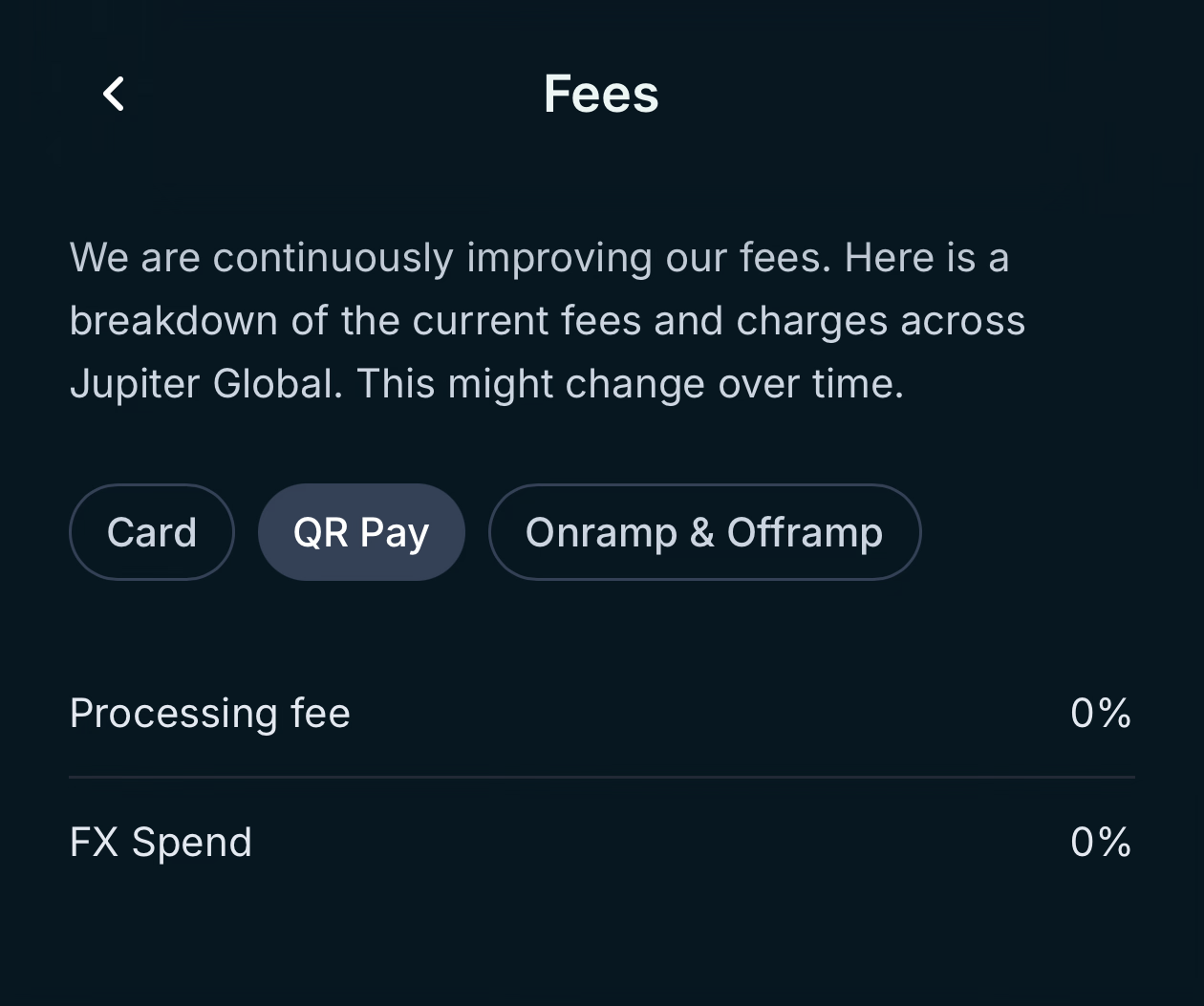
QR Pay - Scan-to-pay at merchants in selected APAC markets. Jupiter's docs list Vietnam, Thailand, the Philippines, and Singapore, but in-app availability appears broader and may be staged by account or issuer; we have live evidence of QR Pay use in Malaysia. Zero fees for payer and merchant. Mid-market rate with no spread. Daily limit: $5,000. Also supports peer-to-peer transfers. QR payments do not earn cashback.
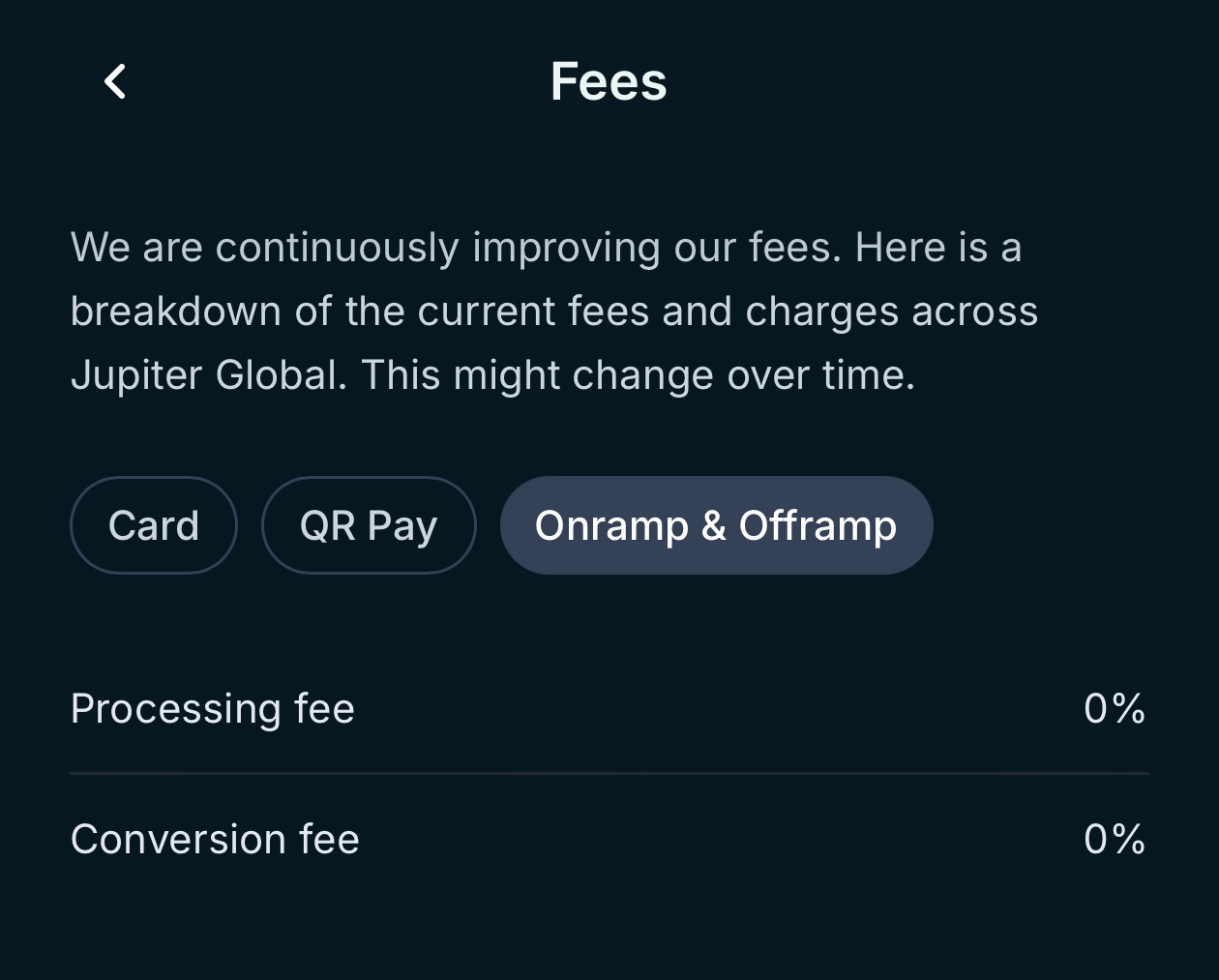
Fiat Remittance - Virtual accounts in USD and EUR. SWIFT transfers to 200+ countries. Local payouts in 20 currencies. No fees on transfers. Mid-market rate with no spread. Per-transfer limit: $10,000.
Available crypto cards by Jupiter in September 2026

1. Jupiter Global
Free virtual USDC card with 2% base cashback
Fees and Rates
| Fee | Rain | DCS |
|---|---|---|
| Annual fee | $0 | $0 |
| USDC deposit | 0% (1:1 to USD) | 0% (1:1 to USD) |
| USD payments | 0% | 0% |
| Non-USD payments (FX) | 1% | 1.8% |
| QR Pay | 0% (mid-market) | 0% (mid-market) |
| Remittance transfers | 0% (mid-market) | 0% (mid-market) |
Your card balance is held in USD, not USDC. Conversion from USDC to USD happens at the moment of deposit, not at the point of sale. This means there is no real-time conversion risk when you spend. The only fee is FX conversion when you pay in a non-USD currency.
For USD spending, Jupiter is free. For non-USD spending, the Rain 1% rate matches xPlace Standard and the former Solflare program, which has been paused since July 2026. It is lower than the DCS 1.8% rate. Jupiter and xPlace do not add a transaction fee on top of FX, so Jupiter's edge over xPlace comes from its 2% base cashback paid in USDC, not the fee structure.
Spending Limits
| Limit | Rain | DCS |
|---|---|---|
| Daily spending | No limit | $50,000 |
| Annual spending | No limit | $990,000 |
| QR Pay daily | $5,000 | $5,000 |
| Remittance per transfer | $10,000 | $10,000 |
Rain's lack of spending limits is notable. Most crypto cards cap at $30,000-$50,000/month. Rain-issued Jupiter cards have no published daily, monthly, or annual cap.
Fees and ROI Framework
$0 annual fee. USDC deposits 1:1 to USD with no fee. 0% on USD payments. FX on non-USD: 1% (Rain) or 1.8% (DCS). QR Pay: 0% at mid-market rate. Remittance: 0% at mid-market rate.
The base tier pays 2% cashback with a $100 monthly cap. That generates about $20/month on $1,000 spend, about $40/month on $2,000 spend, and reaches the full $100/month only once you cross $5,000. The 4% rate (cap $200) applies for a given month only after you refer at least 2 qualifying friends the prior month, and at 4% the $200 cap also binds at $5,000/month.
That means:
- for USD-heavy spend, Jupiter is a clean 2% free card with no annual fee and 0% on USD
- for Rain users spending in foreign currency, the 2% base leaves roughly 1% net after the 1% FX drag
- for DCS users, 1.8% FX nearly cancels the 2% base, so the value there leans on QR Pay rather than card cashback
Rewards accrue in USDC after settlement, then can be moved to the card balance (external-wallet withdrawals are currently disabled).
Rewards and Cashback
Jupiter's cashback is a two-state model, not a tiered ladder. The base state pays 2% on a free card, capped at $100 per month, so the first $5,000 of monthly spend generates the full $100 back. You can raise the rate to 4% (cap $200) for a single month by referring at least 2 qualifying friends during the previous calendar month, where a qualifying friend completes KYC and spends at least $50 on their own Jupiter Card. Referring just 1 person does not unlock it, and the boost expires unless you hit the 2-referral condition again the next month.
| Cashback state | Requirement | Rate | Monthly cap |
|---|---|---|---|
| Base | None | 2% | $100 |
| Boosted (next month only) | Refer 2 qualifying friends this month | 4% | $200 |
The honest way to read this:
- most users should treat Jupiter as a 2% free USDC card
- the 4% rate is a monthly retention offer that depends on referring people, not a permanent upgrade
- the 4% base and the 5%, 8%, and 10% referral tiers were part of a launch promotion that ran its course and ended June 30, 2026
Cashback is credited after each transaction settles, lands in your USDC Rewards balance, and can be moved to the card balance instantly and free. External-wallet withdrawals are currently disabled. ATM withdrawals, P2P transfers, QR payments, refunds, fees, financial services, money transfers, gambling, and government payments do not earn cashback.
Dual-Mode Architecture
Jupiter Global runs two modes:
Pure DeFi Mode - Fully self-custodial. Your Solana wallet is independent of Jupiter Global. Trade, swap, DCA, limit orders - all on-chain with your own keys. Jupiter does not touch your wallet funds.
Secure Global Mode - Enables the Visa card, QR Pay, and fiat remittance. You deposit USDC which converts to USD in your card account. Card balances are managed by the issuing partner (Rain or DCS). Your on-chain wallet remains separate and self-custodial.
KYC via Jupiter ID: Open the Jupiter app, switch to Global mode, complete identity verification (government ID + selfie, 2-4 minutes via SumSub). APAC regions also require proof of address. Jupiter ID is reusable across Jupiter products but cannot be deleted once verified.
How to Apply for the Jupiter Crypto Card
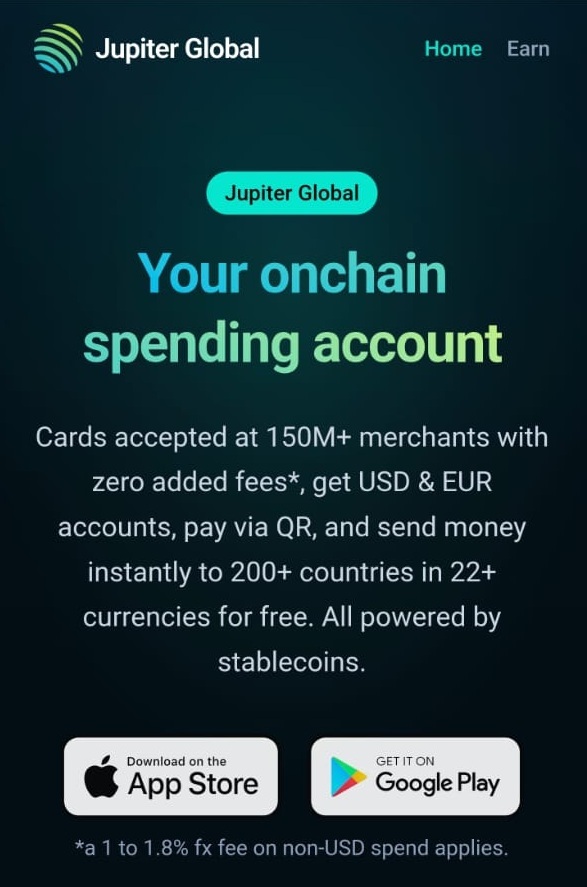
SpendNode app screenshot
Step 1. Download the App. Use the Apply button or SpendNode's Jupiter link, then enter code YWQQ5GYL at signup to unlock the $20 reward after $1,000 of eligible spend in your first 30 days. You can also search for Jupiter in the App Store or Google Play. This is the same app used for swaps, DCA, and limit orders on Solana. The card lives inside the Global section.
Step 2. Create a Wallet. Tap Add Account and sign up with email, Google, X, or Discord. You can also import an existing Solana wallet. Every option creates a non-custodial embedded wallet, meaning you hold the private keys regardless of how you log in. No KYC at this stage, this is just your Solana wallet.

SpendNode app screenshot
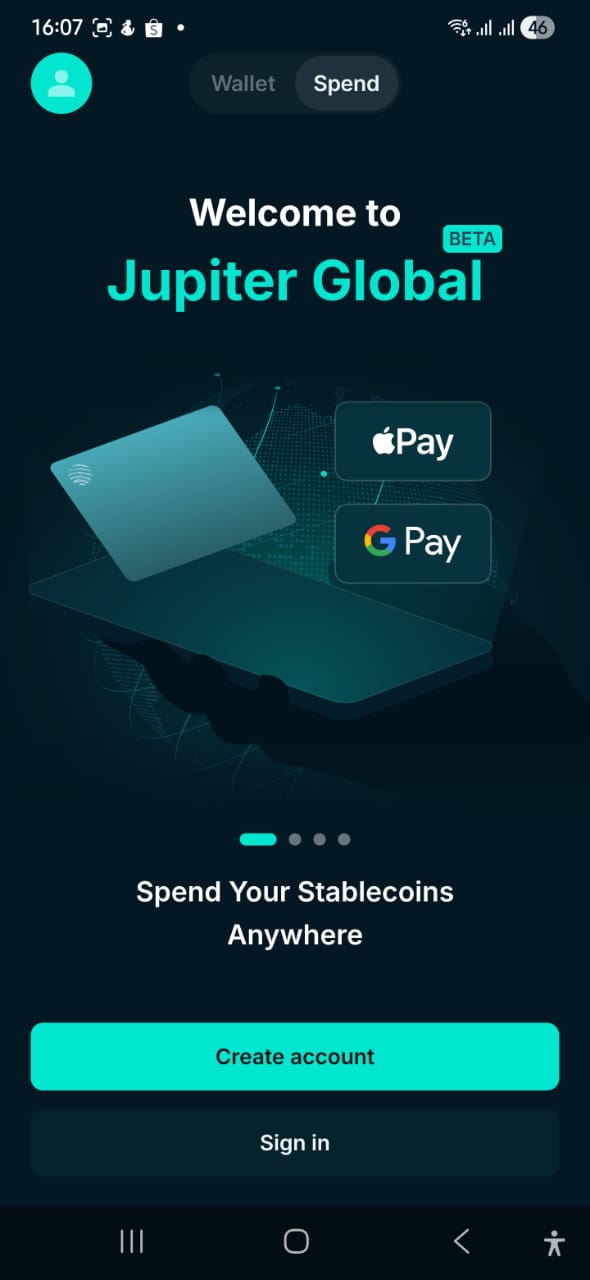
Step 3. Open the Spend Tab. Tap Spend in the top navigation. This is where the card, QR Pay, and fiat remittance features live. If you do not see it, make sure you are in Global mode.
SpendNode app screenshot
Step 4. Create Your Card Account. Inside the Spend tab, tap Create Account. This is a separate account from your wallet - it is specifically for the card and payment features.
Step 5. Complete KYC. Jupiter uses SumSub for identity verification. You will need a government-issued ID and a selfie. APAC users may also need proof of address. Verification usually completes in 2-4 minutes. Once approved, your virtual card is issued immediately.
SpendNode hands-on test: We used the Jupiter Global card for several days during the March 2026 launch campaign, when the base rate was still 4%. The cashback paid out and matched every transaction, showed as pending for roughly 24 hours, then cleared, and withdrawal to the card balance was near-instant. The mechanics work as advertised; note the base rate has since dropped to 2%. Two things to know: customer support is helpful when you reach them, but replies often take more than a few days. There are also frequent complaints about OTP codes not arriving on mobile when trying to view your card details in the app.
Countries and Availability
Jupiter is available in 53 countries as of September 2026. We count a country here when at least one active Jupiter card variant lists it, so individual product pages may be narrower.
Available Regions
Africa
Cote d'Ivoire (CI), Egypt (EG), Ghana (GH), Kenya (KE), Morocco (MA), Nigeria (NG), Senegal (SN), South Africa (ZA), Uganda (UG), Zambia (ZM)
Americas
Antigua and Barbuda (AG), Argentina (AR), Bahamas (BS), Barbados (BB), Belize (BZ), Bolivia (BO), Brazil (BR), Cayman Islands (KY), Colombia (CO), Costa Rica (CR), Dominica (DM), Dominican Republic (DO), Ecuador (EC), El Salvador (SV), Grenada (GD), Guatemala (GT), Guyana (GY), Honduras (HN), Mexico (MX), Panama (PA), Paraguay (PY), Peru (PE), Puerto Rico (PR), Saint Kitts and Nevis (KN), Saint Lucia (LC), Saint Vincent and the Grenadines (VC), Suriname (SR), Trinidad and Tobago (TT), Turks and Caicos Islands (TC), United States (US), Uruguay (UY)
Asia
Japan (JP), Malaysia (MY), Pakistan (PK), Philippines (PH), Singapore (SG), South Korea (KR), Taiwan (TW), Thailand (TH), United Arab Emirates (AE), Vietnam (VN)
Oceania
Australia (AU), New Zealand (NZ)
Major Restricted Markets
These major markets are not currently listed for this vendor. Confirm eligibility with the issuer before applying, especially where card tiers have different country rules.
Americas
Canada (CA), Chile (CL)
Asia
China (CN), Hong Kong (HK), India (IN), Indonesia (ID), Turkey (TR)
Europe
Austria (AT), France (FR), Germany (DE), Italy (IT), Netherlands (NL), Poland (PL), Portugal (PT), Spain (ES), Switzerland (CH), United Kingdom (GB)
Jupiter vs Other Cards
For Solana USDC holders:
- Solflare: paused as of July 2026 (issuer wound down); when live, 1% FX on all non-USD, raffle rewards, EEA/UK only.
- Jupiter Global (Rain): 1% FX, 0% on USD, no spending limits, global (Americas, Africa, Middle East, APAC, US). Wider reach, same FX rate.
- xPlace: 1% FX at Basic (0% at Platinum), no transaction fee, and 0.5-2% USDC cashback in Credit Mode with monthly caps. Jupiter's free 2% base tops xPlace Basic and Silver on rate; Gold and Platinum carry annual fees and caps, so compare net rewards and FX for your spend.
- KAST: 0.5-1.75% FX, 1.5% USD cashback on first $2K/mo. Jupiter's 2% base on USD spend edges KAST's headline rate, though KAST wins on country breadth.
For US residents specifically:
- Jupiter (Rain) is one of the few Solana-native cards available in the US. Gemini is the main alternative (credit card, 4% cashback). KAST serves some US users. Solflare is paused globally, while Gnosis Pay is not available in the US.
For APAC users:
- Jupiter QR Pay at 0% fees and mid-market rate is unmatched. DCS-issued card has 1.8% FX (higher than Rain's 1%), but QR Pay bypasses this entirely where accepted.
For free-card reward seekers:
- Jupiter Global is a solid free option: 2% stable-value USDC cashback with no annual fee and 0% on USD spend.
- Gemini pays up to 4% but it is a US-only credit card and a different product shape.
- Kolo settles cashback in BTC rather than USDC, but at 1% ongoing (2% for the first 30 days, capped $100/month) it pays less than Jupiter's 2% on USD spend, whose own $100/month cap only binds at $5,000 of monthly spend. Jupiter's higher, steadier rate wins unless you specifically want BTC accumulation.
Competitor Comparison
- vs Solflare: Solflare's former EEA/UK program charged 1% FX on non-USD spending and used raffle rewards, but both its virtual and physical cards have been paused since July 2026. Jupiter Rain matches that former 1% FX rate, serves a wider geography, and remains available. The returning Solflare card's fees and rewards have not been announced.
- vs xPlace: xPlace charges 1% FX at Basic (down to 0% at Platinum) and no transaction fee. Credit Mode pays 0.5-2% USDC across tiers, each capped monthly; Cash Mode pays no cashback. Jupiter's free 2% base tops the Basic, Silver, and Gold headline rates without an annual fee, while xPlace's low-FX paid tiers suit a different spending pattern.
- vs KAST: KAST offers 0.5-1.75% FX with 1.5% USD cashback on the first $2,000/month. Jupiter's 2% on USD spend edges the base-rate comparison and is stronger in the US; KAST wins on country breadth.
Who Should Use Jupiter?
Ideal user profile:
- Solana-native user already in the Jupiter ecosystem
- Holds USDC and wants to spend it without an exchange withdrawal
- US-based and needs a Solana spending card (Rain issuer, supported states)
- Values zero fees on USD spending
- APAC-based and wants QR Pay at mid-market rate with no fees
- Needs fiat remittance (USD/EUR virtual accounts, SWIFT to 200+ countries)
Who should avoid:
- Users who will blow past the monthly cashback cap and want uncapped or easier-to-scale reward economics
- Users who need a physical card or ATM access (virtual only)
- DCS region users who want the lowest FX rate (1.8% is higher than Gnosis Pay's 0%; the paused Solflare program formerly charged 1%)
- Users who need a proven card with years of track record (launched January 2026)
The verdict: Jupiter Global is a genuinely useful free card, especially for Solana-native users who already hold USDC. The 2% base cashback in USDC, 0% USD spend, solid Rain economics, QR Pay, and fiat remittance make it a clean daily driver for USD-heavy spenders.
Just size it correctly. The base rate is 2%, not 4%, and the 4% rate is a monthly retention offer that depends on referring 2 people. For a Rain user spending mostly in USD, that 2% with no fees is the real pitch. For a DCS user whose spend is in local currency, the 1.8% FX nearly cancels the base rate, so the value there comes from QR Pay rather than card cashback.
Real User Scenarios
Scenario 1: Marcus (US-Based Developer, Rain Issuer, $3,000/month)
Setup:
- Jupiter Global card (Rain, free)
- Holds USDC from freelance income
- Mostly USD spending
Monthly math:
- Cashback: 2% base on $3,000 = +$60 (under the $100 cap)
- USDC deposit: 1:1 to USD ($0 cost)
- USD payments: 0% fee
- Net monthly result: +$60
- Net annual result: +$720
His verdict: "I already used Jupiter for swaps every day, and the card is a clean off-ramp. At 2% on all-USD spend with no fees, it is a solid daily driver, and if I bother to refer two friends I can push a month to 4%."
Scenario 2: Yuki (Tokyo, DCS Issuer, JPY 350,000/month)
Setup:
- Jupiter Global card (DCS, free)
- All spending in JPY (non-USD)
Monthly math (roughly $2,500 of JPY spend):
- Cashback: 2% base = +$50
- USDC deposit: 1:1 ($0)
- FX fee: 1.8% on JPY spending = approximately -$45/month
- Net monthly result: roughly +$5 before any QR Pay savings
- Net annual result: roughly +$60 before any QR Pay savings
Her verdict: "On the DCS card the 1.8% FX almost cancels the 2% base, so card cashback is close to break-even for my JPY spend. What actually makes it worth carrying is QR Pay at 0% where merchants support it."
Scenario 3: Ana (Sao Paulo, Rain Issuer, $1,500/month mixed USD/BRL)
Setup:
- Jupiter Global card (Rain, free)
- 40% USD online purchases, 60% BRL local spending
Monthly math:
- Cashback: 2% of $1,500 = +$30/month
- USD portion ($600): 0% fee
- BRL portion ($900): 1% FX = -$9/month
- Net monthly result: +$21
- Net annual result: +$252
Her verdict: "The Jupiter pitch for me is mostly lower FX than my bank, plus a bit of cashback on top. I get paid in dollars, spend from the same pool, and the 2% covers the BRL FX drag with a little left over."
Is Jupiter Safe?
Your USDC in Pure DeFi mode:
- Self-custodial. Your Solana wallet seed phrase works independently. Import into Phantom, Backpack, or any Solana wallet.
- Expected recovery: 100%
Your USD card balance in Secure Global mode:
- Held by Rain or DCS (regulated issuers), not by Jupiter directly. If Jupiter ceases operations, the issuer manages the wind-down. Card balances are not covered by deposit insurance (FDIC, FSCS).
- Visa chargeback protections apply to disputed transactions.
Your fiat account balances:
- USD/EUR balances depend on the regulated partner's wind-down process.
Risk level: Very low for on-chain assets (self-custodial). Low-to-moderate for card and fiat balances (issuer-dependent). Jupiter's position as Solana's largest DEX provides operational stability, but the Global payments arm launched January 2026.
Is Jupiter a Scam?
Jupiter is not a scam, and the evidence is mostly already on this page. The affirmative case for authenticity rests on four things:
1. The parent protocol is not new. Jupiter itself is Solana's dominant DEX aggregator and routes more swap volume on Solana than any other protocol. The Jupiter Global payments arm is new (launched January 2026), but it is bolted onto a protocol team and product that existed long before the card. It is not an anonymous launch with no history.
2. The card issuer is not Jupiter. Cards are issued by Rain or DCS depending on your country of residence, as described in the regions section above. Both are named regulated partners. The card runs on Visa Infinite / Visa Platinum rails with Visa chargeback protections, not a white-label prepaid brand.
3. The fund flow is documented end-to-end. Deposit USDC from your Solana wallet. It converts 1:1 to USD at deposit time. The USD balance is held by Rain or DCS until you spend. Rewards accrue in USDC in your Rewards balance and can be moved to the card balance instantly and free (external-wallet withdrawals are currently disabled). The custody is hybrid by design, self-custodial on the DeFi side and issuer-custodial on the card side, and both halves are explained in the Dual-Mode Architecture section rather than obscured.
4. KYC runs through a recognizable provider. Identity verification is handled through Jupiter ID, powered by SumSub. The flow is standard: government ID plus selfie, 2-4 minutes, with proof of address required in APAC. It is not a bespoke in-house KYC system.
What to be aware of
- Product age. Jupiter Global launched January 2026, and cashback went live March 26, 2026. Neither arm has a multi-year track record for incident response, fraud handling, or issuer wind-down scenarios.
- No deposit insurance. Card balances are not FDIC (US) or FSCS (UK) insured. They are prepaid balances held by a regulated partner and inherit whatever wind-down process that partner uses.
- Issuer-split limits you cannot negotiate. DCS users are bound by a $50,000 daily and $990,000 annual cap. Rain users have no published cap. Jupiter cannot waive either, because both limits are set by the issuer, not by Jupiter.
- Single-app dependency. The card, QR Pay, Rewards balance, and remittance features all live inside the Jupiter app. Any outage affects all of them at once.
SpendNode Verified: The editorial team reviewed Jupiter's issuer identity, product terms, and live card flow per our methodology. Verification is not an endorsement or guarantee.
Sources and Verification
Jupiter Crypto Card Volume
Real card activity measured from onchain settlement data. Not self-reported.
Latest closed week
Week ending September 20, 2026
Observed spend
$1.7M
Week over week
-2.8%
Frozen seven-day result using the same measurement boundary as the monthly series. Read the weekly report
- Card spend (Aug 2026)
- $7.1M
- Card transactions
- 79.0K
- Active wallets
- 17.6K
- Month over month
- -5.7%
| Month | Card spend | Card transactions | |
|---|---|---|---|
Sep 2026partial through Sep 20 | $5.1M | 58.8K | |
Aug 2026 | $7.1M | 79.0K | |
Jul 2026 | $7.5M | 80.6K | |
Jun 2026 | $1.4M | 2.4K | |
May 2026 | $1.6M | 2.3K | |
Apr 2026 | $3.0M | 4.7K | |
Mar 2026 | $629K | 900 | |
Feb 2026 | $68K | 51 | |
Jan 2026 | $464K | 227 | |
Dec 2025 | $84K | 52 |
Our read: August settlement volume finished at $7.1M, 6% below July, while transaction count declined only 2%. Average settled purchase size therefore eased more than payment frequency. Both the legacy and main Solana lanes are included across the August collector rotation.
How this is measured: Per-user USDC/USDT card-spend settlement batches into Jupiter's dated collector sequence on Solana. The verified legacy lane overlaps with a main collector that rotated on August 8, 2026; dust probes and treasury-sized transfers are excluded. This measures card spend settled onchain rather than individual authorization-time swipes. Jupiter's Rain-issued EVM side is not yet included, so totals are conservative. The series begins December 2025. Active wallets are distinct Jupiter user accounts settling card spend per month.
Chains: Solana - Source: Direct chain data, Dune indexed tables, and public chain explorers; queries by www.spendnode.io - Updated 2026-09-21 - Methodology
Written by Aleksandar Dukic
Frequently Asked Questions
Is Jupiter crypto card available in the United States?
Yes. Jupiter crypto card is available in the United States.
How do I fund Jupiter Global?
Deposit USDC on Solana through the Jupiter app. It is credited 1:1 in USD with no deposit fee. The card balance is held in USD after deposit.
Does Jupiter Global offer cashback?
Yes. The base tier pays 2% cashback with a $100 monthly cap, credited automatically in USDC after each transaction settles. You can raise the rate to 4% (with a $200 monthly cap) for a given month by referring at least 2 qualifying friends during the previous calendar month, where a qualifying friend completes KYC and spends at least $50 on their own Jupiter Card.
The higher rate applies only for the following month, and rewards land in your USDC Rewards balance for instant, fee-free withdrawal to your card balance.
Is Jupiter Global physical or virtual?
It is currently a digital card only inside the Jupiter app. A physical card has been discussed, but no confirmed launch date is published.
What fees does Jupiter Global charge?
There is no annual fee, no USDC deposit fee, and no fee on USD payments. Non-USD card payments incur 1% FX on Rain-issued cards or 1.8% FX on DCS-issued cards. DCS cards also carry the tighter published spending limits.
Do QR Pay and remittance change where the card is available?
No. They are separate Jupiter Spending features. QR Pay covers selected APAC markets: Jupiter's docs list Vietnam, Thailand, the Philippines, and Singapore, though in-app availability appears broader, with live use observed in Malaysia. Remittance runs through virtual fiat accounts and local payouts, but that does not mean the card itself is live in every remittance corridor.
Is Jupiter Global a credit card?
No. It is a Visa debit card funded from your deposited USDC balance after conversion to USD. There is no revolving credit line, APR, or standard credit underwriting.
Does Jupiter Global have a promo code or discount?
Yes. The Jupiter Global promo code is YWQQ5GYL. If you sign up through SpendNode's Jupiter link, that code is automatically applied and you unlock a $20 reward after spending $1,000 in your first 30 days.
Is the YWQQ5GYL code for Jupiter Global still working in September 2026?
Yes. YWQQ5GYL is still a working Jupiter Global code as of September 24, 2026 - we re-verify it daily. It unlocks the $20 new-user reward after $1,000 of spend in your first 30 days.
User Reviews
Reviews are moderated and may take a moment to appear.
Latest Page Changes to the Jupiter Review
- Jupiter lowered the first-month welcome bonus to $100
- Jupiter Global launched 4-10% cashback, monthly caps, Earn Balance mechanics, and in-app Earn tier screenshots
App Store (56 ratings)
Source: Apple App Store - Updated Feb 2026