

Kolo Crypto Cards Review 2026
Compare Kolo crypto cards and review issuer terms, fees, and availability.

Prefer mobile? Scan to continue
Opens the mobile signup with your SpendNode link.

SpendNode Rating for Kolo
Kolo is interesting because the proposition is clear and easy to like, but the issuer still feels much smaller than the names it competes with on headline value.
The card concept works. The issuer score is held back more by scale and market depth than by the core product idea itself.
Issuer Snapshot
Editorial vendor score stays separate from user reviews. Methodology
Product Quality
3.5
Trust & Custody
3.4
Fee Transparency
3.5
Operational Reliability
3.1
Market Relevance
3.2
On This Page
What Is Kolo?
Kolo is a custodial crypto card platform offering a Visa Platinum virtual prepaid card with zero annual fee, zero FX markup on stablecoins, and broad global availability outside the US and sanctioned jurisdictions. Kolo's own homepage cites 10 million users worldwide. The product runs through a Telegram mini-app and iOS/Android app flow with Sumsub KYC.
Kolo now issues the card in two settlement currencies, a USD card and a EUR card, and its cashback is a defined, capped program: 2% in BTC for your first 30 days, then 1% after that, on both cards. Rewards are capped at $100/EUR 100 per month and at $1/EUR 1 per transaction ($2/EUR 2 during the intro), so a single large purchase still earns only the capped amount. That makes Kolo a free, low-friction way to stack small amounts of Bitcoin on everyday spend rather than a rewards maximizer for big-ticket buying.
Available crypto cards by Kolo in October 2026
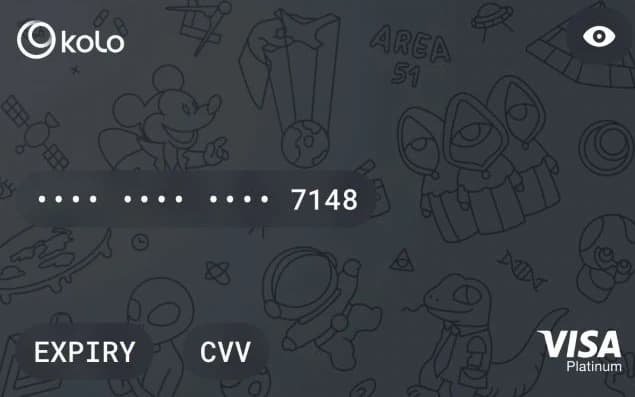
1. Kolo Card
Earn Bitcoin on Purchases: 2% for 30 Days, Then 1% (Capped) + Visa Platinum + 170+ Countries
Kolo Card Promo Code: Sign Up With p692265
Use SpendNode's Kolo Card link to sign up with code p692265 attached automatically. After registration, users can apply for Kolo's virtual Visa Platinum with a $0 annual fee, BTC cashback (2% for 30 days, then 1%), and a 10 USDC activation charge returned to the card balance.
| Offer detail | Current card offer |
|---|---|
| Kolo Card promo code | p692265 |
| How it is applied | Automatically through SpendNode's link |
| Card | Virtual Visa Platinum (USD or EUR) |
| Annual fee | $0 |
| Cashback | 2% BTC for 30 days, then 1% (capped $100/month) |
| Activation | 10 USDC returned to the card balance |
How to use the Kolo Card promo code
- Open SpendNode's Kolo Card link.
- Create your Kolo account with code p692265 attached to the signup URL.
- Complete Sumsub identity verification in the Kolo app.
- Request the virtual card and complete the 10 USDC activation; Kolo returns that amount to the card balance.
Who runs Kolo, and under which regulator
Kolo is operated jointly by Hardline Holdings Limited (Kazakhstan, registered with the Astana Financial Services Authority) for the website/app layer and card services, and BURVIX SP. Z O. O. (Poland) for crypto-asset services. The Terms note a regulated-service-provider migration: Cryppo UAB, a Lithuanian VASP, provided crypto-asset services up to and including 31 December 2025. From 1 January 2026 onwards, those services are provided by BURVIX SP. Z O. O. under Polish law.
Card services themselves are issued in collaboration with Signify Holdings Inc. and run on Raincards rails. Kolo is marketed as MiCA-ready and Travel Rule aligned, which matters for EEA users who want a compliance story that lines up with the current EU framework.
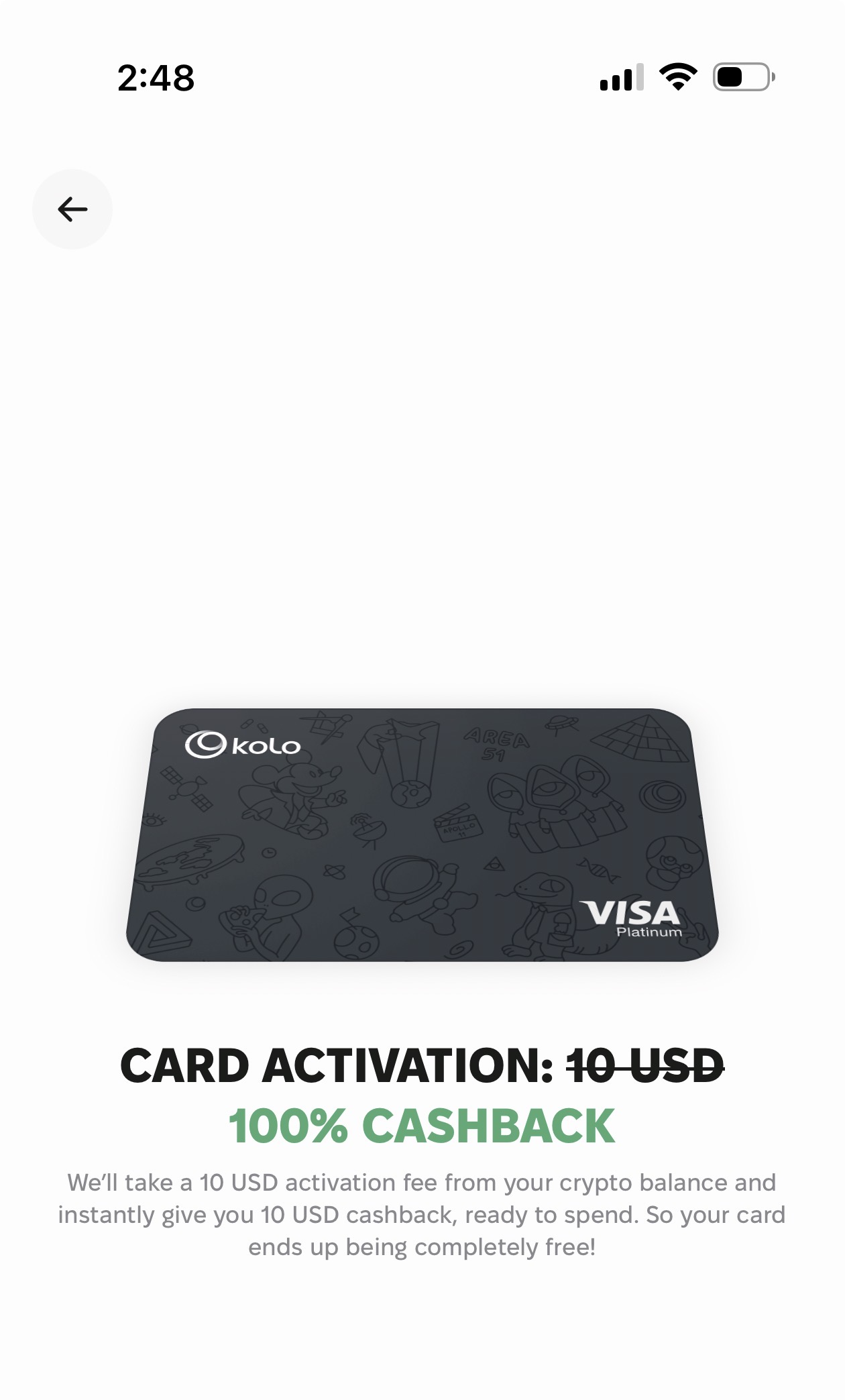
SpendNode app screenshot
Card activation: 10 USDC, then refunded back to balance. Kolo presents activation as effectively free because the fee is returned to the card balance.
USD card vs EUR card
Both are the same Visa Platinum product with the same cashback structure. The settlement currency is the main difference, and it changes the FX math: a euro-zone resident spending in EUR avoids the crypto-to-USD-to-EUR round-trip that the USD card involves on euro purchases.
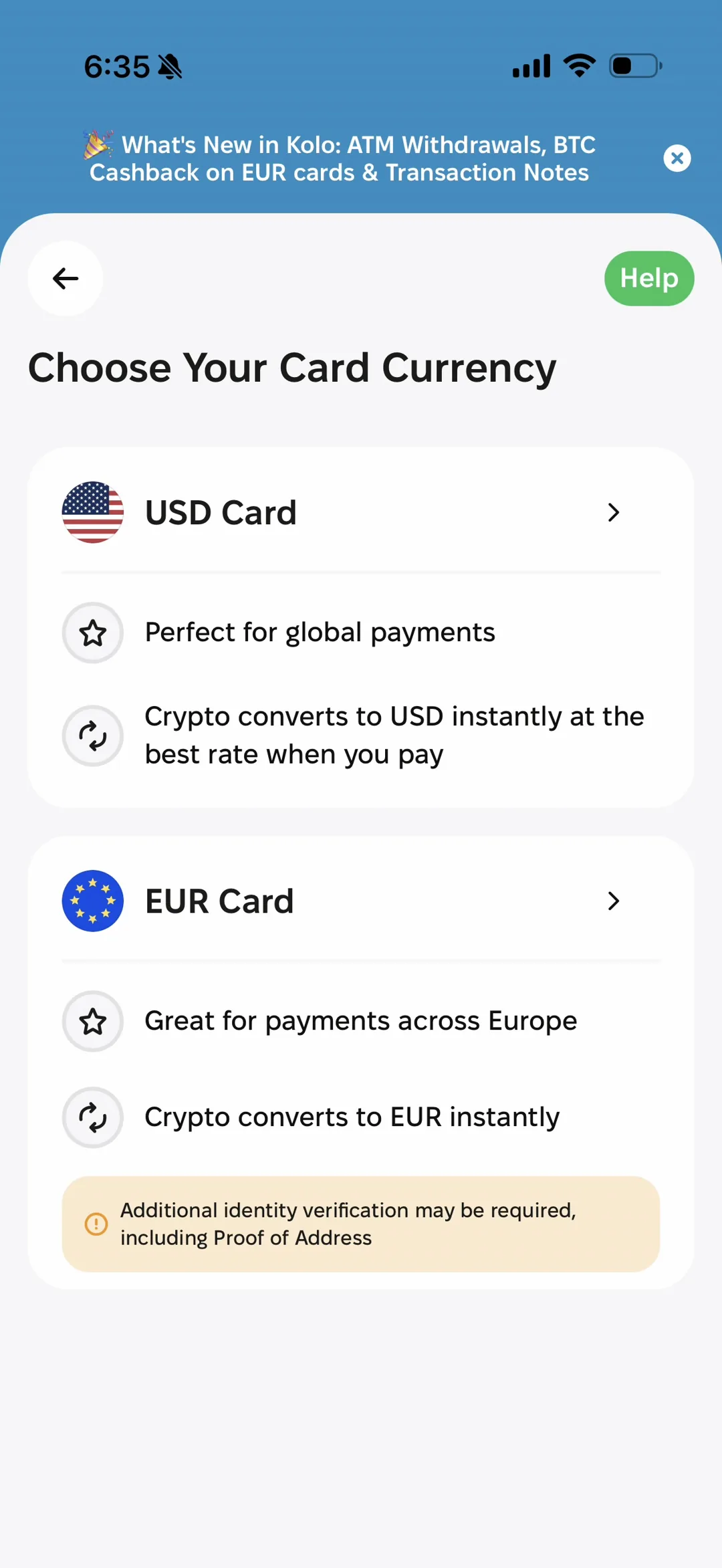
SpendNode app screenshot
Choose USD or EUR at signup. Kolo issues the card in either settlement currency; the EUR card flags that additional identity verification (including proof of address) may be required.
| Detail | USD card | EUR card |
|---|---|---|
| Settlement currency | USD | EUR |
| Intro cashback | 2% BTC for 30 days | 2% BTC for 30 days |
| Ongoing cashback | 1% BTC | 1% BTC |
| Minimum transaction | $1 | EUR 1 |
| Per-transaction reward cap | $2 intro / $1 ongoing | EUR 2 / EUR 1 |
| Monthly reward cap | $100 | EUR 100 |
| Intro period starts | Card activation | First EUR-card issue (or 24 July 2026 for prior holders) |
| Cashback clearing | Usually 1-3 days | Up to 14 days |
| Verification | Standard flow | Additional verification may be required (e.g. proof of address) |
| Advertised coverage | 170+ countries | 130+ countries |
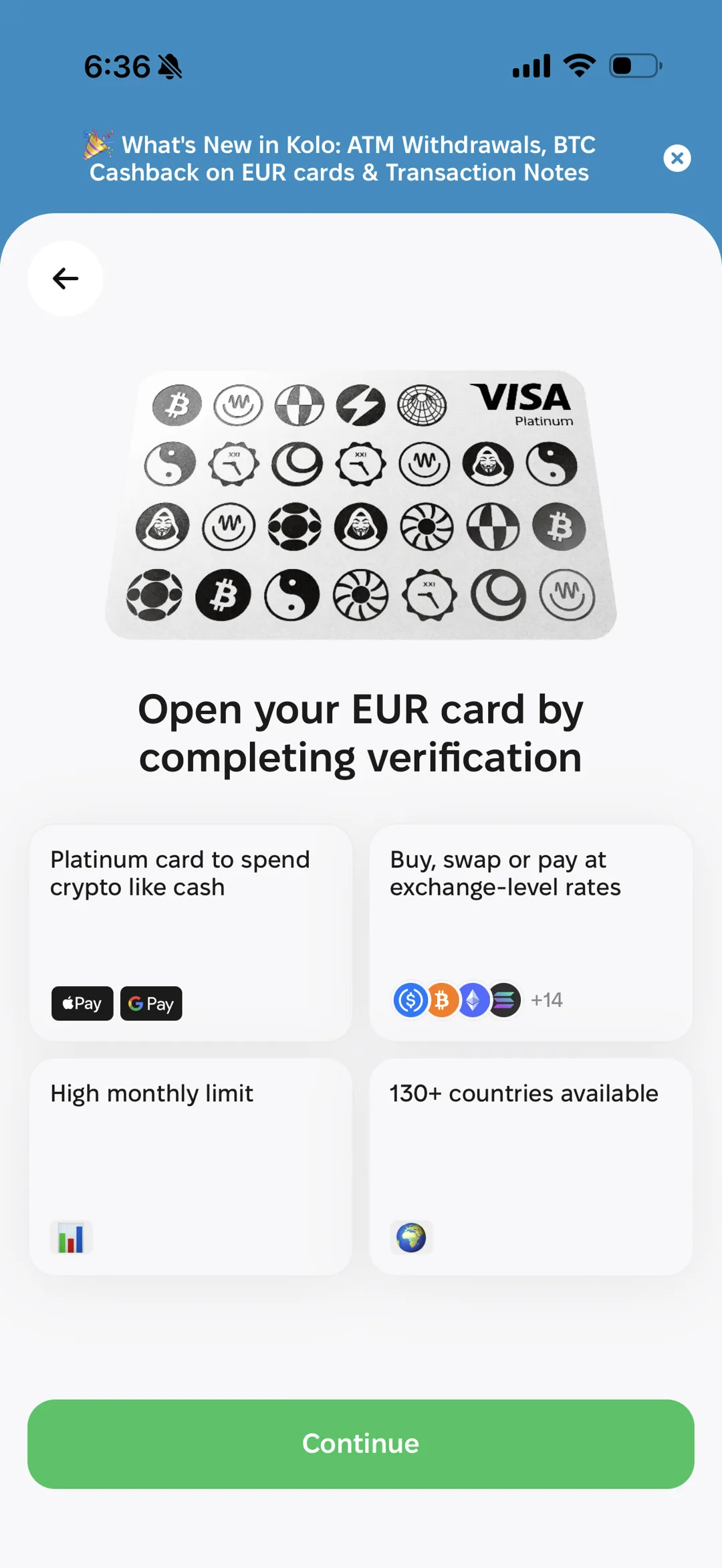
SpendNode app screenshot
Opening the EUR card requires completing verification. It is a Visa Platinum card with Apple Pay and Google Pay, exchange-level conversion, a high monthly limit, and 130+ country coverage.
What Still Looks Solid
- Cashback: 2% BTC for the first 30 days, then 1%, capped at $100/month
- Annual fee: $0
- Stablecoin spend: 0% markup on USDT, USDC, and EURC
- Coverage: 170+ countries (USD) / 130+ (EUR), outside the US and sanctioned markets
- Wallet rails: 7 supported networks across Ethereum, BNB Chain, Arbitrum, Base, Solana, Stellar, and Polygon
- Apple Pay and Google Pay: supported at Visa contactless terminals
- Direct SEPA bank send: crypto-to-fiat transfers straight from the Kolo wallet to Revolut, Wise, N26, or any SEPA bank account without routing through an exchange
- Regulatory story: MiCA-ready, Travel Rule aligned, Sumsub KYC, Polish VASP from January 2026
The SEPA send feature is worth calling out separately. Being able to send EUR directly from a crypto wallet to a European bank account without touching a separate exchange has real value for EEA users and for anyone sending money to relatives in euro-bank countries, independent of the cashback rate.
Where the Caution Is
Two things temper the reward story. First, the caps: at 1% with a $1-per-transaction cap, a $500 purchase still earns only $1, and monthly rewards stop at $100. Reaching that ceiling at the ongoing rate takes a lot of small transactions, so Kolo's real-world cashback is modest and front-loaded to the first 30 days. Second, Kolo's Terms of Use reserve the right to change reward rates and limits at any time, and Kolo has cut its rate before, so treat the current program as accurate but not guaranteed to last.
Fees and Spend Economics
Kolo's strongest claim is still that stablecoin spending is cheap.
| Spending Method | Current Positioning |
|---|---|
| USDT / USDC / EURC | 0% Kolo markup |
| Other crypto | Exchange-level conversion with spread risk (approx. 0.3-1%) |
| Non-USD/EUR purchases | Network FX rate still applies |
| Annual fee | $0 |
| Activation | 10 USDC returned to balance |
| ATM withdrawal | $1.00 + 0.65% (published), $500/withdrawal, 3/day |
Kolo now supports ATM withdrawals, with published limits of $500 per withdrawal and three withdrawals per 24 hours, and a published fee of $1.00 plus 0.65% of the amount (a balance inquiry or declined ATM transaction costs $0.60). ATM-operator surcharges and currency conversion may also apply, and these figures are published in USD terms. Kolo remains a virtual card, and ATM withdrawals are a separately published feature.
If you are spending from USDC or EURC, Kolo still looks structurally cleaner than many prepaid competitors that stack a conversion spread on top of FX. That is the main reason the card remains relevant even with a capped, modest cashback rate.
Rewards and Cashback
Kolo's cashback is a structured, capped program rather than a flat rate:
- First 30 days: 2% in BTC
- After 30 days: 1% in BTC
- Per-transaction cap: $2 in BTC during the intro, $1 after (euro equivalents on the EUR card)
- Monthly cap: $100 (or EUR 100) in BTC
- Minimum transaction: $1 / EUR 1
- Payout: daily in BTC, valued at Kolo's authorization-time rate
- Excluded: business cards and co-branded/affiliate cards
The per-transaction cap matters most here. Because ongoing rewards are capped at $1 per transaction, full 1% cashback only applies up to about $100 of spend per purchase; anything above that still earns $1. In short, Kolo is now:
a zero-fee global prepaid crypto card paying capped BTC cashback (2% for 30 days, then 1%, max $100/month), strongest when used for stablecoin-funded everyday spend.
How to Apply for the Kolo Crypto Card
Kolo runs as a Telegram mini-app alongside its iOS and Android apps, so sign-up can begin inside a chat rather than a standalone download. It is a custodial prepaid card, available across most of the world apart from the US and sanctioned markets. The flow:
SpendNode app screenshot
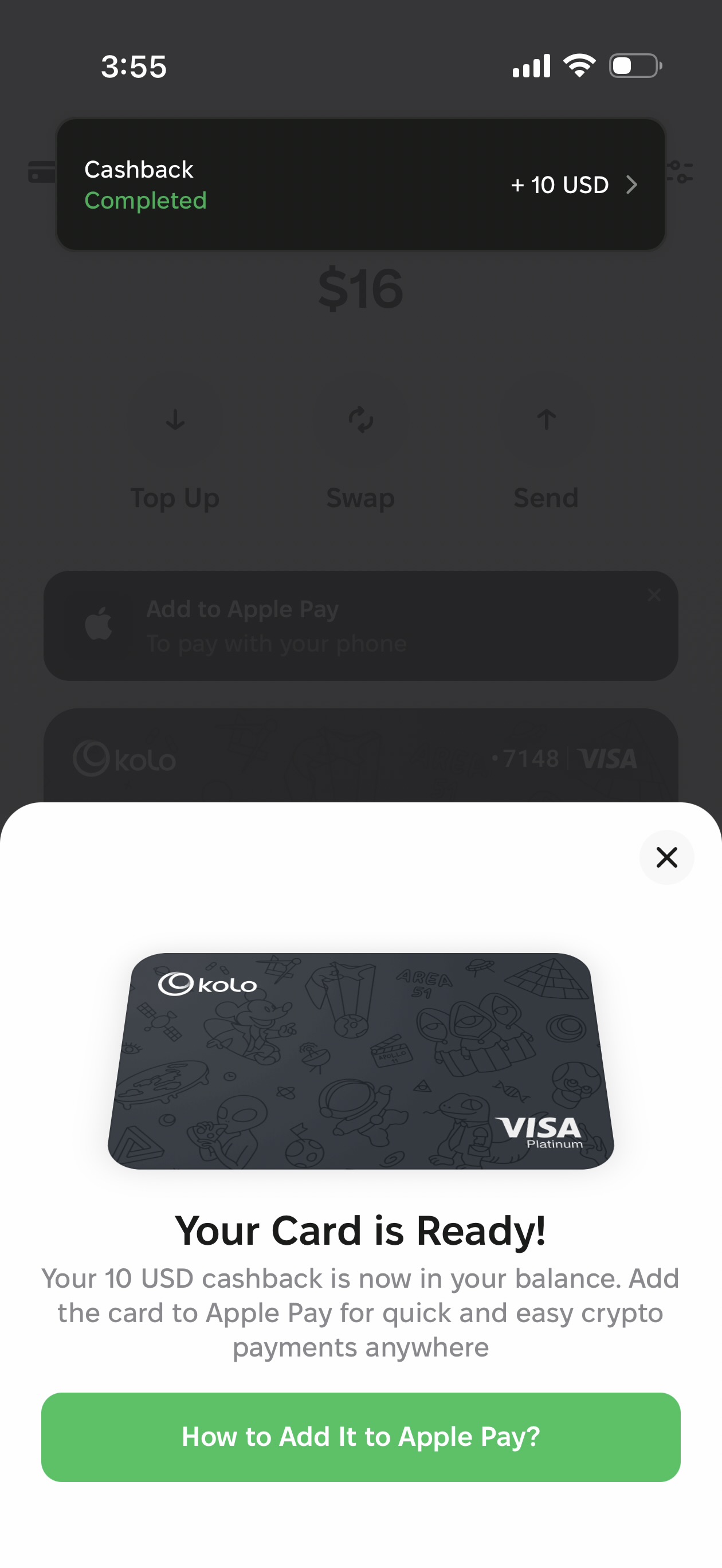
The Visa Platinum virtual card is issued in-app at no annual cost, ready for Apple Pay or Google Pay.
- Open Kolo and create an account. Launch the Kolo mini-app inside Telegram or install the iOS or Android app, then register with your phone or email.
- Pass KYC. Identity verification runs through Sumsub with a government ID and a selfie. Access covers most countries, with the US and sanctioned jurisdictions excluded. The EUR card may ask for extra verification such as proof of address, even if you already verified for the USD card.
- Pick your currency and activate. Choose the USD or EUR card, then issue your Visa Platinum virtual card with no annual fee. Add it to Apple Pay or Google Pay to tap to pay.
- Fund it with stablecoins. Top up your balance in stablecoins such as USDT across the supported networks. Stablecoin spending carries no FX markup, which is the heart of Kolo's remittance-corridor appeal.
- Spend and earn Bitcoin back. Pay at any Visa merchant and earn 2% cashback in BTC for your first 30 days, then 1%, up to the $100/month and per-transaction caps. Kolo can change that program at its discretion.
Kolo vs Other Cards
- vs Bleap: Bleap remains stronger for users who prioritize self-custody and clearer reward semantics. Kolo is broader geographically and simpler to start with, but is custodial and its cashback is capped.
- vs Crypto.com: Crypto.com's stronger tiers still depend on CRO commitment. Kolo is simpler and cheaper to start, but the capped 1% ongoing rate is much less differentiated than the headline suggests.
- vs KAST: KAST stays more points-driven and region-specific in some use cases. Kolo's edge is wider availability and straightforward BTC rewards, within the caps.
- vs RedotPay: RedotPay is more about utility rails than BTC accumulation. Kolo's BTC reward angle is still cleaner if you want small, direct Bitcoin exposure rather than a pure payment rail.
Who Should Use Kolo?
Use Kolo if:
- You want a low-friction global prepaid crypto card with a free BTC cashback perk
- You mostly spend stablecoins and care about low conversion drag
- Your monthly spend is modest enough that the $100/month cashback cap does not bind
- You are comfortable with a custodial setup for spending balances
Avoid Kolo if:
- You want self-custody (Kolo is custodial)
- You are a high-volume spender chasing uncapped rewards; the per-transaction and monthly caps limit the payout
- You want a reward program with guaranteed, locked-in rules (Kolo's terms let it change rates)
Is Kolo Safe?
The core risk profile:
- custodial wallet model
- smaller operator than the biggest exchange-card brands
- card program depends on third-party issuer rails
- terms give Kolo wide discretion over rewards and operational changes
That does not make it unusable. It does mean Kolo should be treated as a spending tool, not a long-term asset storage venue: keep only active spending balances here, not long-term holdings.
Bottom Line
Kolo is a free, low-FX prepaid card that pays a little Bitcoin on everyday spend: 2% BTC for 30 days, then 1%, capped at $100/EUR 100 per month and $1/EUR 1 per transaction, custodial, in USD or EUR.
What remains appealing is the combination of $0 annual fee, wide availability, stablecoin-friendly spending, and BTC-denominated rewards. What it is not is a rewards maximizer for high spend.
Countries and Availability
Kolo is available in 107 countries as of October 2026. We count a country here when at least one active Kolo card variant lists it, so individual product pages may be narrower.
Available Regions
Africa
Cameroon (CM), Cote d'Ivoire (CI), Egypt (EG), Ethiopia (ET), Ghana (GH), Kenya (KE), Morocco (MA), Mozambique (MZ), Nigeria (NG), Rwanda (RW), Senegal (SN), South Africa (ZA), Tanzania (TZ), Tunisia (TN), Uganda (UG)
Americas
Argentina (AR), Bolivia (BO), Brazil (BR), Canada (CA), Chile (CL), Colombia (CO), Costa Rica (CR), Dominican Republic (DO), Ecuador (EC), El Salvador (SV), Guatemala (GT), Jamaica (JM), Mexico (MX), Panama (PA), Paraguay (PY), Peru (PE), Puerto Rico (PR), Trinidad and Tobago (TT), Uruguay (UY), Venezuela (VE)
Asia
Bahrain (BH), Bangladesh (BD), Cambodia (KH), China (CN), Georgia (GE), Hong Kong (HK), India (IN), Indonesia (ID), Iraq (IQ), Israel (IL), Japan (JP), Jordan (JO), Kazakhstan (KZ), Kuwait (KW), Lebanon (LB), Malaysia (MY), Mongolia (MN), Myanmar (MM), Nepal (NP), Oman (OM), Pakistan (PK), Philippines (PH), Qatar (QA), Saudi Arabia (SA), Singapore (SG), South Korea (KR), Sri Lanka (LK), Taiwan (TW), Thailand (TH), Turkey (TR), United Arab Emirates (AE), Uzbekistan (UZ), Vietnam (VN)
Europe
Albania (AL), Austria (AT), Belgium (BE), Bulgaria (BG), Croatia (HR), Cyprus (CY), Czech Republic (CZ), Denmark (DK), Estonia (EE), Finland (FI), France (FR), Germany (DE), Greece (GR), Hungary (HU), Iceland (IS), Ireland (IE), Italy (IT), Latvia (LV), Lithuania (LT), Luxembourg (LU), Malta (MT), Montenegro (ME), Netherlands (NL), North Macedonia (MK), Norway (NO), Poland (PL), Portugal (PT), Romania (RO), Serbia (RS), Slovakia (SK), Slovenia (SI), Spain (ES), Sweden (SE), Switzerland (CH), Ukraine (UA), United Kingdom (GB)
Oceania
Australia (AU), Fiji (FJ), New Zealand (NZ)
Major Restricted Markets
These major markets are not currently listed for this vendor. Confirm eligibility with the issuer before applying, especially where card tiers have different country rules.
Americas
United States (US)
Sources and Verification
- Kolo Official Site
- Kolo Terms of Use
- Kolo July 2026 Product Update (ATM terms, EUR-card cashback announcement)
- Kolo Cashback Program, Help Center (rates, caps, exclusions, clearing)
- Cashback program, ATM terms, and USD/EUR card details verified against Kolo's Help Center and in-app screens on August 13, 2026
Written by Aleksandar Dukic
Frequently Asked Questions
Is Kolo crypto card available in the United States?
No. Kolo crypto card is not available in the United States. Kolo's terms exclude US residents, so US users should use alternatives such as Coinbase, Gemini, Avici, or Cypher.
Is the Kolo Card activation fee really free?
Yes. Kolo charges a 10 USDC activation fee but instantly returns the full amount as spendable card balance. The net cost is zero. You need at least 10 USDC in your Kolo wallet to activate.
How does BTC cashback work on Kolo?
You earn 2% in BTC for the first 30 days, then 1% after that, on both the USD and EUR cards. Rewards are capped at $100/month, and each transaction is capped at $1 ($2 during the intro), so a large purchase still earns only the capped amount. Cashback is paid out daily in BTC. Business and co-branded cards are excluded.
User Reviews
Reviews are moderated and may take a moment to appear.
App Store (7 ratings)
Source: Apple App Store - Updated Jul 2026