

Tria Crypto Cards Review 2026
Compare Tria crypto cards and review issuer terms, fees, and availability.

SpendNode Rating for Tria
Tria is one of the strongest issuer stories in the market because the lineup is ambitious, the rewards are real, and the self-custody angle is not just cosmetic.
The operator scores near the top on lineup quality and market interest. It stops short of a perfect mark because the products still ask more from users than a plain mainstream card.
Issuer Snapshot
Editorial vendor score stays separate from user reviews. Methodology
Product Quality
4.5
Trust & Custody
4.3
Fee Transparency
4.1
Operational Reliability
4.0
Market Relevance
4.4
On This Page
What Is Tria?
The Tria Card is a self-custodial Visa debit card program with a free first Virtual Card and two paid metal tiers: Signature at $109/year and Premium at $250/year. New users who join through SpendNode can earn $5 after four card payments within 14 days. Code Q2YFBW4580 takes 20% off paid card orders, reducing an additional Virtual Card from $25 to $20, Signature to $87, and Premium to $200.
Cashback reaches 6% on capped monthly spend, then falls to a lower rate, while wallet balances can earn up to 15% APY. Tria uses account abstraction on Optimism, Arbitrum, and Solana, supports 1,000+ crypto assets, and is available across EEA, UK, US, and global markets.
Our editorial team reviewed all three Tria tiers side by side - fees, cashback rates, limits, and yield - so you can decide which tier fits your spending level.
Tria's Rewards Season 1 cashback was paid out in USDT, confirming that the program delivered its published reward. The Season 1 and Season 2 claim windows are now closed. Season 2's token allocation converted to staked TRIA with a 12-month lock at 10% APY, followed by monthly unlocking over the next 12 months.
Available crypto cards by Tria in September 2026

1. Tria Virtual Card
Instant Virtual Entry: 1.5% Cashback + Apple Pay
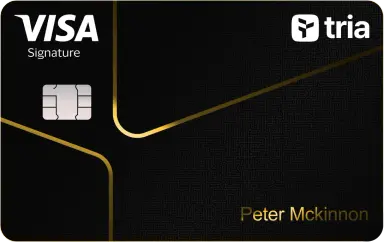
2. Tria Signature Card
High-Yield Self-Custody: 15% APY + Visa Signature Perks

3. Tria Premium Card
Self-Custody Premium: 6% Cashback + Zero ATM Fees
Tria Card Promo Code Q2YFBW4580: Free Virtual Card, $5 Reward and 20% Off
Join through SpendNode's Tria signup link to receive the first Virtual Card free and earn $5 after four card payments within 14 days. The link applies code Q2YFBW4580 automatically for 20% off paid card orders.
| Detail | Current offer |
|---|---|
| Active Tria card code | Q2YFBW4580 |
| First Virtual Card | Free |
| New-user reward | $5 after four card payments within 14 days |
| Paid-card discount | 20% off with code Q2YFBW4580 |
| Prices with code | Additional Virtual $20; Signature $87; Premium $200 |
| Highest cashback tier | Premium: 6% on the first $2,000/month, then 1% |
| Where to enter it | During account registration |
| Current status | Active |
How to apply the Tria promo code
- Open SpendNode's Tria signup link.
- Continue with Google or Apple.
- Confirm that Q2YFBW4580 appears in the access-code field. Paste it manually if needed.
- Complete account setup and identity verification.
- Activate the free Virtual Card and make four card payments within 14 days to qualify for the $5 reward.
- If you order an additional Virtual Card, Signature, or Premium, confirm the 20% code discount before paying.
Tria combines two things most crypto cards force you to choose between: self-custody and high cashback. Your funds stay in a smart account you control until the moment you swipe - no exchange deposits, no custodial intermediary, no counterparty risk. On top of that, Tria offers up to 6% cashback on capped monthly spend and 15% APY, rates that compete with or exceed centralized exchange cards that require you to hand over your keys.
The platform runs on account abstraction across Optimism, Arbitrum, and Solana, supporting 1,000+ crypto assets for spending. That asset breadth is unmatched - most self-custodial competitors support a handful of tokens. Tria lets you load everything from ETH and USDC to long-tail DeFi tokens and spend them directly via Visa.
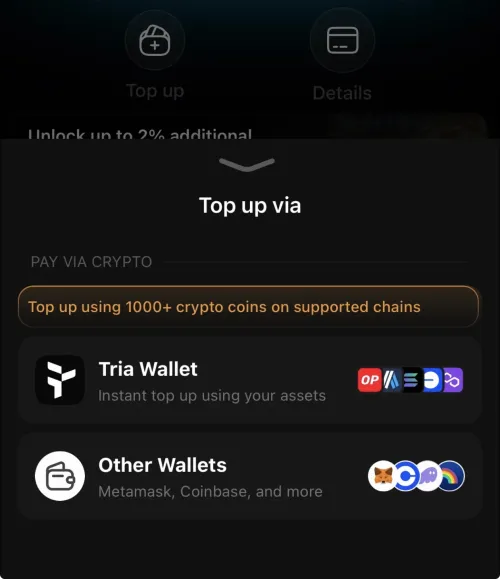
SpendNode app screenshot
1,000+ crypto coins - Top up via Tria Wallet (OP, Arbitrum, Solana) or external wallets like MetaMask and Coinbase. Zero deposit fees.
The Three Tiers
-
Tria Virtual Card - The first card is free. New users who join through SpendNode can earn a $5 welcome bonus after four card payments within 14 days. Additional Virtual Cards cost $25, or $20 with code Q2YFBW4580. It pays 1.5% cashback on the first $100/month, then 0.5%, with instant issuance, Apple Pay, Google Pay, and a $1,000,000/day limit.
-
Tria Signature Card - $109/year, or $87 with code Q2YFBW4580. 4.5% cashback on the first $1,000/month, then 1%. Physical metal card. Visa Signature travel perks (insurance, purchase protection, price protection). $1,000,000/day limit. The sweet spot for regular spenders.
-
Tria Premium Card - $250/year, or $200 with code Q2YFBW4580. 6% cashback on the first $2,000/month, then 1%. Metal card. 0% ATM fees ($750/day). Visa Luxury Hotel Benefits. $1,000,000/day limit. The metal travel-and-perks tier.
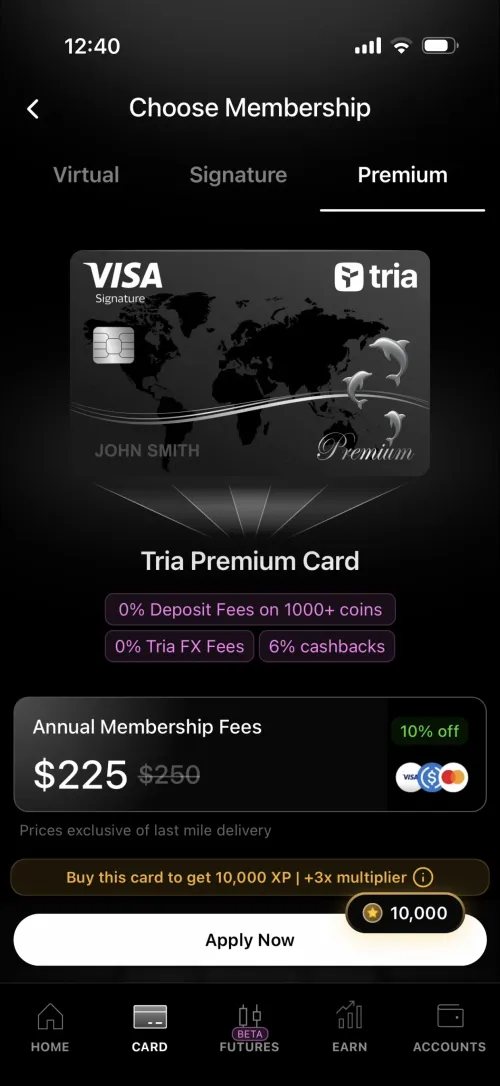
SpendNode app screenshot
Tria Premium - Visa Signature with 0% deposit fees on 1,000+ coins and 6% cashback on the first $2,000/month. $250/year for the highest headline self-custodial cashback rate on any card.
This app screen predates Tria's June 2026 fee change. Tria now charges 1% FX on non-USD spend and a 0.5% fee on every payment.
Fees and Rates
| Feature | Virtual | Signature | Premium |
|---|---|---|---|
| Standard annual fee | Free first card | $109 | $250 |
| Paid card with code Q2YFBW4580 | $20 additional card ($25 standard) | $87 | $200 |
| Cashback (to monthly cap) | 1.5% | 4.5% | 6% |
| Monthly spend at headline rate | $100 | $1,000 | $2,000 |
| Cashback above cap | 0.5% | 1% | 1% |
| FX fee (non-USD) | 1% | 1% | 1% |
| Per-payment fee | 0.5% | 0.5% | 0.5% |
| ATM fee | N/A | 2% | 0% ($750/day) |
| Season 3 points | 1 pt/$1 | 1.5 pts/$1 | 1.5 pts/$1 |
| Daily transaction limit | $1,000,000 | $1,000,000 | $1,000,000 |
| APY | Up to 15% | Up to 15% | Up to 15% |
| Card type | Virtual only | Metal | Metal |
| Auto rental CDW | Global | Global | Global |
| Baggage coverage | No | $500 delay / $1,000 loss | $500 delay / $1,000 loss |
| Price protection | $2,000 | $2,000 | $2,000 |
| Purchase protection | $10,000 | $10,000 | $10,000 |
| Visa Luxury Hotel | No | Yes | Yes |
| Visa Airport Companion | No | Yes | Yes |
| Visa Digital Concierge | Global | Global | Global |
All tiers share: 0% deposit fees, 1,000+ supported crypto assets, Apple Pay + Google Pay, self-custodial account abstraction, $2,000 Price Protection, and $10,000 Purchase Protection.
As of Season 3 (June 2026) Tria charges a 1% FX fee on non-USD spend and a 0.5% fee on every payment, and the headline cashback rate applies only to a monthly spend cap; spend above the cap earns the reduced rate shown. The 0.5% per-payment fee comes off every transaction, so the net rate is roughly half a point below each headline number (and a further 1% below that on non-USD spend).
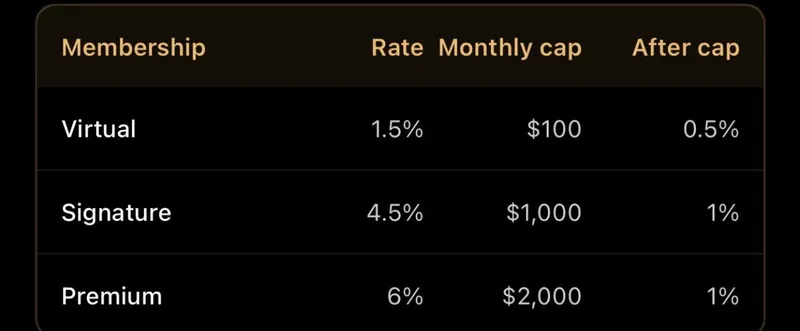
SpendNode app screenshot
Season 3 cashback caps - Each tier earns its headline rate only up to a monthly spend cap, then drops: Virtual 1.5% to $100 (then 0.5%), Signature 4.5% to $1,000 (then 1%), Premium 6% to $2,000 (then 1%).
Break-Even Math
| Tier | Annual Fee | Net cashback (after the 0.5% fee) | Break-Even Spend |
|---|---|---|---|
| Virtual | Free first card | 1% to $100/mo, then 0% | No card fee to recover |
| Signature | $87 with code ($109 standard) | 4% to $1,000/mo, then 0.5% | ~$181/month with code |
| Premium | $200 with code ($250 standard) | 5.5% to $2,000/mo, then 0.5% | ~$303/month with code |
The 0.5% per-payment fee comes off every swipe. At the code prices, Signature breaks even around $181/month (net 4% on the first $1,000) and Premium around $303/month (net 5.5% on the first $2,000). Both thresholds rise if your spending is mostly non-USD, where the extra 1% FX applies.
Virtual has no first-card fee to recover. Net of the 0.5% payment fee, it earns 1% on the first $100/month and nothing above it because the 0.5% above-cap rate is cancelled by the fee. That limits ongoing net cashback to about $12 a year before any non-USD FX cost.
Rewards and Cashback
Cashback applies to a monthly spend cap and then drops: 1.5% on the first $100/month (Virtual), 4.5% on the first $1,000/month (Signature), and 6% on the first $2,000/month (Premium). Spend above the cap earns 0.5% (Virtual) or 1% (Signature and Premium). All tiers earn up to 15% APY on idle wallet balances. The headline rates remain among the highest of any self-custodial card, but the caps mean the effective rate falls for anyone spending well above the threshold.
Tria's eligibility net is also wider than most. We paid a monthly insurance premium with our Tria card and it earned cashback - the same premium earned nothing on Jupiter (which excludes financial services outright) or on xPlace. If part of your spending sits in categories other issuers exclude, that difference compounds.
Tria Travel: Uncapped Cashback on Bookings
In June 2026 Tria added Tria Travel, a booking portal inside the app for hotels, flights, concerts, cruises, and VIP experiences. It is powered by Bookit, which supplies the global inventory. The draw is the cashback: pay for an eligible booking with your Tria Card and you earn your tier's headline rate, with no monthly spend cap on travel.
That last part matters. Season 3 capped Tria's regular card cashback to a monthly threshold (the Premium rate, for example, only applies to the first $2,000 of ordinary spend). Tria Travel bookings sit outside that cap entirely. A Premium holder booking a $5,000 cruise earns the full 6%, roughly $300, no matter what else they spent that month.
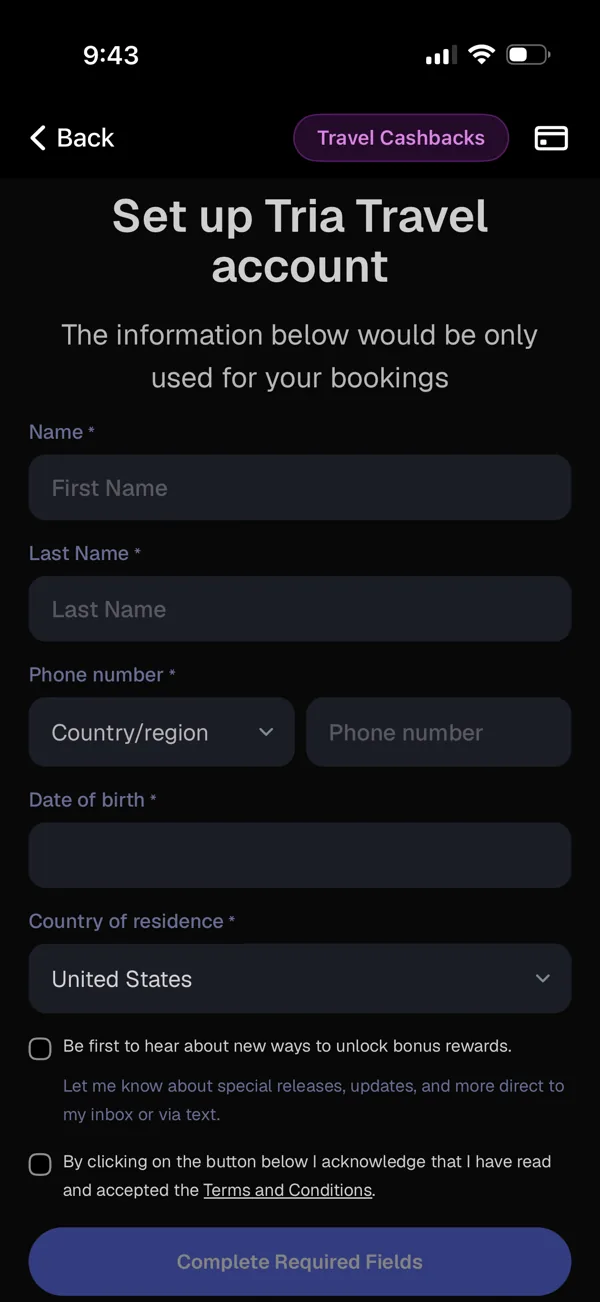
SpendNode app screenshot
Tria Travel - A travel and experiences portal built into the Tria app, powered by Bookit. Pay with your Tria Card to earn your tier's cashback rate on the booking, with no monthly cap on travel spend.
The rate follows your card tier: Virtual earns 1.5%, Signature 4.5%, and Premium 6% on eligible bookings. Anyone can browse and book using any payment method, but only Tria Card payments earn cashback, and flights are reserved for cardholders. Cashback is paid after a booking is completed and confirmed, through the same cashback cycle as the rest of the card, and it is clawed back if the booking is later cancelled, refunded, or disputed.
| Tier | Travel cashback | Monthly cap |
|---|---|---|
| Virtual | 1.5% | None on travel |
| Signature | 4.5% | None on travel |
| Premium | 6% | None on travel |
A VIP trading badge can stack on top of these travel rates too. Tria's trading-volume ladder (detailed below) lifts card and Tria Travel cashback by up to 3.5 points at the top tier, so a VIP 7 Premium holder would earn 9.5% on an eligible booking. The volume required puts that far out of reach for ordinary cardholders, which the trading-badge section below spells out.
None of these rates is quite the net, though. Tria's standard 0.5% per-payment fee still comes off card spend, so the travel rate runs about half a point below the tier number, the same as everywhere else on the card.
Bookit is the other thing to watch. It owns the inventory, pricing, and fulfilment, so the cashback only pays off if the in-app price is competitive. Check the Bookit price against booking the same hotel or flight direct before you commit; a few percent back means little on a fare that is a few percent higher to begin with.
Trading Badge: Higher Cashback for Active Traders
In July 2026 Tria bolted a trading-volume loyalty ladder onto the card. Every perpetuals or spot trade you make inside the Tria app, on Hyperliquid and Decibel, counts toward a rolling 30-day trading volume, and that volume earns a VIP badge that runs from VIP Spark up to VIP 7. The badge does three things at once: it cuts your in-app trading fees, it adds a flat percentage to your card cashback (and to Tria Travel), and it grants a bonus cashback cap on top of your card's normal monthly spend cap. Badges lock for 30 days, then re-check on your rolling volume.
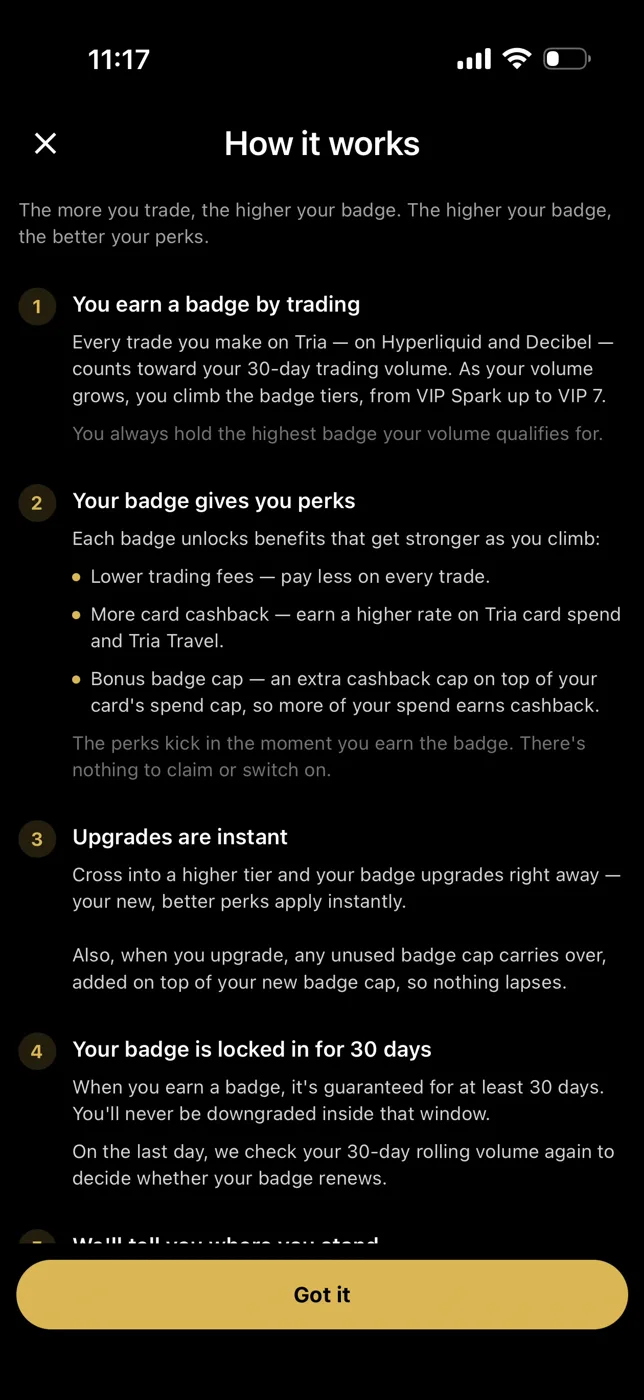
SpendNode app screenshot
How the trading badge works - Trading volume on Hyperliquid and Decibel over a rolling 30 days sets your VIP badge, which lowers trading fees, raises card and Tria Travel cashback, and adds a bonus cashback cap.
The catch is the volume. It takes $100,000 of 30-day trading just to activate the first badge, and that badge (VIP Spark) adds no cashback at all, only a $500 bonus cap. The first actual rate increase, +0.25%, needs $250,000 of trading in a month; +1% needs $1 million; the headline +3.5% needs $100 million in a 30-day window.
| Badge | 30-day trading volume | Trading fee discount | Extra card cashback | Bonus cashback cap |
|---|---|---|---|---|
| VIP Spark | $100K - $250K | - | - | $500 |
| VIP 1 | $250K - $500K | - | +0.25% | $1,000 |
| VIP 2 | $500K - $1M | 5% | +0.5% | $1,500 |
| VIP 3 | $1M - $3M | 15% | +1% | $3,000 |
| VIP 4 | $3M - $10M | 25% | +1.5% | $5,000 |
| VIP 5 | $10M - $30M | 35% | +2% | $10,000 |
| VIP 6 | $30M - $100M | 45% | +2.5% | $15,000 |
| VIP 7 | $100M+ | 50% | +3.5% | $100,000 |
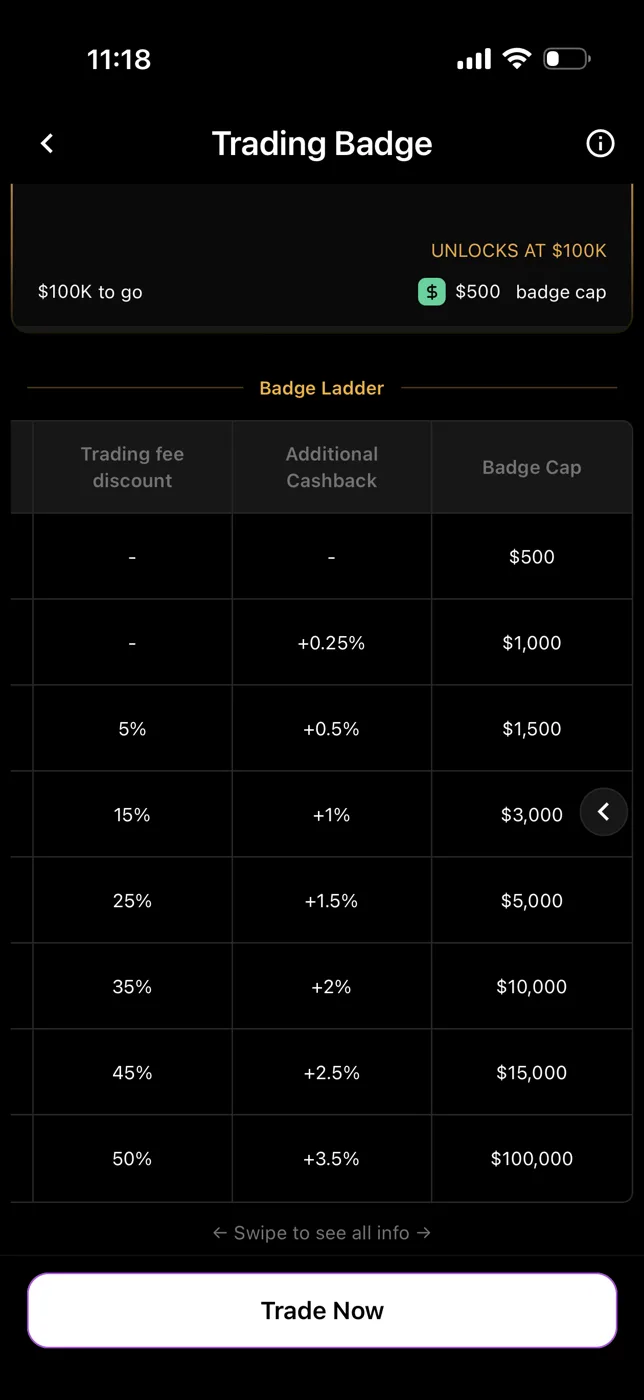
SpendNode app screenshot
The badge ladder - Additional cashback climbs from +0.25% to +3.5%, and the bonus cap from $1,000 to $100,000, but only at trading volumes from $250K to $100M every 30 days.
In context, the top tier lifts Premium's card rate to 9.5% (6% base plus 3.5%) with a six-figure bonus cap, the number the marketing leans on. But reaching it means trading $100 million every 30 days, and even the modest +0.25% asks for a quarter-million dollars of monthly volume. For anyone using Tria as a card rather than a trading venue, the ladder changes nothing: the capped base rates covered above are the economics that actually apply.
There is a blunter point here. This is a card program paying you to trade leveraged perpetuals. Hyperliquid and Decibel are high-risk venues, and pushing trading volume to chase a cashback tier is a fast way to lose far more than the extra fraction of a percent is worth. Treat the badge as a perk if you already trade at that scale, never as a reason to start.
The same trading volume also feeds the Season 3 points below, so an active trader accrues both a cashback badge and mystery-box points at once. The two are separate programs: the badge sets your card rate and cap, the points feed the box ladder.
Season 3 Points and Mystery Boxes
In June 2026 Tria replaced its old staking-badge rewards with a Season 3 points program. You earn points by spending on the card, trading in the app, and referring others, and points unlock a ladder of mystery boxes that pay out surprise rewards.
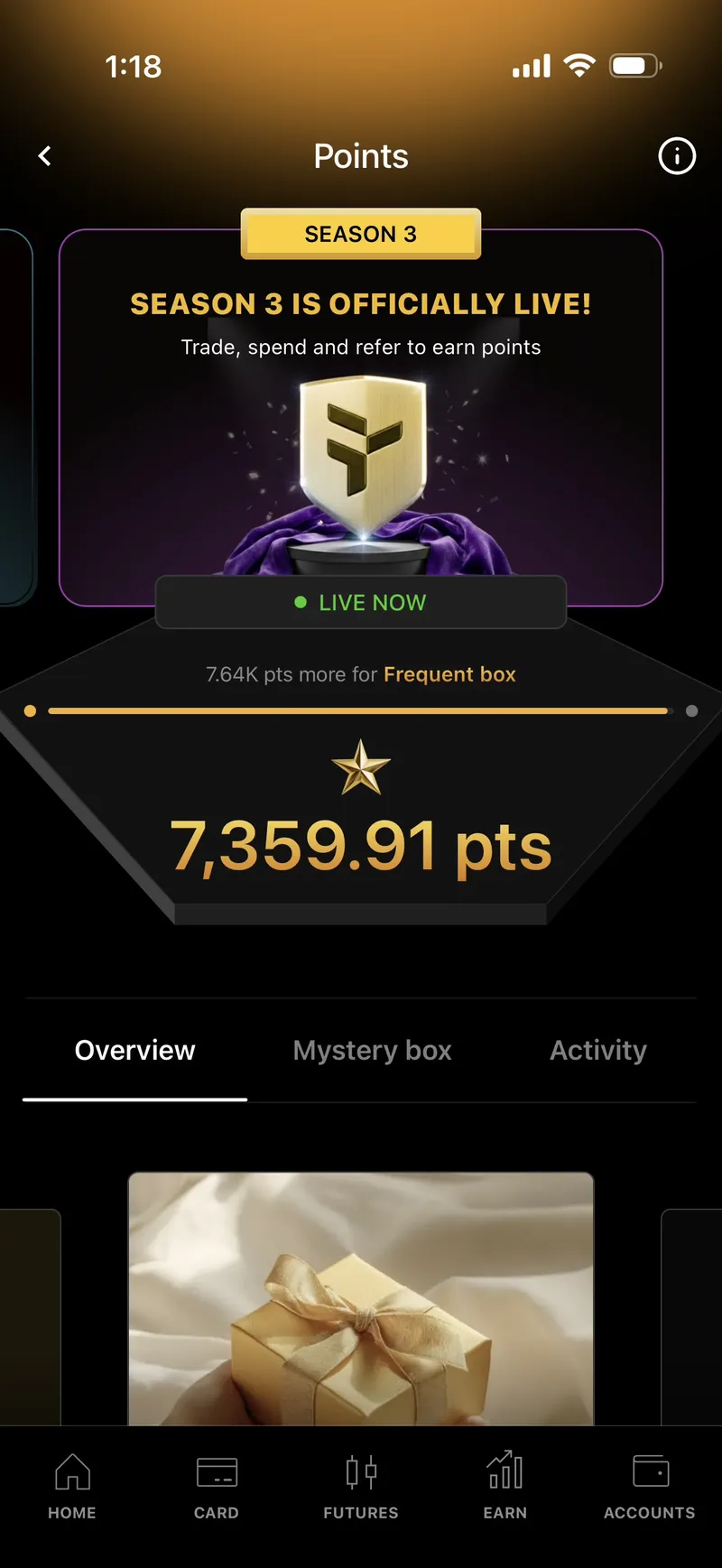
SpendNode app screenshot
Season 3 points - Earned by spending, trading, and referring. Points unlock mystery boxes carrying cashback, travel credits, and ecosystem rewards.
How card spend earns points
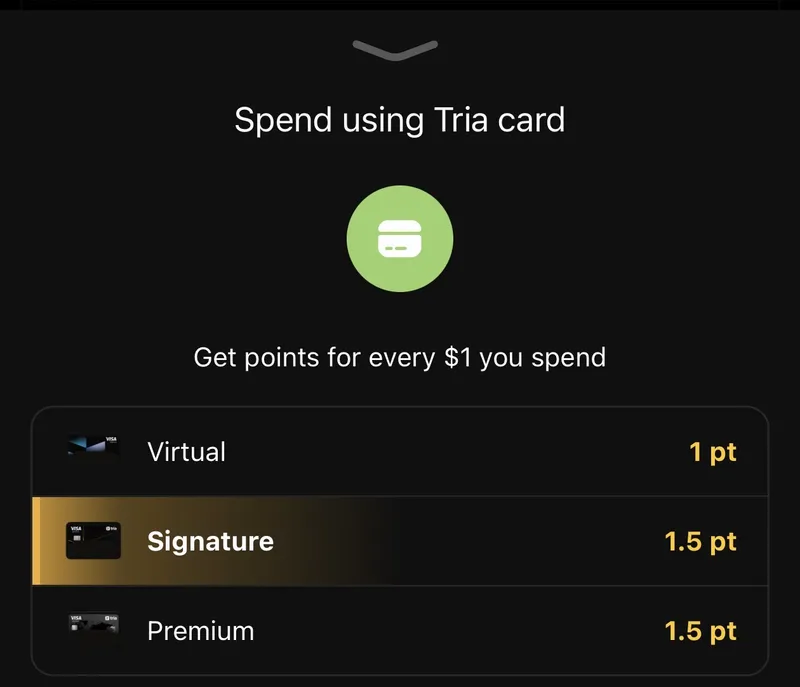
| Tier | Points per $1 spent |
|---|---|
| Virtual | 1 pt |
| Signature | 1.5 pts |
| Premium | 1.5 pts |
SpendNode app screenshot
Points per $1 of card spend - 1 point on Virtual, 1.5 on Signature and Premium. Points can also be earned trading Decibel and Hyperliquid perps inside the app, which is separate from card spend.
The mystery-box ladder
The boxes climb from small, vague rewards to thresholds only the largest accounts will reach. Lower boxes pay out surprise cashback or small travel credits. Higher ones attach a minimum reward plus a "Tria equity" draw at the end of the season.
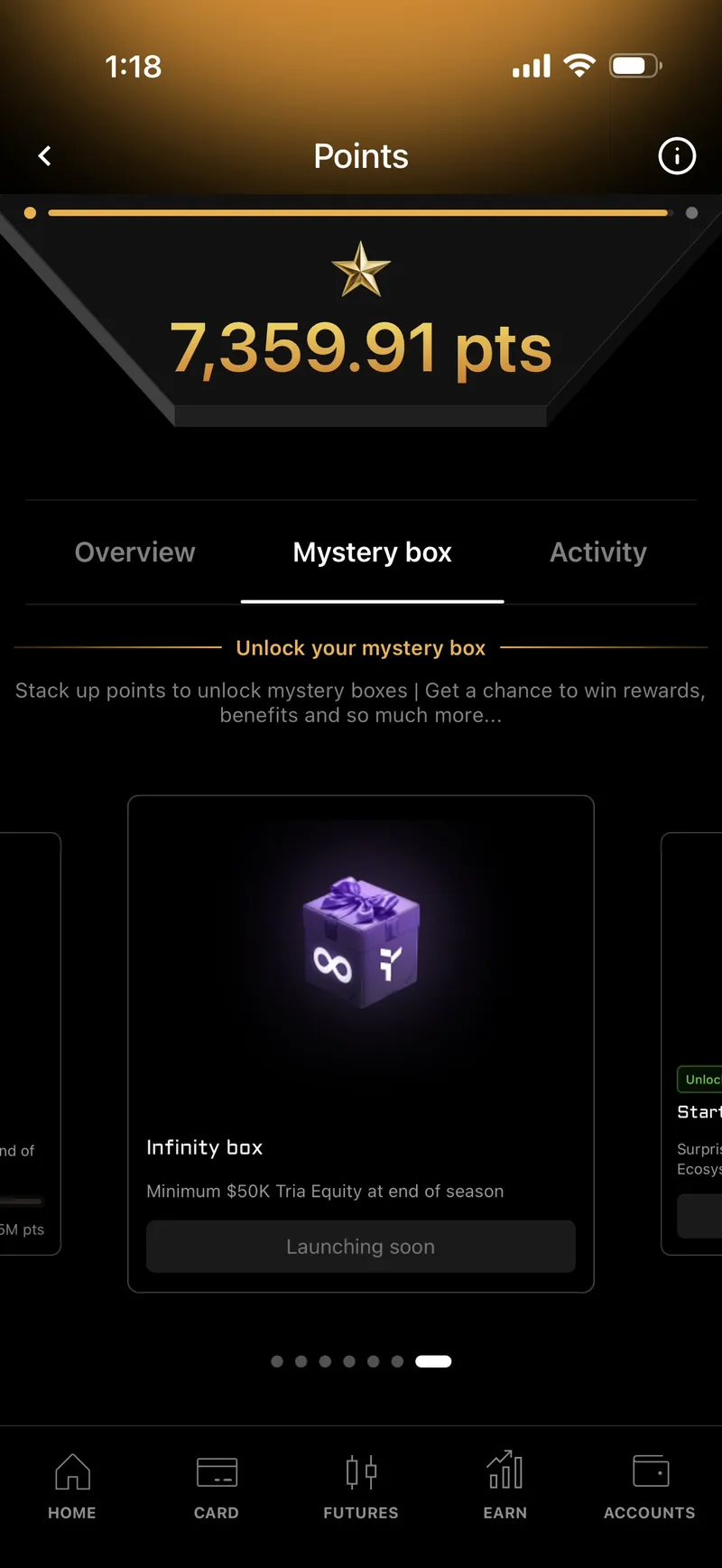
The top of the ladder is steep. The Legendary box requires 5,000,000 points to unlock, which is roughly $3.3 million of card spend if earned through spending alone (points also accrue from trading and referrals), and the Infinity box requires a minimum of $50,000 in Tria equity held at season end, with no published point threshold.
SpendNode app screenshot
Mystery-box ladder - The Infinity box requires a minimum of $50,000 in Tria equity at season end. The boxes worth chasing sit far out of reach for ordinary spenders.
For a typical spender the points program is a lottery-style extra, not a reason to choose Tria. The boxes that matter are gated behind multi-million-point totals or large equity balances, so the capped cashback above is the economics that actually applies to most users.
Account Abstraction on Three Chains
Tria's self-custody model uses account abstraction (AA) smart accounts, not traditional seed-phrase wallets. This means:
- Your funds, your control: Assets stay in your smart account until you spend
- Multi-chain: Optimism, Arbitrum, and Solana supported natively
- 1,000+ assets: From ETH and USDC to long-tail DeFi tokens
- No top-ups: Spend directly from your wallet balance
- Apple Pay + Google Pay: Full mobile wallet support on all tiers
- External wallet support: Connect MetaMask, Coinbase Wallet, or other external wallets
In April 2026, Tria also added Aptos to its Global Trading Engine. That expands the app beyond Optimism, Arbitrum, and Solana for trading and withdrawal flows, giving users direct access to Aptos assets inside the same self-custodial operating stack. The card itself is still the same Visa product, but the broader product becomes more useful if you want to move between spending, deposits, and cross-chain trading without leaving the app.
The AA model eliminates counterparty risk from exchange custody (no FTX/Celsius scenarios) while keeping the UX smooth enough for mobile payments. The tradeoff vs traditional seed-phrase self-custody: AA recovery depends on Tria's infrastructure. Hardware wallet users (Ledger, Trezor) have fully independent recovery. Tria's AA sits between full self-custody and custodial - your keys, but Tria's recovery layer.
How to Apply for a Tria Crypto Card
Tria runs entirely in its mobile app, and there is no bank-style credit check anywhere in the flow. The card spends directly from your self-custodial smart account, so setup is about funding your balance rather than opening a credit line. Here is the path from sign-up to first payment, the way Tria's own onboarding lays it out:
SpendNode app screenshot
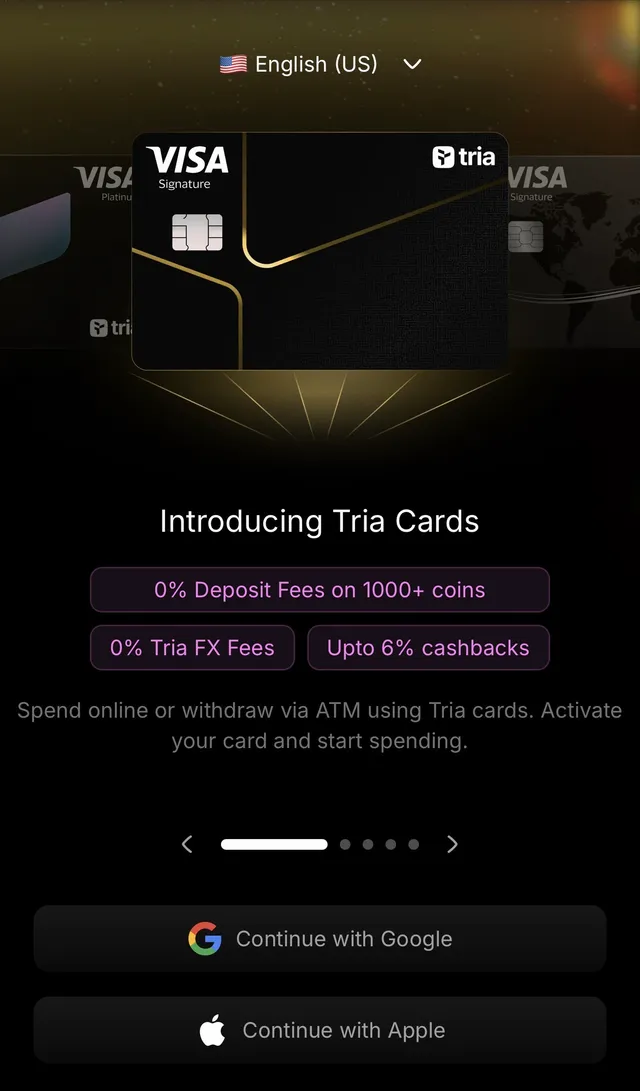
Onboarding opens on the Tria Cards intro, with a one-tap Google or Apple sign-in.
- Create your account. Open the Tria app and continue with a Google or Apple ID. There is no separate password to set up first.
- Pick your tier. Start with the free Virtual Card, or choose Signature ($109) or Premium ($250). Code Q2YFBW4580 reduces paid card prices to $20 for an additional Virtual Card, $87 for Signature, or $200 for Premium.
- Book your card. Confirm the free or discounted price in-app, then complete the card order.
- Complete KYC. Verify your identity to unlock the card. Tria gates this to users 18 and over, and it is a standard ID-and-selfie check, not a financial background check.
- Activate the complimentary virtual card. Your virtual Visa is issued instantly, so you can spend online right away while a physical card is still shipping.
- Fund your account. Deposit from 1,000+ coins at 0% Tria deposit fees, from the in-app Tria Wallet or an external wallet like MetaMask or Coinbase. The card then spends straight from your smart-account balance, so there is no separate card top-up to manage.
- Make four payments. New users who join through SpendNode earn a $5 welcome bonus after four card payments within 14 days. If you ordered a physical card, activate it when it arrives and add it to Apple Pay or Google Pay.
SpendNode app screenshot
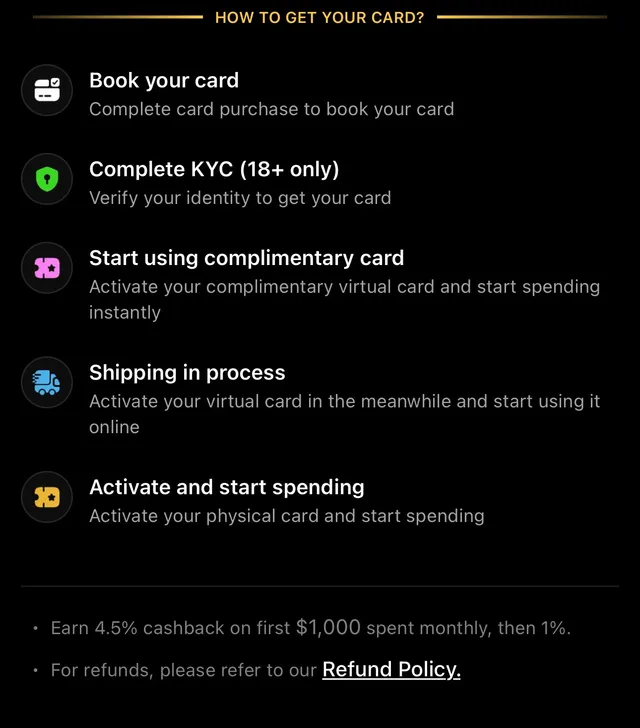
Tria's in-app checklist walks the same path: book, KYC, complimentary virtual card, then the physical card on arrival.
Countries and Availability
Tria is available in 97 countries as of September 2026. We count a country here when at least one active Tria card variant lists it, so individual product pages may be narrower.
Available Regions
Africa
Cameroon (CM), Cote d'Ivoire (CI), Egypt (EG), Ghana (GH), Kenya (KE), Morocco (MA), Mozambique (MZ), Nigeria (NG), Rwanda (RW), Senegal (SN), South Africa (ZA), Tanzania (TZ), Tunisia (TN), Uganda (UG)
Americas
Argentina (AR), Bolivia (BO), Brazil (BR), Canada (CA), Chile (CL), Colombia (CO), Costa Rica (CR), Dominican Republic (DO), Ecuador (EC), El Salvador (SV), Guatemala (GT), Jamaica (JM), Mexico (MX), Panama (PA), Paraguay (PY), Peru (PE), Puerto Rico (PR), Trinidad and Tobago (TT), United States (US), Uruguay (UY)
Asia
Bahrain (BH), Bangladesh (BD), Cambodia (KH), Georgia (GE), Hong Kong (HK), Indonesia (ID), Japan (JP), Jordan (JO), Kazakhstan (KZ), Kuwait (KW), Malaysia (MY), Mongolia (MN), Oman (OM), Pakistan (PK), Philippines (PH), Qatar (QA), Saudi Arabia (SA), Singapore (SG), South Korea (KR), Sri Lanka (LK), Taiwan (TW), Thailand (TH), United Arab Emirates (AE), Uzbekistan (UZ)
Europe
Albania (AL), Austria (AT), Belgium (BE), Bulgaria (BG), Croatia (HR), Cyprus (CY), Czech Republic (CZ), Denmark (DK), Estonia (EE), Finland (FI), France (FR), Germany (DE), Greece (GR), Hungary (HU), Iceland (IS), Ireland (IE), Italy (IT), Latvia (LV), Lithuania (LT), Luxembourg (LU), Malta (MT), Montenegro (ME), Netherlands (NL), North Macedonia (MK), Norway (NO), Poland (PL), Portugal (PT), Romania (RO), Russia (RU), Serbia (RS), Slovakia (SK), Slovenia (SI), Spain (ES), Sweden (SE), Switzerland (CH), United Kingdom (GB)
Oceania
Australia (AU), Fiji (FJ), New Zealand (NZ)
Major Restricted Markets
These major markets are not currently listed for this vendor. Confirm eligibility with the issuer before applying, especially where card tiers have different country rules.
Asia
China (CN), India (IN), Turkey (TR)
Tria vs Other Cards
| Feature | Tria Premium | Crypto.com Icy | ether.fi Core | KAST Standard | Ready Metal (unavailable) |
|---|---|---|---|---|---|
| Max Cashback | 6% (to $2K/mo) | 4% CRO | 3% | 1.5% USD (cap $2K/mo) | 3% STRK |
| Annual Cost | $200 with code | $50,000 CRO stake | $0 | $0 | $120 |
| FX Fee | 1% | 0% | 1% | 0.5-1.75% | 0% |
| Custody | Self-Custodial | Custodial | Self-custodial | Custodial | Self-custodial |
| Yield | Up to 15% APY | CRO staking | ETH staking | No | No |
| Supported Assets | 1,000+ | 20+ | ETH/USDC | USDC/USDT | USDC |
| Best For | DeFi-native maximizers | Loyalty ecosystem | ETH holders | Free custodial USD cashback | Starknet users |
Where Tria wins:
- Among the highest headline cashback of any self-custodial card (6% on Premium, on the first $2,000/month)
- Broadest asset support (1,000+ vs single-digit for most competitors)
- Built-in yield (up to 15% APY on idle balances)
- Multi-chain coverage (OP, Arbitrum, Solana)
Where competitors win:
-
ether.fi Core: 3% cashback for free, more established platform
-
KAST's free K Card and Pengu Card collection: 1.5% USD cashback on the first $2,000/month, custodial model, no annual fee
-
Crypto.com: 7+ year track record, massive ecosystem
-
Ready Metal (unavailable): historical Starknet self-custody design from the ex-Argent team
-
vs Crypto.com: Crypto.com offers 0-8% CRO with CRO staking ($0-$500K) and a 7-year track record. Tria offers a free first Virtual Card plus paid metal tiers, with 1.5-6% cashback on monthly spend caps and self-custody. Crypto.com wins on maturity and ecosystem breadth. Tria wins on self-custody, asset diversity (1,000+ vs 20+), and cost efficiency at moderate spend.
-
vs ether.fi: ether.fi offers 3% for free with proven self-custody on Ethereum. Tria offers up to 6% (capped) with multi-chain support. ether.fi wins on zero-cost 3% and platform maturity. Tria wins on headline cashback rate and multi-chain flexibility.
-
vs KAST: KAST offers 1.5% USD cashback on the first $2,000/month (Standard tier) with $0 annual fee and 0.5-1.75% FX on non-USD. Premium tier (2% USD + 1% Points, $10K/mo cap) and Luxe tier (3% USD + 2% Points, $50K/mo cap) require higher card costs. KAST wins on $0 annual fee at the free tier and 2-minute KYC. Tria wins on self-custody, supported asset variety, and a higher headline rate (though, like KAST, its cashback is now capped per month, and Tria now charges 1% FX on non-USD spend plus a 0.5% per-payment fee).
Who Should Use Tria?
Tria is a strong fit if you:
- Want self-custodial spending with high cashback (unique combination)
- Hold a diverse portfolio across multiple chains and want to spend without swapping
- Value yield on idle balances (up to 15% APY) alongside card spending
- Travel internationally for the Visa Signature perks on Signature (note: non-USD spend now carries 1% FX plus the 0.5% per-payment fee)
- Spend within the monthly cap, where the headline rate actually applies
Consider alternatives if you:
- Prefer the most proven platform with longest track record - Crypto.com (7+ years) or Coinbase (10+ years)
- Want 3% cashback for free without annual fees - ether.fi Core
- Want richer free token-heavy rewards on a custodial model - KAST K Card or the Pengu Card collection
- Need battle-tested self-custody with independent recovery - Gnosis Pay (Safe accounts) or MetaMask in supported markets
Our take: Tria offers a rare combination of self-custody, high headline cashback, multi-chain support, 1,000+ assets, built-in yield, and buyer protections on every tier. The free first Virtual Card is the lowest-risk way to test it, and new users who join through SpendNode can earn a $5 welcome bonus after four card payments within 14 days.
Start there, verify that cashback credits reliably and the app meets your expectations, then upgrade if the math works for your spending level - keeping in mind that Season 3 caps the headline rate to a monthly spend threshold.
Is Tria Safe?
Tria uses account abstraction smart accounts on Optimism, Arbitrum, and Solana. Your funds stay in your smart account until the moment of purchase. The AA model sits between full self-custody (hardware wallets with independent seed phrase recovery) and custodial (exchange-held funds): your keys, but Tria's recovery infrastructure.
All tiers include Visa protections: $2,000 Price Protection, $10,000 Purchase Protection, and Auto Rental CDW (Global). Signature and Premium add Baggage Delay ($500/event), Baggage Loss ($1,000/event), Visa Luxury Hotel Collection, and Visa Airport Companion.
If Tria fails, your on-chain assets in the smart account persist on the respective chains (Optimism, Arbitrum, Solana). Recovery depends on the AA contract standard - if compatible wallets support the same account type, you can access your funds independently. This is stronger than custodial cards (where exchange failure means total balance risk) but weaker than traditional seed-phrase recovery (where any BIP-39 wallet works).
Is Tria a Scam?
-
Tria offers self-custodial spending via account abstraction on three chains (Optimism, Arbitrum, Solana), with funds remaining in your smart account until the moment of purchase. The custody architecture is verifiable on-chain.
-
Three distinct Visa card tiers are operational with verified cashback rates, each on a monthly spend cap: 1.5% to $100/mo (first Virtual Card free), 4.5% to $1,000/mo (Signature, $109/yr), and 6% to $2,000/mo (Premium, $250/yr), with a reduced rate above the cap. All tiers include $2,000 Price Protection and $10,000 Purchase Protection.
-
1,000+ supported crypto assets can be deposited and spent through the card, the broadest asset support among self-custodial cards. External wallet integration (MetaMask, Coinbase Wallet) is supported.
-
The Season 3 points program awards points on card spend (1 pt/$1 Virtual, 1.5 pts/$1 Signature and Premium) toward a mystery-box ladder. The top boxes are heavily gated (the Infinity box needs a minimum $50,000 in Tria equity at season end). The program is verified from in-app screenshots.
-
Visa Signature perks on the Signature and Premium tiers include Auto Rental CDW (Global), Baggage Delay ($500), Baggage Loss ($1,000), Visa Digital Concierge, Visa Luxury Hotel Collection, and Visa Airport Companion - verified from app documentation.
What to be aware of
- Tria is a newer platform compared to competitors like Crypto.com (7+ years) or Ready/Argent (9 years).
- The account abstraction recovery model depends on Tria's infrastructure - it is not as independently recoverable as a traditional seed-phrase wallet.
- The Season 3 points and mystery-box program mostly rewards whales - the top boxes require millions of points or $50,000+ in Tria equity, so for ordinary spenders it adds little over the capped cashback.
- The up to 15% APY on idle balances is variable and depends on DeFi market conditions.
- The first Virtual Card is free. Code Q2YFBW4580 reduces paid card orders by 20%, to $20 for an additional Virtual Card, $87 for Signature, and $200 for Premium.
- Season 3 added monthly spend caps to the headline cashback rates, cutting the effective return for anyone spending well above the cap.
SpendNode Verified: The editorial team reviewed Tria's issuer identity, product terms, and live card flow per our methodology. Verification is not an endorsement or guarantee.
Sources and Verification
Tria Crypto Card Volume
Real card activity measured from onchain settlement data. Not self-reported.
Latest closed week
Week ending September 13, 2026
Observed spend
$5.1M
Week over week
+2.0%
Frozen seven-day result using the same measurement boundary as the monthly series. Read the weekly report
- Card spend (Aug 2026)
- $18.9M
- Card transactions
- 233.1K
- Active wallets
- 43.2K
- Month over month
- +2.9%
| Month | Card spend | Card transactions | |
|---|---|---|---|
Sep 2026partial through Sep 13 | $9.5M | 107.8K | |
Aug 2026 | $18.9M | 233.1K | |
Jul 2026 | $18.3M | 209.3K | |
Jun 2026 | $15.8M | 182.2K | |
May 2026 | $17.4M | 199.1K | |
Apr 2026 | $14.7M | 195.7K | |
Mar 2026 | $12.3M | 198.6K | |
Feb 2026 | $10.6M | 159.0K | |
Jan 2026 | $10.8M | 195.7K |
Our read: August settlement-based spend reached $18.9M, 3% above July, while transaction count rose 11%. Both sequential four-chain collector lanes are included because accounts migrated during the month; the narrower Rain-only external series remains a control, not the total.
How this is measured: Daily card-spend settlement pulls from Tria users' Rain collateral accounts into Tria's settlement address on Optimism, Arbitrum, Base and Polygon, verified against a known cardholder's statement. Transfers of $2,000 or more into the same address are Tria treasury and liquidity moves and are excluded (the retail median settlement is about $21). Tria's Solana lane is not yet included, so totals are conservative. Active wallets are distinct settling accounts deduplicated across all four chains (Tria deploys each user's account at the same address on every chain).
Chains: Arbitrum, Base, Optimism, Polygon - Source: Direct chain data, Dune indexed tables, and public chain explorers; queries by www.spendnode.io - Updated 2026-09-14 - Methodology
Written by Aleksandar Dukic
Frequently Asked Questions
Are Tria crypto cards available in the United States?
Yes. Tria crypto cards are available in the United States.
Is Tria Rewards Season 2 still active?
No. Season 2 XP accumulation and its claim window are closed. Season 1 claims also closed on July 31, 2026. Tria's current rewards program is Season 3, where card spend earns points toward mystery boxes alongside capped USDT cashback.
Does Tria have a promo code or discount code?
Yes. New users who join through SpendNode's Tria link receive their first Virtual Card free and can earn $5 after making four card payments within 14 days. Promo code Q2YFBW4580 also takes 20% off paid Tria cards: an additional Virtual Card costs $20 instead of $25, Signature costs $87 instead of $109, and Premium costs $200 instead of $250. Card-specific cashback rates and monthly spend caps still apply.
How do I earn the $5 Tria welcome bonus?
Join Tria through SpendNode, activate the free Virtual Card, and make four card payments within 14 days. The $5 welcome bonus lands after those four payments. Tria may apply account eligibility and payment-validation rules in the app.
Can I still claim Season 1 rewards?
The Season 1 snapshot was taken on January 30, 2026, and its claim window closed on July 31, 2026. Claims required 25,000+ XP plus either an active card membership (Signature or Premium) or at least $25,000 in futures trading volume; XP alone did not unlock the reward.
User Reviews
Reviews are moderated and may take a moment to appear.
Latest Page Changes to the Tria Review
- Tria added Tria Travel, an in-app portal for booking hotels, flights, concerts, cruises, and experiences. Pay with the Tria Card and bookings earn up to 6% cashback with no monthly cap on travel spend
- Tria introduced a 1% FX fee on non-USD spend and a 0.5% fee on every payment, ending its previous 0% FX positioning across all three tiers
- Within each tier's monthly cashback cap, the net rate is now roughly half a point lower on domestic spend and about 1% lower again on foreign spend
- Tria launched Season 3 (June 1, 2026) and capped the headline cashback to a monthly spend threshold: 1.5% on the first $100/month (Virtual), 4.5% on the first $1,000/month (Signature), and 6% on the first $2,000/month (Premium), with a reduced rate above the cap
- The TRIA staking badge bonus that previously lifted cashback, APY, and fee discounts no longer drives the headline Season 3 economics; treat any remaining badge boost as limited to the capped allowance, or unclear, unless Tria clarifies
- Introduced a Season 3 points program with a mystery-box reward ladder earned by spending, trading, and referring, where the top boxes require very high point totals or large Tria-equity balances
- Ended the SpendNode-link card-price discount; standard pricing now applies, with the Virtual tier listed at $25/year and currently free for a limited time
- Rewards Season 1 cashback was paid out in USDT to claimants who met the unlock conditions, confirming the program delivers as advertised
- Rewards Season 2 cashback is claimable on August 31, 2026 in USDT
- Rewards Season 2 XP claim converts to staked TRIA locked for 12 months at a fixed 10% APY, then unlocks monthly over the following 12 months - 24 months total to a fully-liquid position
- Marked Rewards Season 2 XP accumulation as closed while keeping Season 1 claims open through July 31, 2026
App Store (34 ratings)
Source: Apple App Store - Updated Jul 2026