
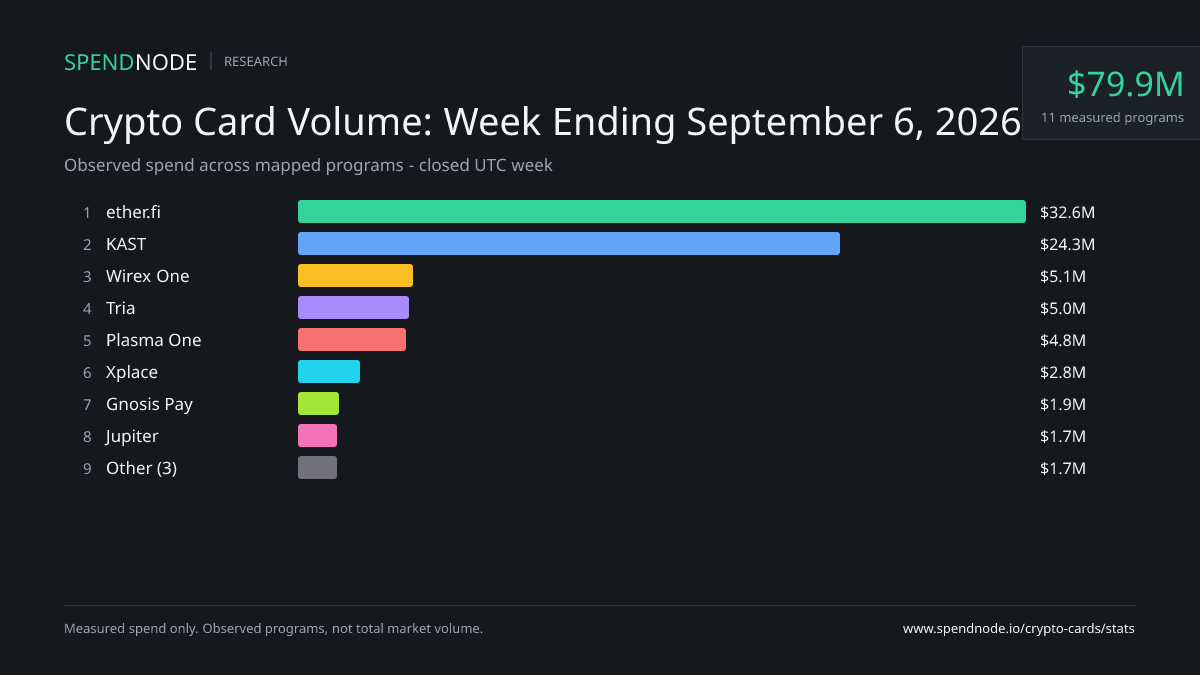
Key findings
- SpendNode observed $79.88 million of crypto card spending across 11 mapped programs in the seven days through September 6, up 11.81% from the immediately preceding UTC week.
- Ten of the 11 programs recorded higher volume. Ether.fi added $4.94 million and generated 58.5% of the measured set's $8.44 million net increase.
- Ether.fi and KAST remained dominant at a combined $56.84 million, or 71.2% of observed spend.
- Plasma One posted the fastest growth among programs above $1 million, rising 28.6% to $4.83 million. Its observed active-wallet count increased 19.4%.
- Optimism's share rose to 41.1%, while Solana's fell to 24.2%. The movement partly reflects the timing and destination chains of KAST settlement batches, not only changes in cardholder activity.
The weekly close
Observed spending reached $79,884,005 between August 31 at 00:00 UTC and September 7 at 00:00 UTC. The comparison week used the same 11 programs and the same measurement rules, so the 11.81% change does not come from adding coverage.
The increase was broad but not evenly distributed. Ether.fi rose 17.9% to $32.58 million and accounted for more than half of the net dollar gain. KAST added $1.33 million, Plasma One added $1.07 million, and Tria added $583,947. Those four programs supplied 93.9% of the aggregate increase.
Gnosis Pay was the only program to decline, easing 3.1% to $1.85 million. Wirex One was nearly flat at $5.14 million, up 0.9%. The remaining programs grew by between 4.3% and 11.2%.
Ten of 11 mapped crypto card programs grew in the week through September 6, but ether.fi alone generated nearly three of every five net dollars added.
Program movement
Ether.fi retained first place with $32.58 million, followed by KAST at $24.26 million. Their combined 71.2% share was slightly lower than the prior week's 70.8%, despite both programs growing, because Plasma One and Tria expanded faster in percentage terms.
Plasma One reached $4.83 million, a weekly increase of 28.6%. Observed active wallets rose from 8,883 to 10,607, while events increased from 22,114 to 31,537. The simultaneous rise in value, wallets, and activity makes this the clearest broad-based expansion in the measured set.
Tria rose 13.3% to $4.97 million. Its deduplicated active-wallet count increased 12.2% to 21,362. Jupiter gained 9.5% to $1.73 million as active wallets increased 9.0%, and Xplace gained 10.0% to $2.77 million with an 8.9% wallet increase.
MetaMask recorded $876,922 across its observed Base, Linea, and Solana rails, up 4.3%. Avici settled $837,398 across its current Solana and EVM routes, up 11.2%. Peanut remained the smallest measured program at $25,971, also up 11.2%.
Active-wallet figures cannot be added across programs because one person may use more than one card, and some settlement designs do not expose a comparable wallet count. KAST, for example, settled through seven issuer batches in each week. Its transaction count therefore describes settlement operations, not seven card purchases.
The chain mix changed sharply
Optimism carried $32.85 million, or 41.1% of observed spend, and remained the largest settlement chain because ether.fi accounts for most of that route. Solana ranked second at $19.34 million, down from $24.09 million in the prior week. Ethereum rose to $6.59 million and Base to $5.09 million.
That does not mean card demand moved cleanly from Solana to Ethereum and Base. KAST settles large issuer-level batches, and its seven weekly batches landed on a different chain mix: four on Solana, two on Ethereum, and one on Base. In the comparison week, six landed on Solana and one on Ethereum. A change in settlement timing or treasury routing can move millions of dollars between chain columns without representing the same-sized change in purchases made during that week.
The chain table is still useful as a settlement-footprint view. It shows where the mapped programs moved value onchain. It should not be read as blockchain market share for all crypto cards.
Measurement notes
This report covers a closed seven-day UTC period. It combines purchase-level wallet debits, card-settlement events, and issuer settlement batches only where each program's public methodology labels the basis. These event counts are not interchangeable.
Later offchain refunds and chargebacks may not return through the same onchain route, so several series are gross rather than net. Wirex also produced 15 events carrying the unsupported currency code TGB; they were excluded instead of being assigned an assumed exchange rate. MetaMask's identified Monad rail and Avici's unidentified retired route remain outside coverage.
The prior week is stored as a frozen comparison baseline. This report and its downloadable CSV, JSON, and chart keep a stable URL. If stronger evidence changes a published result, SpendNode will label and date the correction rather than silently rewriting the weekly close.