

RedotPay Solana Card Review 2026
Solana-branded virtual Visa card with direct SOL spending. Apple Pay and Google Pay support at 130M+ merchants.

Prefer mobile? Scan to continue
Opens the mobile signup with your SpendNode link, code SPENDV.

SpendNode Rating for RedotPay Solana Card
The Solana version gives RedotPay a more natural home in crypto-native spending. It still needs to earn trust the usual way, through use, not just alignment.
Solana tie-in makes the use case easier to place if you are already in that ecosystem. Scores land close to the standard RedotPay Virtual. The chain alignment helps with positioning, but it does not change the underlying economics or trust profile much.
How It Competes
Cost Efficiency
4.0
Product Utility
3.9
Custody & Trust
3.4
Reliability & UX
3.8
Transparency
3.7

VIRTUAL CARD
Verified

NO ANNUAL FEE
Verified

APPLE PAY
Verified
RedotPay Solana Card Overview
Solana Goes IRL: Spend SOL Directly at 130M+ Merchants
The RedotPay Solana Card brings Solana ecosystem spending to 130M+ merchants worldwide. It offers the same high-volume infrastructure as the standard RedotPay card with SOL as a natively supported spending asset.
Fees & Charges
Annual Fee
Free
FX Fee
1.2%
ATM Fee
TBD
Requirements
Supported Regions
GLOBAL, APAC, LATAM, EEA
Spendable Assets
SOL, USDT, USDC, BTC, ETH, BNB, XRP, SUI, TRX, S
On This Page
What Is the RedotPay Solana Card?
The RedotPay Solana Card is a Solana-branded custodial prepaid virtual Visa that lets you spend SOL directly at 130M+ merchants without first swapping it to a stablecoin. It runs on the same chassis as the standard RedotPay Virtual Card: $10 one-time issuance ($8 with promo code SPENDV at the purchase step for 20% off), $0 annual fee, $1,000,000 daily and $100,000 per-transaction limits, 1% crypto conversion plus 1.2% FX, Apple Pay and Google Pay, and no cashback. New users who register through SpendNode's link also receive a separate $5 USD welcome bonus, spendable at merchants but not toward the card fee. The one thing it adds is SOL as a native spending asset.
That single feature is the entire reason to pick it. Every other RedotPay setting is identical to the Standard card, so this page stays on what is actually different: spending SOL.
For a Solana holder the appeal is skipping the swap. You do not convert SOL to USDC to load the card, which means no swap fee and no slippage, and it removes the separate SOL-to-stablecoin conversion that is its own taxable disposal in many places. The card purchase itself can still be taxable where you live, so this is one fewer taxable step, not tax-free spending.
A launch promo offering 3% cashback ran through February 28, 2026 and has since ended, so the card now carries RedotPay's standard 2.2% fee structure with nothing to offset it.
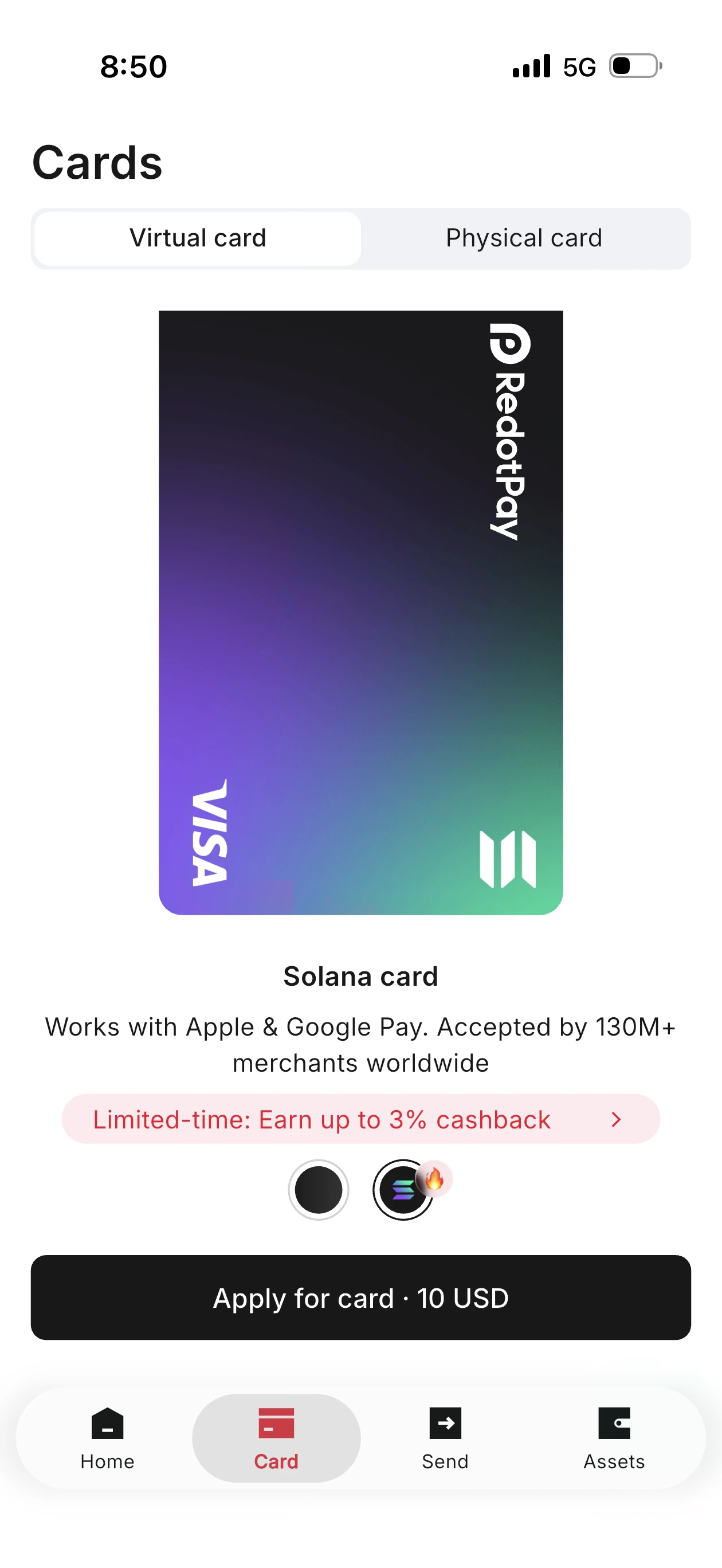
SpendNode app screenshot
RedotPay Solana Card - Solana-branded virtual Visa. $10 issuance, the same $1M daily limits and 2.2% fee structure as Standard, with direct SOL spending at 130M+ merchants.
Card Basics
It is a virtual-only Visa, issued instantly in the RedotPay app in the Solana-branded design, and it spends through Apple Pay and Google Pay. Funds are custodial: your SOL and any other supported assets (USDT, USDC, BTC, ETH, BNB, XRP, SUI, TRX, and S) sit on the RedotPay platform until you tap. Identity verification is required to activate the card, the same fast in-app KYC as every RedotPay card.
The full mechanics (the fee table at each spending level, replacement fees, the complete limit schedule) are identical to the standard card and are covered in depth on the Virtual Card review. What follows here is only what SOL changes.
Fees
| Fee | Amount |
|---|---|
| Issuance | $10 one-time ($8 with code SPENDV, 20% off) |
| Annual fee | $0 |
| Crypto conversion | 1.0% |
| FX markup | 1.2% (non-local currency) |
| Cashback | 0% (launch promo ended Feb 28, 2026) |
| ATM | N/A (virtual only) |
That is a flat 2.2% on international spend (1% conversion plus 1.2% FX), or 1% on same-currency domestic spend. The per-spend-level economics match the standard Virtual exactly: roughly $132/year at $500/month and $792/year at $3,000/month, with no cashback to claw any of it back.
How Spending SOL Works
Example: EUR 80 dinner in Berlin, funded with SOL
- Load SOL. Transfer SOL to your RedotPay balance. It is held custodially, with no swap to USDC or USDT.
- Tap Apple Pay. Visa processes the EUR 80 purchase.
- Conversion and fees. SOL converts to EUR at market rate, less 1% conversion (about $0.87) and 1.2% FX (about $1.05).
- Settled. About $89.72 leaves your SOL balance. No cashback. Net cost about $1.92 (2.2%).
The difference from every stablecoin card here is Step 1: you never had to sell SOL to spend it.
How the Solana Card Compares
Spending SOL: the alternatives
| Feature | RedotPay Solana | Solflare Card (paused Jul 2026) | KAST Standard | Ready Lite (unavailable) |
|---|---|---|---|---|
| SOL support | Direct spending | USDC (Solana) | USDC/USDT | USDC (Starknet) |
| Custody | Custodial | Self-custodial | Custodial | Self-custodial |
| Issuance | $10 | $0 | $0 | $0 |
| Cashback | 0% | Raffle system | 1.5% USD ($2K/mo cap) | 0.5% STRK |
| FX fee | 1.2% | 1% | 0.5-1.75% | 1% |
| Conversion fee | 1% | 0% | 0% | 0% |
| Daily limit | $1M | Standard | $50K | Standard |
| Regions | Broad global | EEA/UK | Limited | EEA/UK |
The Solana Card's one edge: it is the only active card here that spends SOL itself. Every active competitor makes you hold USDC or USDT, which means a swap first. The trade-off is the 2.2% fee. Before its July 2026 pause, Solflare ran self-custodial USDC spending on Solana at 1% FX and 0% conversion. Its replacement card's fees have not been announced.
Solana Card vs the standard RedotPay Virtual
| Solana Card | Virtual Card | |
|---|---|---|
| SOL as spending asset | Yes | No |
| Card design | Solana-branded | Standard black |
| Price, limits, fees, custody | Identical | Identical |
The honest version: if you hold SOL, take the Solana Card, since it is the same product plus SOL. If you do not hold SOL, the design is the only difference, so pick whichever you prefer.
Real User Scenarios
Scenario 1: Max (Amsterdam Solana Developer, $2,000/month spending)
Setup:
- RedotPay Solana Card (EEA, $10 issuance)
- Earns SOL from validator rewards and DeFi yields
- Wants to spend SOL directly without swapping to USDC
- 70% EUR domestic, 30% international
Results after 12 months:
- Monthly spending: $2,000
- Conversion (1%): -$240/yr
- FX markup (1.2% on 30%): -$86.40/yr
- Net fees: -$326.40/yr (1.36% effective on mixed spending)
His verdict: "I use KAST (1.5% USD on first $2K/mo) for daily spending and keep the RedotPay Solana Card for large one-off transactions where KAST's $15K per-transaction limit is too low. Spending SOL directly saves me the swap fees and slippage I would pay converting SOL to USDC for Solflare. For SOL holders who want to skip the extra swap to a stablecoin, direct SOL spending is the feature."
Scenario 2: Lucia (Sao Paulo NFT Artist, $800/month spending, post-promo)
Setup:
- RedotPay Solana Card (LATAM, $10 issuance)
- Receives SOL from NFT sales on Magic Eden
- Spends in BRL domestically
- Uses the card as an off-ramp for SOL earnings
Results after 12 months (post-promo):
- Total spending: $9,600
- Conversion fees (1%): -$96
- FX markup (1.2%): -$115.20
- Issuance: -$10
- Net fees: -$216.20/yr (2.25% effective)
Her verdict: "I earn SOL from NFT sales and need to spend it in Brazil. My options are limited: Solflare does not operate in Brazil, KAST has limited LATAM support. RedotPay works everywhere in Sao Paulo. The $216/year in fees is the cost of turning SOL into BRL instantly. The alternative is a CEX withdrawal to my bank, which takes 2-3 days and costs $10-15 each. At 2 withdrawals per month, that is $240-$360/year. RedotPay is comparable in cost and far faster."
Scenario 3: Kenji (Hong Kong Solana DeFi Trader, $5,000/month spending)
Setup:
- RedotPay Solana Card (APAC, $10 issuance)
- Heavy Solana DeFi user (Jupiter, Marinade, Raydium)
- Spends in HKD domestically, USD internationally
- Values the $100K per-transaction limit for large purchases
Results after 12 months (post-promo):
- Total spending: $60,000
- Conversion fees (1%): -$600
- FX markup (1.2% on 40%): -$288
- Issuance: -$10
- Net fees: -$898/yr (1.5% effective)
His verdict: "At $5,000/month with 60% domestic spending, my effective rate is 1.5%, since the FX markup only hits international transactions. KAST would earn me 1.5% USD on the first $2K/mo, meaningful but capped, and the gap to RedotPay's zero rewards adds up on under-cap spending.
I use KAST as my primary card and keep the RedotPay Solana Card for two things: transactions over $15K, and spending SOL directly without the extra stablecoin swap. The Solana branding does not matter to me. The SOL support does."
Is the RedotPay Solana Card Safe?
The risk model is identical to every RedotPay card, with one SOL-specific wrinkle. RedotPay is custodial, so your SOL sits on the platform. If RedotPay fails you are an unsecured creditor, there is no published Proof of Reserves, and the $107M Series B is operational runway, not a deposit guarantee. The standard Virtual review covers the full failure analysis.
The SOL wrinkle: a SOL balance on the card carries price exposure on a volatile asset, not just a stablecoin amount. Keep long-term SOL in self-custody (Phantom, Solflare) and move only near-term spending amounts to RedotPay.
Who Should Choose the Solana Card
Choose it if:
- You hold SOL and want to spend it directly, skipping the separate swap to a stablecoin
- You need $1M daily limits with SOL support
- You are in APAC or LATAM where self-custodial Solana cards do not operate
Skip it if:
- You do not hold SOL: the standard Virtual is identical without the SOL branding
- You want rewards: KAST (1.5% USD on first $2K/mo) or ether.fi Core (3%)
- You want an active self-custodial Solana card: xPlace offers a non-custodial credit line against Solana assets; Solflare is paused
- You spend under $1,000/month: the 2.2% drag outweighs the convenience versus a free rewards card
Our view: The Solana Card is a narrow but real product. It is the only practical way to spend SOL itself at Visa scale without converting to stablecoins first, with RedotPay's $1M limits behind it. The launch cashback is gone, so it now competes on convenience and reach, not economics. It fills a gap while Solflare remains paused and in markets KAST does not reach. For everyone else, weigh the SOL direct-spend convenience against the 2.2% fee versus swapping to USDC on a rewards card.
Sources and Verification
All card specs, fees, and limits verified from:
Written by Aleksandar Dukic
FAQ
How is the Solana Card different from the standard RedotPay Virtual Card?
It runs on the same chassis (same $10 issuance, fees, limits, and KYC) but adds SOL as a native spending asset, so you can spend SOL directly without first swapping it to a stablecoin.
Does the RedotPay Solana Card require KYC?
Yes. It needs full identity verification, a government ID and a selfie, usually cleared in about two minutes. There is no no-KYC tier.
Does it earn cashback?
No base cashback. Only the separate paid RedotPay Pro membership adds 3% on Apple Pay and Google Pay.
Is spending SOL a taxable event?
In many countries, spending SOL is a disposal that can trigger capital gains, the same as selling it. The card removes the manual swap step, not the tax treatment, so check your local rules.
Is there a promo code for the RedotPay Solana Card?
RedotPay's virtual card code SPENDV gives 20% off virtual card issuance, reducing the $10 price to $8 when entered at the card purchase step. Sign up through SpendNode's RedotPay link and apply the code when opening the card. New users also get a separate $5 USD welcome bonus after registration, spendable at merchants (but not toward the card fee).
Is the SPENDV promo code for RedotPay still working in September 2026?
Yes. SPENDV is still a working RedotPay promo code as of September 24, 2026 - we re-verify it daily. Enter it at the card purchase step for 20% off virtual card issuance ($8 instead of $10). New users who register through SpendNode's link also receive a separate $5 welcome bonus, spendable at merchants but not toward the card fee.
This is a prepaid card. Merchants that require pre-authorization holds (gas stations, hotels, car rentals, toll booths) may decline it. Fund only what you plan to spend.
Your funds are held by RedotPay. If the provider faces insolvency, your balance may be at risk. This card does not offer self-custody protection.
Fees shown above are the card's disclosed fees. Additional costs may apply: Visa/Mastercard network spread (typically 0.5-0.9%), crypto-to-fiat conversion spread at point of sale, and blockchain gas fees for on-chain top-ups.
Found any issues?
User Reviews
Reviews are moderated and may take a moment to appear.