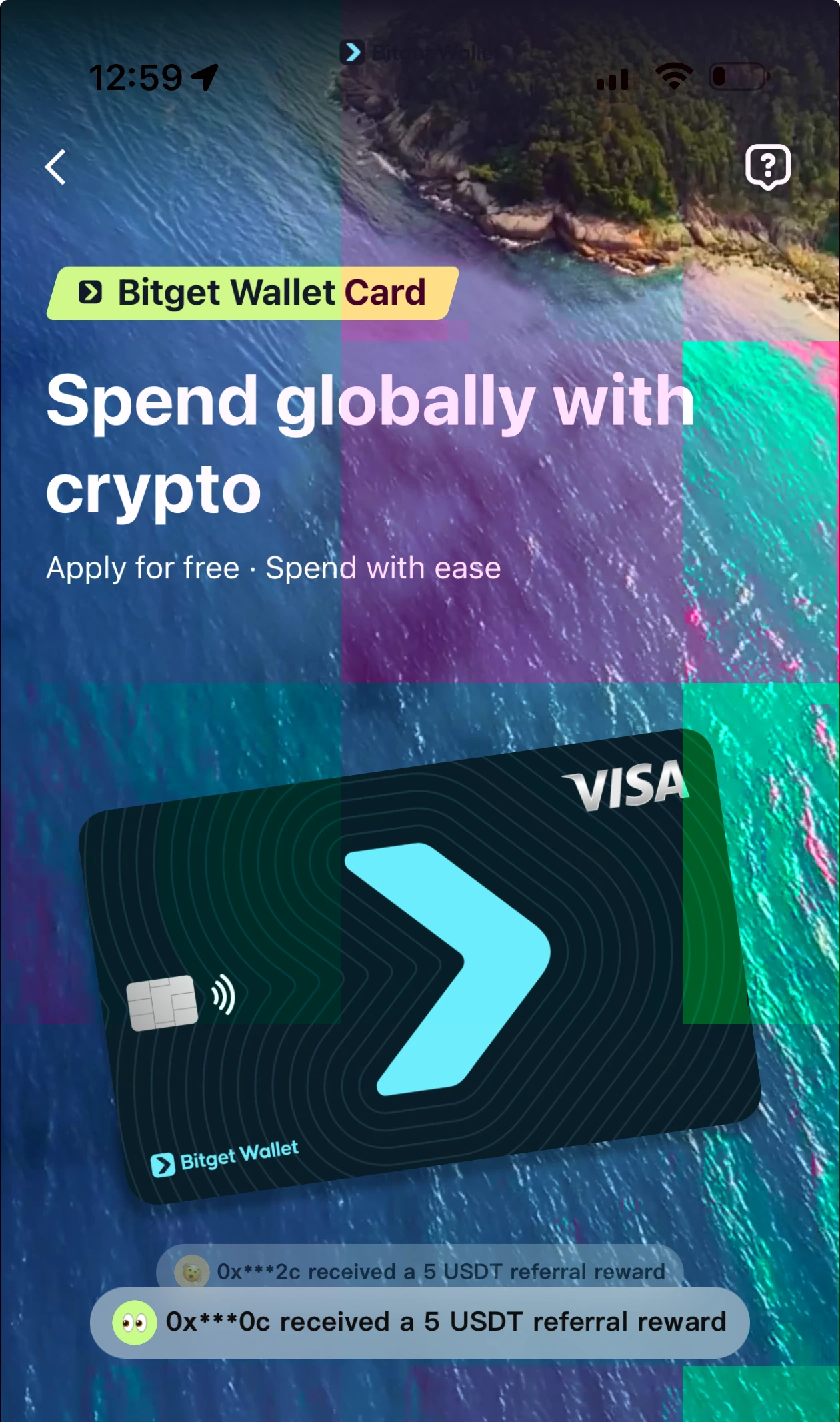
Two distinct crypto cards, with a welcome bonus of up to $20 using code p8bRFP on the Wallet Card.
Prefer mobile? Scan to continue
Opens the mobile signup with your SpendNode link, code p8bRFP.
SpendNode Rating for Bitget
3.6/5
Known for: high-reward exchange card
Bitget competes aggressively on rewards and distribution, which keeps it relevant fast. The trade is the same one you make with most exchange-linked cards: convenience over cleaner trust assumptions.
The issuer scores well on market presence and product appeal. It loses ground on custody dependence and long-term confidence compared with stronger wallet-native operators.
Issuer Snapshot
Active Products2
Editorial vendor score stays separate from user reviews. Methodology
Bitget offers two distinct crypto debit card products (neither is a credit card): a Mastercard Wallet Card for stablecoin spending with a $400/month zero-fee quota, and a Visa exchange Card linked to your Bitget trading account with BGB-based cashback tiers up to 8%.
Bitget is a crypto exchange that runs an unusual card setup: two entirely separate products built for different user profiles. Most exchanges offer a single card program. Bitget runs two with different issuers, networks, and fee models.
Available crypto cards by Bitget in November 2026
Option 1
1. Bitget Wallet Card
Stablecoin Spending Made Simple: $400/Month Fee-Free
The Bitget Wallet Card is a practical stablecoin off-ramp with broad regional availability. The $400/month zero-fee quota makes it free for anyone spending within that cap. Beyond the quota, the 1.7% FX fee is steep compared to competitors like {{link:wirex|Wirex}} (0%) or {{link:plutus|Plutus}} (0%).
The Bitget Card is built for active Bitget exchange users who want to spend directly from their trading balance. The 0.9% per-transaction fee matches industry standard for exchange cards ({{link:binance|Binance}} and {{link:bybit|Bybit}} charge the same). The 8% BGB cashback ceiling is competitive but requires significant BGB holdings.
+Up to 8% BGB cashback based on holding tiers
+Spend directly from Bitget exchange balance
+No annual fees
+Four spending levels up to $3M/month
Bitget Wallet Card Invite Code p8bRFP: How to Use It
Sign up for Bitget Wallet with invite code p8bRFP to get a welcome bonus of up to $20 after opening the Wallet Card and completing qualifying card transactions. SpendNode's Bitget Wallet signup link carries the invite code automatically.
Create or open Bitget Wallet and confirm invite code p8bRFP is attached.
Complete the required identity verification and open the Card section.
Apply for the Wallet Card, fund it with USDC or USDT, and complete qualifying card transactions.
Bitget says the welcome bonus is available to new Wallet Card holders, is credited automatically, and may vary up to $20. Its public reward page does not specify the required transaction count, spend threshold, or completion window.
SpendNode app screenshot
Bitget Wallet Card - Mastercard prepaid for USDC/USDT spending with $400/month zero-fee quota. Available in EEA, UK, LATAM, APAC.
Bitget Wallet Card - Mastercard prepaid, issued via Immersve (EU) and DCS Card Centre (Asia). Spends USDC and USDT from your Bitget Wallet. Charges 1.7% FX on non-USD transactions but offers a $400/month zero-fee quota where both FX and conversion fees are refunded. Available in EEA, UK, LATAM, APAC.
Bitget Card - Visa debit, linked to your Bitget exchange account. Spends directly from your trading balance (USDT). Charges 0.9% transaction fee on all purchases. Offers BGB cashback tiers up to 8%. Available in EEA and APAC only.
Recent Rollout Update: Bitget Card in Selected APAC Markets
In early April 2026, Bitget said the Visa-powered Bitget Card had opened to all users in selected APAC markets. The practical claims were instant activation, zero setup costs, use in 180+ countries, and cashback promotions reaching as high as 20%.
That does not change the base economics reviewed on this page. What changes is distribution: Bitget is pushing the exchange-linked card harder in APAC rather than leaving it as a narrow EEA side product. For users in supported APAC markets, the Bitget Card is now a live spending option, not just an exchange feature page.
Head-to-Head Comparison
Feature
Wallet Card
Bitget Card
Network
Mastercard
Visa
Card type
Prepaid
Debit
FX fee
0% (first $400/mo) / 1.7%
0%
Transaction fee
Included in FX
0.9% on all purchases
Cashback
None
Up to 8% in BGB
Assets
USDC, USDT
USDT only
Regions
EEA, UK, LATAM, APAC
EEA, APAC
Mobile wallets
Apple Pay, Google Pay, WeChat, Alipay
Google Pay
Annual fee
$0
$0
Wallet Card: The Stablecoin Off-Ramp
The Wallet Card does one thing: lets you spend USDC or USDT at any Mastercard terminal. The $400/month zero-fee quota makes it free for light-to-moderate spending.
Best for: Stablecoin holders in LATAM and APAC where other crypto cards are scarce. UK residents who want a crypto spending option. Anyone spending under $400/month on crypto.
Watch out for: The 1.7% FX beyond the quota is steep. At $1,000/month spend, the blended rate is still 1.02% - more expensive than Wirex (0%) or Coinbase (0%).
Bitget Card: The Trader's Daily Driver
The Bitget Card targets users already trading on Bitget. Spending directly from your exchange balance eliminates the withdrawal-to-bank step entirely.
Best for: Active Bitget traders holding BGB who spend $2K+/month. The 2% cashback tier (1,000 BGB = approx. $850) nets $33/month after the 0.9% fee at $3,000 spend.
Watch out for: At the base tier (0.5% cashback), the 0.9% transaction fee means you lose money on every purchase. You must hold BGB to break even.
Fees and Rates
Wallet Card at $400/month: Free (within quota). Best case scenario.
Wallet Card at $1,000/month: $10.20/month in FX fees (1.02% blended). Expensive.
Bitget Card at Tier 3 + $3,000/month: $33/month net profit ($60 cashback - $27 fee).
Bitget Card at base tier + $1,500/month: -$6/month loss (0.5% cashback < 0.9% fee).
Rewards and Cashback
Bitget has two card models, and only one is a rewards card. The Wallet Card is a stablecoin off-ramp with no cashback; its value is the $400/month zero-fee allowance and broad LATAM/APAC availability.
The Bitget Card is the cashback product. It pays tiered BGB rewards up to 8%, but the 0.9% transaction fee means the base 0.5% tier is negative after fees. The card starts to make sense once your BGB tier clears that fee, especially for active Bitget traders who already hold BGB and spend from their exchange balance.
Bitget vs Other Cards
Feature
Bitget Card
Binance
Bybit
Max cashback
8% (20K BGB)
2% (Brazil Mastercard)
10% (Supreme VIP)
Realistic tier
2% (approx. $850)
2% (capped under Brazil terms)
3% (VIP 1)
Transaction fee
0.9%
0.9%
0.9%
FX fee
0%
2%
0%
Supported assets
USDT only
10
12+
Regions
EEA, APAC
Brazil, Australia, New Zealand, Peru verified
EEA, APAC
Bitget wins on: Lower entry barrier for meaningful cashback ($850 for 2% vs Binance's capped structure under published Brazil terms). 0% FX fee on the exchange Card. Broader Wallet Card availability (UK, LATAM).
Bitget loses on: Asset support (USDT only vs Binance's 10). Track record (Bitget launched cards in 2024 vs Binance's older card history). BGB is less liquid than BNB.
Who Should Use Bitget?
Bitget's dual-card strategy gives users a choice between simplicity (Wallet Card) and rewards (Bitget Card). Neither card leads its category - Plutus and Wirex beat the Wallet Card on FX, while Bybit offers higher cashback ceilings than the exchange Card.
The Wallet Card shines for users in underserved regions (LATAM, APAC) who need a reliable stablecoin off-ramp. The Bitget Card makes sense only for existing Bitget traders willing to hold 1,000+ BGB.
Is Bitget Safe?
Regulatory status: Bitget holds a MiCA operating license (obtained December 2025) and an EMI license via the Lithuanian Central Bank. This means:
Fiat balances in segregated accounts
Quarterly reserve proofs published
AML/KYC standards enforced
Custodial risk: Both cards are fully custodial. Your crypto sits on Bitget's servers. If the exchange fails, you are an unsecured creditor for your crypto balance. Fiat card balances held by the EMI are protected under EU regulations.
September 2026 Security Incident
On September 24, attackers transferred approximately $388 million from part of Bitget's hot- and warm-wallet infrastructure. Bitget and its independent investigators say the attacker exploited a zero-day vulnerability in a third-party security product, obtained high-privilege internal credentials, and used them to forge withdrawal instructions. Bitget says cold wallets and private keys were not compromised and customer account balances were unaffected.
Bitget identified and remediated the vulnerability, reset internal credentials, strengthened withdrawal approvals, and restored all token, fiat, and C2C withdrawals by October 2. Mandiant and SlowMist reviewed the incident. Those controls and the reported protection of customer balances are relevant positives, but a loss of this size remains material evidence of exchange and supply-chain risk. Cardholders should not treat a card-linked Bitget balance like an insured bank deposit.
Mitigation: Keep only 1-2 months' spending balance on Bitget. Store long-term holdings in self-custody.
Is Bitget a Scam?
Bitget is not a scam, and the regulatory paper trail on this page is unusually concrete for a crypto exchange card program:
1. Real licenses, named regulators. Bitget holds a MiCA operating license (obtained December 2025) and an EMI license via the Lithuanian Central Bank. Both are verifiable regulatory registrations in the EU, not vague "globally compliant" marketing. The EMI license is what lets the card program hold customer fiat under EU e-money rules.
2. Operational transparency. Under that EU regulatory framework, Bitget operates segregated fiat accounts and publishes quarterly reserve proofs - both of which are disclosed in the safety section of this page. AML and KYC are enforced through the same framework.
3. Two products, two issuers, two networks - and all four are named. A scam card program typically runs a single opaque brand. Bitget runs two separate products with different issuers: the Bitget Wallet Card (Mastercard prepaid, issued via Immersve in the EU and DCS Card Centre in Asia) and the Bitget Card (Visa debit linked to the exchange account). Their fee models, supported assets, and regional footprints are fully specified in the tables above rather than blurred together.
4. Product terms are fully disclosed. The full fee and reward tables are above. The most important scam-check detail is the 0.9% per-transaction fee on the exchange Card - that is the kind of number scam programs hide until after activation, and here it is stated in the entity definition.
5. Regulatory actions are disclosed, not swept under the rug. Bitget has been the subject of enforcement action in at least two jurisdictions: the French AMF blacklisted Bitget as an unregistered DASP in November 2023, and the Philippine SEC named Bitget in a 10-exchange ban in August 2025. Both are tracked in the card data and used to exclude those countries from featured placements. That is not a scam signal - the scam signal would be pretending the enforcement history does not exist.
What to be aware of
Fully custodial. Both cards sit on Bitget. If the exchange fails, your crypto balance makes you an unsecured creditor. Only the fiat card balance held by the EMI is protected under EU rules. Keep only 1-2 months of spending money on the platform.
Real country bans. France and the Philippines are excluded. If you reside in either, this card program is not available to you, regardless of what the Wallet Card's regional list suggests.
BGB cashback carries token risk. The Bitget Card's up-to-8% headline rate is paid in BGB, the exchange's own token. BGB is less liquid than BNB, and the rewards keep their headline value only as long as BGB does. Convert or withdraw rewards rather than letting them accumulate on the platform.
The base Bitget Card tier loses money. At 0.5% cashback with a 0.9% transaction fee, every purchase is a net loss until you stake enough BGB to lift your tier. This is disclosed on the page, but it means the card is only viable for users who are willing to hold a meaningful BGB position.
Card program is only a couple of years old. The card lineup launched in 2024. It does not have the multi-year track record that Crypto.com, Coinbase, or Wirex card programs have for incident response and dispute handling.
The exchange suffered a major wallet breach in September 2026. Bitget reports that users did not lose account balances and withdrawals were fully restored, but approximately $388 million left hot and warm wallets after a third-party security product was compromised. The incident reinforces the case for keeping only a working spending balance on the exchange.
SpendNode Verified: The editorial team reviewed Bitget's issuer identity, product terms, and live card flow per our methodology. Verification is not an endorsement or guarantee.
Countries and Availability
Bitget is available in 97 countries as of November 2026. We count a country here when at least one active Bitget card variant lists it, so individual product pages may be narrower.
Available Regions
Africa
Cameroon (CM), Cote d'Ivoire (CI), Egypt (EG), Ethiopia (ET), Ghana (GH), Kenya (KE), Morocco (MA), Mozambique (MZ), Nigeria (NG), Rwanda (RW), Senegal (SN), South Africa (ZA), Tanzania (TZ), Tunisia (TN), Uganda (UG)
Americas
Argentina (AR), Bolivia (BO), Brazil (BR), Canada (CA), Chile (CL), Colombia (CO), Costa Rica (CR), Dominican Republic (DO), Ecuador (EC), El Salvador (SV), Guatemala (GT), Jamaica (JM), Mexico (MX), Panama (PA), Paraguay (PY), Peru (PE), Trinidad and Tobago (TT), Uruguay (UY)
Asia
Bahrain (BH), Bangladesh (BD), Cambodia (KH), China (CN), Georgia (GE), Japan (JP), Jordan (JO), Kazakhstan (KZ), Kuwait (KW), Lebanon (LB), Malaysia (MY), Mongolia (MN), Oman (OM), Pakistan (PK), Philippines (PH), Qatar (QA), Saudi Arabia (SA), Singapore (SG), South Korea (KR), Sri Lanka (LK), Taiwan (TW), Thailand (TH), United Arab Emirates (AE), Uzbekistan (UZ), Vietnam (VN)
Europe
Albania (AL), Austria (AT), Belgium (BE), Bulgaria (BG), Croatia (HR), Cyprus (CY), Czech Republic (CZ), Denmark (DK), Estonia (EE), Finland (FI), France (FR), Germany (DE), Greece (GR), Hungary (HU), Iceland (IS), Ireland (IE), Italy (IT), Latvia (LV), Liechtenstein (LI), Lithuania (LT), Luxembourg (LU), Malta (MT), Montenegro (ME), Netherlands (NL), North Macedonia (MK), Norway (NO), Poland (PL), Portugal (PT), Romania (RO), Serbia (RS), Slovakia (SK), Slovenia (SI), Spain (ES), Sweden (SE), Switzerland (CH), United Kingdom (GB)
Oceania
Australia (AU), Fiji (FJ), New Zealand (NZ)
Major Restricted Markets
These major markets are not currently listed for this vendor. Confirm eligibility with the issuer before applying, especially where card tiers have different country rules.
Americas
United States (US)
Asia
Hong Kong (HK), India (IN), Indonesia (ID), Turkey (TR)
Our Verdict on Bitget
Bitget's two cards answer different questions. Anyone spending under $400 a month in stablecoins gets the better deal from the Wallet Card, whose monthly zero-fee quota makes light USDC and USDT spending effectively free across the EEA, UK, LATAM, and APAC; above the quota, the 1.7% FX rate gets expensive fast.
The exchange-linked Bitget Card only wins if you hold BGB. Its 0.9% transaction fee eats the 0.5% base cashback, so purchases lose money until roughly 1,000 BGB (about $850) lifts the tier to 2%, where a $3,000 monthly spender nets about $33. Both cards are fully custodial, and the September 2026 hot- and warm-wallet breach makes the balance limit more than a generic precaution: keep no more than a month or two of spending money on the platform.
Are Bitget crypto cards available in the United States?
No. Bitget crypto cards are not available in the United States.
What is the difference between Bitget Wallet Card and Bitget Card?
The Bitget Wallet Card is a Mastercard prepaid card that spends USDC/USDT from your Bitget Wallet with a $400/month zero-fee quota. The Bitget Card is a Visa debit linked to your Bitget exchange account with BGB cashback tiers. They are separate products with different issuers.
Does the Bitget Wallet Card have FX fees?
Within the $400/month zero-fee quota, FX and conversion fees are refunded. Beyond the quota, non-USD transactions incur a 1.7% FX fee.
Is the Bitget Card's 8% BGB cashback live?
The BGB cashback tiers are listed on Bitget's card page. Check bitget.com/cards directly, since the feature may still be rolling out in some regions.
Is the Bitget Card a credit card?
No. Both Bitget cards are debit/prepaid cards, not credit cards. The Wallet Card is a Mastercard prepaid and the exchange Card is a Visa debit - you spend your own balance with no credit line, no APR, and no credit check. For crypto-backed credit card options, see our reviews of Gemini, ether.fi, Nexo, and Avici.
How do I get the Bitget Wallet Card welcome bonus?
Open SpendNode's Bitget Wallet signup link and use invite code p8bRFP, which the link applies automatically. New Wallet Card holders can receive up to $20 after opening the card and completing qualifying card transactions. Bitget does not publish the required transaction count, spend amount, or completion window on its public reward page, and says the final reward amount may vary.