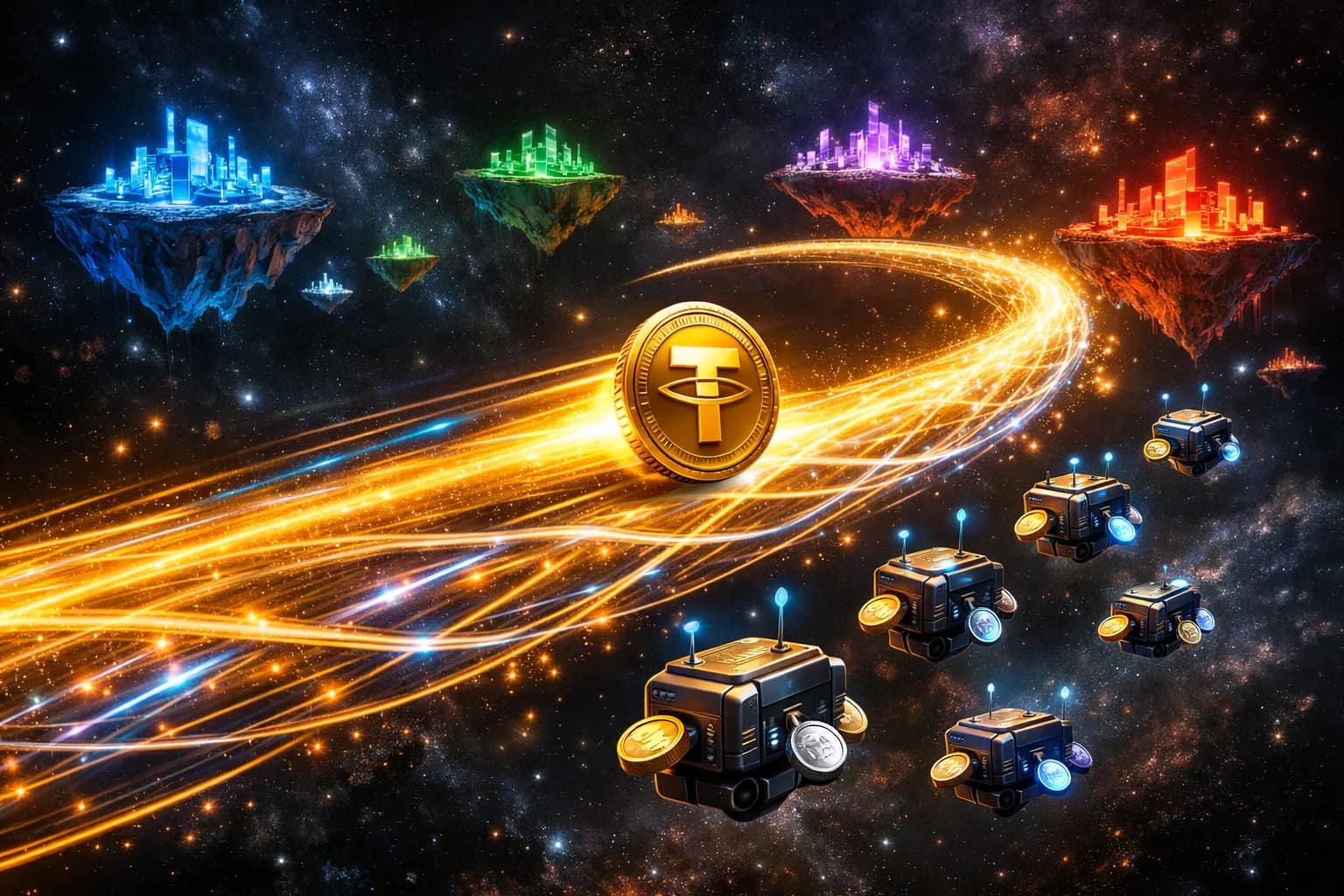
Tether Puts Capital Behind the Protocol Powering Its Cross-Chain Stablecoin
Tether Investments announced a new strategic stake in LayerZero Labs on February 10, the development company behind the interoperability protocol that already underpins $70 billion in cross-chain stablecoin transfers. The deal size was not disclosed, but the investment signals that Tether views LayerZero's infrastructure as a core rail for its expanding stablecoin empire.
The move comes after USDt0, Tether's omnichain stablecoin deployed by Everdawn Labs using LayerZero's Omnichain Fungible Token (OFT) standard, quietly became one of the most heavily used cross-chain assets in crypto. Unlike traditional bridged versions of USDT that fragment liquidity across networks, USDt0 maintains unified liquidity as it moves between blockchains, eliminating the wrapped token complexity that has plagued cross-chain transfers for years.
Paolo Ardoino, Tether's CEO, framed the investment around "infrastructure delivering tangible utility" and supporting what he called "the infinite agentic AI economy." Bryan Pellegrino, LayerZero's CEO, called it "the ultimate validation," pointing to USDt0's success as a stepping stone toward "permissionless global markets."
Why $70 Billion in 12 Months Changes the Interoperability Game
The $70 billion figure is not a projection. It represents actual cross-chain value that has moved through USDt0 in under twelve months of live operation across 15+ blockchain networks. For context, LayerZero's broader protocol connects over 100 blockchains, making it one of the most widely deployed interoperability frameworks in production.
This volume validates a thesis that the stablecoin wars will not be won by minting alone. Distribution matters. If USDT can flow between Ethereum, Solana, Arbitrum, TON, Polygon, and dozens of other chains without users needing to worry about bridging mechanics, it removes one of the biggest friction points in crypto. The OFT standard treats the token as a single asset regardless of which chain it sits on, which means no more USDT.e, USDT (Bridged), or other confusing variants.
For LayerZero, the Tether investment is also a commercial endorsement. When the largest stablecoin issuer in the world backs your interoperability layer with both capital and its flagship product, competing cross-chain protocols take notice.
The Wallet Development Kit and the Agentic Finance Angle
Beyond the investment itself, the more forward-looking piece is how Tether's Wallet Development Kit (WDK) integrates with LayerZero's infrastructure. The WDK is a fully open-source, ecosystem-agnostic toolkit that lets developers, organizations, and even autonomous AI agents build self-custody wallets across multiple platforms and blockchains.
The WDK currently supports Bitcoin (including Lightning Network), EVM chains like Ethereum, Arbitrum, and Polygon, as well as non-EVM networks like Solana and TON. It ships with DeFi primitives (lending, swaps), customizable UI templates, and runs on everything from mobile devices to IoT hardware and servers.
The "agentic finance" narrative is where this gets interesting. The combined infrastructure of WDK plus LayerZero is explicitly designed to let AI agents manage their own wallets and send payments autonomously. Imagine an AI trading bot that holds USDT across five chains, automatically rebalancing based on yield opportunities, without any human touching a private key. That is the use case Tether and LayerZero are building toward.
This is not theoretical. Tether's WDK documentation already references an "agentic AI economy" where autonomous systems handle transactions, settlements, and custody at machine speed. The LayerZero investment provides the cross-chain plumbing those agents need to operate across fragmented blockchain ecosystems.
What This Means for Stablecoin Users and Crypto Card Holders
For everyday users, the practical impact is smoother stablecoin transfers. If you hold USDT on one chain and need it on another, whether to load a crypto card or interact with a DeFi protocol, USDt0 via LayerZero should make that transfer faster and cheaper than traditional bridges.
The ZRO token initially gained 10% on the announcement before pulling back 3% over 24 hours, suggesting that traders are pricing in long-term infrastructure value rather than short-term hype.
For stablecoin-focused card users, the USDt0 standard could eventually mean that loading a card with USDT from any chain becomes seamless. Several card issuers already accept USDT on specific chains, but the fragmented experience (send USDT from Ethereum, wait for bridge, convert on destination chain) remains a pain point. Unified omnichain USDT eliminates that friction entirely.
Tether also deployed XAUt0, a gold-backed token using the same OFT standard, hinting that the omnichain playbook extends beyond dollar stablecoins into tokenized commodities.
The Bigger Picture: Interoperability as a Competitive Moat
Tether's LayerZero bet sits within a broader trend of stablecoin issuers investing in distribution infrastructure rather than just reserve management. Circle has pushed native USDC deployments on individual chains. Tether is taking the opposite approach: one token standard that works everywhere via interoperability.
The agentic finance angle also positions Tether ahead of competitors in the AI-crypto intersection. As AI agents become more prevalent in DeFi, the wallets and rails they use need to be programmable, cross-chain, and self-custodial. Tether's WDK, combined with LayerZero's reach across 100+ chains, creates a stack that is purpose-built for that future.
For protocols and exchanges, the investment reduces counterparty risk. Rather than relying on third-party bridges (which have been responsible for billions in hacks), USDt0's native omnichain design means the asset moves without intermediary contracts that can be exploited.
Overview
Tether's strategic investment in LayerZero Labs cements the interoperability protocol as a foundational layer for the world's largest stablecoin. With USDt0 already processing $70 billion in cross-chain transfers across 15+ networks, the partnership is about scaling what works: unified stablecoin liquidity without bridges, wrapped tokens, or fragmented user experiences. The agentic finance angle, powered by Tether's open-source WDK, points toward a future where AI agents manage cross-chain wallets autonomously. For users, the takeaway is simpler: moving USDT between chains is getting faster, cheaper, and eventually invisible.