Binance has published a detailed warning about lookalike wallet address scams, a growing attack vector where scammers generate wallet addresses that closely resemble a victim's frequently used addresses. The post, which pulled over 24,000 views, outlines how these scams work and provides specific detection and prevention methods.
The warning comes during a period of extreme market fear, when panicked users making hasty transactions are especially vulnerable to address manipulation attacks. With the Crypto Fear and Greed Index at single-digit levels, the urgency of basic security hygiene has never been higher.
How Lookalike Address Scams Work
The attack exploits a common user behavior: copying a wallet address from transaction history rather than from a trusted source. Here is the step-by-step anatomy of the scam:
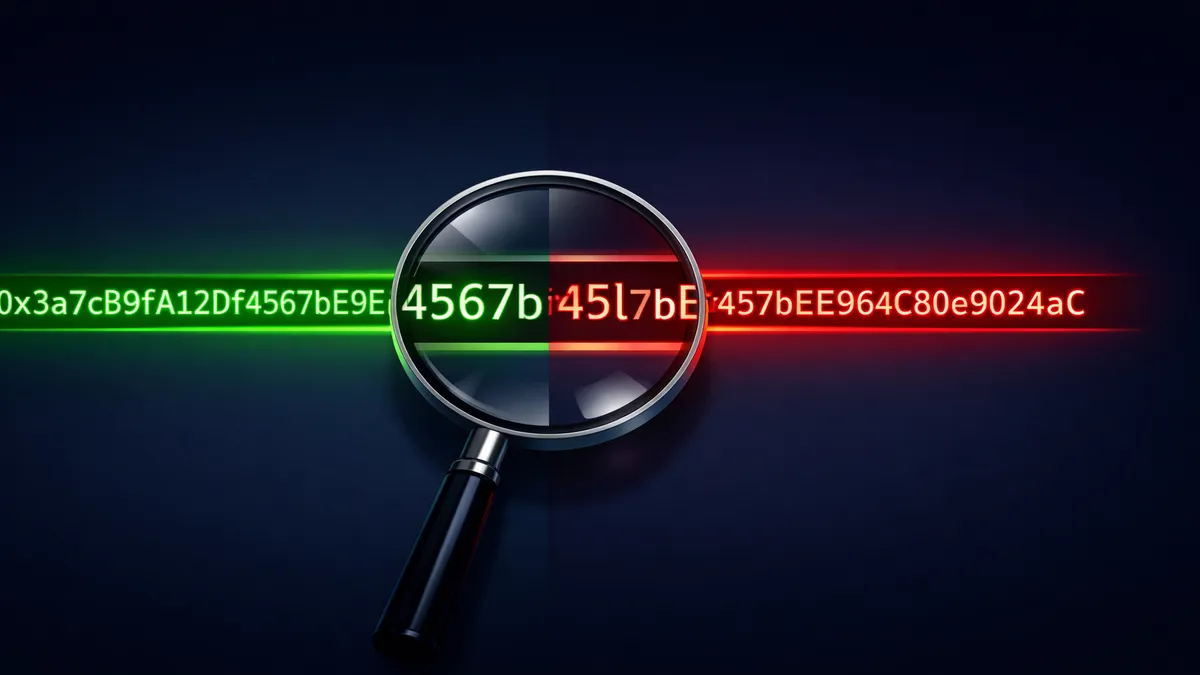
Step 1: Address generation. The scammer uses vanity address generators to create wallet addresses that match the first 4 to 6 characters and last 4 to 6 characters of a target's real address. Since most wallet interfaces only display the beginning and end of an address (truncating the middle), the fake address appears identical at a glance.
Step 2: Dust transactions. The scammer sends a tiny amount of cryptocurrency (often fractions of a cent worth of tokens) from the lookalike address to the victim's wallet. This "dusting" plants the fraudulent address in the victim's transaction history.
Step 3: The trap. When the victim needs to send funds, they scroll through their transaction history, see what appears to be a familiar address, copy it, and send their funds to the scammer's lookalike address instead of their intended recipient.
Step 4: Funds are gone. Blockchain transactions are irreversible. Once funds are sent to the wrong address, there is no chargeback, no recovery, and no customer service that can reverse it.
Why This Scam Is So Effective
The genius of the attack lies in its exploitation of user interface design. Most wallets and block explorers display addresses in a truncated format:
- Full address:
0x1a2B3c4D5e6F7890aBcDeF1234567890AbCdEf12 - Displayed as:
0x1a2B...Ef12
The scammer only needs to match the visible portions. With modern GPU computing power, generating a vanity address that matches 4 to 6 characters on each end takes minutes, not days. The middle characters are completely different, but users never see them.
This is not a theoretical risk. Blockchain security firms have documented millions of dollars lost to address poisoning attacks across Ethereum, BNB Chain, and other EVM-compatible networks. One incident in May 2024 saw a single victim lose $68 million in wrapped Bitcoin after copying a poisoned address.
Binance's Recommended Detection Methods
Binance's guide outlines several specific countermeasures:
Always verify the full address. Before sending any transaction, expand the full address and verify every character, not just the first and last few. This takes 10 extra seconds and can save your entire portfolio.
Use address whitelists. Most major exchanges and wallets allow you to save verified addresses to a whitelist. Once an address is whitelisted, you can only send to pre-approved destinations. Binance itself offers this feature in its withdrawal settings.
Ignore unsolicited small transactions. If you receive tiny amounts of tokens from unknown addresses, do not interact with them. These are almost certainly dusting attacks designed to plant lookalike addresses in your history.
Use QR codes when possible. Scanning a QR code from a trusted source eliminates the risk of copying a tampered text address. Many crypto card apps support QR-based transfers for this reason.
Name your addresses. Wallet apps that support address labels (like MetaMask's address book) let you assign names to saved addresses. Always send to a named contact rather than scrolling through raw transaction history.
The Broader Crypto Security Landscape
Address poisoning is part of a growing category of social engineering attacks that target user behavior rather than protocol vulnerabilities. The blockchain itself is secure. Smart contracts can be audited. But the human copying and pasting an address is the weakest link.
Other prevalent attack vectors in the current environment include:
- Clipboard malware. Software that monitors your clipboard and automatically replaces copied crypto addresses with the attacker's address. This is why self-custody wallets with built-in address verification are critical.
- Phishing approval transactions. Fake dApps that request unlimited token approvals, draining wallets of all approved assets.
- Seed phrase harvesting. Fake wallet apps or browser extensions that capture recovery phrases during setup.
The common thread is that all of these attacks exploit trust and convenience. Users who trade security for speed are the primary targets.
How Crypto Card Users Should Protect Themselves
For anyone using crypto cards linked to exchange accounts or DeFi wallets, the implications are direct:
Top-up address verification. When funding your card from an external wallet, double-check the deposit address every time. Do not rely on previously copied addresses. Card platforms like OKX, Bybit, and Binance each have unique deposit addresses that should be verified on the platform itself.
Enable withdrawal whitelists. If your card is linked to an exchange account, enable the withdrawal whitelist feature. This adds a 24-hour cooldown when adding new addresses, giving you time to catch unauthorized changes.
Use MPC wallets. Cards backed by MPC (multi-party computation) security add an extra layer of protection. Even if an attacker compromises one signing key, they cannot authorize transactions without the other key shares.
Monitor transaction history. Regularly review your wallet's incoming transactions. If you see unexpected small deposits from unknown addresses, flag them and avoid interacting with those addresses.
Overview
Binance's warning about lookalike address scams is a timely reminder that the biggest threat in crypto is not protocol hacks or smart contract exploits. It is human error exploited by social engineering. Address poisoning attacks are cheap to execute, difficult to detect at a glance, and devastating when they succeed. The fix is simple but requires discipline: verify every character of every address, every time. Use whitelists, use QR codes, use address labels, and never copy addresses from transaction history during a panic sell. In a market where the Fear and Greed Index sits at 9, slowing down by 10 seconds to verify an address could be the most valuable trade you make.