
Key findings
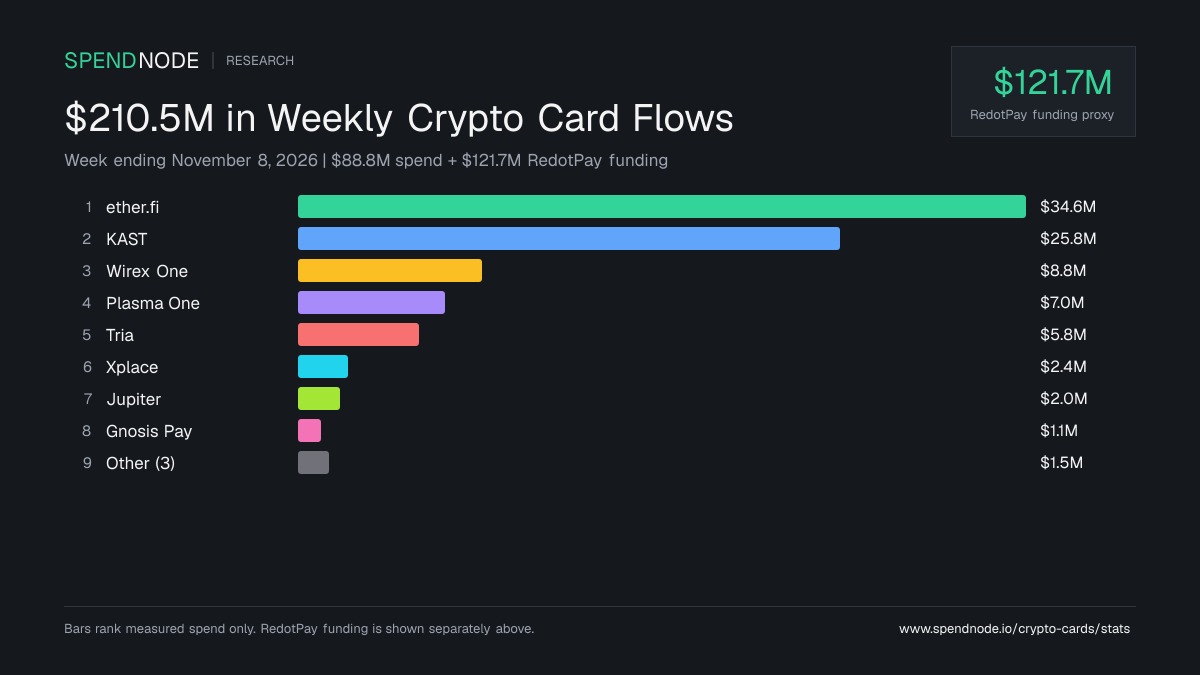
- SpendNode observed $210.49 million across two onchain crypto-card ledgers in the seven days through November 8: $88.82 million in measured card spending and $121.67 million in RedotPay account funding.
- Measured spending increased 1.4% to its highest level in the 11-week series. The comparison uses the same 11 programs as the preceding close.
- RedotPay funding was 37.0% larger than measured spending and represented 57.8% of the combined observed flow. It is a top-up proxy, not card purchase volume.
- Ether.fi reached a series high of $34.61 million, while Wirex One set its own high at $8.75 million. KAST declined 6.0% to $25.79 million.
- xPlace rebounded 35.9% to $2.37 million even as observed events and wallets declined. Average observed value per event rose from $101.21 to $176.26.
- Away from the volume ledger, the week brought a U.S. transfer cutoff for MEXC, a Gnosis Pay customer-data breach, new payment access in Paraguay, and card, funding, or rewards updates from more than 20 vendors.
Two onchain ledgers reached $210.49 million
The combined figure is the arithmetic sum of two measurements with different meanings. SpendNode recorded $88,823,761 of measured card spending across 11 mapped programs and $121,666,193 of recognized-asset funding sent to RedotPay's mapped collectors between November 2 at 00:00 UTC and November 9 at 00:00 UTC.
The $210.49 million headline is observed onchain card flow, not payment volume and not an estimate of the whole crypto-card market. RedotPay's row measures money entering an account before it may be spent. The other ledger measures purchase-level wallet debits, settlement events, or issuer settlement batches under each program's stated methodology.
This distinction also applies to rankings. RedotPay is the largest observed flow in the report, but it is not ranked against card-spending programs because funding and spending are different stages.
SpendNode observed $210.49 million across two onchain crypto-card ledgers: $88.82 million in measured spend and $121.67 million in RedotPay funding.
RedotPay recorded $121.67 million in mapped funding
RedotPay received 164,596 mapped top-ups worth $121.67 million during the closed week. This is the first weekly report to include its funding proxy, so there is no prior weekly comparison under the same published scope.
Tron supplied $60.88 million, BNB Chain $29.90 million, and Ethereum $20.66 million. Together, those three chains carried 91.6% of the mapped funding total. Solana added $4.76 million, Arbitrum $2.36 million, Base $1.86 million, Polygon $930,283, TON $313,033, and Optimism $92.
| RedotPay funding chain | Weekly funding | Mapped top-ups |
|---|---|---|
| Tron | $60.88M | 42,923 |
| BNB Chain | $29.90M | 89,597 |
| Ethereum | $20.66M | 19,373 |
| Solana | $4.76M | 7,569 |
| Arbitrum | $2.36M | 3,308 |
| Base | $1.86M | 677 |
| Polygon | $930K | 141 |
| TON | $313K | 1,007 |
| Optimism | $92 | 1 |
The series covers recognized EVM, Solana, TON, and Tron assets sent to verified collectors. Bitcoin and unidentified funding routes remain outside the mapped proxy. Cross-chain user totals are withheld because wallet identities cannot be safely deduplicated across networks.
Measured card spending set a series high
Measured spending increased by $1.22 million, or 1.4%, from the November 1 close. The $88.82 million total was the highest of the 11 weekly observations collected so far.
Six programs increased and five declined. Wirex One supplied the largest gain at $1.15 million, followed by ether.fi at $869,374, xPlace at $625,393, Plasma One at $144,550, Avici at $143,059, Jupiter at $140,710, and Peanut at $1,334. These gains outweighed a $1.64 million KAST decline and smaller decreases at Gnosis Pay, MetaMask, and Tria.
Multiplying this week's measured-spend total across 52 weeks gives about $4.62 billion. That is a scale reference, not a forecast. Annualizing the combined $210.49 million flow would be even less useful because it would mix account funding with spending.
Ether.fi and Wirex One reached new highs
Ether.fi increased 2.6% to $34.61 million, its highest weekly total in the series. Observed spend events rose 1.5% to 446,140, while average observed value increased from $76.79 to $77.58. Ether.fi represented 39.0% of measured spending.
Wirex One increased 15.1% to a series-high $8.75 million. Merchant-debit events rose 2.2% to 124,933 and active wallets increased 5.1% to 13,963. Average observed value per event rose from $62.22 to $70.08. No unsupported Wirex currency codes appeared in the closed window.
Together, ether.fi and KAST represented $60.40 million, or 68.0% of measured spending. Their combined share declined from 69.8% because KAST moved in the opposite direction.
KAST fell while xPlace rebounded
KAST declined 6.0% to $25.79 million across seven issuer settlement batches. Six Solana batches carried $25.49 million and one Ethereum batch carried $300,630. These are aggregate issuer settlements, not seven purchases.
xPlace increased 35.9% to $2.37 million after the preceding week's sharp decline. The rebound came without more observed activity: events fell 22.0% to 13,427 and active wallets declined 20.6% to 1,608. Average observed value per event rose 74.2% to $176.26.
The pattern indicates a larger average observed settlement rather than a broad increase in event or wallet counts. The chain data does not establish why transaction size changed.
Plasma One increased 2.1% to $6.98 million. Settlement events rose 22.9% to 63,652 and active wallets increased 7.0% to 13,369, while average observed value declined from $132.01 to $109.71.
Smaller programs moved in both directions
Jupiter increased 7.6% to $2.00 million even as events declined 8.0%. Average observed value rose from $89.71 to $104.91. Jupiter launched Borrow to Pay during the week, but the chain data cannot establish that the feature caused the increase.
Avici increased 25.9% to $695,440. Accepted Solana settlements declined 11.2% to 2,852, while average observed value rose from $172.03 to $243.84. Its five monitored EVM networks produced no qualifying settlements.
Tria declined 0.8% to $5.75 million. Deduplicated events fell 8.0% to 57,113 and active observed addresses declined 1.0% to 22,654. Both recipient eras remained in scope and were deduplicated before aggregation.
MetaMask declined 7.5% to $730,221 across the observed Base, Linea, and Solana deployments. The total included $333,414 on Linea, $233,449 on Solana, and $163,358 on Base. Seventy-four EURC and 24 cbBTC entries on Base were excluded because the weekly valuation registry did not support them.
Gnosis Pay declined 8.4% to $1.12 million as its scheduled December 20 card closure approaches. Peanut increased 4.6% to $30,492 across 377 accepted settlements and 170 active collateral accounts.
Optimism and Solana carried 73.7% of measured spend
Optimism remained the largest observed settlement chain at $34.73 million, or 39.1% of measured spending. Solana followed at $30.78 million, or 34.7%. The two chains together carried 73.7% of the measured-spend ledger.
| Observed settlement chain | Weekly volume | Share |
|---|---|---|
| Optimism | $34.73M | 39.1% |
| Solana | $30.78M | 34.7% |
| Arc | $8.75M | 9.9% |
| Plasma | $6.98M | 7.9% |
| Base | $2.29M | 2.6% |
| Polygon | $1.87M | 2.1% |
| Arbitrum | $1.67M | 1.9% |
| All other mapped chains | $1.75M | 2.0% |
These shares describe the 11 measured-spend programs only. They exclude RedotPay funding and are not blockchain market-share estimates. Issuer-batch routing can move value between chains without an equivalent change in purchases.
MEXC faced a U.S. cutoff as Gnosis Pay disclosed a breach
The week's most serious vendor news sat outside the volume rankings. FinCEN ordered covered U.S. financial institutions to stop transmitting fiat and crypto funds involving MEXC. The restriction takes effect 30 days after Federal Register publication. MEXC said operations remained normal, but Plasma One had already started warning users that deposits from MEXC were suspended. SpendNode suspended its MEXC recommendation.
Gnosis Pay disclosed a breach of the system behind its consumer cards. The company said some customer information was exposed, affected users were emailed, and funds were not touched. Its consumer card platform is still due to close on December 20. A data breach during that final stretch gives existing cardholders another reason to download records and complete the move to another card early.
Binance restored withdrawals in stages after a service pause, then removed API keys linked to SignalPlus as a precaution following a reported issue at the third-party platform. Uphold also worked through deposit and withdrawal delays caused by a provider outage. Most routes were back to normal by November 6, although eight assets or network combinations remained delayed.
Thailand also moved to block Bitget. That action concerns exchange access rather than the card alone, but it matters to anyone relying on one Bitget account for trading, funding, and spending.
New payment rails reached Paraguay, Europe and Samsung Wallet
Hyperbeat opened Liquid Banking access in Paraguay, including its Pay card and named USD and EUR virtual accounts. Gate Pay launched in Europe, while Gate Card received new names and six designs a day later.
Coinbase began powering USDC inside Samsung Wallet for more than 82 million eligible Galaxy users in the United States. The wallet can now top up, hold, send, and receive USDC. The release concerns Coinbase's wallet integration rather than Coinbase Card, putting a stablecoin balance inside a mainstream mobile wallet beside familiar payment tools.
Two card apps changed the route from crypto balance to purchase. COCA added zero-fee USDC top-ups on Base and paired the release with 8% cashback on the first three purchases for November signups. Jupiter launched Borrow to Pay, allowing cardholders to borrow against token holdings instead of selling them first. Jupiter did not publish the borrowing rate or liquidation terms in the launch post.
Other rails moved too. BitPay added one-tap crypto purchases through MoonPay with Apple Pay, Google Pay, cards, and SEPA. Crypto.com enabled USDC deposits and withdrawals on Arc. RedotPay promoted crypto-funded merchant QR payments in Argentina, and Ledger added direct Morpho access with Clear Signing for deposits, loans, and vault interactions.
KAST dropped its token plan as card rewards changed elsewhere
Ether.fi refunded eligible bank-deposit fees for Luxe, Pinnacle, and VIP members through December 31, with monthly covered deposits ranging from $3,000 to $150,000 by tier. That offer landed in the same week that ether.fi set a new high in SpendNode's measured-spend series.
KAST ended its planned token launch and replaced qualifying Points with non-tradable Pioneer Units. Points earning stops November 30. Users who do not qualify for KPUs are due to receive spending vouchers, but KAST has not published the conversion formula or qualification threshold.
Ethena Pay opened Earn+ to all users, doubled its initial capacity after it filled, and added clearer monthly cashback-cap tracking. It also added CSV transaction exports. Users can now see what each purchase earned, how much room remains under the cap, and export the account history.
The rest of the week's card activity was mostly rewards, deposits, and targeted campaigns:
- Cashi promoted its $5 invite program, which pays after the invited user's first $50 in spending. It also ran 5% merchant campaigns and continued its 3% subscription cashback offer.
- Plasma One offered 11% back in XPL at 11 named Asian marketplaces for Singles Day. The promotion runs through November 12 and has a $30 cap per card account.
- Pulsar added Bitcoin and Ether deposits, then previewed a higher-reward Ultra tier and ran rotating double-cashback offers for Pro members.
- Tuyo replaced its Buy Now, Pay Maybe campaign with 1.5% cashback.
- Bleap added a choice of cashback in dollars, crypto, or stocks.
- Avici announced 5% card cashback in London from November 14 to 18 for Breakpoint week.
- Kolo and AMLBot offered new AMLBot users 100% cashback on one card payment, plus an AMLBot card design inside Kolo.
- Solid reported $1 million in card spending and $2 million in deposits, introduced euro cards and accounts, and later added 50% cashback on AntSeed AI access.
- Ready launched its first Community Finance program with Method. Card purchases support the community and earn points toward Method-linked rewards.
- Bybit began a month-long Black Friday campaign across Bybit Card and Bybit Pay. Its announcement promoted rewards but did not state the rates or caps.
- Oobit and TRON DAO published research on how Oobit users spend digital assets on everyday purchases.
- Tria opened Gacha to its wider user base with 1% back in WBTC on eligible wallet-funded purchases. Tria Card payments were not live for Gacha during the report window.
Measurement notes
This report covers a closed seven-day UTC period. It combines purchase-level wallet debits, card-settlement events, and issuer settlement batches only where each program's public methodology labels the basis. Event counts are compared within programs and are not treated as interchangeable across different settlement designs.
RedotPay account funding is published beside measured spending because it is the largest mapped onchain crypto-card flow in this report. It remains excluded from every spending total, spending ranking, and spending growth rate. The combined $210.49 million figure must therefore be read with its $88.82 million spend and $121.67 million funding components attached.
Later offchain refunds and chargebacks may not return through the same onchain route, so several series are gross rather than net. KAST's seven transactions are issuer settlement batches, not seven card purchases. MetaMask's identified Monad rail and Avici's unidentified retired route remain outside coverage.
The preceding week and this report are frozen snapshots. Their downloadable CSV, JSON, and chart files keep stable URLs. If stronger evidence changes a published result, SpendNode will label and date the correction rather than silently rewriting the weekly close.
Suggested citation: SpendNode Research, "$210.49M in Weekly Crypto Card Flows, Including $121.67M in RedotPay Funding," published November 9, 2026, https://www.spendnode.io/crypto-cards/stats/weekly/2026-11-08/.