Free virtual Visa with 3-2-1 cashback and 2% asset rewards. Use referral code aleksandar4885 to get $5 after $50 of card spending.
Prefer mobile? Scan to continue
Opens the mobile signup with your SpendNode link, code aleksandar4885.
SpendNode Rating for Cashi
3.8/5
Known for: 3-2-1 cashback and 2% asset rewards on a custodial global spending app
Cashi has one coherent virtual Visa product, broad stablecoin funding routes, clear category cashback, and a balance reward. SpendNode verified the onboarding, activation credit, and a real card payment.
Fee and reward disclosures are unusually readable for a young card. Custodial uninsured balances, closed-loop rewards, limited mobile-wallet support, and the short public track record keep trust and reliability below established operators.
Issuer Snapshot
Active Products1
Editorial vendor score stays separate from user reviews. Methodology
Cashi is a custodial crypto wallet and global spending app operated by Cashi Limited in Hong Kong. Its main product is a free USD-denominated virtual Visa Platinum debit card that spends supported stablecoins and crypto, pays 3-2-1 category cashback, and adds a 2% annual reward on eligible balances.
The card runs through Visa, issuer infrastructure associated publicly with Reap, and processing from Thredd. Cashi says it serves users in more than 100 countries, excludes US residents and citizens, and confirms exact account and card eligibility inside the app.
What Is Cashi?
Cashi combines three functions that are often split across separate crypto apps: a custodial multi-asset wallet, a virtual Visa card, and cross-border deposits and sends. You can hold USDT, USDC, BTC, ETH, SOL, and XRP, arrange a spending order, and let the app convert the required balance when a card payment settles.
The product is built around a simple consumer proposition. The card is free after using the returned $5 activation credit, eligible purchases earn category cashback, and eligible balances earn a separate 2% annual Asset Reward. There are no paid card tiers, token locks, or staking levels to model.
SpendNode app screenshot
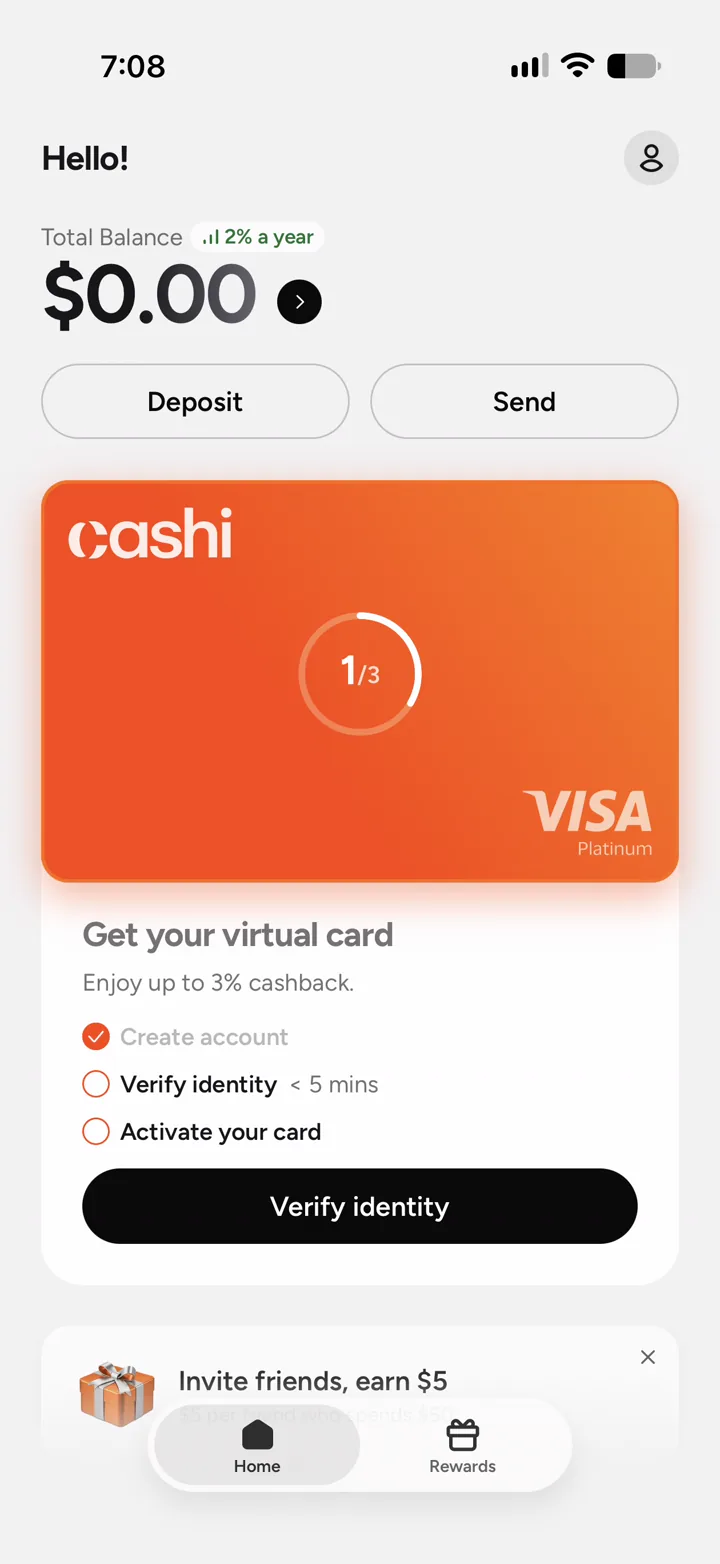
One app for balance, rewards, and card setup - The home screen shows the 2% annual balance reward and the three card steps: account creation, identity verification, and activation.
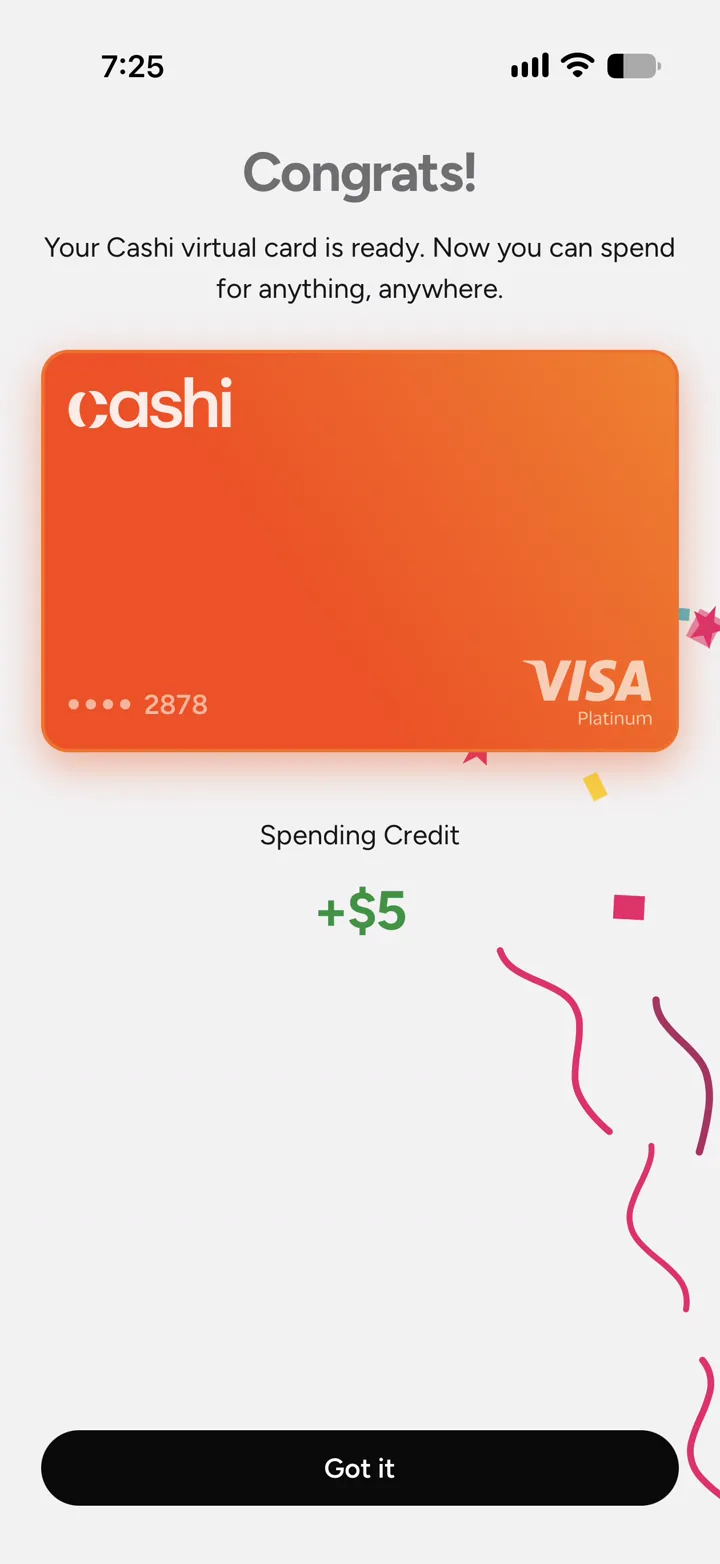
SpendNode opened and verified a Cashi account, activated the virtual Visa, funded it, and completed a real Malaysian-ringgit purchase. The issued card appeared immediately and the $5 activation amount returned as Spending Credit. Our non-USD transaction also gave us a direct FX result rather than relying only on the advertised 1% fee.
That first-hand result is important because Cashi is a young product. Its iPhone app first appeared in August 2026, and the public review sample remains small. The product worked in our test, but a successful card transaction is evidence of a working flow, not a guarantee about future uptime, support quality, or custody outcomes.
Available crypto cards by Cashi in November 2026
Option 1
1. Cashi Card
Free Virtual Visa Platinum with 3-2-1 Cashback and 2% Asset Rewards
RewardsUp to 3%
FX fee1% on non-USD purchases; 0% on USD purchases
The Cashi Card is a free custodial virtual Visa Platinum with 3% maximum cashback and 2% annual Asset Rewards. It is strongest for selected subscriptions and online shopping, especially for Android users who can add it to Google Pay. The important constraints are card-only reward credit, no ATM or Apple Pay access, and an observed all-in non-USD cost of about 1.46% versus mid-market in SpendNode's test.
+3% on selected monthly subscriptions, 2% on qualifying online shopping, and 1% on eligible travel
+2% annual Asset Rewards on up to $100,000 of supported balances, calculated daily and paid weekly
+No issuance, monthly, inactivity, or digital-asset deposit fee
+Google Pay support and a user-set daily spending limit up to $50,000
The Cashi Card
Cashi currently has one consumer card: the Cashi Card. It is a USD-denominated virtual Visa Platinum debit card. There is no revolving credit line, no interest rate, and no borrowing against collateral. A purchase deducts value from the balances held inside Cashi.
The virtual card works online by entering its number, expiry date, and security code. Android users can add it to Google Pay for contactless purchases. Apple Pay is not available, so iPhone users are limited to online or card-on-file payments until that changes. A physical card is also not currently available, and the virtual card cannot be used at an ATM.
SpendNode app screenshot
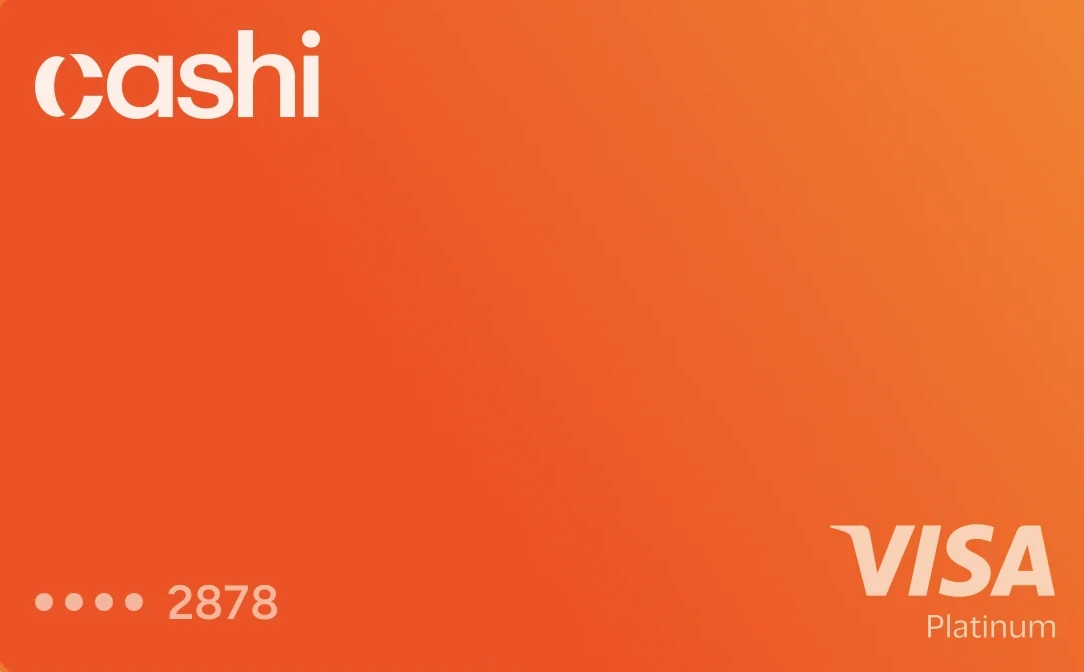
SpendNode's issued Cashi card - The activation screen shows the real last four digits and confirms that the $5 activation amount returned as Spending Credit. No full card number is displayed.
The Platinum label describes the Visa product band printed on the card. Cashi does not advertise a separate premium membership, lounge program, insurance package, concierge, purchase protection, extended warranty, or price protection tied to this card. We treat those traditional perks as absent unless Cashi publishes the applicable benefit guides and eligibility rules.
How the Custodial Wallet and Spending Order Work
Cashi is custodial. Its terms say supported assets remain the user's property, but Cashi holds them on the user's behalf, may pool them in omnibus wallets, and uses its internal ledger to determine each user's entitlement. Cashi may also appoint sub-custodians.
That differs from self-custodial cards such as Tuyo and Plasma One, where the user controls an on-chain wallet. With Cashi, the app can recover account access and coordinate card settlement, but access to the balance depends on Cashi and its partners continuing to operate.
Users choose the order in which assets fund card purchases. If the first balance is insufficient, Cashi moves to the next asset in the order until the purchase is fully covered. The app's transaction record shows the assets deducted and their USD equivalent. Refunds are credited in USDC, even if the original purchase used another asset, so a refund does not necessarily restore the same quantity or asset mix.
Cashi's November Asset Rewards material also includes XRP among reward-eligible and spendable balances. The older network table does not yet give an XRP network route, so users should copy the live deposit instructions from the app rather than assuming a chain or destination tag.
How 3-2-1 Cashi Cashback Works
Cashi's card rewards are category-specific rather than a flat rate on every purchase:
Category
Rate
Important limit
Selected monthly subscriptions
3%
One eligible recurring charge per service per month; annual plans do not earn
Named online merchants
2%
First $500 of spend per named merchant each month, or up to $10 cashback per merchant
Other eligible online categories
2%
First $500 shared across all other qualifying merchants each month, or up to $10 total
Eligible travel
1%
Up to $20 cashback per month; only the first $2,000 of each booking is counted
The subscription whitelist currently includes Amazon Prime, Google One, Canva, and Uber One. The charge must be a regular monthly plan. Apple App Store billing does not identify the underlying service clearly enough for Cashi's rules, so subscriptions billed through Apple do not qualify. Direct merchant billing and Google Play billing can qualify when the merchant and transaction meet the program rules.
Online shopping is broader but still depends on how the merchant and transaction are coded. Cashi names merchants such as Amazon, eBay, AliExpress, Adidas, Nike, IKEA, Lazada, Mercado Libre, Temu, and Zara, then adds approved retail merchant-category codes. The purchase must be online. An in-person tap at a qualifying retailer does not become a 2% e-commerce transaction.
Travel covers eligible airlines, hotels, and listed booking sites. Car rentals, cruises, taxis, rideshare, fuel, parking, and public transport are excluded. Cash withdrawals, money transfers, digital-asset trading, gambling, gift cards, wallet top-ups, insurance, real estate, and government payments also do not earn.
SpendNode app screenshot
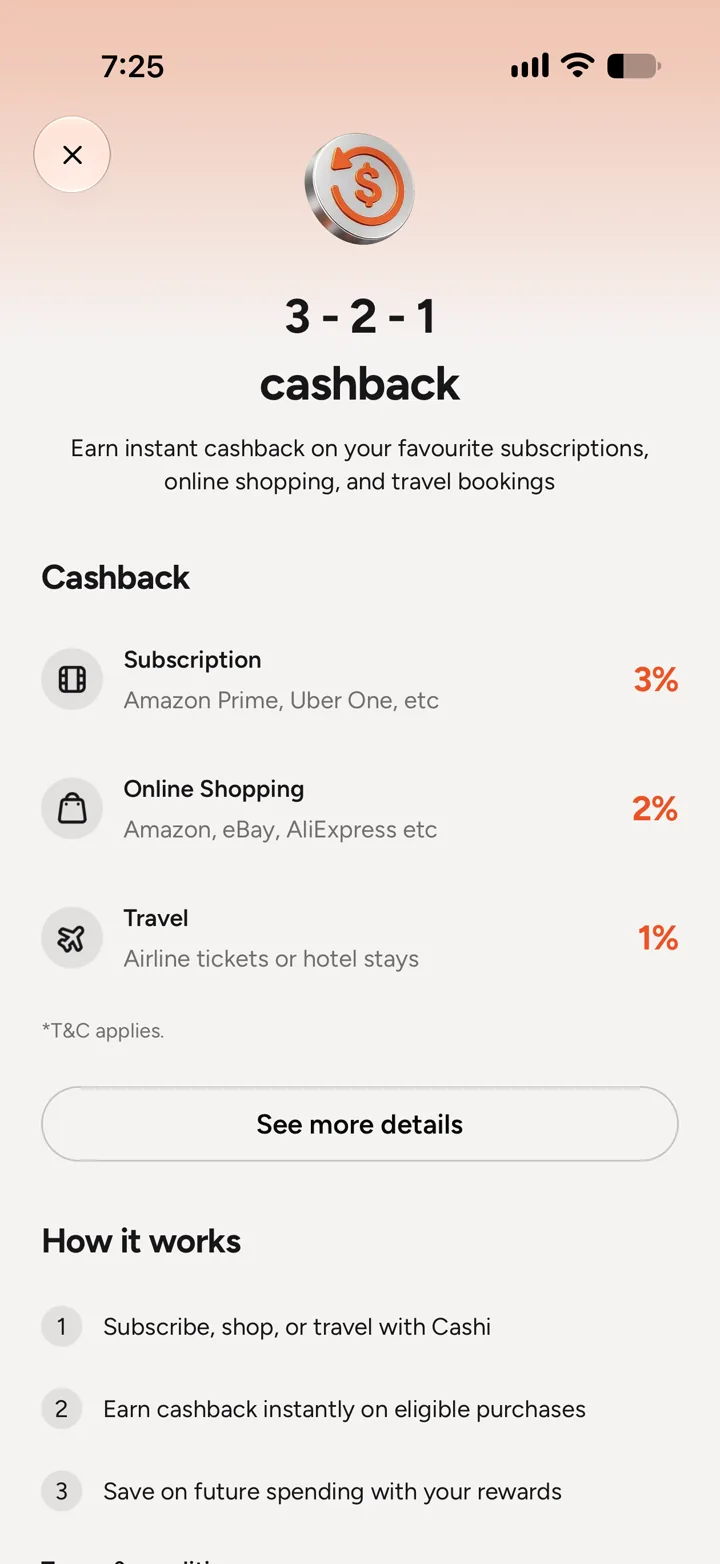
The live 3-2-1 rewards screen - Cashi presents the three rates clearly in the app, but the help-center rules and merchant limits determine what actually qualifies.
Cashback appears as pending after payment and confirms after settlement. It is not withdrawable cash or crypto. Once claimed, it becomes Spending Credit that automatically pays for future card purchases. It does not expire, but it cannot be transferred to another Cashi user or external wallet.
The 2% Asset Rewards Program
Asset Rewards are separate from purchase cashback. Cashi calculates a 2% annual reward each day on the USD value of eligible balances, then posts the week's total every Monday. The first $100,000 per user counts, there is no lockup, and every verified user with a balance is enrolled automatically.
The eligible assets listed by Cashi are USDT, USDC, BTC, ETH, SOL, and XRP. Spending Credit does not earn Asset Rewards. The payout itself is claimable reward balance that converts into Spending Credit, so this is a card-spending incentive rather than withdrawable yield.
The simple annual math is:
Average eligible balance
Approximate annual reward
Approximate weekly reward
$1,000
$20
$0.38
$5,000
$100
$1.92
$25,000
$500
$9.62
$100,000
$2,000
$38.46
These figures assume the balance remains at the stated USD value for a full year and the 2% rate remains unchanged. BTC, ETH, SOL, and XRP balances fluctuate in dollar terms, so their daily reward base changes with the market. The program is also a promotional reward under Cashi's terms, not bank interest, a protected savings account, or a guaranteed investment return.
Fees and Rates
Cashi publishes no card issuance, monthly, inactivity, or minimum-balance fee. Activation requires $5 in the cash balance, but Cashi immediately returns $5 as Spending Credit. The net cost is zero if you use the credit for a card purchase, though it is not withdrawable.
For card spending, Cashi publishes 0% on USD purchases and a 1% currency-conversion fee when the merchant charges another currency. In our test, a 24.33 MYR purchase charged $6.08 when the reference mid-market rate was 4.06 MYR per USD.
Mid-market USD cost: 24.33 / 4.06 = approximately $5.99
Cashi charge: $6.08
Effective transaction rate: 24.33 / 6.08 = approximately 4.002 MYR per USD
All-in difference versus mid-market: approximately 1.46%
The result is reasonably close to the advertised 1% fee, but it is not identical. The remaining difference can reflect the conversion rate used at authorization or settlement and timing against the external reference quote. We therefore label the observed result SpendNode Tested FX Fee: approximately 1.46% all-in, not simply 1%.
Digital-asset deposits and sends have no Cashi fee, though blockchain network charges apply. Local-currency deposits and sends carry app-quoted fees that vary by currency, payment rail, and amount. Cashi also lists a $50 dispute fee and a $10 wrong-deposit recovery charge when it successfully recovers funds. Asking a merchant for a normal refund is free.
How to Join Cashi With Referral Code aleksandar4885
The application is app-first:
Open SpendNode's Cashi link and install or open the app. The link binds referral code aleksandar4885; enter it manually during signup if the app asks for a code.
Create an account and complete identity verification with a government-issued ID and selfie.
Confirm that your residence and identity are eligible. Cashi excludes US residents and citizens.
Deposit at least $5 into the cash balance.
Activate the virtual card. Cashi deducts $5 and returns it immediately as Spending Credit.
Set a daily card limit and arrange the asset spending order.
Add the card to Google Pay on Android or use the card details online.
Complete $50 of qualifying settled card spending to receive the $5 welcome bonus.
Cashi's referral terms say a new user who joins through a bound link can receive $5 after obtaining the card and completing $50 of settled eligible card purchases. The referral must be attached before the card application is approved. Reward terms can change, so the app should show the current qualification before you rely on it.
Cashi vs Other Cards
Versus Kolo.Kolo is also a custodial virtual Visa Platinum with a refunded activation amount. Kolo pays BTC cashback on a broader purchase base but caps each transaction's reward sharply. Cashi's rates are higher in selected categories and its 2% balance reward adds value between purchases, but Cashi has no Apple Pay and its reward credit cannot leave the card ecosystem.
Versus Tuyo.Tuyo uses self-custodial USDC and pays a simpler flat cashback rate. Cashi offers broader asset custody, more deposit networks, and higher category rates, while Tuyo gives the user direct wallet control. The deciding question is whether you value convenience and multi-asset spending more than self-custody.
Versus Plasma One Lite.Plasma One Lite is a free self-custodial Visa with XPL cashback and an on-chain Earn vault. Cashi avoids token-denominated cashback and has a clearer subscription and online-shopping proposition. Plasma keeps spendable funds in the user's smart wallet, while Cashi holds the assets and pays rewards as card-only credit.
Cashi's distinctive combination is not any one rate. It is the pairing of a free custodial Visa, targeted 3-2-1 cashback, multi-network transfers, and a 2% balance reward in one app. The compromises are equally concentrated: the rewards stay inside the card, Apple Pay is absent, and the operator has a short public track record.
Is Cashi Safe?
Cashi includes standard account and card controls: identity verification, transaction monitoring, user-set daily limits, payment alerts, and in-app card freeze and unfreeze. Card transactions run through Visa, while Thredd publicly identifies itself as Cashi's issuer-processing partner. Reap publicly lists Cashi among platforms using its stablecoin card infrastructure.
Custody remains the main risk. Cashi's terms say customer assets are recorded separately from company assets and are not available to Cashi's creditors, but they may sit in omnibus wallets and with sub-custodians. The same terms warn that supported assets are not deposits and have no government deposit protection. They also state that a user may not recover full value if Cashi becomes insolvent or ceases operating.
The 2% balance reward should not obscure that difference. Keeping $50,000 in Cashi for a projected $1,000 annual card credit exposes far more principal to a young custodian than keeping only the amount needed for near-term spending. A cautious user can fund through low-cost networks in smaller amounts instead of treating Cashi as a long-term savings account.
Is Cashi a Scam?
The available evidence does not support calling Cashi a scam. Cashi Limited is identified in the app stores and terms, the Google Play listing gives a Hong Kong business address and support details, the terms identify a Canadian FINTRAC-registered affiliate for regulated functions, and both Thredd and Reap publicly associate themselves with the card program. SpendNode also completed identity verification, received the issued Visa, recovered the activation amount as promised, and made a real purchase.
That does not make Cashi risk-free. It is a recently launched custodial product with a small app-review sample, changing reward programs, reliance on multiple partners, and no government protection for wallet assets. The strongest evidence is that the product and card flow operate as described. The largest open questions are long-term reliability, support performance at scale, and how custody arrangements behave during a serious operational failure.
Who Should Use Cashi?
Cashi makes sense for Android users who spend online, pay one or more qualifying monthly subscriptions, and already move USDT or USDC across the supported low-cost networks. It also suits travelers who want a virtual backup Visa and users who value a multi-asset spending order more than self-custody. The free structure makes it reasonable as a secondary card even if the cashback categories are only occasionally useful.
Look elsewhere if you need Apple Pay, a physical card, ATM withdrawals, flat cashback on everyday in-store purchases, or withdrawable rewards. It is also a poor fit if you want to keep a large balance under your own keys. US residents and citizens are not eligible.
The best way to use Cashi is as a funded spending wallet, not an uninsured bank replacement. Deposit through an inexpensive supported network, hold the amount needed for upcoming purchases, use the categories that genuinely match your spending, and value Spending Credit only if you expect to keep using the card.
Countries and Availability
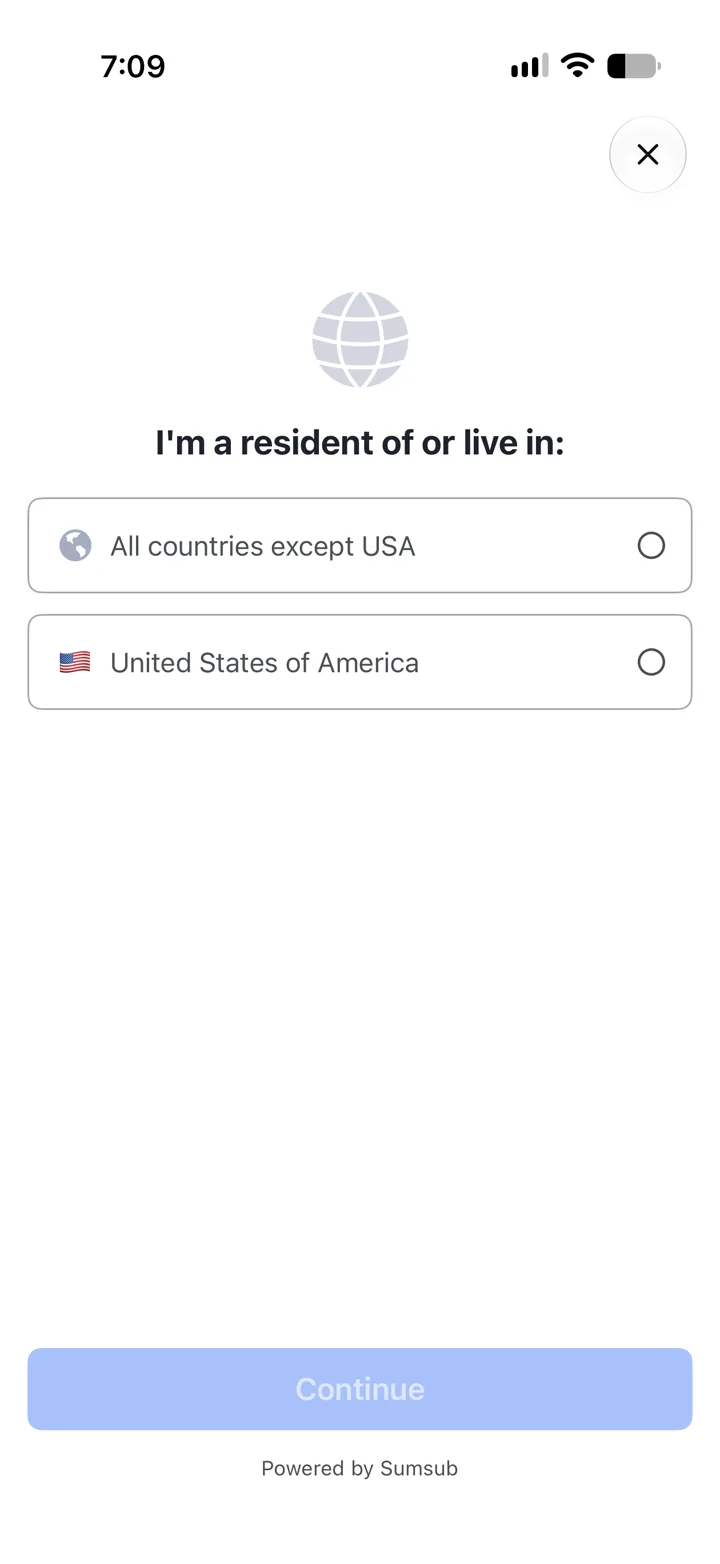
Cashi says it supports users in more than 100 countries and excludes US residents and citizens. It does not publish the complete country-level account and card-issuance list. SpendNode therefore records country coverage as unknown rather than treating a broad "global" claim as verified availability in every market. Confirm eligibility in the app before moving funds.
SpendNode app screenshot
Cashi separates US applicants at the start of verification, but the complete supported-country check occurs later in onboarding.
SpendNode does not currently have a verified country-level availability list for Cashi. Treat eligibility as unknown and confirm it with the issuer.
Our Verdict on Cashi
Cashi is a credible young spending app with a working virtual Visa, clear published card fees, useful multi-network funding, and unusually practical rewards for subscriptions and online shopping. SpendNode's test confirmed card issuance, the returned $5 activation credit, and a settled foreign-currency purchase. The measured 1.46% all-in MYR cost was above the published 1% fee but still competitive for a free crypto card.
The product is best treated as a spending wallet. Its 3-2-1 cashback and 2% Asset Rewards both become card-only Spending Credit, while the underlying wallet is custodial and uninsured. Android users get the most complete experience through Google Pay. iPhone users, cash users, and anyone who prioritizes self-custody should choose a different card until Apple Pay, physical cards, or stronger custody protections exist.
Sources and Verification
Product mechanics, fees, custody terms, rewards, and eligibility claims were checked against four Cashi-controlled sources:
SpendNode's direct test evidence includes account verification, virtual-card activation, the returned $5 Spending Credit, and a real 24.33 MYR card purchase charged at $6.08. The complete transaction record is retained privately; the published card image shows only the last four digits.
Is Cashi crypto card available in the United States?
No. Cashi crypto card is not available in the United States.
What is the Cashi referral code?
SpendNode's Cashi referral code is aleksandar4885. Join through SpendNode's Cashi link or enter aleksandar4885 during signup. New users receive a $5 welcome bonus after completing $50 in card spending. Card eligibility, qualifying-transaction rules, and reward fulfillment remain subject to Cashi's terms.
Is Cashi custodial?
Yes. Cashi maintains a custodial wallet and may hold supported assets in omnibus wallets through its custody arrangements. Balances are not bank deposits and are not covered by government deposit insurance.
How does Cashi's 3-2-1 cashback work?
Cashi pays 3% on selected monthly subscriptions, 2% on eligible online shopping and 1% on eligible travel. Merchant and monthly limits apply. Cashback becomes Spending Credit that can be used for card purchases but cannot be withdrawn or transferred.
Does Cashi support Apple Pay and Google Pay?
Cashi supports Google Pay on Android. Apple Pay is not currently available. On iPhone, the virtual card can be used online with its card details.