
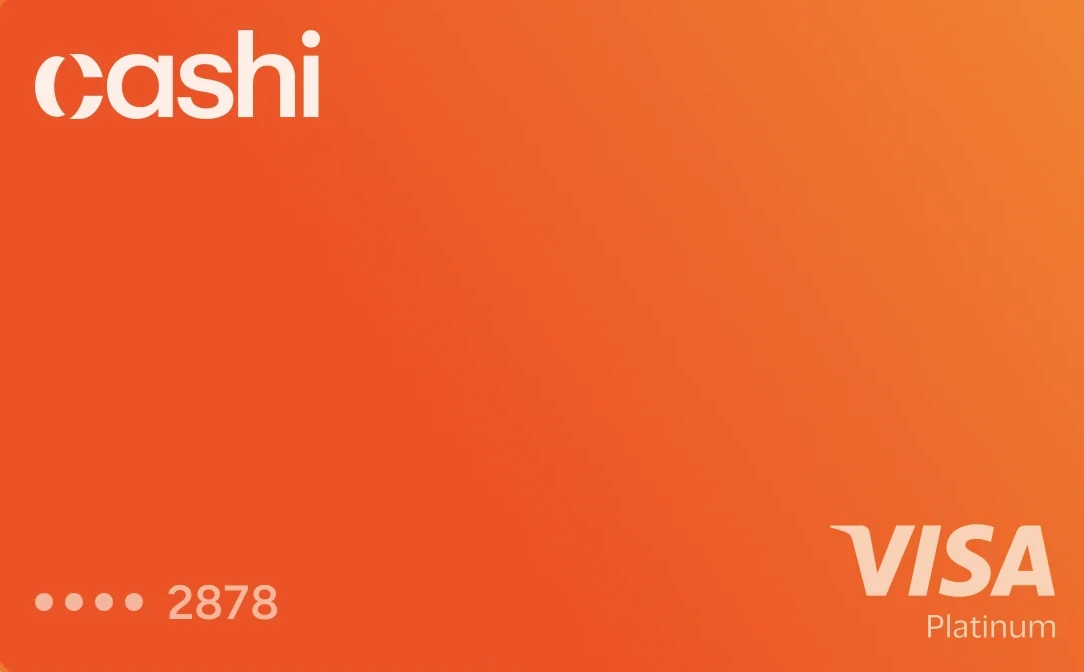
Cashi Card Review 2026
Free virtual Visa for spending USDT, USDC and crypto, with 3-2-1 cashback, 2% asset rewards, Google Pay, and a tested 1.46% FX cost.

Prefer mobile? Scan to continue
Opens the mobile signup with your SpendNode link, code aleksandar4885.

SpendNode Rating for Cashi Card
Cashi combines a free virtual Visa with clearly defined 3-2-1 cashback and a 2% annual balance reward. SpendNode activated the card and completed a real non-USD purchase, measuring about 1.46% all-in versus mid-market.
The no-fee structure, multi-network funding, and category rewards are useful. The score is held back by custodial uninsured balances, card-only Spending Credit, no Apple Pay or physical card, and a short operating history.
Also relevant for Stablecoin Spending.
How It Competes
Cost Efficiency
4.3
Product Utility
4.0
Custody & Trust
3.2
Reliability & UX
3.5
Transparency
4.1

CASHBACK
Verified

YIELD LINKED
Verified

NO ANNUAL FEE
Verified
Cashi Card Overview
Free Virtual Visa Platinum with 3-2-1 Cashback and 2% Asset Rewards
The Cashi Card is a free custodial virtual Visa Platinum with 3% maximum cashback and 2% annual Asset Rewards. It is strongest for selected subscriptions and online shopping, especially for Android users who can add it to Google Pay. The important constraints are card-only reward credit, no ATM or Apple Pay access, and an observed all-in non-USD cost of about 1.46% versus mid-market in SpendNode's test.
Fees & Charges
Annual Fee
Free$5 activation is returned immediately as card-only Spending Credit
Published FX Fee
1% on non-USD purchases; 0% on USD purchases
SpendNode Tested FX Fee
~1.46%All-in vs mid-market
ATM Fee
ATM withdrawals unavailable (virtual card only)
Published FX fee is the card's stated charge. SpendNode Tested FX Fee measures the all-in difference from mid-market, including the network conversion rate and any transaction or conversion charges.
Eligibility & Funding
Supported Regions
TBD
Spendable Assets
USDT, USDC, BTC, ETH, SOL, XRP
On This Page
The Cashi Card is a free USD-denominated virtual Visa Platinum debit card connected to Cashi's custodial crypto wallet. It spends USDT, USDC, BTC, ETH, SOL, and XRP, pays 3% cashback on selected monthly subscriptions, 2% on eligible online shopping, and 1% on eligible travel, with Google Pay support and a user-set daily limit up to $50,000.
Cashi publishes a 1% fee on non-USD purchases. SpendNode measured an approximately 1.46% all-in difference versus the mid-market rate on a real Malaysian-ringgit transaction.
What Is the Cashi Card?
The Cashi Card is the single card offered by Cashi, a Hong Kong-incorporated custodial wallet and cross-border payments app. It is a virtual Visa Platinum debit card, not a credit card. There is no credit line, APR, or collateralized borrowing: purchases deduct and convert value from balances held inside Cashi.
The card's value comes from four connected features:
- No issuance, monthly, or inactivity fee
- 3-2-1 cashback on selected subscriptions, online shopping, and travel
- A separate 2% annual Asset Reward on up to $100,000 of eligible balances
- Multi-asset spending with a user-controlled priority order
SpendNode completed Cashi's identity verification, activated the virtual card, received the promised $5 Spending Credit, and made a real foreign-currency purchase. The card worked, and the transaction gives us a direct all-in FX measurement rather than only the advertised fee.
SpendNode app screenshot
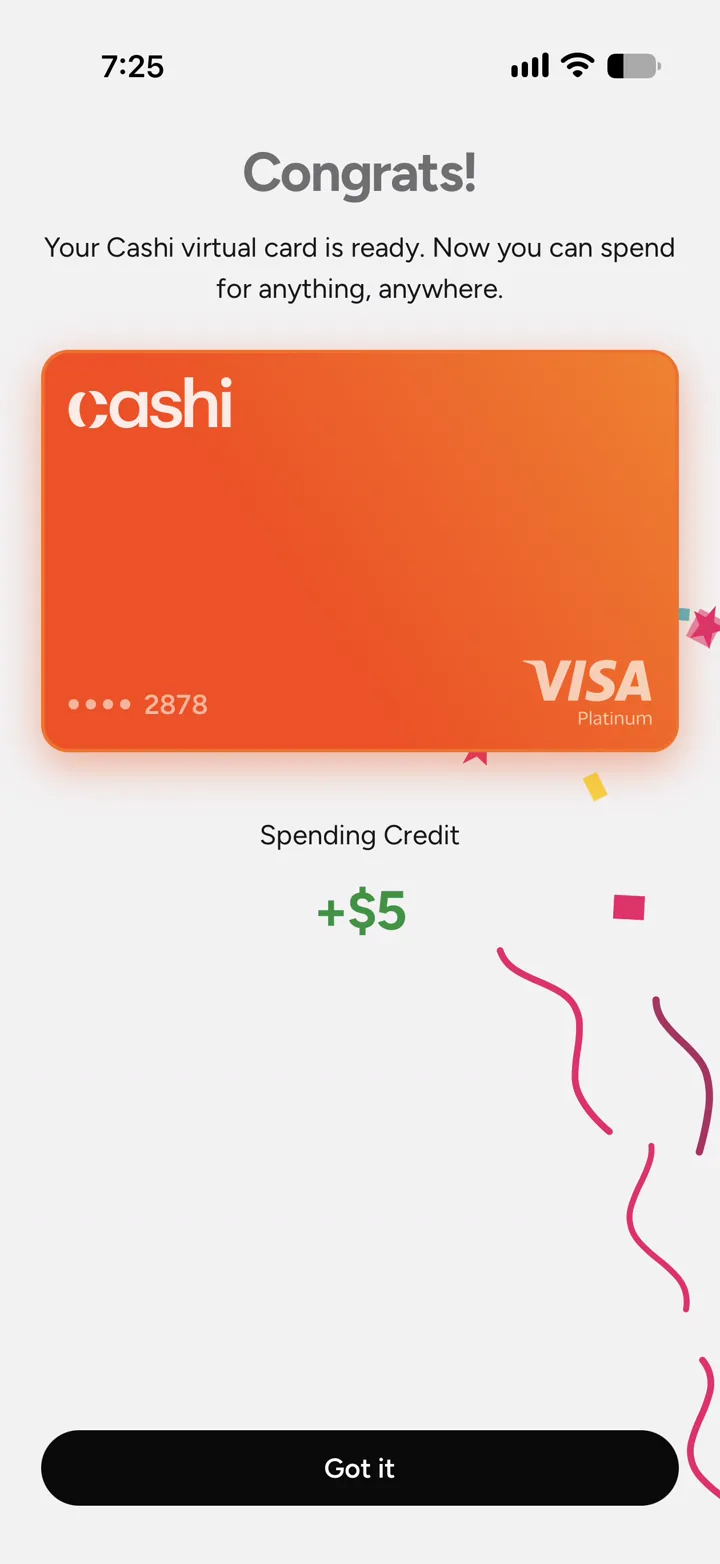
The card we tested - Cashi issued the virtual Visa Platinum immediately after activation. The image retains the real last four digits as first-hand evidence without showing the full card number.
The best fit is an Android user who shops online and pays eligible monthly subscriptions. Google Pay turns the virtual card into an in-store contactless card on Android. On iPhone, Apple Pay is unavailable, so the practical use is online checkout and card-on-file payments.
Card Specs: What You Are Actually Getting
| Feature | Cashi Card |
|---|---|
| Card type | Virtual debit card |
| Network and tier | Visa Platinum |
| Settlement currency | USD |
| Wallet custody | Custodial |
| Supported spending assets | USDT, USDC, BTC, ETH, SOL, XRP |
| Mobile wallet | Google Pay |
| Apple Pay | No |
| Physical card | No |
| ATM withdrawals | No |
| Maximum user-set daily limit | $50,000 |
| Published non-USD fee | 1% |
| SpendNode tested all-in FX | Approximately 1.46% |
The card works wherever the merchant accepts Visa and the transaction type is not restricted. Online purchases use the card number, expiry date, and security code shown in the app. Android contactless purchases run through Google Pay. There is no chip card to insert, magnetic stripe to swipe, or physical card to take to an ATM.
The Visa Platinum logo should not be read as an automatic premium-benefit bundle. Cashi does not currently publish cardholder guides for travel insurance, rental-car cover, airport lounge access, concierge, purchase protection, price protection, or extended warranty. Without the applicable issuer documents, those perks should be valued at zero.
Security and Card Controls
Cashi lets users set a daily spending limit, approve and monitor payments, receive transaction alerts, and freeze or unfreeze the card in the app. Identity verification is required before issuance. These controls reduce account and card misuse, but they do not change the wallet's custodial structure.
How to Get and Activate the Cashi Card
The setup flow is straightforward but fully app-based:
- Open SpendNode's Cashi link. The link binds referral code aleksandar4885; enter it manually during signup if the app asks for a code.
- Create the Cashi account.
- Complete identity verification with a government-issued ID and selfie.
- Confirm country eligibility in the onboarding flow.
- Deposit at least $5 into the cash balance.
- Pay the $5 activation amount.
- Receive $5 immediately as Spending Credit and use the virtual card.
- Complete $50 of qualifying settled card spending to receive the separate $5 welcome bonus.
The returned $5 is economically different from a cash refund. It can pay for any future card purchase and does not expire, but it cannot be withdrawn or transferred. If you activate and use the card, the net card cost is zero. If you wanted only to activate and withdraw the same money, the credit does not allow that.
Cashi's referral schedule currently credits $5 to an eligible new user after the card is issued and at least $50 of genuine settled card purchases are completed. The referral must be bound before card approval. Refunds, transfers, fees, cash-like transactions, and several payment categories do not count toward the threshold.
How Cashi Card Spending Works
Cashi lets users arrange supported assets in a spending order. A purchase draws from the first asset until that balance is exhausted, then moves to the next balance if necessary. The transaction record shows what was deducted and its USD value.
Example: a $75 online purchase.
Step 1. Set the order. You put USDC first, USDT second, and BTC third.
Step 2. Pay with the card. The merchant authorizes $75 through Visa.
Step 3. Deduct balances. If the USDC balance is $50, Cashi uses it first, then takes the remaining $25 from USDT. BTC remains untouched.
Step 4. Determine cashback. If the purchase is online, uses an eligible merchant or merchant-category code, and is within the monthly allowance, it earns 2% or $1.50.
Step 5. Settle rewards. Cashback appears pending, confirms after the transaction settles, and can be claimed into Spending Credit for a later purchase.
A refund is credited in USDC regardless of which asset funded the original purchase. If BTC or another volatile asset paid for the transaction, the refund therefore restores a dollar amount in USDC rather than the original quantity of crypto.
Fees and Rates
| Fee | Amount | Notes |
|---|---|---|
| Card issuance | $0 | One current virtual card product |
| Activation | $5 | Returned immediately as $5 Spending Credit |
| Monthly fee | $0 | No subscription plan |
| Inactivity fee | $0 | No published inactivity charge |
| Minimum balance | $0 | $5 is needed only at activation |
| USD card purchases | 0% Cashi card fee | Merchant and third-party charges can still apply |
| Non-USD card purchases | 1% published | SpendNode tested approximately 1.46% all-in versus mid-market |
| Digital-asset deposit | $0 Cashi fee | Sending wallet or exchange may charge network fees |
| Digital-asset send | $0 Cashi fee | Network fee is deducted from the Cashi balance |
| Card dispute | $50 | A normal merchant refund request is free |
| Wrong-deposit recovery | $10 | Charged only when Cashi recovers the funds |
Local-currency cash deposits and sends are separate from card spending. Their fees and limits depend on the currency, payment method, and amount and are quoted in the app before confirmation. USD account transfers use their own partner schedule.
SpendNode Tested FX: About 1.46% All-In
We tested a 24.33 MYR card purchase. Cashi charged $6.08. The online mid-market reference at the time was 4.06 MYR per USD.
The calculation is:
| Metric | Result |
|---|---|
| Local purchase | 24.33 MYR |
| Cashi charge | $6.08 |
| Mid-market reference | 4.06 MYR/USD |
| Cost at mid-market | 24.33 / 4.06 = $5.9926 |
| Effective Cashi rate | 24.33 / 6.08 = 4.0016 MYR/USD |
| All-in difference | ($6.08 / $5.9926 - 1) x 100 = 1.46% |
The total FX fee for the Cashi Card was approximately 1.46% when tested by SpendNode. This is the all-in difference against the mid-market exchange rate, including the published FX fee, network conversion rate, and any transaction or conversion charges reflected in the final amount. Actual results vary by currency, quote source, authorization time, and settlement time.
The observed result is about 0.46 percentage points above Cashi's published 1% non-USD fee. That does not prove there is a separate fixed 0.46% charge. It shows that the real converted amount was 1.46% worse than the external mid-market reference in this transaction.
For a user spending the equivalent of $1,000 a month in non-USD currencies, the difference between the advertised 1% and our tested 1.46% would be about $4.60 a month. The larger point is that Cashi remains a low-cost card for occasional foreign spend, but “1% fee” should not be interpreted as a guaranteed 1.00% all-in result.
Rewards and Cashback
Cashi pays its highest rates only in defined categories.
3% Selected Monthly Subscriptions
The current list includes Amazon Prime, Google One, Canva, and Uber One. Only the regular monthly subscription charge earns, limited to one eligible charge per service each month. Annual plans, gift subscriptions, and one-time purchases do not qualify.
Apple App Store billing is excluded because the transaction does not expose the underlying subscription to Cashi. Direct billing and Google Play can qualify. This makes the 3% rate more useful on Android than iPhone if you prefer app-store billing.
2% Online Shopping
Named merchants each receive a separate $500 monthly spend allowance, producing up to $10 cashback per named merchant. The current list includes major online retailers and marketplaces such as Amazon, eBay, AliExpress, Temu, Zara, Nike, Adidas, IKEA, Lazada, Mercado Libre, and others.
Other qualifying online merchants share one separate $500 monthly allowance across approved retail categories, producing up to $10 total cashback. Purchases must be card-not-present. Tapping through Google Pay at a physical store does not qualify for the online-shopping rate.
1% Travel
Eligible airlines, hotels, and listed online travel agencies earn 1%. Travel cashback is capped at $20 each calendar month, and only the first $2,000 of each booking earns. Booking.com, Agoda, Expedia, and Trip.com are among the listed travel sites.
The travel category is narrower than its name suggests. Car rentals, cruises, taxis, rideshare, fuel, parking, and public transport are excluded.
The Spending Credit Constraint
Cashback is not USDC, USDT, or cash. It becomes Spending Credit after the user claims it. The credit can fund any card payment and never expires, but it cannot be withdrawn, sent to another Cashi user, or transferred to an external wallet.
That means a nominal $20 reward is worth $20 only to someone who will make another Cashi card purchase. A user who stops using the card cannot cash it out. This is the central rewards caveat and should be weighted more heavily than the attractive headline rates.
SpendNode app screenshot
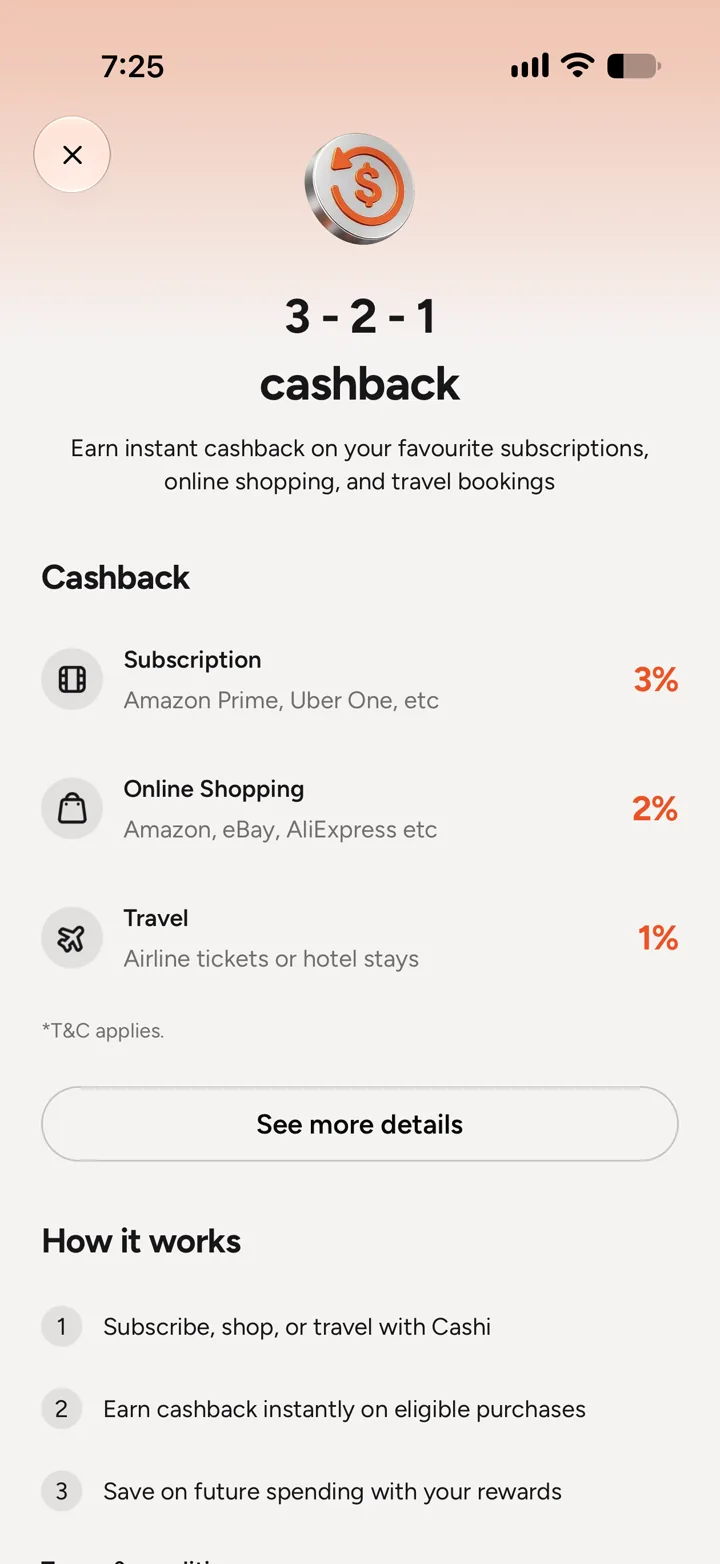
The in-app reward summary - The simple 3-2-1 display is accurate at the headline level. Merchant eligibility, billing channel, settlement, and monthly limits control the realized return.
The 2% Asset Reward on Wallet Balances
Verified users automatically earn a 2% annual reward on the first $100,000 of supported balance. Cashi calculates the reward daily based on the assets' USD value and posts the weekly amount every Monday. There is no lockup or minimum spend.
The eligible list is USDT, USDC, BTC, ETH, SOL, and XRP. Spending Credit does not count. The weekly reward must be claimed and becomes Spending Credit, so it is spendable through the card but not withdrawable.
At a constant $10,000 balance, the headline return is about $200 a year or $3.85 a week. At $100,000, it is about $2,000 a year. Those numbers do not include crypto price changes, card FX costs when the credit is spent, or future changes to the promotional rate.
We would not hold a large balance in Cashi solely for this reward. The extra $200 per year on $10,000 is useful if the money is already staged for spending, but it is not enough compensation by itself for the custody risk of leaving long-term savings with a recently launched operator.
Assets, Networks, and Funding
Cashi's main stablecoin routes cover several low-cost networks:
- USDT: Ethereum, Arbitrum, BNB Chain, Solana, and Tron
- USDC: Ethereum, Arbitrum, Base, BNB Chain, Polygon, and Solana
- BTC: Bitcoin
- ETH: Ethereum, Arbitrum, and Base
- SOL: Solana
The November reward material also names XRP. Because the public network table has not yet added an XRP route, users should follow the live deposit screen exactly rather than choosing a network from memory.
Cashi charges no fee to deposit or send digital assets, but the originating wallet and chosen network can charge gas or withdrawal fees. Solana, Tron, and Polygon are usually the lowest-cost routes among the published options. Ethereum can cost more during congestion.
Internal sends to another Cashi username are instant and free because they update Cashi's ledger rather than making an on-chain transfer. Local-currency rails and a partner-provided USD account add fiat entry and exit options, but their availability and pricing are country-specific.
Limits and Restrictions
The user can set the card's daily spending limit as high as $50,000. The actual usable amount is still bounded by available balances, merchant acceptance, compliance controls, and any partner-level transaction limits.
The virtual card cannot withdraw cash from an ATM. Cash advances and cash-like purchases are also excluded from cashback. Restricted reward categories include money transfers, digital-asset trading, gambling, gift cards, prepaid and wallet top-ups, insurance, real estate, government payments, and manufactured spending.
Cashi uses the merchant category code and merchant whitelist to classify rewards. A store's brand name does not guarantee a rate if its processor submits an unexpected code. Refunds reverse related cashback, and Cashi can withhold or recover rewards associated with error, abuse, or ineligible transactions.
Country Eligibility
Cashi says it serves users in more than 100 countries, but it does not publish the complete card-issuance list. The app verifies the exact country only during onboarding. US residents and US citizens are excluded.
SpendNode therefore does not place Cashi on individual country pages yet. That is a data-quality choice, not a claim that the card is unavailable outside the United States. Applicants should confirm support in the app before sending assets.
Is the Cashi Card Safe?
The card itself has useful controls: transaction notifications, freeze and unfreeze, identity verification, and a configurable daily limit. Visa provides the acceptance network, and Thredd publicly confirms that it processes Cashi's card program. Reap publicly lists Cashi as a client of its stablecoin financial infrastructure.
The larger safety question is the wallet. Cashi is custodial. Its terms state that customer assets remain customer property, are internally segregated from Cashi's own assets, and are not available to its creditors. The same terms allow omnibus wallets and sub-custodians and warn that users may not recover full value if Cashi becomes insolvent or ceases operations.
Supported assets are not bank deposits and are not protected by a government compensation scheme. The USD account is also partner-provided rather than a bank account with Cashi. Users should size balances accordingly.
Is the Cashi Card a Scam?
We found no basis to describe the Cashi Card as a scam. Cashi Limited is named in current legal terms and both app stores. Thredd announced the card-processing partnership, and Reap displays Cashi among the platforms using its infrastructure. SpendNode independently completed KYC, activated the card, received the activation credit, and completed a real purchase.
The sensible concern is not whether a card exists. It is whether a young custodial platform will remain reliable through rapid expansion, market stress, support disputes, and partner changes. Cashi launched its consumer apps in 2026 and has only a small body of public app-store feedback. Treat it as an operating but early-stage financial product.
Real User Scenarios
Scenario 1: Maya, online shopper using Android
Monthly activity: $700 at two named online merchants, $40 across two qualifying subscriptions, and $300 of ordinary in-store spend.
Expected rewards: If $500 of the online spend is at one named merchant and $200 at another, the 2% category produces $14. The subscriptions add $1.20. The ordinary in-store spend earns nothing unless it falls into another eligible category. Total: approximately $15.20 in Spending Credit.
Verdict: The card fits. Google Pay handles in-store acceptance, while the meaningful return comes from online merchants and direct-billed subscriptions.
Scenario 2: Daniel, traveler spending in non-USD currencies
Monthly activity: One $1,500 eligible hotel booking and $1,000 of foreign everyday purchases.
Expected rewards and costs: The hotel earns about $15 in travel credit. Using SpendNode's tested 1.46% all-in FX result as an illustration, $2,500 of total non-USD spend would cost about $36.50 versus mid-market. Net after the hotel reward is roughly negative $21.50 before any other rewards.
Verdict: Cashi is a useful backup card, but the 1% travel cashback does not fully offset foreign-currency conversion. A true zero-FX card is better for heavy international spend.
Scenario 3: Sofia, stablecoin holder considering Asset Rewards
Average balance: $20,000 USDC staged for future spending.
Expected reward: Approximately $400 per year at 2%, credited weekly as card-only Spending Credit.
Verdict: The reward is valuable only if Sofia expects at least $400 of future Cashi card purchases. She should still compare that return with the custody risk and avoid treating the balance as insured savings.
How the Cashi Card Compares
Kolo Card: Kolo offers Apple Pay and Google Pay, BTC cashback, and a refunded activation amount. Its per-transaction cashback cap limits large-purchase value, while Cashi's named online merchants each get a separate monthly allowance. Kolo is more flexible for mobile wallets; Cashi is stronger for selected subscriptions and balance rewards.
Tuyo Card: Tuyo spends self-custodial USDC and pays a simpler flat reward. Cashi supports more assets and networks and has higher category rates, but users surrender direct custody. Choose Tuyo for wallet control and Cashi for the broader custodial account.
Plasma One Lite: Plasma One Lite is free, self-custodial, and pairs card rewards with a stablecoin vault. Its cashback pays in volatile XPL. Cashi pays predictable dollar-denominated Spending Credit, but the credit is locked to future card purchases and the wallet is custodial.
Cashi's unique value: A free virtual Visa that rewards selected online behavior and idle supported balances without requiring a paid tier or platform token. The trade is accepting custody and a closed-loop reward balance.
Who Should Use the Cashi Card?
Use Cashi if you have an Android phone, already hold supported stablecoins or crypto, pay qualifying monthly subscriptions directly, shop online at the named merchants, and expect to keep using the card long enough to spend the rewards. It also works as a free virtual backup card with a high configurable daily limit.
Choose another card if you need Apple Pay, a physical card, ATM access, broad flat cashback, or rewards you can withdraw. Heavy foreign-currency spenders should compare a zero-FX card because Cashi's 1% published fee and 1.46% tested result can outweigh its 1% travel category. Self-custody users should prefer Tuyo, Plasma One, or another wallet-controlled card.
The disciplined setup is to keep only a working spending balance in Cashi, fund through a low-cost supported network, set a conservative daily limit, bill qualifying subscriptions directly, and treat the 2% balance reward as a bonus rather than a reason to move long-term savings into the app.
Our Verdict on Cashi Card
The Cashi Card is a well-designed free virtual Visa for online shoppers and subscription users. Its 3-2-1 categories are specific enough to verify, the $5 activation amount returns immediately as usable card credit, and the multi-asset spending order works without a paid plan. SpendNode's real 24.33 MYR transaction measured approximately 1.46% all-in versus mid-market, modestly above the published 1% non-USD fee.
The closed-loop reward model is the deciding caveat. Cashback and the separate 2% Asset Reward become Spending Credit, not withdrawable money, and the underlying wallet is custodial and uninsured. Cashi is easy to justify as a funded spending wallet on Android. It is harder to justify as a place for long-term savings or for iPhone users who need contactless payments.
Sources and Verification
Card specifications, fees, reward rules, custody mechanics, and availability claims were verified from four Cashi-controlled sources:
- Cashi General Terms and Conditions
- Cashi card fees and limits
- How 3-2-1 Cashi cashback works
- Cashi Asset Rewards
SpendNode directly verified account creation, identity verification, card activation, the returned $5 Spending Credit, and a real 24.33 MYR purchase charged at $6.08. The tested FX percentage uses a 4.06 MYR/USD mid-market reference. The complete transaction record is retained privately, while the public card screenshot shows only the last four digits.
The scenarios are illustrations based on Cashi's current reward rules, SpendNode's tested transaction, and stated fees. Actual qualification and FX results depend on merchant coding, settlement, currency, timing, and future program changes.
Written by Aleksandar Dukic
FAQ
What is the total FX fee for the Cashi Card?
The total FX fee for the Cashi Card is ~1.46% when tested by SpendNode. This measures the all-in difference against the mid-market exchange rate, including the published FX fee, network conversion rate, and any transaction or conversion charges. Actual results can vary by currency and transaction timing.
What is the Cashi referral code?
SpendNode's Cashi referral code is aleksandar4885. Join through SpendNode's Cashi link or enter aleksandar4885 during signup. New users receive a $5 welcome bonus after completing $50 in card spending. Card eligibility, qualifying-transaction rules, and reward fulfillment remain subject to Cashi's terms.
What fees does the Cashi Card charge?
Cashi publishes no issuance, monthly or inactivity fee. Card activation requires $5, which is returned immediately as card-only Spending Credit. Non-USD purchases carry a published 1% currency-conversion fee, while USD purchases have no published Cashi card fee.
Which assets can be used with the Cashi Card?
Cashi supports USDT, USDC, BTC, ETH, SOL and XRP. Users can set a spending order, and Cashi deducts and converts supported balances when a card payment is made.
Can the Cashi Card be used at ATMs?
No. Cashi currently issues a virtual Visa debit card, and the virtual card cannot be used for ATM withdrawals. A physical card is not currently available.
How does Cashi cashback work?
Eligible purchases earn 3% on selected monthly subscriptions, 2% on qualifying online shopping and 1% on qualifying travel. Cashback is subject to merchant and monthly limits and is paid as non-withdrawable Spending Credit.
This is a debit card. Some merchants with pre-authorization holds (hotels, car rentals) may temporarily hold funds beyond the transaction amount.
Your funds are held by Cashi. If the provider faces insolvency, your balance may be at risk. This card does not offer self-custody protection.
Fees shown above are the card's disclosed fees. Additional costs may apply: Visa/Mastercard network spread (typically 0.5-0.9%), crypto-to-fiat conversion spread at point of sale, and blockchain gas fees for on-chain top-ups.
Found any issues?
User Reviews
Reviews are moderated and may take a moment to appear.