
Key findings
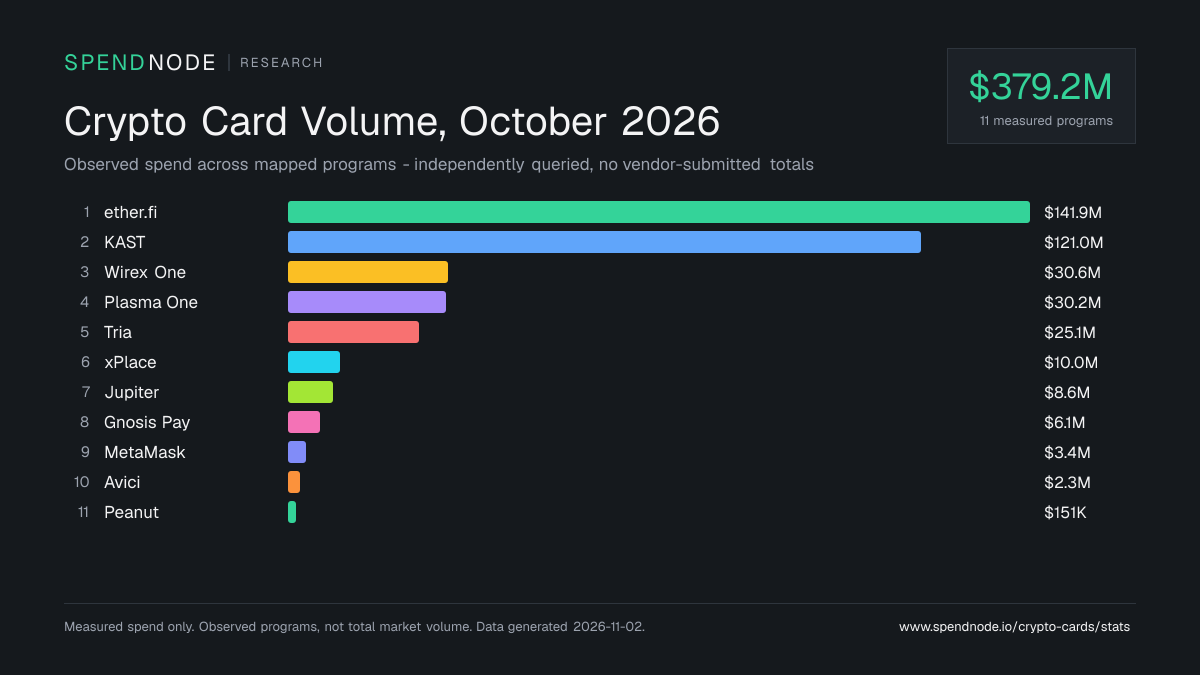
- SpendNode observed $889.5 million across two onchain crypto-card ledgers in October: $379.2 million of measured card spending across 11 programs and $510.3 million of RedotPay card funding. Funding and spending remain separate because they measure different stages of the same money.
- Measured spending increased 9.2% from September on an unchanged 11-program basis. Seven programs grew and four declined.
- Ether.fi supplied the largest dollar increase, adding $13.1 million. Its independently measured lifetime total reached $1.065 billion since November 2024.
- Wirex One rose 24.4% to $30.6 million, the fastest percentage growth among programs above $1 million. Observed card-debit events increased 25.0% and active wallets increased 29.5%.
- Ether.fi and KAST still represented 69.3% of measured spending. Optimism and Solana carried 69.8% of the observed chain mix.
The month in one page
October extended the measured market's growth streak without changing the program count. The 11-program total rose by $32.1 million to $379.2 million, after increasing $41.5 million in September. Growth slowed from 13.6% to 9.2%, but seven programs still finished above their corrected September closes.
Ether.fi and KAST remained far ahead of the rest. Ether.fi reached $141.9 million and KAST reached $121.0 million. Wirex One and Plasma One both passed $30 million, while Tria reached $25.1 million.
The month's product developments were unusually practical. MetaMask opened UK card sign-ups, Solid launched euro cards, RedotPay introduced a paid Pro tier, and Gate launched a new Gold Card. At the infrastructure level, Visa Direct moved stablecoin payouts into production and Stripe partnered with Plasma on card infrastructure across more than 30 countries.
Not every program moved forward. Gnosis Pay declined as its direct consumer card approached its December closure. xPlace finished slightly below September, then paused Credit Mode after Kamino stopped SOL and BTC borrowing late in the month.
Measured spending reached $379.2 million
Ether.fi added $13.1 million, the largest dollar increase in the set. KAST added $7.2 million, Wirex One added $6.0 million, Plasma One added $4.5 million, and Tria added $3.2 million. Those gains absorbed declines at Gnosis Pay, Avici, xPlace, and MetaMask.
| Program | October volume | September volume | Net change | Change |
|---|---|---|---|---|
| ether.fi | $141.88M | $128.78M | +$13.10M | +10.2% |
| KAST | $121.03M | $113.81M | +$7.22M | +6.3% |
| Wirex One | $30.65M | $24.64M | +$6.01M | +24.4% |
| Plasma One | $30.15M | $25.64M | +$4.52M | +17.6% |
| Tria | $25.09M | $21.92M | +$3.17M | +14.5% |
| xPlace | $9.97M | $10.27M | -$0.30M | -2.9% |
| Jupiter | $8.57M | $7.63M | +$0.94M | +12.4% |
| Gnosis Pay | $6.08M | $7.58M | -$1.50M | -19.8% |
| MetaMask | $3.36M | $3.37M | -$0.02M | -0.5% |
| Avici | $2.28M | $3.38M | -$1.09M | -32.4% |
| Peanut | $0.15M | $0.11M | +$0.04M | +34.5% |
Program totals are rounded for display. KAST transactions are issuer settlement batches, not individual card purchases. September uses the corrected Peanut close published on October 19.
SpendNode observed $889.5 million across two onchain crypto-card ledgers in October: $379.2 million in measured spending and $510.3 million in RedotPay funding. The sum is not spending or unique economic activity.
At October's pace, the measured set runs at about $4.55 billion annualized. This is a simple scale anchor, not a forecast or an estimate of the entire market.
Wirex One and Plasma One grew on transaction counts
Wirex One reached $30.6 million across 511,287 gross merchant POS and ePOS settlements from 19,476 active wallets. Volume increased 24.4%, events increased 25.0%, and active wallets increased 29.5%. The average observed event stayed close to $60.
Plasma One increased 17.6% to $30.2 million. Settlement events rose 53.3% to 402,745, while active settling wallets increased 5.7% to 26,213. Average observed value fell from about $98 to $75. September's smaller-ticket pattern therefore persisted for a second month, although active wallets returned to growth. These are settlement events from user accounts and are not guaranteed to map one-to-one to retail purchases.
Tria increased 14.5% to $25.1 million. Deduplicated events rose 8.9% and active observed accounts rose 6.4%, lifting average observed value by about 5.1%.
Jupiter increased 12.4% to $8.57 million while observed events rose 6.1%. Active wallets declined 5.3%, so the chain data shows more value across a somewhat smaller observed wallet set. It does not identify the cause.
Ether.fi crossed $1 billion in independently measured spending
Ether.fi reached $141.9 million in October, up 10.2%, across 1.86 million observed spend events. Active Optimism accounts increased 6.4% to 51,839. Its monthly result was the largest in the dataset and supplied 40.8% of the market's net increase.
The independently mapped series now totals $1.065 billion since November 2024. Ether.fi separately announced on October 17 that its own lifetime card total had passed $1 billion. The company figure and SpendNode series use different sources and may not cover precisely the same scope, but both place the milestone in October.
Ether.fi also opened read-only card and account access to compatible AI assistants. The connector can read transactions, balances, and subscriptions but cannot move funds.
Gnosis Pay declined before its consumer-card closure
Gnosis Pay fell 19.8% to $6.08 million. Observed transactions declined 20.5% to 127,262 and active wallets declined 11.1% to 6,267.
The direct consumer card is scheduled to stop on December 20, 2026. October is therefore part of a terminal series rather than an ordinary long-term demand trend. Safe balances remain self-custodial, and Gnosis says its withdrawal route will remain available after card spending ends.
Gnosis Pay stays in the measured set while the card remains operational. Its December result will need a clearly bounded final window.
xPlace ended the month with Credit Mode paused
xPlace declined 2.9% to $9.97 million. This was the first full calendar month after its September 14 cashback reduction. Observed events fell 10.8% and active wallets fell 6.3%, while average observed value increased about 8.9%. Grandfathered memberships and the absence of purchase-level attribution prevent the monthly result from isolating the reward change.
On October 30, xPlace paused Credit Mode after Kamino stopped SOL and BTC borrowing. Cash Mode remained available. The pause arrived too late to explain the full October result, and the chain data does not establish a causal link.
Avici recorded the sharpest monthly decline
Avici fell 32.4% to $2.28 million, the largest percentage decline in the measured set. SpendNode counted 14,676 qualifying Solana settlements; the five monitored EVM routes produced no qualifying October settlements.
No verified October product event explains the decline, so the result should remain a measured observation rather than a product conclusion. November will show whether it was a one-month contraction or the start of a lower run rate.
Two programs and two chains still dominated
Ether.fi and KAST generated $262.9 million, or 69.3% of measured spending. Their share was slightly below September's corrected 69.9%, as the rest of the set grew faster in aggregate.
Optimism carried $142.5 million, or 37.6%, primarily through ether.fi. Solana carried $122.2 million, or 32.2%, led by KAST and supplemented by xPlace, Jupiter, Avici, and MetaMask. Together they represented 69.8% of the observed chain mix.
KAST's $121.0 million arrived in 31 issuer settlement batches: $100.4 million on Solana, $12.8 million on Ethereum, $4.2 million on Base, and $3.6 million on Polygon. Those batches aggregate underlying card activity and must not be read as 31 purchases.
| Observed settlement chain | October volume | Share |
|---|---|---|
| Optimism | $142.49M | 37.6% |
| Solana | $122.17M | 32.2% |
| Arc | $30.65M | 8.1% |
| Plasma | $30.15M | 8.0% |
| Base | $12.91M | 3.4% |
| Ethereum | $12.79M | 3.4% |
| All other mapped chains | $28.04M | 7.4% |
These shares describe the 11 mapped programs only. They are not blockchain market-share estimates, and issuer routing can move value between chains without an equivalent change in purchases.
RedotPay funding rose to $510.3 million
RedotPay received $510.3 million across 710,499 recognized-asset top-ups on nine mapped chains, up 2.7% from September under the same scope. Tron contributed $260.8 million, BNB Chain $134.4 million, and Ethereum $86.8 million.
This series measures money entering observed card infrastructure, not the value later spent. It excludes Bitcoin and unmapped routes, so it remains a lower bound for recognized funding rather than a company-wide total.
Shown side by side with the split explicit, the two ledgers total $889.5 million: $379.2 million measured as spending and $510.3 million measured as funding. The sum is not spending, unique economic activity, or total market size. Trackers that blend the two stages can publish a larger single number; SpendNode keeps them separate because a top-up and a purchase are different events.
RedotPay launched a Pro subscription with cashback and card-fee waivers on October 22. Five days later, reports said the company was considering a US IPO filing and a $4 billion to $5 billion pre-IPO valuation. Neither development changes the measurement basis used here.
October changed the product map
These are dated product developments. The table does not claim that any event caused a measured volume change.
PlasBit also disappeared from the active market during October. SpendNode first suspended its signup links after the site and public channels became unreachable, then delisted it when no shutdown, withdrawal, or customer-funds notice appeared. PlasBit was not part of the measured onchain set.
Stablecoin card rails moved into production
Three announcements brought stablecoin payment infrastructure closer to ordinary card and payout use:
These are infrastructure and distribution changes. The October spending data cannot attribute a program's movement to any one announcement.
Stablecoin supply contracted during October
Tracked USD-pegged stablecoin supply fell from the prior report's frozen October 1 close of $310.71 billion to $298.81 billion on November 1, a decline of $11.91 billion or 3.8%, based on DeFiLlama's daily UTC snapshots.
The largest decline among the main chains in this report was on Ethereum, down about $5.52 billion. BNB Chain declined by about $2.57 billion, Solana by $0.91 billion, and Tron was almost unchanged. Base increased slightly.
| USD-pegged supply by chain | Oct. 1 | Nov. 1 | Net change |
|---|---|---|---|
| Ethereum | $147.08B | $141.56B | -$5.52B |
| Tron | $93.94B | $93.93B | -$0.02B |
| BNB Chain | $16.86B | $14.29B | -$2.57B |
| Solana | $16.34B | $15.43B | -$0.91B |
| Base | $5.06B | $5.09B | +$0.03B |
Supply is market context, not an explanation for card spending. DeFiLlama can revise historical series; SpendNode retains each prior report's frozen opening snapshot for month-to-month continuity.
What September's watchlist produced
September set six October watch items. Here is what happened:
- Ether.fi crossed $1 billion: SpendNode's independently measured series passed the threshold during the October 12-18 weekly window and ended the month at $1.065 billion. Ether.fi separately announced its own $1 billion milestone on October 17.
- Gnosis Pay entered its terminal quarter: measured spending declined 19.8%, but the card remained active ahead of its December 20 closure.
- xPlace completed its first full month under the September cashback rates: volume declined 2.9%, events declined 10.8%, and active wallets declined 6.3%. The data does not isolate cashback as the cause.
- Plasma One repeated its smaller-ticket pattern: events rose 53.3% while average observed value fell from about $98 to $75. Unlike September, active wallets also grew.
- Pulsar Money remained outside measured coverage: no independently observable spending rail was established. Pulsar Money did launch Pulsar Earn, an optional USDC vault, on October 29.
- Payy's recovery remained unresolved: by the October close, Payy had not published a complete restitution outcome or an independently validated replacement verifier.
Watching November
- Gnosis Pay's final full month: November is the last complete calendar month before the consumer card closes on December 20.
- xPlace without Credit Mode: November will provide the first longer read after Credit Mode was paused, while Cash Mode remains available.
- Avici's lower run rate: a second month will show whether October's 32.4% decline was temporary.
- MetaMask's UK opening: November is the first full month after UK card sign-ups opened on October 20.
- RedotPay funding and Pro: the funding series will show whether October's 2.7% increase continues through the first full month of the paid Pro tier.
- Ether.fi after $1 billion: the independently measured series will test whether October's 10.2% growth holds after the milestone month.
Methodology and limitations
This report covers the closed UTC period from October 1 at 00:00 through November 1 at 00:00. It combines purchase-level wallet debits, card-settlement events, and issuer settlement batches only where each program's methodology identifies the basis.
Later offchain refunds and chargebacks may not return through the same onchain route, so several series are gross rather than net. Active-wallet definitions differ by program and are never summed into a market-wide user figure.
MetaMask excludes its identified Monad rail because complete historical logs remain unavailable. Avici excludes an unidentified retired settlement route. RedotPay excludes Bitcoin and unmapped funding routes. KAST's transactions are issuer settlement batches rather than purchases.
Peanut changed Rain coordinator contracts during October. SpendNode scanned both sides of the cutover and required every observed collateral account to resolve to Peanut's factory at runtime. The October total includes 1,783 accepted settlements with no unmatched coordinator activity.
This report is a frozen snapshot published November 1, 2026. SpendNode does not silently rewrite closed reports. A material correction receives a visible dated note, while the live tracker and later reports continue with newly closed periods.
Download the report PDF, October CSV, or October JSON. The numerical tables and data downloads are available under CC BY 4.0. Editorial text, charts, logos, and other site content are not included in that license.
Suggested citation: SpendNode Research, "State of Crypto Cards: October 2026," published November 1, 2026, https://www.spendnode.io/crypto-cards/stats/october-2026/.
Previous edition: State of Crypto Cards: September 2026. Weekly closes: October 4, October 11, October 18, and October 25.