
Key findings
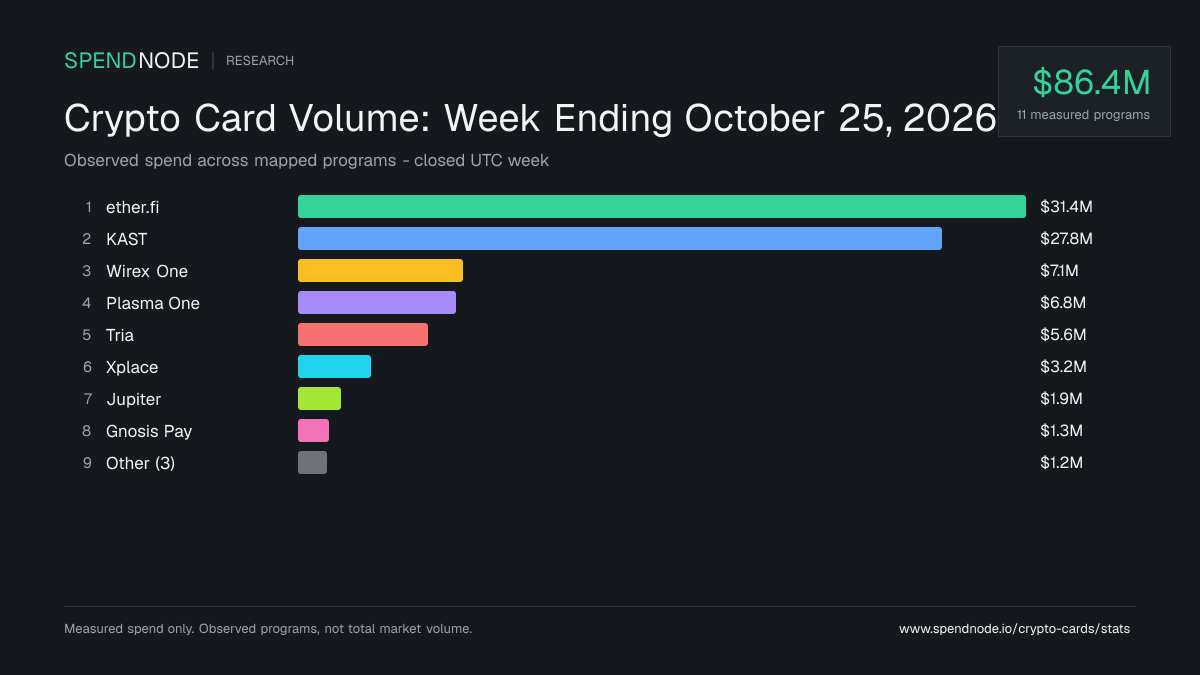
- SpendNode observed $86.41 million of crypto card spending across 11 mapped programs in the seven days through October 25, up 5.2% from the immediately preceding UTC week.
- KAST supplied the largest dollar increase at $1.71 million. xPlace followed at $1.56 million after its measured volume nearly doubled despite fewer observed events and active wallets.
- Ether.fi remained first at $31.43 million and KAST remained second at $27.82 million. Together they represented 68.6% of observed spending.
- Plasma One's measured volume increased 2.9% while settlement events rose from 37,969 to 260,494, cutting average observed value per event from $174.44 to $26.16.
- Peanut moved to a new Rain coordinator during the week. SpendNode scanned both sides of the cutover and measured $30,227 across 400 accepted settlements.
The weekly close
Observed spending reached $86,407,829 between October 19 at 00:00 UTC and October 26 at 00:00 UTC. The comparison uses the same 11 programs and measurement rules as the October 18 close, so the $4.28 million increase does not reflect a coverage change.
Seven programs increased and four declined. KAST and xPlace together supplied $3.27 million, or 76.4%, of the net weekly increase. Wirex One added $547,734, ether.fi added $404,277, and Plasma One added $190,215.
The four declines totaled $176,698. Jupiter fell by $64,905, Gnosis Pay by $64,275, Avici by $44,482, and Tria by $3,037.
Multiplying this week's observed total across 52 weeks gives about $4.49 billion. That figure shows the scale of the measured set; it is not a forecast or an estimate of the entire crypto-card market.
Observed crypto card spending rebounded 5.2% to $86.41 million, led by larger KAST batches and a near-doubling at xPlace.
KAST and xPlace drove the rebound
Ether.fi increased 1.3% to $31.43 million as observed spend events rose 2.4% to 416,837. Average observed value per event declined from $76.18 to $75.39. Ether.fi remained first, finishing $3.61 million ahead of KAST.
KAST increased 6.6% to $27.82 million across seven issuer settlement batches. Six Solana batches carried $22.62 million and one Ethereum batch carried $5.21 million. KAST's batches are not individual card purchases.
xPlace recorded the largest percentage increase, rising 97.7% to $3.16 million. Observed events declined 2.8% to 18,200 and active wallets declined 12.9% to 1,566, while average observed value per event increased from $85.19 to $173.35. The chain data establishes the change in value, not its cause.
Ether.fi and KAST together represented $59.25 million, or 68.6% of observed spending, down from 69.6% one week earlier.
More Wirex volume and smaller Plasma settlements
Wirex One increased 8.3% to $7.14 million. Card-debit events rose 3.5% to 117,286 and active wallets rose 5.4% to 12,516. Average observed value per event increased from $58.15 to $60.87. No unsupported Wirex currency codes appeared in the closed window.
Plasma One increased 2.9% to $6.81 million, but its activity mix changed sharply. Settlement events increased from 37,969 to 260,494 and active wallets from 12,641 to 22,954. Average observed value per event fell from $174.44 to $26.16. Those are settlement events rather than a guaranteed one-to-one count of card purchases, and the chain data does not explain the shift.
Tria was almost flat at $5.63 million, down 0.05%. Deduplicated events declined 0.7% to 60,939, while active wallets increased 0.8% to 22,185.
Jupiter declined 3.4% to $1.87 million. Gnosis Pay declined 4.6% to $1.32 million ahead of the announced December 20 closure of its direct consumer card.
MetaMask grew as UK sign-ups opened
MetaMask increased 6.2% to $733,943 across the observed Base, Linea, and Solana deployments. Observed wallet debits rose 1.8% to 14,707. The total included $351,858 on Linea, $216,968 on Solana, and $165,117 on Base.
During the week, MetaMask opened card sign-ups in the United Kingdom. That announcement expands the product's addressable market, but this report does not attribute the weekly volume increase to it.
Fifty-nine MetaMask Base entries involving EURC and two involving cbBTC were excluded because the weekly valuation registry did not support those assets. They were not assigned an assumed dollar value.
Avici declined 8.7% to $469,303 across 3,272 accepted Solana settlements. Its five monitored EVM networks recorded no qualifying settlements during the week. Three Solana liquidations without the expected single transfer remained excluded.
Peanut completed a coordinator migration
Peanut increased 1.6% to $30,227 across 400 accepted Arbitrum settlements and 161 active collateral accounts.
Its Rain factory changed coordinator contracts at Arbitrum block 516398828 on October 19. SpendNode scanned the previous coordinator through block 516398827 and the new coordinator from the next block onward. Every observed collateral account resolved back to Peanut's factory at runtime, and no shared-coordinator liquidation was left unmatched.
This migration explains why a stale single-coordinator scan would have returned incomplete data. It does not change Peanut's measurement basis: gross native-USDC settlement outflows after card authorization.
Solana gained as KAST left Polygon
Optimism remained the largest measured settlement chain at $31.56 million, or 36.5% of observed spending. Solana followed at $28.33 million, or 32.8%.
Solana increased by $5.52 million, mostly because KAST carried six batches there instead of five. Ethereum increased by $1.26 million as KAST's single Ethereum batch grew to $5.21 million.
Polygon declined by $3.57 million because KAST had no Polygon batch this week after settling $3.60 million there in the preceding close. The chain table records where mapped value settled onchain. It is not blockchain market share for all crypto cards, and issuer-batch routing can move its columns without an equivalent change in purchases.
Product development continued around the measured rails
Ether.fi added read-only MCP access for AI assistants, allowing users to query card transactions, balances, and subscriptions through compatible clients.
Plasma also promoted its existing Deel payroll-to-card flow, where stablecoin payouts can land on Plasma and be spent through Plasma One. These developments affect product utility; the weekly chain data does not establish whether either announcement changed spending.
Measurement notes
This report covers a closed seven-day UTC period. It combines purchase-level wallet debits, card-settlement events, and issuer settlement batches only where each program's public methodology labels the basis. Event counts are compared within programs and are not treated as interchangeable across different settlement designs.
RedotPay remains a separately measured top-up proxy. Its account-funding flows are excluded from every spending total and ranking in this report and will be updated through the same October 25 cutoff in the month-to-date dataset.
Later offchain refunds and chargebacks may not return through the same onchain route, so several series are gross rather than net. KAST's seven transactions are issuer settlement batches, not seven card purchases. MetaMask's identified Monad rail and Avici's unidentified retired route remain outside coverage.
The preceding week and this report are frozen snapshots. Their downloadable CSV, JSON, and chart files keep stable URLs. If stronger evidence changes a published result, SpendNode will label and date the correction rather than silently rewriting the weekly close.
Suggested citation: SpendNode Research, "Crypto Card Volume: Week Ending October 25, 2026," published October 26, 2026, https://www.spendnode.io/crypto-cards/stats/weekly/2026-10-25/.