
Key findings
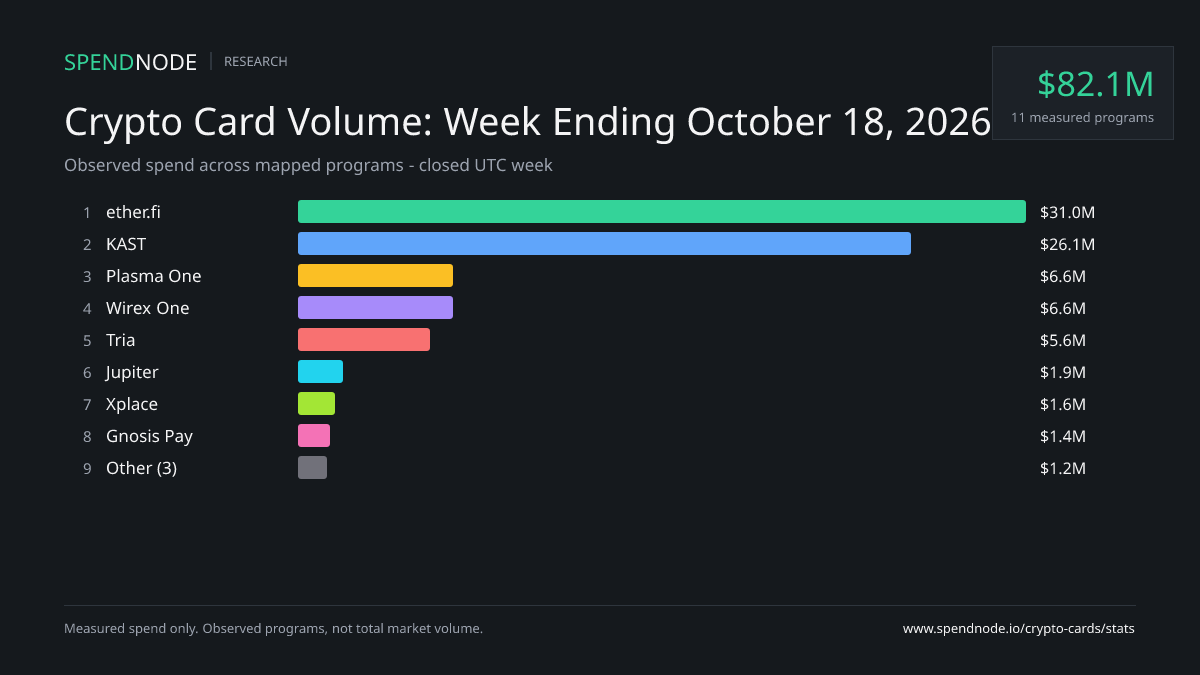
- SpendNode observed $82.13 million of crypto card spending across 11 mapped programs in the seven days through October 18, down 3.98% from the immediately preceding UTC week.
- All 11 measured programs declined. KAST recorded the largest dollar decrease at $1.21 million, while xPlace recorded the largest percentage decrease at 22.6%.
- Ether.fi remained first at $31.02 million and KAST remained second at $26.11 million. Together they represented 69.6% of observed spending.
- Wirex One's observed card-debit events and active wallets both increased even as its measured volume declined 2.1%, lowering average observed value per event from $60.42 to $58.15.
- KAST settled one of its seven issuer batches on Polygon. The batch carried $3.60 million, while Polygon's measured total increased by $3.64 million and Solana's declined by $5.73 million.
The weekly close
Observed spending reached $82,127,033 between October 12 at 00:00 UTC and October 19 at 00:00 UTC. The comparison uses the same 11 programs and measurement rules as the October 11 close, so the 3.98% decline does not reflect a coverage change.
The previous three closes stayed between $85.53 million and $86.11 million. This week's result ended that narrow run, with all 11 programs moving lower. Their combined decrease was $3.41 million.
KAST accounted for $1.21 million of the decline. Plasma One supplied another $656,633, followed by ether.fi at $594,007 and xPlace at $466,783. The other seven programs declined by a combined $478,236.
Multiplying this week's observed total across 52 weeks gives about $4.27 billion. That figure shows the scale of the measured set; it is not a forecast or an estimate of the entire crypto-card market.
Observed crypto card spending fell 4.0% to $82.13 million as every program in the measured set moved lower.
Ether.fi stayed first after reporting $1 billion lifetime
Ether.fi declined 1.9% to $31.02 million as observed spend events fell 1.4% to 407,248. Average observed value per event moved from $76.57 to $76.18, leaving ether.fi first by $4.91 million over KAST.
During the week, ether.fi said its card had crossed $1 billion in cumulative spending across 199 countries, 131 currencies, and more than 12.6 million transactions. Those are first-party lifetime figures rather than this report's independently mapped seven-day window, so they are presented separately.
KAST declined 4.4% to $26.11 million across seven issuer batches. Five Solana batches carried $18.56 million, while one Ethereum batch carried $3.94 million and one Polygon batch carried $3.60 million.
KAST's batches are not individual purchases. Ether.fi and KAST together represented $57.13 million, or 69.6% of observed spending, slightly above 68.9% one week earlier despite both programs declining.
More Wirex activity carried less value
Wirex One declined 2.1% to $6.59 million while card-debit events increased 1.8% to 113,347 and active wallets increased 3.2% to 11,870. Average observed value per event fell from $60.42 to $58.15. No unsupported Wirex currency codes appeared in the closed window.
Plasma One declined 9.0% to $6.62 million even as observed settlement events increased 2.5% and active wallets increased 1.1%. Average observed value per event fell from $196.44 to $174.44, reversing part of the preceding week's increase.
Tria was the closest to flat, declining 0.34% to $5.63 million. Deduplicated events increased 0.7% to 61,358 while active wallets declined 1.0% to 22,008.
Jupiter declined 4.5% to $1.94 million despite increases in both observed events and active wallets. Its average observed value per event fell from $93.28 to $86.74.
xPlace recorded the largest percentage decline
xPlace declined 22.6% to $1.60 million. Observed events fell from 39,886 to 18,729, while active wallets fell from 5,844 to 1,798. The chain data records the change but does not identify its cause.
Gnosis Pay declined 4.7% to $1.38 million ahead of the announced December 20 closure of its direct consumer card. MetaMask declined 13.7% to $691,080 across the observed Base, Linea, and Solana deployments.
Fifty-four MetaMask Base entries involving EURC and one involving cbBTC were excluded because the weekly valuation registry did not support those assets. They were not assigned an assumed dollar value.
Avici declined 8.1% to $513,785. On October 13, its observed Solana program shifted from one first signer to ten parallel first signers. SpendNode included the new routes only after confirming that they retained the established co-signer, instruction types, USDC mint, and settlement account. One liquidation without a qualifying USDC transfer remained excluded.
Peanut declined 16.1% to $29,764 across 408 accepted Arbitrum settlements and 158 active collateral accounts.
KAST shifted one batch to Polygon
Optimism remained the largest settlement chain at $31.16 million, or 38.0% of observed spending. Solana followed at $22.81 million, or 27.8%. Plasma and Arc each represented about 8.0%.
Polygon increased from $1.89 million to $5.52 million after KAST settled one $3.60 million batch there. Solana declined from $28.55 million to $22.81 million as KAST's Solana batch count fell from six to five.
The chain table records where mapped value settled onchain. It is not blockchain market share for all crypto cards, and issuer-batch routing can move its columns without an equivalent change in purchases.
Card rails moved further into production
The same week brought several payment-infrastructure announcements. Visa Direct moved USDC prefunding from pilot to production, while Stripe and Plasma announced stablecoin card infrastructure across more than 30 countries.
Mastercard also outlined wider stablecoin checkout support, although complete settlement, token, and fee details were not published. These announcements describe payment rails and product distribution; this report does not attribute any measured weekly movement to them.
Measurement notes
This report covers a closed seven-day UTC period. It combines purchase-level wallet debits, card-settlement events, and issuer settlement batches only where each program's public methodology labels the basis. Event counts are compared within programs and are not treated as interchangeable across different settlement designs.
Separately, SpendNode observed $299.96 million across RedotPay's mapped top-up routes from October 1 through October 18. That figure measures recognized account funding, not spending, and is excluded from every total and ranking in this report.
Later offchain refunds and chargebacks may not return through the same onchain route, so several series are gross rather than net. KAST's seven transactions are issuer settlement batches, not seven card purchases. MetaMask's identified Monad rail and Avici's unidentified retired route remain outside coverage.
The preceding week and this report are frozen snapshots. Their downloadable CSV, JSON, and chart files keep stable URLs. If stronger evidence changes a published result, SpendNode will label and date the correction rather than silently rewriting the weekly close.
Suggested citation: SpendNode Research, "Crypto Card Volume: Week Ending October 18, 2026," published October 19, 2026, https://www.spendnode.io/crypto-cards/stats/weekly/2026-10-18/.