

Best Crypto Cards in Ivory Coast (2026)
Compare crypto cards available in Ivory Coast (Cote d'Ivoire). West Africa's largest francophone economy with CFA franc pegged to EUR at 655.957:1, dominant Mobile Money ecosystem, and no explicit crypto ban. Global cards serve the growing tech-savvy population in Abidjan.
Verified for Ivory Coast
36 crypto cards available
Local currency: XOF
Ivory Coast (Cote d'Ivoire) is West Africa's largest francophone economy with a GDP approaching USD 75 billion and the fastest-growing major economy in the WAEMU zone, averaging 7-8% annual growth since 2012. The "Elephant d'Afrique" recovery from the 2010-2011 political crisis transformed Abidjan into Sub-Saharan Africa's fourth-largest city and a regional financial hub hosting the African Development Bank headquarters.
Orange Money, MTN MoMo, and Wave handle daily payments for over 30 million mobile money accounts serving a population of 28 million, but none can process international e-commerce, foreign subscriptions, or cross-border online purchases. A crypto card bridges that gap, giving Ivorian users Visa/Mastercard rails that mobile money cannot reach.
The CFA franc (XOF) is pegged to the euro at a fixed rate of 655.957 XOF per EUR, guaranteed by the French Treasury (Tresor Public). This peg eliminates FX volatility risk entirely when using EUR-settled crypto cards. Unlike Nigeria (naira lost 77% against USD in 2023-24), Ghana (cedi lost 60%), or even neighboring Guinea (franc lost 40%+), the CFA franc provides absolute stability against the euro.
A card settling in EUR converts to XOF at the guaranteed rate, not at a floating market rate. This makes Ivory Coast one of the most predictable environments in Africa for crypto card spending.
Summary:
Which crypto cards are best in Ivory Coast?
The best crypto cards in Ivory Coast in October 2026 are Kolo Card, KAST K Card, Rizon Standard Card, and Tria Signature Card. The detailed ranking below explains the local tax, fee, and availability trade-offs.
| Crypto card | Base reward | Net after fees | Annual fee | FX fee | Type |
|---|---|---|---|---|---|
| 1% base2% for the first 30 days, then 1%; also capped at $1/EUR 1 per transaction ($2/EUR 2 during intro) and $100/EUR 100 per month | 1% | Free | 0% | Prepaid | |
| 1.5% base | 1% | Free | 0.5% | Prepaid | |
| Varies | - | Free | 1.7% | Crypto Backed Credit | |
| 4.5% base4.5% on the first $1,000/mo, then 1% | 3% | $109/year | 1% | Debit |
Best Card For Every Need in Ivory Coast
Top 4 Crypto Cards in Ivory Coast
The CFA franc's guaranteed EUR peg at 655.957:1 removes much of the currency volatility that shapes crypto card selection in other African markets. The practical problem is that local bank cards can be unreliable on international transactions. Kolo takes the top slot as the free card that sidesteps them.
Kolo pays 1% ongoing BTC cashback, after 2% for the first 30 days, with a $100 monthly cap and $1 transaction cap. Its $0 annual fee and 0% FX make it a free BTC option for smaller purchases.
KAST at 1.5% USD cashback on the first $2,000/month with lighter KYC gets an Ivorian onto foreign-merchant card rails immediately, bypassing the 2-4 week bank card application and salary domiciliation requirements.
Rizon Standard is the direct answer to this page's core failure mode: where SGBCI and BICICI cards decline 30-40% of international transactions, Rizon issues a US Visa Platinum whose transactions originate from a US program in the first place.
The Ivorian passport is on its 49-nationality list, the virtual card costs $1 with code spendnode, USD account details come attached, and collateral sits in the user's own smart-contract wallet. Cashback is absent on the free plan (rewards accrue as RizPoints) and non-USD spend runs 1.7% + $0.30, so Kolo keeps the CFA cashback lane while Rizon carries the foreign-merchant reliability and the dollar account.
Tria Signature at 4.5% on the first $1,000/mo (then 1%), with 1% FX and a 0.5% per-payment fee that net it to about 3%, breaks even at approximately EUR 280/month, within reach for higher-earning Abidjan professionals.
In our Ivory Coast guide, Kolo leads as the free card built for this market: 1% ongoing BTC cashback after a 2% introductory month, capped at $100 per month and $1 per transaction, with no annual or FX fee. KAST pays 1.5% USD cashback on the first $2,000 per month and is a practical international-spend card when local bank cards fail at foreign merchants.
Tria Signature at 4.5% on the first $1,000/mo (then 1%), 1% FX plus 0.5% per payment, suits higher-earning Abidjan professionals who can break even on the $109/yr fee at approximately EUR 280/month.
Card acceptance concentrates in Abidjan (Plateau business district, Cocody, Marcory, and Zone 4), with limited penetration elsewhere.
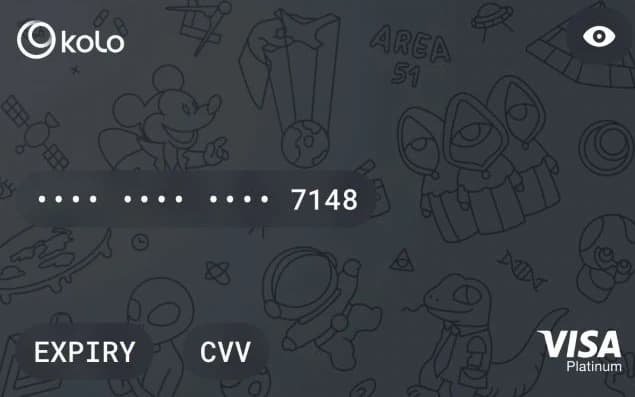
1. Kolo Card
Earn Bitcoin on Purchases: 2% for 30 Days, Then 1% (Capped) + Visa Platinum + 170+ Countries
2. KAST K Card
Free USD Cashback: 1.5% on First $2K/Month
3. Rizon Standard Card
A $1 US virtual Visa Platinum for passport holders the traditional card system skips.
4. Tria Signature Card
High-Yield Self-Custody: 15% APY + Visa Signature Perks
Complete list:
All 36 crypto cards available in Ivory Coast in October 2026
This table includes every crypto card we currently track for Ivory Coast. Rows marked Top pick are ranked and reviewed above.
| Crypto card | Max rewards | Annual fee | FX fee | Type | Custody |
|---|---|---|---|---|---|
1 Kolo CardTop pick | Up to 2% rewards | Free | 0% | Prepaid | Custodial |
2 KAST K CardTop pick | Up to 1.5% rewards | Free | 0.5% | Prepaid | Custodial |
3 Rizon Standard CardTop pick | Varies | Free | 1.7% | Crypto Backed Credit | Self-custody |
4 Tria Signature CardTop pick | Up to 4.5% rewards | $109/year | 1% | Debit | Self-custody |
| Up to 8% rewards | Free | 0% | Debit | Custodial | |
| Up to 8% rewards | TBD | 0% | Prepaid | Custodial | |
| Up to 6% rewards | $250/year | 1% | Debit | Self-custody | |
| Up to 5% rewards | Free | 1% | Crypto Backed Credit | Self-custody | |
| Up to 5% rewards | TBD | 0% | Prepaid | Custodial | |
| Up to 5% rewards | Free | 1% | Debit | Self-custody | |
| Up to 4% rewards | Free | 1% / 1.8% | Debit | Hybrid | |
| Up to 4% rewards | TBD | 0% | Prepaid | Custodial | |
| Up to 3% rewards | $10000 | 0.5% | Prepaid | Custodial | |
| Up to 3% rewards | $299.9 | 0% | Prepaid | Custodial | |
| Up to 3% rewards | $129 | 1.2% | Prepaid | Custodial | |
| Up to 2.5% rewards | $83.88 | 1.02% | Crypto Backed Credit | Self-custody | |
| Up to 2% rewards | $1000 | 0.5% | Prepaid | Custodial | |
| Up to 2% rewards | $49.9 | 0% | Prepaid | Custodial | |
| Up to 2% rewards | $999 | 0% | Crypto Backed Credit | Self-custody | |
| Up to 1.5% rewards | Free | 0.5% | Prepaid | Custodial | |
| Up to 1.5% rewards | $20/year | 1% | Debit | Self-custody | |
| Up to 1.5% rewards | $249 | 0.25% | Crypto Backed Credit | Self-custody | |
| Up to 1% rewards | Free | 1% | Crypto Backed Credit | Self-custody | |
| Up to 1% rewards | Free | TBD | Prepaid | Custodial | |
| Up to 1% rewards | $47.88 | 1.275% | Crypto Backed Credit | Self-custody | |
| Up to 1% rewards | $99 | 0.5% | Crypto Backed Credit | Self-custody | |
| Up to 0.5% rewards | Free | 1% | Crypto Backed Credit | Self-custody | |
| none | Free | 0% | Crypto Backed Credit | Self-custody | |
| none | $30 | 0% | Crypto Backed Credit | Self-custody | |
| none | Free | 0% | Prepaid | Custodial | |
| none | Free | 1% | Prepaid | Self-custody | |
| Varies | Free | 1.5% | Debit | Custodial | |
| Varies | Free | 1.2% | Prepaid | Custodial | |
| Varies | Free | 1.2% | Prepaid | Custodial | |
| Varies | Free | 1.2% | Prepaid | Custodial | |
| points | Free | 1% | Debit | Self-custody |
Crypto Card Regulation in Ivory Coast
Ivory Coast's financial regulation follows the WAEMU (West African Economic and Monetary Union, UEMOA) framework. The Banque Centrale des Etats de l'Afrique de l'Ouest (BCEAO) is the central bank for all eight member states.
The BCEAO has repeatedly warned that cryptocurrencies are not legal tender, are not regulated as currency, and carry significant risks.
However, the BCEAO has not explicitly banned crypto ownership or trading. The grey area exists because the BCEAO's jurisdiction covers monetary policy and banking regulation, while crypto does not clearly fall under existing legal categories. The ARTCI (Autorite de Regulation des Telecommunications/TIC de Cote d'Ivoire) regulates digital services but has not specifically addressed crypto.
The Ivorian government has shown interest in blockchain technology. The Ministry of Digital Economy and Digital Transition (Ministere de l'Economie Numerique et de la Transition Digitale) has included blockchain in its national digital strategy. Abidjan hosts annual blockchain conferences and the tech ecosystem in Yopougon's Abobo-Adjame digital hub is growing.
Ivory Coast's regulatory environment is permissive by omission rather than by design. No explicit ban exists, but no consumer protections are specific to crypto. Use well-regulated global issuers (FCA, MiCA-licensed) and avoid storing large amounts on unregulated platforms.
Tax Treatment of Card Rewards in Ivory Coast
Ivory Coast has no specific cryptocurrency tax legislation. Under general tax principles, crypto gains could fall under the impot sur le revenu (personal income tax) or the impot sur les benefices industriels et commerciaux (business profits tax).
Personal Income Tax
The Direction Generale des Impots (DGI) has not published a crypto-card disposal rate. Do not apply a salary-tax bracket automatically to a personal investment gain.
Ivory Coast also reformed its employee income-tax calculation. The old IGR salary bands are not a sound proxy for crypto taxation.
Practical Tax Situation
The DGI has not published crypto-card disposal guidance, and we have not identified a published enforcement case focused on an individual's crypto-card spending. That describes the visible enforcement record, not a tax exemption. The absence of specific guidance leaves the classification of gains and rewards open; keep acquisition, conversion, and reward records.
The BCEAO's 2026 crypto-assets conference discussed regional policy work; it did not itself create a tax exemption or VASP license.
| Cashback Type | Tax When Received | Tax When Spent/Sold | Optimal Strategy |
|---|---|---|---|
| BTC/ETH cashback | Depends on reward terms | Later gain may need assessment | Track receipt and basis |
| Stablecoin cashback (USDC) | Depends on reward terms | Gain may be small | Keep conversion records |
| Points/token cashback | Depends on reward terms | Depends on later use | Track receipt and disposal |
Recently acquired stablecoins may limit price gains between funding and spending, but they do not resolve how a card conversion or reward is classified. Keep records and check the applicable DGI treatment before making a tax claim.
How to Apply from Ivory Coast
Crypto card applications from Ivory Coast require the Carte Nationale d'Identite (CNI, National Identity Card), issued by the Office National de l'Etat Civil et de l'Identification (ONECI). The CNI is mandatory for Ivorian citizens over 15 and contains biometric data, a NNI (Numero National d'Identification), and a photo.
Alternative identification: Ivorian passport (Passeport de la Republique de Cote d'Ivoire), issued by the Direction de la Police de l'Air et des Frontieres. Carte de Sejour (residence card) for foreign residents. Proof of address via utility bills from CIE (Compagnie Ivoirienne d'Electricite), SODECI (Societe de Distribution d'Eau de Cote d'Ivoire), or Orange/MTN phone bills. Bank statements from SGBCI (Societe Generale), BICICI (BNP Paribas), or Ecobank also work.
Some global card issuers may have limited support for Ivorian documents. KAST and RedotPay, with fast KYC (2 min) requirements, are the most accessible options. For Ivorians with secondary residency or banking in France or other WAEMU states, using those documents may provide broader issuer access.
Spending Tips for Ivory Coast
Banking System: Why Cards Get Declined
Ivory Coast's banking sector is dominated by French-affiliated institutions that carry both the professionalism and the fee structures of European parent banks. SGBCI (Societe Generale subsidiary) is the largest commercial bank with branches across Abidjan but charges XOF 2,500-5,000 (EUR 3.80-7.60) per international card transaction plus 2-3% FX markup on non-EUR purchases.
BICICI (BNP Paribas subsidiary) serves the corporate and expatriate market with similar international fee structures. Ecobank Ivory Coast (pan-African) offers slightly lower fees but international online purchases are frequently declined by their fraud systems. NSIA Banque focuses on insurance-linked products. Bridge Bank (now part of Coris Group) serves SMEs but international card issuance is limited.
The core problem: even with a SGBCI or BICICI Visa card, international online purchases from US-based merchants (Amazon, Netflix, Spotify) fail at rates of 30-40% due to 3DS verification issues, merchant-side country blocks, and transaction amount limits set by BCEAO regulations.
Local banks may apply international-card limits and issuer-specific checks. An overseas-issued crypto card uses a different issuer and funding route, but that does not exempt a resident from applicable exchange-control, AML, or tax rules.
The CFA-EUR Peg: Stability With a Hidden Cost
The CFA franc's fixed peg to the euro (655.957:1) provides a stability that neighboring countries envy. While the naira, cedi, and Guinean franc crash and recover on cycles, the XOF sits anchored. For crypto card users, this means EUR-settled transactions convert at a predictable rate with zero currency surprise.
But the peg has a hidden cost: when the euro weakens against the dollar (as it did from 2021-2022, dropping from 1.22 to near parity), everything priced in USD becomes 15-20% more expensive for CFA users. Netflix, AWS, Adobe, App Store purchases, and Amazon orders are all dollar-denominated.
Holding USDC (dollar-pegged) in a crypto wallet and spending through a card effectively hedges this risk. When the EUR/USD rate moves against you, your USDC purchases stay dollar-stable. This is a real advantage over bank card spending for anyone whose costs are partly USD-denominated.
The ongoing ECOWAS Eco currency debate adds another layer. If the CFA franc is eventually replaced by a regional currency with a floating rate, the stability advantage disappears. Users holding stablecoins on a crypto card would be insulated from that transition entirely.
Card Selection by Use Case
- Free BTC cashback: Kolo (1% ongoing BTC, 2% for 30 days, capped $100/mo and $1/txn, cashback cards, $0, 0% FX)
- Best card when local banks fail on foreign merchants: KAST (1.5% USD cashback on first $2K/mo, $0, 0.5-1.75% FX, lighter KYC)
- Capped cashback, no token risk: Tria Signature (4.5% on first $1,000/mo, $109/yr, 1% FX + 0.5%/payment, ~3% net)
- Premium perks: Crypto.com Icy (4% + airport lounge perks at ABJ)
Break-Even Math: CFA-EUR Peg Environment
All amounts in EUR (XOF equivalent at 655.957:1 peg). Tax impact unclear but likely minimal. Kolo pays the full 1% only up to EUR 100 a purchase, since each transaction earns at most EUR 1 of cashback.
| Monthly Spend | Tria Sig (4.5% to ~EUR 920/mo, EUR 100/yr, 1% FX + 0.5%/payment) | Crypto.com Icy (4%, CRO stake) | Kolo (1% BTC, free) |
|---|---|---|---|
| EUR 100 | -EUR 64/yr | EUR 48/yr + lounges | EUR 12/yr |
| EUR 200 | -EUR 28/yr | EUR 96/yr + lounges | EUR 24/yr |
| EUR 400 | EUR 44/yr | EUR 192/yr + lounges | EUR 48/yr |
| EUR 800 | EUR 188/yr | EUR 384/yr + lounges | EUR 96/yr |
The Kolo column assumes purchases stay at or below $100, before its $1-per-transaction reward cap reduces the effective rate.
At Ivory Coast's average monthly income of approximately EUR 300, Kolo is the free pick, returning about EUR 36/year in BTC, while the staked Crypto.com Icy earns more for CRO holders willing to hold the token.
Tria Signature breaks even at approximately EUR 280 per month after its annual and transaction fees, so it remains marginal at typical local spend. KAST suits budget-conscious users who value lighter KYC, while Kolo handles BTC accrual on routine spending.
Cost of Living by Area
Spending patterns vary widely across Ivory Coast, and card acceptance follows the money:
Cocody/Riviera (Abidjan's upscale district): Rent XOF 300,000-800,000/month (EUR 460-1,220) for a 2-bedroom. Restaurants EUR 8-25/meal. This is where POS terminals are common: Playce Palmeraie mall, La Rotonde, restaurants along Boulevard Latrille. Best area for daily crypto card use.
Plateau (CBD): Business district with banks, hotels, government offices. Sofitel Ivoire, Pullman, Novotel all accept cards. Business lunches EUR 10-20. Very card-friendly during business hours but quieter evenings.
Marcory/Zone 4: Nightlife, restaurants, and the expat social scene. Maquis (outdoor restaurants) are cash-only, but formal restaurants and bars increasingly accept cards. Zone 4's "Rue des Jardins" strip has growing POS adoption.
Yopougon (largest commune): 2+ million residents, predominantly cash and Mobile Money economy. Rent XOF 50,000-150,000 (EUR 75-230). Formal card acceptance is rare. Use crypto card primarily for online purchases.
Bouake (second city): 800,000+ population, almost entirely cash/mobile money. No realistic daily card spending use case. Online purchases and subscriptions only.
San Pedro (cocoa port city): Growing economy tied to cocoa exports. Limited card infrastructure but hotels and the port area accept Visa/Mastercard.
The Cocoa Economy and Crypto
Ivory Coast produces over 2 million tonnes of cocoa annually, roughly 40% of the world's supply. The Conseil du Cafe-Cacao (CCC) sets the farmgate price at the start of each campaign season. In 2023-2024, global cocoa prices surged past USD 10,000/tonne (and briefly touched USD 12,000 in early 2024), but the CCC farmgate price lagged far behind, paying farmers XOF 1,000-1,500/kg while world prices implied XOF 3,000+.
This gap means cocoa wealth concentrates in trading houses (Cargill, Barry Callebaut, Olam) and government revenue, not in farmer incomes.
For the urban professional and trading class in Abidjan, the cocoa boom drives economic growth, construction, and services spending. For farmers and rural middlemen who increasingly use crypto as an informal savings vehicle (buying USDT on Binance P2P to escape the XOF-denominated farming cycle), a crypto card converts those holdings into spending power at Abidjan supermarkets during family visits or for school fees paid to private institutions that accept card payments.
Diaspora Remittances: France, WAEMU, and Beyond
Ivory Coast receives USD 2-3 billion in annual remittances, with France as the dominant corridor. An estimated 300,000+ Ivorians live in France (concentrated in Paris/Ile-de-France, Marseille, Lyon, and Toulouse), with another 100,000+ across other WAEMU states (Senegal, Burkina Faso, Mali). Smaller but growing communities exist in the US (New York, Washington DC, Houston), Canada (Montreal, due to the francophone pull), Belgium, Switzerland, and Morocco.
Traditional remittance fees through Western Union, MoneyGram, or Orange Money International run 5-8% per transfer, dropping to 3-4% for large amounts. Wave disrupted domestic transfers ($0 annual fee within Ivory Coast) but cross-border remittances from France still carry 2-4% costs.
A family member in Paris loading USDC onto a RedotPay or KAST card held by family in Abidjan eliminates the remittance fee entirely. The USDC arrives in seconds, the family spends at any POS terminal, and zero goes to intermediaries.
Online Shopping and Subscriptions
The primary frustration driving Ivorian users to crypto cards is international online shopping. Local bank cards from SGBCI or BICICI get declined on Amazon, are blocked by Netflix's fraud systems, and cannot pay for App Store or Google Play subscriptions without repeated 3DS failures. The workaround used to be buying gift cards from informal resellers (at 10-15% markup), but a crypto card solves this natively.
Common purchases: Netflix/Canal+ streaming (EUR 8-16/month), Spotify, Amazon purchases (shipped via freight forwarders to Abidjan), AliExpress (popular for electronics and fashion), Shein, educational platforms (Coursera, Udemy), software subscriptions (Adobe, Canva), VPN services, and gaming (Steam, PlayStation Store). Jumia Cote d'Ivoire accepts local bank cards but international Jumia orders and cross-border e-commerce require international card rails.
Cross-Border Spending
Ghana border (Elubo-Noe crossing): Active trade corridor. Ghanaians shop in Abidjan for goods, Ivorians cross to Takoradi and Accra. The cedi floats while the CFA is pegged, creating arbitrage opportunities that shift seasonally. A crypto card works in both countries without the need to carry physical currency.
WAEMU free movement: As a WAEMU member, Ivorians can travel freely across all 8 member states (Senegal, Mali, Burkina Faso, Niger, Togo, Benin, Guinea-Bissau) using the same CFA franc. A crypto card adds spending capability beyond what CFA cash provides: international merchants, airline bookings, hotel reservations.
France: The most common international destination. Direct flights Abidjan-Paris (Air France, Corsair, Air Cote d'Ivoire). Crypto card eliminates the EUR/XOF conversion fees that SGBCI charges (typically 2-3% markup above the official peg rate, plus transaction fees). At the guaranteed peg rate, a EUR-settled crypto card actually costs less than an Ivorian bank card for spending in France.
Morocco/Turkey: Growing travel destinations. RAM (Royal Air Maroc) and Turkish Airlines serve Abidjan. Shopping in Istanbul's Grand Bazaar or Casablanca's Morocco Mall with a crypto card avoids multi-currency conversion chains (XOF to EUR to TRY/MAD through a bank costs 4-6% in stacked fees).
Local Payment Infrastructure
Ivory Coast's payment system is dominated by Mobile Money. Orange Money leads with over 15 million accounts and an agent network reaching even rural villages. MTN MoMo holds the second position. Wave (Senegal-founded, backed by Stripe's Patrick Collison) disrupted the market in 2020-2022 with zero-fee person-to-person transfers, forcing Orange Money to slash its own fees. Together these three platforms process more transaction volume than the entire formal banking sector.
Card acceptance (Visa/Mastercard POS terminals) concentrates in Abidjan: Plateau business district, Cocody, Zone 4, and major shopping centers (Cap Sud, Playce Marcory, Playce Palmeraie, Centre Commercial Cosmos, PlaYce). Hotels (Sofitel Abidjan Hotel Ivoire, Pullman, Radisson Blu, Onomo) and supermarkets (Carrefour Market, Prosuma/CDCI chain, King Cash) accept cards reliably.
Outside Abidjan, card acceptance drops to near zero. Bouake, Yamoussoukro (political capital), San Pedro, and Daloa are cash-and-mobile-money economies.
Apple Pay and Google Pay have no domestic merchant support but work through international card issuers for online purchases. GIM-UEMOA (Groupement Interbancaire Monetique de l'UEMOA) provides the regional interbank card network for domestic transactions.
Supported Exchanges & Wallets in Ivory Coast
Our Ivory Coast availability check found 17 card vendors serving the country through global coverage, each filling a distinct niche in the Ivorian spending market.
Kolo delivers 1% ongoing BTC cashback (2% for the first 30 days), capped at $100/month and $1 per transaction, at $0 annual fee and 0% FX. In a market where bank savings yield under 3%, that BTC cashback still functions as a small-purchase savings layer on top of the FX benefit for the Abidjan tech community.
Tria Signature at 4.5% on the first $1,000/mo with 1% FX plus a 0.5% per-payment fee (about 3% net) breaks even at approximately EUR 280/month, within reach for higher-earning professionals earning XOF 300,000-500,000/month; its USDT cashback can take up to three months to arrive.
KAST leads the accessibility segment. Its lighter KYC can be quicker than a local bank card application requiring salary domiciliation. The card pays 1.5% USD cashback on the first $2,000 per month, with no annual fee and 0.5-1.75% FX.
KAST rewards carry a 14-day lock and require manual redemption. They apply to a later purchase rather than paying out as cash.
Crypto.com offers tiered rewards. The Midnight Blue (0%, free entry) is the base route. The real value for frequent Abidjan-Paris travelers comes at the Icy tier: 4% cashback plus airport lounge access at Felix Houphouet-Boigny International (ABJ), Charles de Gaulle, and Orly. Those lounge visits save EUR 30-50 per trip.
RedotPay serves stablecoin-first users, with the physical card at USD 100 adding ATM access for cash withdrawals in XOF outside Abidjan where Mobile Money dominates. Jupiter rounds out the DeFi-native options.
Local On-Ramps and P2P Trading
No crypto exchanges hold BCEAO or ARTCI licenses in Ivory Coast. The primary on-ramp is Binance P2P, which supports XOF pairs directly. Sellers post offers on the P2P marketplace, buyers pay via Orange Money or Wave transfer, and USDT arrives in the Binance wallet within minutes. Typical P2P markup: 1-3% above spot, varying by payment method and order size. Orange Money transfers settle fastest and carry the lowest premium.
Yellow Card (Nigerian-founded, operates across West Africa including Cote d'Ivoire) provides a more regulated fiat-to-crypto bridge with USDT and USDC support. The interface is simpler than Binance P2P and suits first-time buyers. Luno has limited West African presence but operates in neighboring countries. OTC trading through Telegram groups (search "Crypto CI" or "Bitcoin Abidjan") handles larger volumes, particularly for diaspora members converting EUR to USDT for family spending.
The CFA franc's EUR peg creates a unique on-ramp advantage: USDT/EUR P2P trades convert to XOF at the guaranteed rate, eliminating the floating-rate risk that plagues Nigerian or Ghanaian P2P markets. An Ivorian buying USDT with XOF via Orange Money on Binance P2P, then loading a KAST or RedotPay card, has a clean and predictable cost chain from start to finish.
Abidjan Tech Ecosystem
Abidjan's tech scene is the largest in francophone West Africa. The Orange Digital Center (Plateau) provides co-working, training, and startup incubation. Seedstars Abidjan and Impact Hub Abidjan support early-stage ventures. The AfricArena conference brings pan-African tech investors.
Ivorian startups like CinetPay (payments), Julaya (B2B payments), Djamo (neobanking, raised $14M Series A and the most-funded Ivorian fintech), and Wave (though Senegal-founded, has major operations in Abidjan) represent the local fintech layer.
For the developer and startup community concentrated in Cocody and Plateau, crypto cards serve a practical professional need: paying for cloud services (AWS, Google Cloud, DigitalOcean), SaaS tools (Figma, Slack, Notion), domain registrations, and API credits. These USD-denominated subscriptions are the exact transactions that Ivorian bank cards fail to process reliably.
Ivory Coast's combination (CFA stability, no explicit crypto ban, Abidjan's role as a regional financial hub, and the gap between Mobile Money's domestic reach and the absence of international card infrastructure) makes crypto cards useful for any Ivorian engaging with the global digital economy.
Written by SpendNode Editorial
Frequently Asked Questions
Which crypto cards work in Ivory Coast?
Ivory Coast is served by globally available crypto cards including Kolo (1% BTC ongoing, 2% for the first 30 days, free, 0% FX), KAST, Rizon, Tria Signature, and Crypto.com Icy. Visa and Mastercard acceptance is concentrated in Abidjan, while the CFA franc remains pegged to EUR at 655.957:1.
How is cryptocurrency taxed in Ivory Coast?
No specific crypto tax legislation exists. Under general tax rules, capital gains may fall under the impot sur le revenu (income tax) at progressive rates from 2% to 36%. The Direction Generale des Impots (DGI) has not issued crypto-specific guidance. Enforcement is minimal, but record-keeping is advisable as WAEMU harmonizes digital economy taxation.
Is crypto legal in Ivory Coast?
Crypto occupies a legal gray area. The BCEAO (Banque Centrale des Etats de l'Afrique de l'Ouest) has warned against crypto use and does not recognize it as legal tender. However, there is no explicit ban on ownership or trading. The ARTCI (Autorite de Regulation des Telecommunications) monitors digital financial services but has not specifically regulated crypto.
Can crypto cards replace Mobile Money in Ivory Coast?
Not entirely, but they complement it. Mobile Money (Orange Money, MTN MoMo, Wave) dominates person-to-person payments and bill settlement. Crypto cards serve a different use case: online purchases, international spending, and access to global e-commerce that Mobile Money cannot reach. For the tech-savvy population in Abidjan, crypto cards add international purchasing power.


