
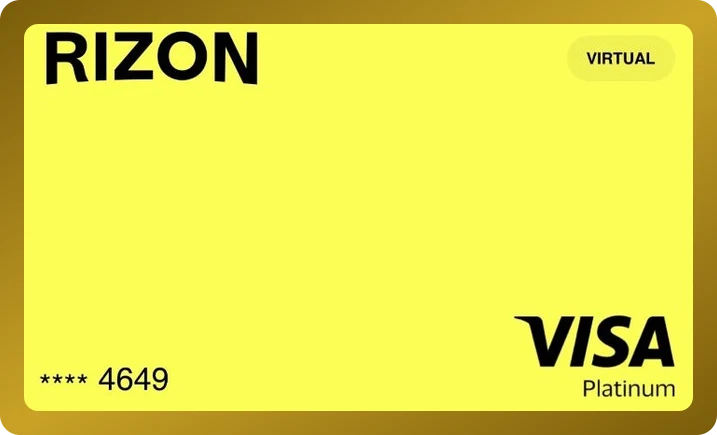
Rizon Gold Card Review 2026
Rizon Gold: $3.99/month plan with 25% off transaction fees (~1.275% international), 1% cashback capped at the plan fee, free virtual card, $24.99 physical card, and 1 RizPoint per $5 spent, on Rizon's US-issued Visa Platinum.

SpendNode Rating for Rizon Gold Card
For $3.99 a month, Gold cuts transaction fees by 25%, includes the virtual card, and pays 1% cashback up to the plan fee. It crosses the free tier at about $280 a month of eligible international spend.
Gold earns strong cost and utility scores because its capped cashback can return the entire subscription fee while the transaction discount continues saving money beyond that point. The free virtual card, half-price physical card, published ATM rate, and self-custodial collateral add practical value. Rizon documents the cap and exclusions, and our hands-on onboarding test supports the reliability score; the short operating history remains the main restraint.
Also relevant for Self-Custody Spending.
How It Competes
Cost Efficiency
4.2
Product Utility
4.2
Custody & Trust
4.4
Reliability & UX
4.3
Transparency
4.2

VIRTUAL CARD
Verified

PHYSICAL CARD
Verified

APPLE PAY
Verified
Rizon Gold Card Overview
The fee-discount tier: international transaction costs drop to ~1.275% and the plan fee earns itself back in cashback.
Gold is a fee product at a low price: $3.99/month cuts the international drag by a quarter, the virtual card comes free, and the capped 1% cashback claws the fee back. It earns its keep for cross-border spenders around $280/month and up; USD-only spenders should stay on the free Standard plan.
Fees & Charges
Annual Fee
$47.88
FX Fee
1.275%
ATM Fee
0.65%
Requirements
Supported Regions
GLOBAL
Spendable Assets
USDC, USDT
The Rizon Gold Card is the middle plan on Rizon's US-issued Visa Platinum, a collateralized 0%-APR charge account from Third National funded by stablecoins in the user's own non-custodial wallet. For $3.99/month (minimum 3-month commitment), Gold discounts all transaction fees by 25%, pays 1% cashback capped at the plan fee, includes the virtual card free, and halves the physical card to $24.99.
A Fee Product Wearing a Rewards Badge
Rizon Gold sells itself on 1% cashback. The number that actually justifies it is different: 25% off every transaction fee. International spending drops from 1.7% to roughly 1.275%, trading matches it, the virtual card goes free, and the physical card falls from $49.99 to $24.99. For someone running cross-border volume through the card, those discounts are recurring money.
Before choosing Gold, check the exclusive Rizon code spendnode: it unlocks one month of Emerald plus 90% off a card. Confirm the promotional month, final card price, and renewal terms in the app before ordering.
The cashback works as a rebate: Rizon caps it each subscription period at the value of one month's plan fee, so spending enough hands you your $3.99 back, which makes an actively used Gold plan effectively free. Read the tier that way and the value math becomes easy to run honestly - we do it below.
The card and account underneath are identical to every Rizon plan: US-issued Visa Platinum, self-custodial stablecoin collateral on Polygon, Optimism, or Arbitrum, passport-based eligibility across 49 nationalities. Fundamentals live on the Rizon hub and the Standard card review; this page is the tier math.
What Gold Changes
| Item | Standard (free) | Gold |
|---|---|---|
| Plan fee | $0 | $3.99/mo (3-month minimum) |
| International fee | 1.7% + $0.10-0.30 | ~1.275% |
| Trading fee | 1.7% | ~1.275% |
| Cashback | None | 1%, capped at the plan fee per period |
| Virtual card | $10 ($1 with code spendnode) | Free |
| Physical card | $49.99 | $24.99 |
| ATM withdrawal | $1 + 0.65% | $1 + 0.65% |
| Small-transaction fee | $0.50 | $0.38 |
| RizPoints | 1 / $10 spent | 1 / $5 spent |
| Bank account opening | $1.99 | $0.99 |
These are ceiling prices: Rizon rotates in-app discounts on plans and cards almost continuously, so the app usually shows something lower.
How Spending Works on Gold
Example: $200 hotel booking in Mexican pesos, funded with USDT
Step 1: The charge posts against your collateralized account, converted at the Visa rate.
Step 2: Fees. On Standard this non-USD transaction would cost about $3.70 (1.7% + $0.30). On Gold it costs about $2.55 (1.275%, per the plan's discounted rate): roughly $1.15 saved on one booking.
Step 3: Cashback. 1% credits $2.00 toward the period's cap of $3.99, so this single transaction earns half the month's plan fee back.
Step 4: RizPoints. 40 points at Gold's 1-per-$5 rate, on top of the cashback.
That is the whole tier in one purchase: the discount trims the meter, the cashback refunds the subscription, the points accumulate quietly.
The Break-Even Math
Gold costs $47.88/year. Three levers pay it back:
Fee discounts. The 25% cut saves about $4.25 per $1,000 of international spend. At $500/month cross-border, that is ~$25.50/year; at $1,000/month, ~$51/year - the discount alone covers the plan.
Capped cashback. 1% on eligible spend, stopping at $3.99 per period. The cap binds at roughly $399 of eligible monthly spend, past which the program has fully rebated your fee. Insurance, utilities, rent, education, tax, money transfers, gambling, and charity MCCs are excluded from earning.
The free virtual card. Worth $10 ($1 with our code) against Standard, one-time.
Put together:
| Monthly international spend | Monthly fee saving | Monthly cashback (capped) | Net vs Standard per month |
|---|---|---|---|
| $150 | ~$0.64 | $1.50 | roughly -$1.85 |
| $280 | ~$1.19 | $2.80 | break-even |
| $600 | ~$2.55 | $3.99 | roughly +$2.55 |
The crossover sits around $280/month of international spending. Below it, Standard covers the same card for free. And check Emerald before committing: its higher cashback rate (2.5% vs 1%) plus its deeper fee discount together cover its extra $3 of monthly fee from roughly $170/month of eligible international spend, and it includes the physical card.
USD-only spending has no break-even to find: US-merchant USD transactions carry no listed fee on any plan, so the discount has nothing to discount and Standard already runs clean.
Rewards and RizPoints on Gold
Gold's 1% cashback pays on eligible card purchases until it reaches the plan fee for the period, then pauses until the next cycle. The MCC exclusion list applies (insurance, utilities, rent, education, tax, money transfers, gambling, charities), and cashback stacks with RizPoints, which accrue at 1 per $5 - double the free plan's rate - and redeem toward flights, hotels, and gift cards.
The honest mental model: the cashback is the mechanism that makes the plan free for active spenders; the fee discounts are the reason to want the plan at all.
Limits and the Fine Print
- No published spending limits ("we do not set any limits"); ATM withdrawals at $1 + 0.65%
- Minimum 3-month commitment on paid plans
- Physical card at $24.99; Emerald is the tier that includes it
- Passport-based eligibility (49 nationalities) and 49-country physical delivery, unchanged by plan
Is the Rizon Gold Card Safe?
Nothing changes at this tier except the exposure: a Rizon failure still cannot touch the stablecoins in your own smart-contract wallet, and what you would lose is the working card, any accrued cashback (at most one fee-cap's worth), your RizPoints, and up to a month of prepaid subscription. Partner-provided USD/EUR account details would follow the partners' own wind-down handling, not Rizon's.
The full counterparty map (Third National as issuer, the Delaware and Lithuanian entities, Privy's wallet infrastructure) and our scam-signal check live on the Rizon hub.
Real User Scenarios
Scenario 1: Diego (Mexico City, $1,200/month, ~$600 cross-border)
Setup: Upgraded from Standard after three months of watching fees. Results after 12 months: fee savings ~$31, and at $600/month his 1% cashback fills the cap every period, rebating the full $47.88 of plan fees. Net roughly $31 ahead of Standard, plus the free virtual card and the cheaper physical at $24.99. The takeaway: the plan pays for itself on fees; the cashback is the rebate that closes the gap.
Scenario 2: Sara (Manila VA, $400/month, mostly USD platforms)
Setup: Tried Gold for a quarter (the 3-month minimum), then downgraded. Results: her spending is USD-denominated, so the fee discount saved almost nothing, and the capped cashback returned less than the fees she paid. Standard at $0 did the same job. The takeaway: Gold is built for money that crosses borders; USD-only spending gets nothing from it.
Scenario 3: Kofi (Accra consultant, $900/month, half international)
Setup: Gold from month one, physical card at $24.99 for client-site travel. Results after 12 months: ~$23 in fee savings on his ~$450/month of cross-border spend, cashback rebating most of the plan fees, and the cheaper plastic covering hotels and terminals on work trips. The takeaway: right at the crossover, the tier roughly washes on money and wins on convenience.
Rizon Gold Card vs Other Cards
-
vs staying on Standard: the honest default comparison. Gold wins on international volume above ~$280/month; the free virtual card and half-price plastic sweeten the switch.
-
vs Emerald: Emerald overtakes Gold at roughly $170/month of eligible international spend, on the strength of its higher cashback rate and deeper fee discount. Gold's niche is light cross-border spenders who want the smaller monthly commitment.
-
vs RedotPay Pro ($129/yr): Pro pays 3% on wallet spend to $600/month with no fee-linked cap, a different rewards structure entirely, on a custodial account. Gold costs a third as much per year and competes on fee reduction plus self-custody rather than reward yield.
-
vs Plasma One Core ($199/yr): Core pays tapering XPL cashback plus AI-subscription rebates on the sibling self-custody architecture. Gold is a quarter of the price and pays its value in fee relief and a USD-denominated rebate rather than a volatile token.
Who Should Use the Rizon Gold Card?
Gold fits cross-border spenders who already chose Rizon for its passport-based access and move $280 a month or more through non-USD merchants: expat professionals paying across two countries, travelers whose spending leaves home currency weekly, and freelancers whose costs land in several currencies while income arrives in dollars.
It also fits anyone stepping up from Standard who wants the physical card sooner: $24.99 on Gold against $49.99 on the free plan, with the virtual card thrown in free. At $3.99 a month - a fraction of RedotPay Pro's $129/year or Plasma One Core's $199/year - the commitment is small enough that the fee table, not the price, should make the decision.
Sources and Verification
- Rizon official site
- Plans & RizPoints (rates and cashback cap)
- MCC cashback exclusions
- In-app plan screens captured by SpendNode, July 2026
All rates and mechanics checked against Rizon's help documentation and our July 2026 in-app plan screens. User scenarios are composite illustrations built on the published fee schedule.
Written by Aleksandar Dukic
FAQ
Does code spendnode apply if I am considering Rizon Gold?
Yes. Code spendnode unlocks one month of Emerald plus a 90% card discount, so check that exclusive offer before starting Gold at its regular $3.99 monthly price. Enter the code at the card purchase step and confirm the discounted card, promotional month, and renewal terms shown in-app before paying.
Is Rizon Gold worth the monthly fee?
It depends on your international spend. The 25% fee discount saves about $4.25 per $1,000 of cross-border spending, the 1% cashback returns up to the plan fee, and the virtual card comes free. Around $280+/month of international spending, Gold beats the free plan; below that, or for USD-only spending, Standard is the better deal. Note the minimum 3-month commitment on paid plans.
How does Rizon Gold cashback work?
Gold pays 1% on eligible card spend, but Rizon caps cashback each subscription period at the value of one month's plan fee. In practice the cashback rebates your subscription rather than paying beyond it. Insurance, utilities, rent, education, tax, money transfer, gambling, and charity categories are excluded from earning.
Does Rizon Gold include the physical card?
Not included, but discounted: the physical Visa Platinum costs $24.99 on Gold versus $49.99 on the free plan, and the virtual card is free. The Emerald plan includes the physical card outright. Paid plans carry a minimum 3-month commitment.
You retain custody of your funds until the moment of spending. Your balance is not exposed to provider insolvency risk.
Fees shown above are the card's disclosed fees. Additional costs may apply: Visa/Mastercard network spread (typically 0.5-0.9%), crypto-to-fiat conversion spread at point of sale, and blockchain gas fees for on-chain top-ups.
Found any issues?
User Reviews
Reviews are moderated and may take a moment to appear.