
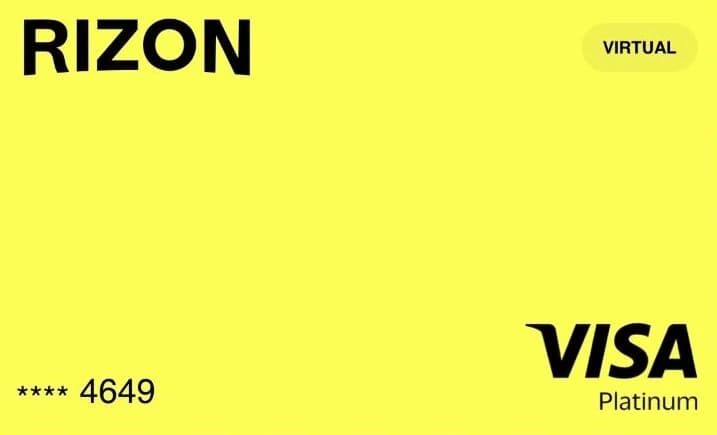
Rizon Standard Card Review 2026
Rizon Standard: the free plan. US-issued virtual Visa Platinum at $10 one-time ($1 with code spendnode), physical card $49.99, 1.7% + $0.10-0.30 international fee, ATM $1 + 0.65%, no cashback, 1 RizPoint per $10, funded from a non-custodial stablecoin wallet.

SpendNode Rating for Rizon Standard Card
The free plan pairs a $1 virtual card with code spendnode, self-custodial stablecoin funding, fee-free USD spending, and a US-issued Visa Platinum. It is a low-cost entry into the full Rizon account even without cashback.
Standard scores highest on cost and access: the virtual card is $1 with our code, there is no recurring fee, USD spending is free, and ATM pricing is published at $1 plus 0.65%. The same named issuer and user-controlled collateral structure support the trust score, while our completed KYC, funding, and activation flow supports the UX assessment. The full 1.7% international fee and lack of cashback remain the tier's practical limits.
Also relevant for Self-Custody Spending.
How It Competes
Cost Efficiency
4.5
Product Utility
4.2
Custody & Trust
4.4
Reliability & UX
4.3
Transparency
4.2

VIRTUAL CARD
Verified

PHYSICAL CARD
Verified

APPLE PAY
Verified
Rizon Standard Card Overview
A $1 US virtual Visa Platinum for passport holders the traditional card system skips.
The Standard plan is the access play: code spendnode reduces the $10 virtual card to $1 and now adds one month of Emerald, making it one of the cheapest ways to test a working US Visa card. USD spending at US merchants carries no listed transaction fee, which makes Standard a clean tool for dollar-denominated online spending funded from stablecoins you control after the promotional month.
Fees & Charges
Annual Fee
Free
FX Fee
1.7%
ATM Fee
0.65%
Requirements
Supported Regions
GLOBAL
Spendable Assets
USDC, USDT
On This Page
The Rizon Standard Card is the free plan on Rizon's US-issued Visa Platinum: a collateralized 0%-APR charge account from Third National, funded by stablecoins in the user's own non-custodial smart-contract wallet. The virtual card costs $10 one-time ($1 with code spendnode), the physical card $49.99, with no plan fee and passport-based eligibility across 49 nationalities.
What a Dollar Buys Here
With SpendNode's code spendnode, the $10 Rizon Standard virtual card costs $1. The same exclusive code now also unlocks one month of the Emerald Plan, giving the account Emerald's plan benefits during the promotional period. For that dollar, an eligible passport holder in Karachi, Cairo, Manila, or Bogota gets a working US-issued Visa Platinum number in minutes: Apple Pay, Google Pay, US merchant acceptance, and a card whose funding lives in a stablecoin wallet only they control.
Standard is the access tier: no plan fee, full transaction fees, and the same core card as every Rizon plan. If your spending is USD-denominated, that combination is close to free to run. The Gold and Emerald plans layer fee discounts and cashback on top when the volume justifies them.
We opened an account ourselves in July 2026: KYC cleared in about two minutes, the discount code applied at the purchase step, and the first stablecoin top-up was spendable immediately.
Card Specs: What You Are Actually Getting
Virtual and Physical Cards
- Virtual: issued in minutes after KYC, $10 one-time ($1 with code spendnode), multiple cards per account, freeze and delete in-app
- Physical: optional at $49.99 on this plan, plastic Visa Platinum with chip-and-PIN and contactless; ships to 49 countries, and in the US to 31 listed states. The same card drops to $24.99 on Gold and comes included free with the Emerald plan
- PIN viewable and manageable in-app; delivery tracked in-app
Payment Network and Account
- Network: Visa, Platinum tier
- Account type: collateralized 0%-APR charge account issued by Third National; your stablecoin balance secures spending, with no credit check and no interest mechanics
- Wallets: Apple Pay and Google Pay provisioning
- Acceptance: Rizon markets 100M+ merchants across 147+ countries; standard Visa acceptance rules apply
Security and Custody
- Funds sit in a smart-contract wallet you control (wallet infrastructure by Privy) on Polygon, Optimism, or Arbitrum
- Rizon holds no custody and cannot access collateral outside the contract's settlement mechanics
- App controls: card freeze, transaction visibility, PIN and card details in-app
Getting the Card
The flow runs download, KYC, purchase, fund. The app asks for a referral code at signup, which can be skipped; the discount code comes later. At the card purchase step, enter spendnode to claim one month of Emerald plus 90% off the card. On the $10 Standard virtual card, a 90% discount reduces the price to $1. Confirm both benefits and any post-promotion renewal terms on the order screen before paying.
The full five-step walkthrough with screenshots lives on the Rizon hub; the version that matters here is the timing. Our account went from install to funded in about two minutes, with the passport check clearing faster than most exchanges manage.
How Spending Works
Example: $120 subscription renewal at a US SaaS merchant, funded with USDC
Step 1: Deposit USDC to your Rizon wallet on Polygon (bank account, credit card, or stablecoin transfer; the deposit sheet shows all three).
Step 2: Pay with the virtual card number or Apple Pay. The charge posts against your collateralized account.
Step 3: Fees. A USD transaction at a US merchant carries no listed transaction fee: $120 costs $120. The same payment to a non-USD merchant carries the international fee of 1.7% + $0.10-0.30, about $2.14-2.34 on $120.
Step 4: Rewards. On Standard: 1 RizPoint per $10 spent (12 points here), redeemable toward flights, hotels, and gift cards.
The pattern to plan around: USD rails are the free lane, international spending pays the meter, and purchases small enough to dodge the percentage fee still meet the $0.50 small-transaction fee.
Fees and Rates
| Item | Amount |
|---|---|
| Plan fee | $0 |
| Virtual card | $10 one-time ($1 with code spendnode) |
| Physical card | $49.99 (free on Emerald, $24.99 on Gold) |
| USD spend, US merchants | No listed fee |
| International/non-USD | 1.7% + $0.10 (US terms) / 1.7% + $0.30 (non-US terms) |
| Small-transaction fee | $0.50 |
| Declined transaction | $0.10 |
| Trading (in-app investing) | 1.7% |
| ATM withdrawal | $1 + 0.65% |
| Bank account opening | $1.99 |
Annual cost at three spending profiles, all-international:
| Monthly spend | Fee drag (1.7% + $0.30/txn est.) | Annual cost |
|---|---|---|
| $300 (10 txns) | ~$8.10 | ~$97 |
| $800 (25 txns) | ~$21.10 | ~$253 |
| $2,000 (50 txns) | ~$49.00 | ~$588 |
The same profiles spending USD at US merchants: approximately $0. Route what you can through USD rails and Standard is nearly free to run. Once cross-border volume passes roughly $280/month, the Gold plan's 25% fee discount starts paying for itself.
The ATM line is a quiet strength. $1 + 0.65% per withdrawal is far below the 2-3% typical of prepaid competitors, and it is a published number rather than a surprise at the machine. Withdrawing $200 costs about $2.30 plus any ATM-operator surcharge.
Rewards and RizPoints
Standard earns RizPoints rather than cashback: 1 point per $10 of eligible spend, redeemable in-app toward flights, hotel bookings, and gift cards. Cashback belongs to the paid plans (1% on Gold, 2.5% on Emerald, each capped at the monthly plan fee), and both programs share the same MCC exclusion list: insurance, utilities, rent, education, tax, money transfers, gambling, and charities earn nothing.
RizPoints and cashback stack on paid plans, so the points keep accruing after an upgrade, at a faster rate (1 per $5 on Gold, 1 per $2 on Emerald).
Funding the Card
Three deposit routes, all shown on one sheet in the app:
- US bank account. The app generates virtual US account details in about a minute, which also makes Rizon a landing spot for platform payouts (Upwork, Deel, YouTube) that pay US accounts.
- Credit card. The convenience route for small top-ups.
- Stablecoin transfer. USDC or USDT from any wallet or exchange on Polygon, Optimism, or Arbitrum. This is the route that matches the card's collateral design, and the one we used: the balance was spendable immediately.
Limits and Restrictions
Rizon publishes no spending limits and states "we do not set any limits," with user-defined controls announced as coming. What does shape usage:
- Passport gating: registration requires one of the 49 supported nationalities regardless of where you live
- Physical delivery: 49 countries matching the eligibility map; in the US, 31 listed states
- Eligible-spend rules: the RizPoints program follows the same MCC list as the paid plans' cashback
Is the Rizon Standard Card Safe?
The trust question splits into custody and counterparty. Custody is the strong half: your stablecoins live in a smart-contract wallet you control on public chains, so a Rizon failure does not take your balance. That failure mode is shared with Plasma One and is structurally better than custodial cards such as RedotPay, where your balance is a claim on the company.
The counterparty half runs through named entities: Third National issues the card under Puerto Rico-governed terms with US-style consumer disclosures, Rizon Global, Inc. (Delaware) operates the app, and the USD/EUR account details come from integrated banking partners rather than Rizon itself. If the card program ended, the card would stop and the wallet would survive; if a banking partner wound down, the account details would follow that partner's process.
The full counterparty map, failure analysis, and our scam-signal check (verdict: real product, young company) live on the Rizon hub. The sensible posture here is the standard one: fund the wallet with what you plan to spend and keep savings elsewhere.
Real User Scenarios
Scenario 1: Amina (Karachi freelancer, $700/month)
Setup: Standard plan, virtual card at $1 with code spendnode, funded with Upwork USDC via Polygon. Results after 6 months: ~$4,200 spent, most of it USD-denominated (SaaS, ads, app stores) at no listed transaction fee. Total cost of ownership: $1. The comparison that matters to her: a Pakistani bank card declines many of these merchants and charges 3-5% FX on the rest; this card cost a dollar.
Scenario 2: Diego (Mexico City, $1,200/month, regional travel)
Setup: Started on Standard; ~$600/month of his spending is cross-border. Results after 3 months: ~$31 in international fees. The Gold plan would have cut that by a quarter and rebated its own fee in cashback, so he upgraded. The takeaway: Standard worked as the test drive; the fee math justified the upgrade.
Scenario 3: Rania (Egyptian national in Doha, $400/month)
Setup: Qatar residence, Egyptian passport - exactly the case the passport rule exists for. Standard plan, virtual card, funded by stablecoin transfers. Results after 6 months: a working US Visa for online spending her Qatari bank cards handle badly, at $1 of setup cost and no monthly fee. The takeaway: the eligibility follows her passport, so relocating changes nothing about the card.
Rizon Standard Card vs Other Cards
-
vs RedotPay Virtual: The direct rival for cheap card access. RedotPay costs $8 with code SPENDV and is custodial with wider residence-based coverage; Rizon costs $1 with code spendnode, is self-custodial, and its US issuance opens US-side utility RedotPay does not have. On running costs, Rizon's USD lane is free while RedotPay charges 1% conversion on everything.
-
vs KAST: KAST's free tier pays 1.5% USD cashback where Standard pays points, and KAST ships physical cards more widely. Rizon's edge is the $1 entry, the US-issued account with bank details, and first-class eligibility for passports KAST underserves.
-
vs Plasma One Lite: The self-custody twin. Lite pays 2% in XPL on the first $500/month; Standard pays points but adds USD/EUR account details and stock investing. Eligibility decides many cases: Rizon's LATAM-Africa-South Asia passport list reaches users Plasma One's availability map misses.
Who Should Use the Rizon Standard Card?
Standard fits anyone whose passport qualifies and whose spending is dollar-shaped: freelancers billing foreign clients, remote workers paid through US platforms, online spenders whose local cards decline international merchants, and anyone who wants a US Visa Platinum in their phone wallet for a dollar.
It is also the right first step for everyone considering the paid plans. Start free, watch a month of fees in the app, and let the numbers say whether Gold's discounts (from ~$280/month of international spend) or Emerald's full package (from ~$220/month, with both cards included) earn their fee. The $1 entry means the decision costs nothing to start.
Sources and Verification
- Rizon official site
- US Spend Card Terms
- Non-US Spend Card Terms
- Eligibility: supported nationalities
- Plans & RizPoints
Fees and mechanics confirmed against Rizon's help documentation and in-app screens, July 2026. Signup, KYC, funding, and the spendnode code verified by hands-on testing. User scenarios are composite illustrations based on the published fee schedule and plan terms.
Written by Aleksandar Dukic
FAQ
Is there a promo code for the Rizon Standard Card?
Yes. Enter spendnode at the card purchase step to unlock one month of Emerald plus 90% off the card. On the $10 Standard virtual card, the discount reduces the price to $1. Sign up through SpendNode's Rizon link, apply the code, and confirm both benefits before paying.
Is the spendnode promo code for Rizon still working in October 2026?
Yes. spendnode is still a working Rizon promo code as of October 15, 2026 - we re-verify it daily. It unlocks one month of Emerald plus 90% off the card; on the Standard virtual card, that means $1 instead of $10. Check the post-promotion renewal terms shown in-app before ordering.
What does spending cost on the free Rizon plan?
USD spending at US merchants carries no listed transaction fee. International or non-USD transactions cost 1.7% plus a fixed $0.10-0.30 depending on your terms set. ATM withdrawals cost $1 + 0.65%, a lower rate than most prepaid competitors publish. There is no plan fee and no annual fee; the only entry cost is the card itself ($1 with code spendnode).
Does the Rizon Standard Card earn cashback?
No. Cashback is a paid-plan feature (1% on Gold, 2.5% on Emerald, capped at the monthly plan fee). Standard earns 1 RizPoint per $10 of eligible spend instead, redeemable toward flights, hotels, and gift cards.
You retain custody of your funds until the moment of spending. Your balance is not exposed to provider insolvency risk.
Fees shown above are the card's disclosed fees. Additional costs may apply: Visa/Mastercard network spread (typically 0.5-0.9%), crypto-to-fiat conversion spread at point of sale, and blockchain gas fees for on-chain top-ups.
Found any issues?
User Reviews
Reviews are moderated and may take a moment to appear.