
Hyperbeat Pay Card Review 2026
Free self-custodial Visa on HyperEVM with Cash and Credit modes, 0.2-1% everyday cashback (3-12% trading-gated, paid in WHYPE), 0.4-1% FX, and a $15 welcome bonus via SpendNode.

SpendNode Rating for Hyperbeat Pay Card
Hyperbeat Pay is a free virtual Visa linked to an on-chain ManagementAccount. Cash mode spends a funded balance, Credit mode borrows through approved DeFi markets, and everyday cashback runs from 0.2% to 1% in WHYPE.
The card earns credit for a coherent Hyperliquid integration, limited operator permissions, published audits, and a useful choice between funded and borrowed spending. The young operating history, upgradeable account contracts, immediate Credit mode interest, token-denominated rewards, and a 1% everyday ceiling that requires five-figure balances and spend keep it below the most established self-custody cards.
Also relevant for Rewards / Cashback.
How It Competes
Cost Efficiency
3.8
Product Utility
4.4
Custody & Trust
4.2
Reliability & UX
3.4
Transparency
3.8

CASHBACK
Verified

SELF CUSTODY SPEND
Verified

STABLECOIN SPEND
Verified
Hyperbeat Pay Card Overview
Spend Without Selling: Free Visa With Cash and Credit Modes on Hyperliquid
The Hyperbeat Pay Card is a free self-custodial Visa for Hyperliquid users. Cash mode spends a funded balance, while Credit mode borrows through Morpho against supported collateral. Everyday cashback runs from 0.2% to 1%; the separate 3-12% trading ladder requires $1M-$50M of rolling volume and applies only to capped spend. Code SPENDNODE adds a $15 welcome bonus after KYC and 3 card transactions.
Fees & Charges
Annual Fee
Free
FX Fee
1%
ATM Fee
0.65%
Requirements
Supported Regions
US, EEA, LATAM, APAC, MEA
Spendable Assets
USDC, USDT, BTC, ETH, SOL, WHYPE
What Is the Hyperbeat Pay Card?
The Hyperbeat Pay Card is a free virtual Visa linked to a self-custodial ManagementAccount on Hyperliquid's HyperEVM. Cash mode spends a funded USD or stablecoin balance; Credit mode borrows through approved DeFi markets against supported crypto collateral. Everyday cashback starts at 0.2% and reaches 1%, while a separate 3% to 12% ladder requires $1 million to $50 million of rolling Hyperliquid trading volume.
Hyperbeat Pay is built for users who already keep capital on Hyperliquid. It turns the same on-chain account into a payment source without moving funds into a normal custodial card wallet.
The virtual card is free, carries no annual or monthly fee, and can be added to Apple Pay or Google Wallet. Hyperbeat's terms identify Third National as the issuer under a Visa license. A physical card is listed as coming soon.
SpendNode app screenshot
The live virtual card - Hyperbeat issues the digital card after identity verification. The app supports up to five virtual cards, including controlled Agent cards.
Hyperbeat Pay Card Promo Code SPENDNODE: $15 Reward
Apply through SpendNode's Hyperbeat Pay link with code SPENDNODE. New users can earn $15 after completing KYC and making three card transactions.
| Offer detail | Hyperbeat Pay offer |
|---|---|
| Promo code | SPENDNODE |
| Reward | $15 |
| Card price | Free virtual Visa |
| Qualification | Complete KYC and make 3 card transactions |
| Stated minimum purchase | None |
How to apply the Hyperbeat Pay code
- Follow SpendNode's Hyperbeat Pay signup link.
- Register with SPENDNODE attached to the account.
- Complete KYC and activate the virtual card.
- Make three card transactions.
- Receive the $15 reward after the qualifying activity is confirmed.
The launch offer does not state a minimum transaction value or deadline. The card transactions must be genuine purchases; do not assume extra conditions that are not shown in your account.
Getting the Hyperbeat Pay Card
Start through SpendNode's Hyperbeat Pay link, enter SPENDNODE through the referral-code toggle, and complete identity verification. Hyperbeat says a clean KYC usually takes about two minutes.

SpendNode app screenshot
Enter the code during signup - The referral toggle appears before account creation. The SpendNode link should carry SPENDNODE, but the field gives you a place to confirm it manually.
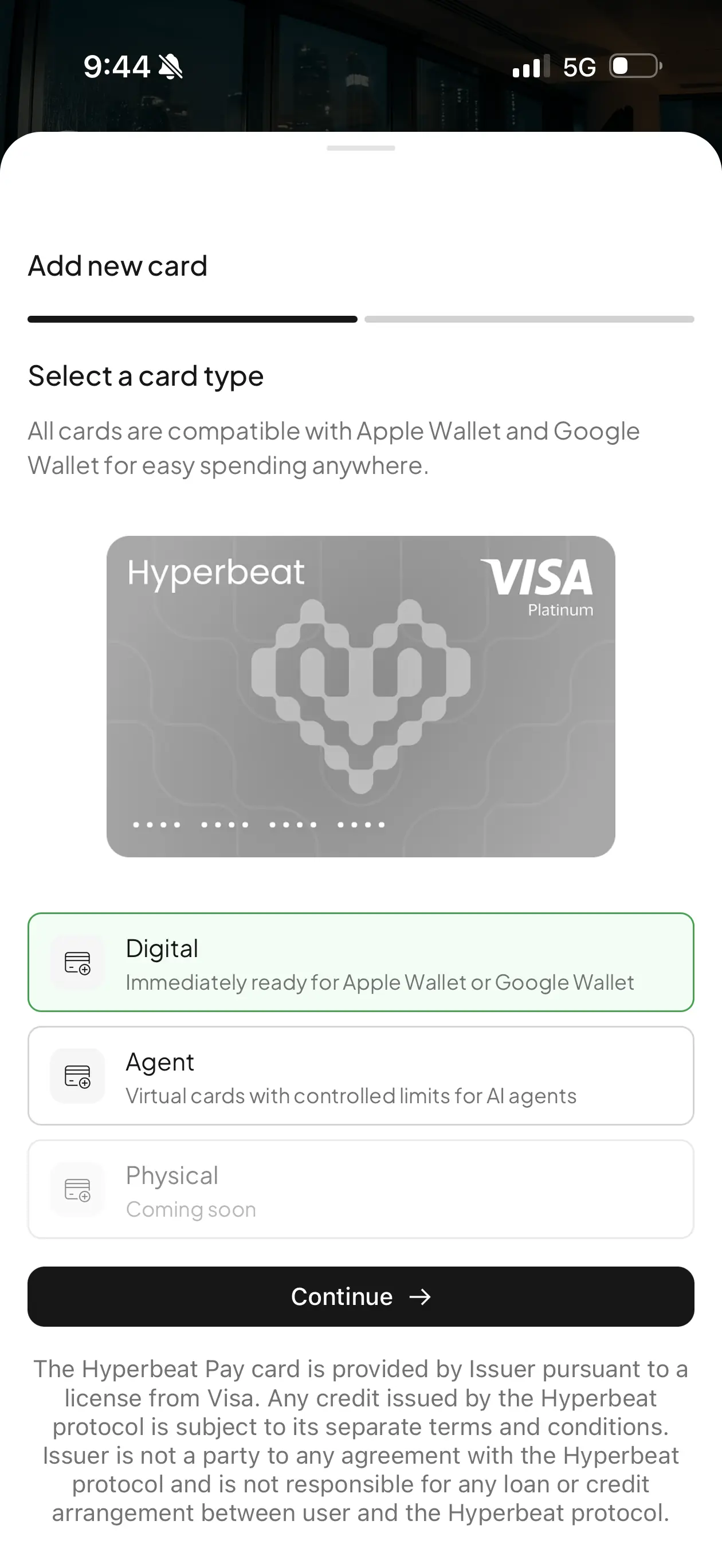
After approval, open Cards and tap Add new card. Choose Digital for normal spending or Agent for a controlled card tied to an automated workflow.
SpendNode app screenshot
Digital is the normal choice - It provisions to Apple Wallet or Google Wallet. Agent cards have controlled limits; the physical card is not live yet.
Fund a Cash mode balance or configure Credit mode, then add the virtual Visa to your mobile wallet. Hyperbeat allows up to five virtual cards, but one Digital card is enough for the standard flow.
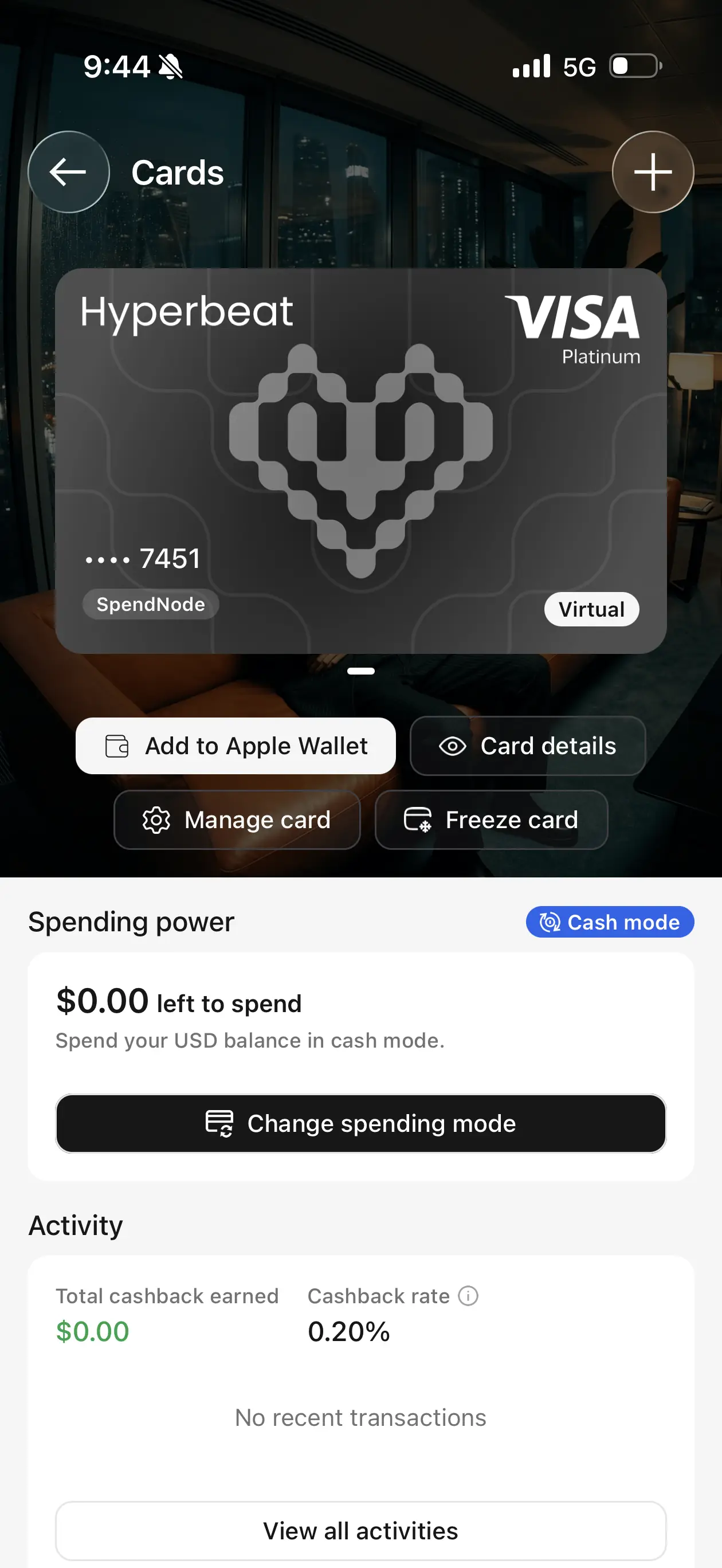
SpendNode app screenshot
The issued card - Apple Wallet, card details, freeze controls, spending mode, and rewards activity sit on the main Cards screen.
Card Specs: What You Are Actually Getting
Digital, Agent, and Physical Cards
Hyperbeat offers a standard Digital card and an Agent card. Both are virtual. Agent cards are intended for controlled automated spending and should be given narrow limits rather than access to a large settlement allowance.
Physical is marked coming soon. Hyperbeat does not publish a launch date, shipping price, or supported delivery markets, so the review treats the virtual Visa as the current product.
Payment Network and Issuer
Hyperbeat Pay runs on Visa. Hyperbeat's Terms of Use name Third National as issuer under a Visa license. The card screen itself uses the generic label "Issuer," so the legal terms are the stronger source for the named issuing relationship.
Limits and Settlement Allowance
The default card limit is $100,000 per month and is not currently user-configurable. Up to five virtual cards can be created. That card limit is separate from the on-chain allowance the user grants for settlement.
The operator can settle valid purchases only within the authorized allowance. It cannot use that permission to transfer assets to arbitrary addresses. The settlement token has a default one-day withdrawal cooldown to leave room for pending Visa transactions to clear.
How Spending Works
Cash Mode
Cash mode pays from USD or supported stablecoins already held for spending. There is no loan and no interest charge. For most cardholders, this is the clearer and lower-risk way to use Hyperbeat Pay.
Funds still sit in an on-chain ManagementAccount rather than an exchange ledger. Card settlement requires the limited operator permission, so "self-custodial" does not mean every payment is executed solely by the user's key.
Credit Mode
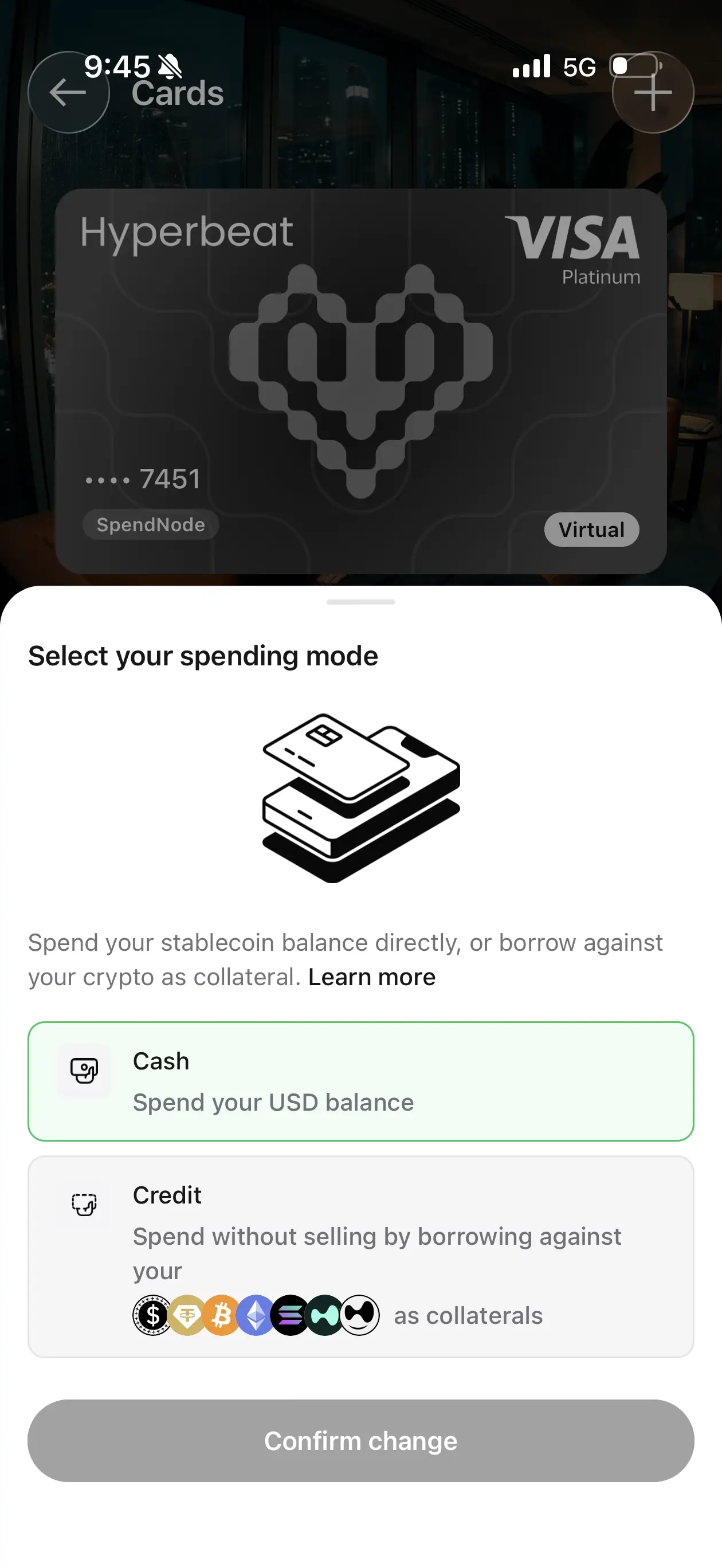
Credit mode borrows stablecoins against supported collateral through an approved DeFi market such as Morpho. Hyperbeat documents collateral options including BTC, ETH, SOL, HYPE, stablecoins, and XAUT, but the live app is the source of truth for current markets and parameters.
Borrowing begins when the card payment occurs. Interest starts immediately at the protocol's variable rate, with no grace period. Hyperbeat may also disclose an applicable markup before the transaction.
The economic question is not simply whether selling can be avoided. A user must compare the borrow rate, tax treatment, expected holding period, and liquidation risk. A prolonged fall in collateral value can make an ordinary purchase far more expensive than paying from cash.
Collateral withdrawals require operator approval so the account cannot remove backing while payments or debt remain unsettled. This protects the card program from bad debt but adds a gate to collateral access.
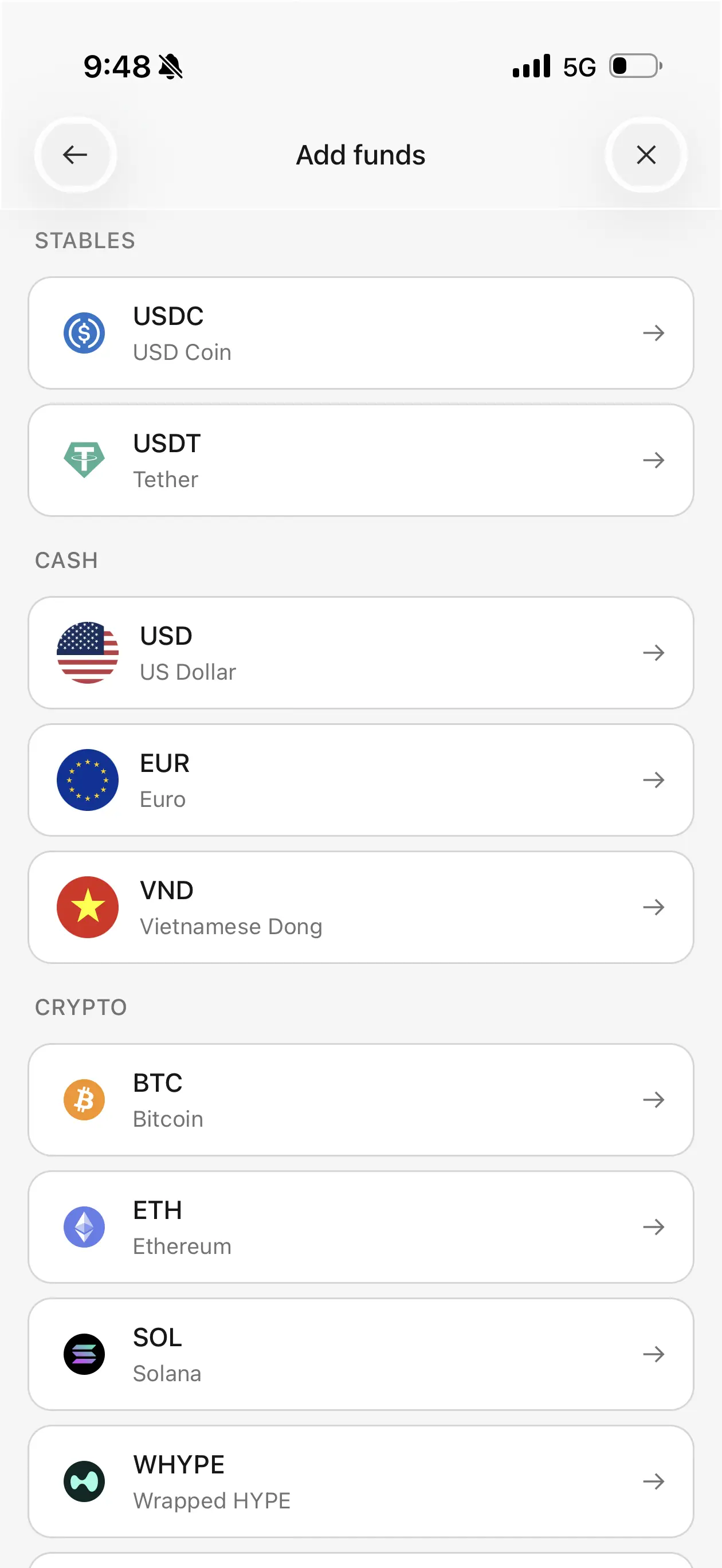
SpendNode app screenshot
Cash or collateralized credit - Credit mode is not a traditional credit-card balance. It is an on-chain loan with variable interest and liquidation mechanics.
Everyday Cashback
The normal card program pays a 0.2% base rate in WHYPE. Four boosters add 0.2 percentage points each:
| Requirement | Total rate after unlocking |
|---|---|
| No booster | 0.2% |
| Hold $1,000 in eligible deposits | 0.4% |
| Also hold $10,000 | 0.6% |
| Also spend $1,000 over rolling 30 days | 0.8% |
| Also spend $10,000 over rolling 30 days | 1.0% |
This table assumes each lower threshold is also met. Eligible deposits include beatUSD, USD+ in the vault, and USD+ supplied as Morpho collateral.
The app's live reward screen matters here. The everyday program begins at 0.2%; 1% is the ceiling after all balance and spending conditions are met.
SpendNode app screenshot
The live reward split - The app shows 0.20% on all eligible spend, with a separate higher rate on part of the user's spend after qualifying trading volume. The rates do not add together.
Hyperliquid Trader Cashback
Trading volume can unlock a higher rate on a limited amount of card spend:
| Rolling 30-day volume | Trader rate | Maximum spend at trader rate | Maximum reward at that rate |
|---|---|---|---|
| $1 million | 3% | $3,300 | $99 |
| $5 million | 5% | $10,000 | $500 |
| $10 million | 8% | $12,500 | $1,000 |
| $25 million | 10% | $25,000 | $2,500 |
| $50 million | 12% | $41,700 | $5,004 |
Spend above the tier cap falls back to the everyday rate. The two systems do not stack; each eligible dollar receives the higher available rate.
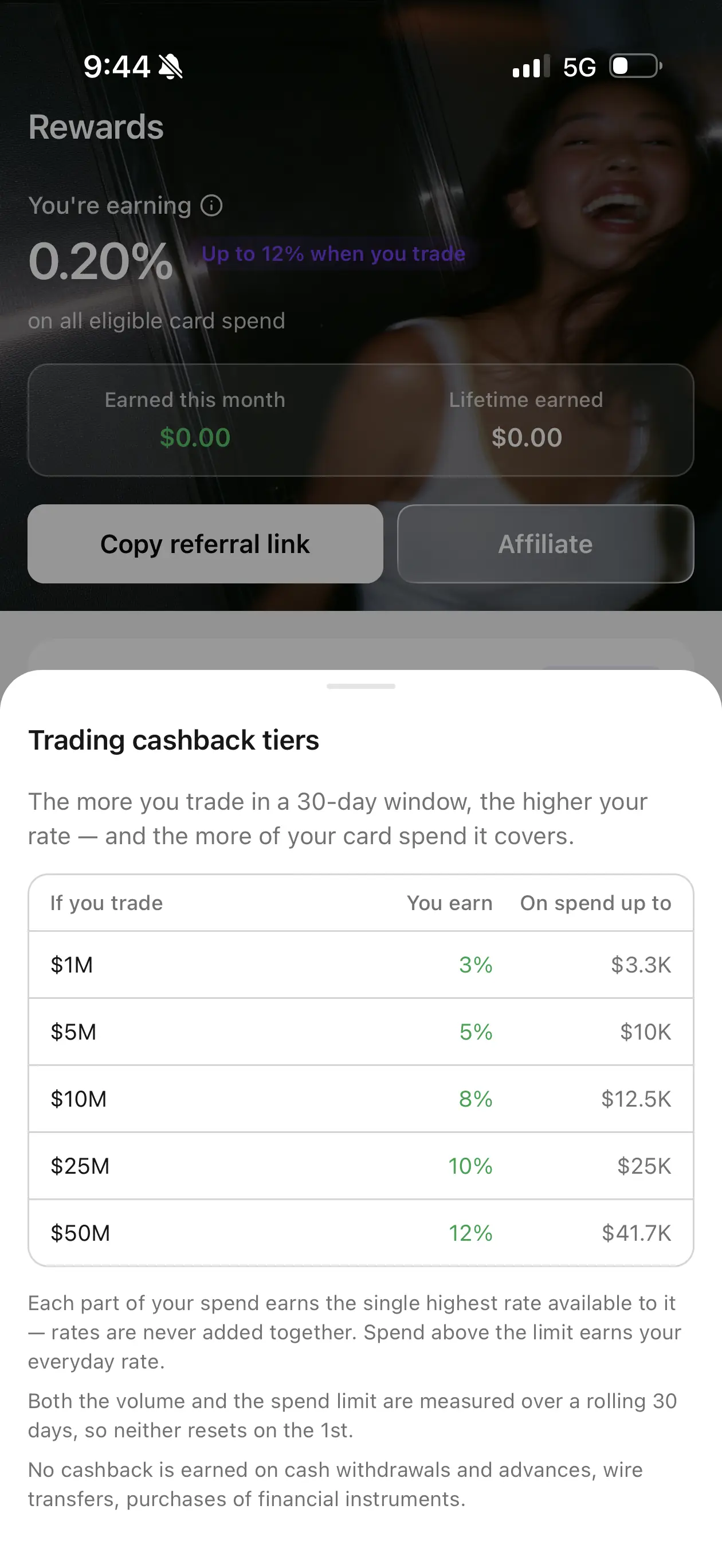
SpendNode app screenshot
The 12% tier in context - It requires $50 million of rolling trading volume. That belongs in specialist analysis, not the card's general reward headline.
Cashback arrives in WHYPE about 48 hours after the transaction posts. The reward is calculated in USD, but its value can move after conversion into the token. ATM withdrawals, wire transfers, and financial-instrument purchases do not earn cashback.
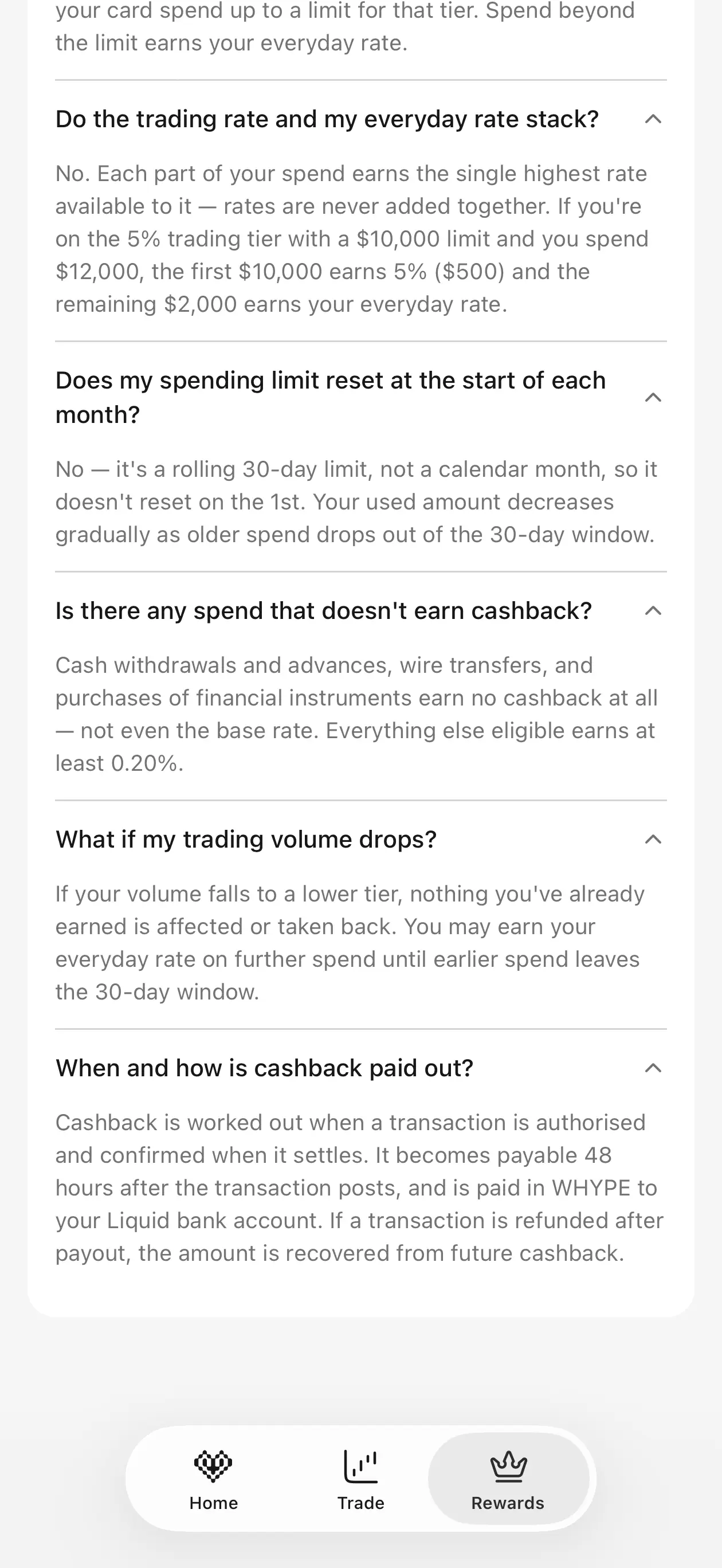
SpendNode app screenshot
Payout and exclusions in-app - The rewards FAQ confirms that limits roll over 30 days rather than resetting on the first, excluded transactions earn no base rate, and cashback becomes payable about 48 hours after posting.
Fees and ATM Costs
| Fee | Amount |
|---|---|
| Virtual card issuance | $0 |
| Annual fee | $0 |
| Monthly fee | $0 |
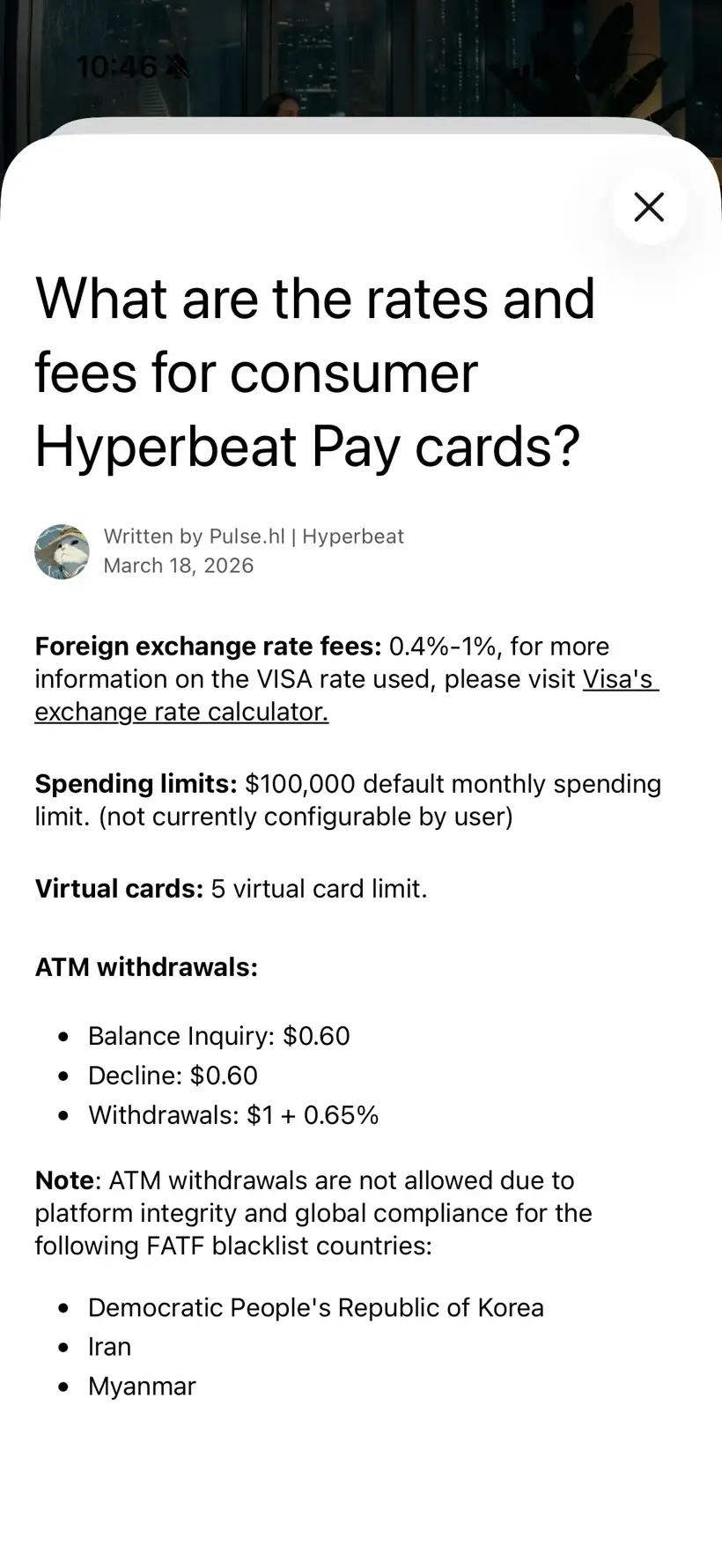
| Non-USD FX fee | 0.4%-1% |
| ATM withdrawal | $1 + 0.65% |
| ATM balance inquiry | $0.60 |
| Declined ATM transaction | $0.60 |
| Credit mode interest | Variable, begins immediately |
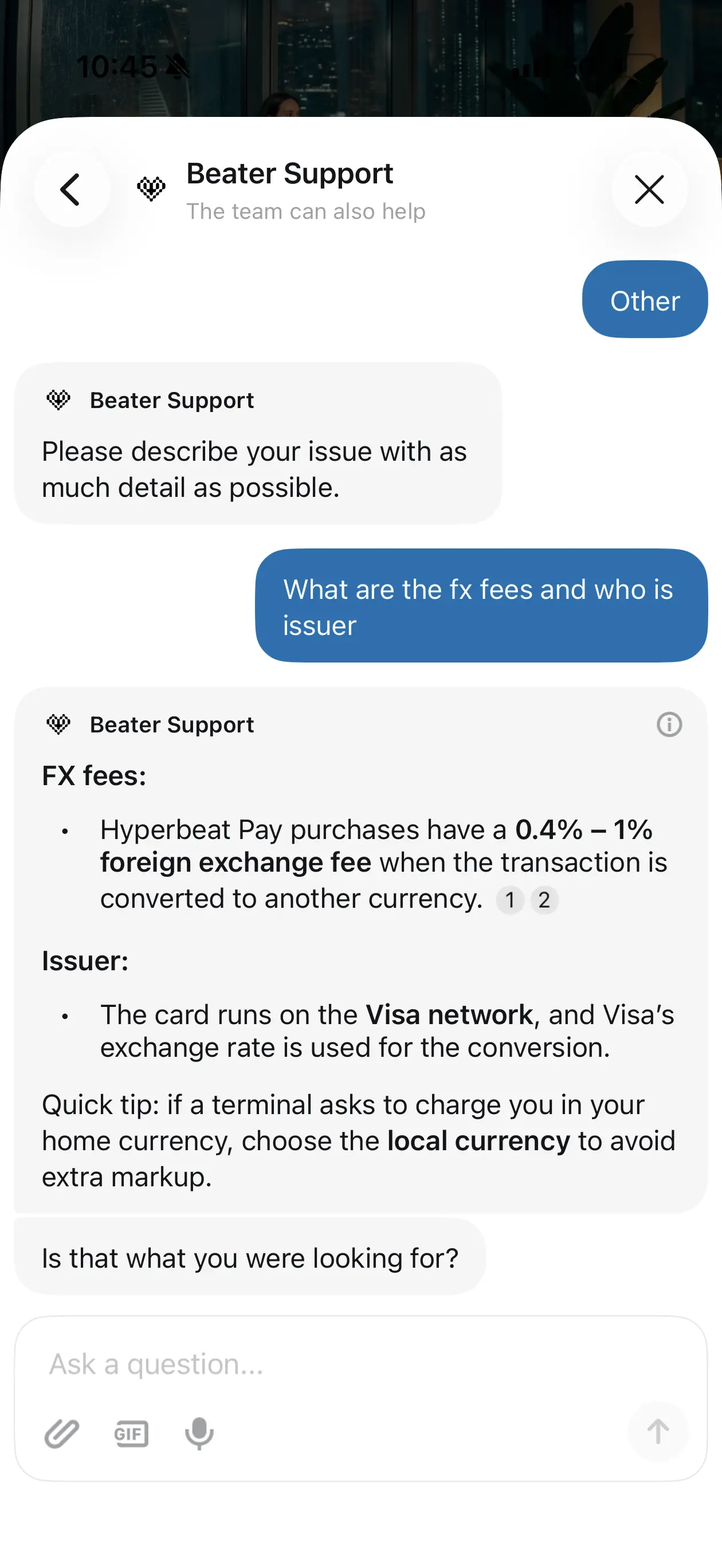
Hyperbeat says non-USD purchases convert at Visa's rate plus a 0.4%-1% FX fee. We have not measured the full card-to-mid-market difference, so the table uses the published fee rather than presenting it as an all-in observed cost.
An ATM operator can add its own surcharge. ATM access is also blocked in North Korea, Iran, and Myanmar. The card remains virtual while Hyperbeat advertises ATM support, so confirm the available withdrawal method in your app before relying on it for cash.
SpendNode app screenshot
Published card fees - The FX range is modest, but Credit mode borrowing can become the larger ongoing cost.
SpendNode app screenshot
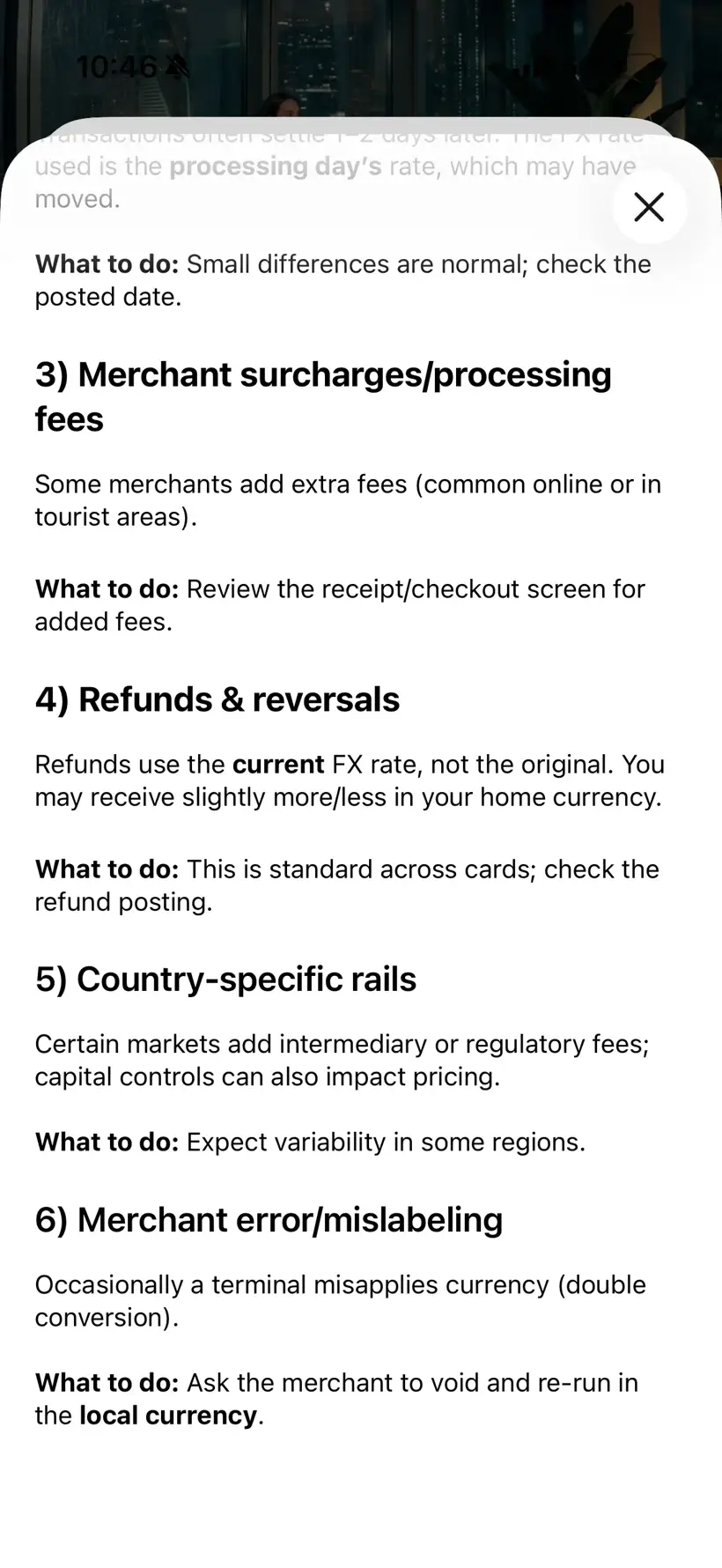
FX can exceed the stated range - Hyperbeat says dynamic currency conversion, delayed settlement, merchant charges, refunds, and some local rails can change the final result. Choose the local currency when a terminal offers a conversion.
Worked Examples
Maya: funded spending, no boosters
Maya holds $500 and spends $800 a month in Cash mode. At the 0.2% base rate, she earns about $1.60 in WHYPE. If all purchases are non-USD and the FX fee lands at 0.4%-1%, the disclosed fee is roughly $3.20-$8 before any difference in Visa's conversion rate.
Cashback does not offset the published FX fee in this case. The card's value is account integration and self-custody, not net rewards.
Daniel: all everyday boosters
Daniel holds at least $10,000 in eligible deposits and spends $10,000 over 30 days. He reaches the 1% everyday ceiling and earns $100 in WHYPE on eligible purchases.
The return should be judged against the opportunity cost and risk of the qualifying deposit. If those funds would already sit in Hyperbeat, the booster is useful. Moving $10,000 solely to gain an extra fraction of a percent is much harder to justify.
Priya: $5 million trader tier
Priya generates $5 million of qualifying rolling Hyperliquid volume. The 5% trader rate applies to the first $10,000 of eligible card spend, producing up to $500 in WHYPE. Further spend falls back to her everyday rate.
The reward can be attractive for activity she already planned. Creating millions in extra trading volume for the card benefit would be irrational once trading fees, spread, funding, and market risk are included.
Availability and KYC
Hyperbeat requires identity and liveness checks before card issuance and says verification usually takes about two minutes. The live country list covers named markets across Latin America, the Caribbean, Africa, Asia-Pacific, the UAE, and supported US states.
Its documentation also lists "Europe" as a region without naming the countries. We do not convert that label into blanket EEA availability. Confirm eligibility in the app before moving funds.
US documentation contains a Wisconsin conflict: the state appears in both supported and prohibited lists. Users in any uncertain state should rely on the actual onboarding result rather than a copied list.
Is the Hyperbeat Pay Card Safe?
The ManagementAccount owner key is protected through Turnkey passkeys. Hyperbeat says session keys are short-lived and policy-limited, while the operator can perform only authorized settlement or borrowing actions.
The account contracts have published Zellic and Nethermind audits. The design still has several trust surfaces:
- The ManagementAccount is an upgradeable proxy.
- Administered registries decide which DeFi services can connect.
- Credit mode relies on external lending markets and oracle behavior.
- The card depends on Third National, Visa, and the settlement operation.
- WHYPE rewards introduce token-price risk.
Self-custody limits the damage of a card-program failure because assets are not simply an unsecured balance owed by Hyperbeat. It does not make the entire stack permissionless or risk-free.
Is the Hyperbeat Pay Card a Scam?
The evidence supports a working card program rather than a fake listing. We completed KYC and card issuance in the mobile app, Hyperbeat identifies Zoeion Ltd Corporation in its terms, Third National is named as card issuer, and the ManagementAccount audits are public.
The concerns are operational and technical. Hyperbeat Pay is new, the account contracts are upgradeable, Credit mode can liquidate collateral, and the card relies on several counterparties. A legitimate product can still fail or change terms.
How the Hyperbeat Pay Card Compares
-
ether.fi Core pays 3% in ETHFI on its first monthly band, with a seven-day reward lock. Hyperbeat fits active Hyperliquid traders better and offers controlled Agent cards.
-
Solid Card starts at 3% USDC with a $50 monthly cap and centers on stablecoin vault yield. Hyperbeat starts at 0.2% WHYPE and adds a more fully documented collateralized Credit mode.
-
Plasma One Lite pays 2% XPL on the first $500 each month, then 0.1%. Hyperbeat uses balance and spend boosters for its everyday rate and trading volume for the specialist ladder.
Who Is the Hyperbeat Pay Card For?
Choose Hyperbeat Pay if you already use Hyperliquid, value on-chain custody, and want a card attached to the same account. Cash mode offers the cleanest setup. Credit mode is suitable only when the tax and liquidity benefit exceeds the borrow cost and liquidation risk.
Do not choose it for a 12% cashback headline. Most users earn 0.2%-1%, paid in WHYPE. The upper ladder is credible only for traders who already produce the required volume.
The card is also a weak fit for anyone who wants a physical backup, predictable fiat cashback, or a simple bank-like chargeback and deposit-protection model.
Verdict
Hyperbeat Pay is a strong piece of Hyperliquid infrastructure and a more complicated card than the free price suggests. Its best features are the self-custodial account, Cash and Credit modes, high monthly spending limit, and direct fit with an existing Hyperliquid workflow.
The reward story is secondary for normal users. Treat 0.2%-1% as the real everyday range, account for the 0.4%-1% published FX fee, and use Credit mode only after checking the live borrow rate and health factor.
Use code SPENDNODE through SpendNode's Hyperbeat Pay link for the $15 new-user reward after KYC and three card transactions.
Sources and Verification
- Hyperbeat official website
- Hyperbeat documentation
- Hyperbeat Help Center
- Hyperbeat Terms of Use
- Hyperbeat Apple Cashback Campaign Terms
- Hyperbeat iOS app tested by SpendNode from Malaysia in August 2026
Written by Aleksandar Dukic
FAQ
Does the Hyperbeat Pay Card have a promo code or discount?
Yes. Join through SpendNode's Hyperbeat Pay link and code SPENDNODE applies automatically. Eligible new users receive $15 after completing KYC and making three card transactions. No minimum transaction amount or deadline is stated in the launch offer.
Is the SPENDNODE code for Hyperbeat working in October 2026?
Yes. SPENDNODE is Hyperbeat's active SpendNode referral code as of October 3, 2026. It is carried by SpendNode's signup link, and eligible new users receive $15 after KYC and three card transactions.
What does the Hyperbeat Pay Card cost?
Nothing to get: virtual card issuance is free and there is no annual or monthly fee. Ongoing costs are a 0.4-1% FX fee on non-USD purchases, $1 + 0.65% on ATM withdrawals, and, if you use Credit mode, variable Morpho interest that starts accruing the moment you pay.
Can I get a physical Hyperbeat card?
Not yet. The app lists the physical card as coming soon; Digital (instant, Apple Wallet and Google Wallet) and Agent card types are live. Virtual card details work for online purchases immediately after KYC.
Which assets can I use as collateral in Credit mode?
Hyperbeat's Credit mode runs on segregated Morpho markets with collateral including BTC, ETH, SOL, HYPE (as Hyperliquid Unit assets), stablecoins, and gold-token XAUT per its documentation. The exact list is shown in-app and can change; loan-to-value and liquidation thresholds are set at the protocol level and displayed before you borrow.
You retain custody of your funds until the moment of spending. Your balance is not exposed to provider insolvency risk.
Fees shown above are the card's disclosed fees. Additional costs may apply: Visa/Mastercard network spread (typically 0.5-0.9%), crypto-to-fiat conversion spread at point of sale, and blockchain gas fees for on-chain top-ups.
Found any issues?
User Reviews
Reviews are moderated and may take a moment to appear.