

Ethena Pay Spend Card Review 2026
Secured virtual Visa with 4-5% first-band cashback in AVAX, 0% APR, no account fees, no Ethena Pay FX markup, and an annualized Daily Boost of up to 6% after monthly card use.

SpendNode Rating for Ethena Pay Spend Card
The Ethena Pay Spend Card is a secured virtual Visa backed by a self-custodial wallet: 0% APR, 4-5% first-band cashback paid in AVAX, no account fee or Ethena Pay FX markup, and a Daily Boost that lifts eligible balances to a 5-6% annualized total rate after monthly card use.
Published fee terms and the 4% free Standard band support the cost score. The counterweights are an early beta with waitlisted access, AVAX-denominated rewards, upper-tier access terms that are not fully public, a virtual-only card with no Google Pay yet, and exposure to a synthetic dollar rather than a fiat-reserve stablecoin.
Also relevant for Self-Custody Spending.
Cost Efficiency
4.5
Product Utility
3.2
Custody & Trust
3.9
Reliability & UX
2.9
Transparency
4.6

CASHBACK
Verified

YIELD LINKED
Verified

SELF CUSTODY SPEND
Verified
Ethena Pay Spend Card Overview
Spend Against Your Own Wallet: Banded Cashback That Never Re-Prices What You Already Earned
The Ethena Pay Spend Card is a secured virtual Visa backed by collateral in your own wallet at 0% APR. First-band cashback runs from 4% on Standard to 5% on VIP, paid in AVAX, with bracket-style bands that do not reprice earlier spending. One qualifying card transaction each month also unlocks the Daily Boost on eligible balances. Availability and supporting account features vary by country.
Fees & Charges
Annual Fee
Free
FX Fee
1%
ATM Fee
0.65%
Requirements
Supported Regions
APAC, LATAM, MEA
Spendable Assets
USDE, AVAX
The Ethena Pay Spend Card is a secured virtual Visa issued by Third National under a program managed by Rain. It is offered through the Ethena Pay app to eligible non-US persons in 48 countries, charges 0% APR, uses collateral in the user's self-custodial wallet, and pays tier-banded cashback of 4% to 5% in AVAX.
A Secured Visa Backed by Your Wallet
The Ethena Pay Spend Card does not require moving the spending balance into an exchange account. Assets remain in a linked self-custodial wallet and secure the card's charges. From the checkout side it behaves like a virtual Visa; legally and operationally it is a secured credit product with statements, payment obligations, and a liquidation mechanism.
Standard is the free entry tier. It earns 4% on the first $2,500 of monthly spending, then 1% until $4,000. Pro and VIP increase the first-band rate and spending allowance, but Ethena Pay does not publish their complete access terms outside enrollment.
SpendNode app screenshot
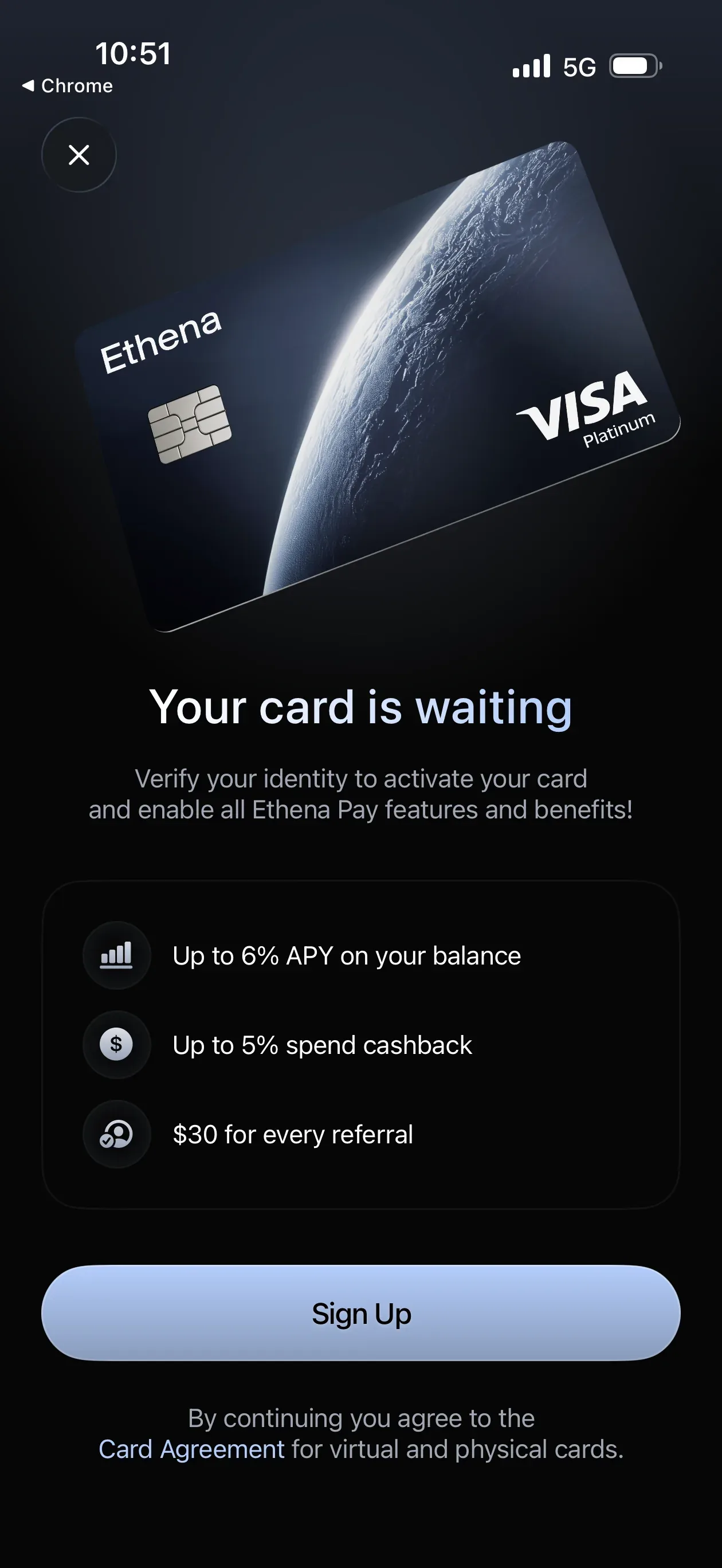
Two reward tracks - Eligible card purchases earn AVAX cashback. A separate Daily Boost can top up eligible balances after at least one qualifying card transaction each month.
Card Specs
Virtual Card and Mobile Wallets
Virtual-card issuance, activation, and replacement are free. No physical card is documented. Apple Pay is available, while Google Pay is still listed as coming soon. That makes Android in-person use a meaningful limitation until support arrives.
SpendNode app screenshot
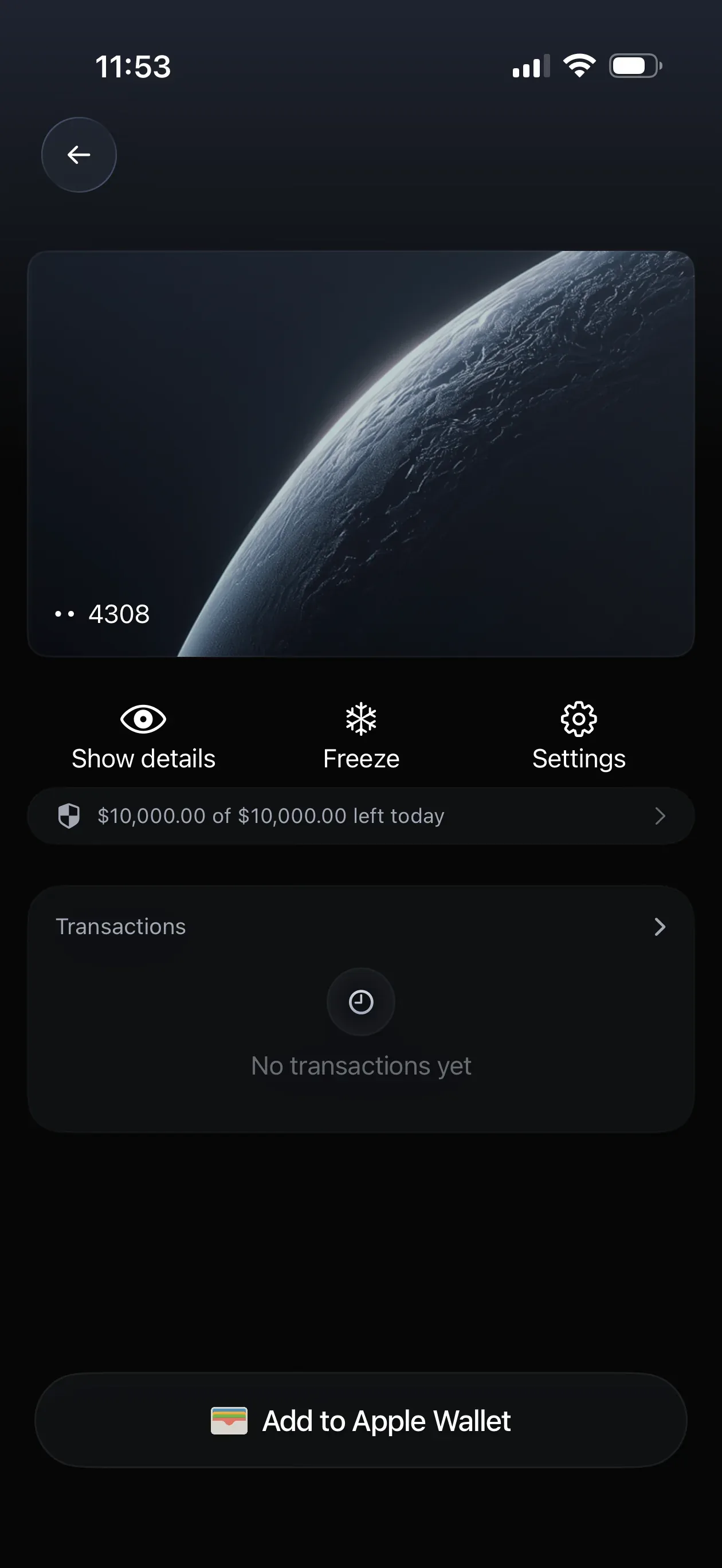
Card management - The live dashboard includes card details, freeze and settings controls, transaction history, an account-specific daily limit, and an Apple Wallet button.
Network and Providers
Third National, a Puerto Rico-chartered bank, issues the Visa. Signify Holdings, operating as Rain, manages the card program. Avalanche is the settlement network used behind the payments experience.
Security and Custody
The wallet uses device-held keys, passkeys, and biometric authentication. Ethena Pay says it cannot access or recover the keys. This is a self-custodial model, with the familiar trade-off that the user carries more responsibility for account recovery.
The collateral is subject to a security interest for card obligations. Card terms permit third-party liquidation if charges remain unpaid after the specified period or collateral value falls below the amount owed. Self-custody therefore does not mean the collateral is outside the secured-card agreement.
SpendNode app screenshot
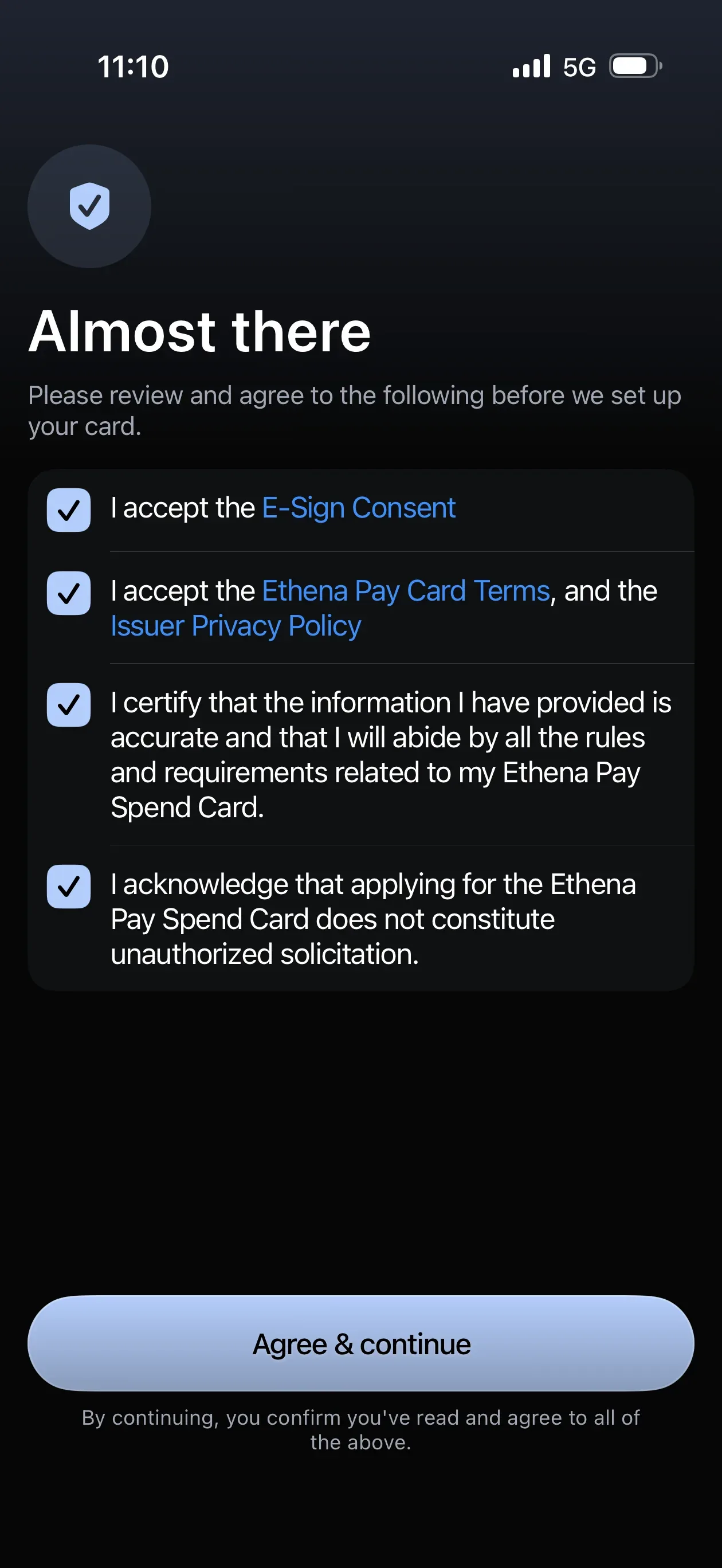
Terms before issuance - The app requires explicit acceptance of the e-sign consent, card terms, issuer privacy policy, accuracy declaration, and non-solicitation acknowledgement before setting up the card.
How a Purchase Works
Consider a $120 equivalent grocery purchase in Mexico paid through Apple Pay:
- USDe or other eligible collateral remains in the linked wallet.
- Visa authorizes the purchase against that collateral at 0% APR.
- A non-USD purchase uses Visa's exchange rate and may carry its conversion charge, described as typically around 1%. Ethena Pay adds no markup.
- Once the transaction settles, usually in one to three business days, Standard cashback inside the first band is $4.80.
- Cashback is credited in AVAX using the exchange rate at credit time. The purchase also satisfies that month's card-use requirement for the Daily Boost.
Cashback Bands
| Tier | Access | First band | Additional monthly spend |
|---|---|---|---|
| Standard | Free | 4% to $2,500 | 1% to $4,000; 0% above |
| Pro | Terms shown at enrollment | 4.5% to $8,000 | 2% to $10,000; 1% to $12,000; 0.5% above |
| VIP | Terms shown at enrollment | 5% to $20,000 | 2% to $30,000; 1% to $40,000; 0.5% above |
The bands are progressive. A Pro user spending $9,000 earns 4.5% on the first $8,000 and 2% on the final $1,000, for $380 total. Refunds reverse the associated reward and restore the portion of the monthly band consumed by the purchase.
Cashback does not apply to transactions under $1, ATM or cash activity, account funding, financial assets, gift cards, gambling, peer-to-peer transfers, loan payments, taxes, or fees. Rewards arrive in AVAX, so their dollar value can change after credit.
Ethena Pay does not publish complete Pro and VIP access terms. Users should rely on the premium-tier requirements and any recurring fees displayed during enrollment before committing assets.
Daily Boost
One qualifying card transaction per calendar month can activate the balance Boost:
| Tier | Annualized total rate | Eligible balance cap |
|---|---|---|
| Standard | 5% | $5,000 |
| Pro | 6% | $100,000 |
| VIP | 6% | $1,000,000 |
This is the total annualized rate, including the market-driven USDe base rate. The Boost portion adjusts with that base rate, accrues daily, and is paid in USDe. It is a discretionary promotional incentive, not guaranteed interest or an insured bank yield.
Fees and Limits
| Item | Current term |
|---|---|
| Annual, account, and issuance fees | $0 |
| Purchase APR | 0% |
| Ethena Pay FX markup | 0% |
| Visa conversion on non-USD purchases | Typically about 1%; varies |
| ATM where supported | $1 + 0.65%, plus possible operator fee |
| Late payment | Up to $40 |
| Returned payment | Up to $29 |
Ethena Pay has not published one universal card-spending limit. Its terms allow limits to vary with verification status, transaction history, risk profile, location, and provider. SpendNode's verified account displayed a $10,000 daily limit in the app, but that should not be treated as a limit every user receives. Available credit also depends on the eligible collateral supporting the account. ATM access varies by card, device, and country, and cash withdrawals do not earn cashback.
The 0% APR does not remove repayment duties. Users receive statements and must satisfy card obligations. If an amount remains unpaid or collateral becomes insufficient, the agreement permits liquidation and recovery of charges, fees, gas, and shortfalls from the pledged assets.
How to Apply
- Open Ethena Pay and install the app.
- Sign up with Apple, Google, or email, then secure the wallet with a passkey.
- Complete identity verification through the in-app Sumsub process.
- Review and accept the e-sign consent, card terms, issuer privacy policy, and account declarations.
- Review the tier, collateral, repayment, and reward terms presented in the app.
- Issue the virtual card and add it to Apple Pay where supported.
SpendNode app screenshot
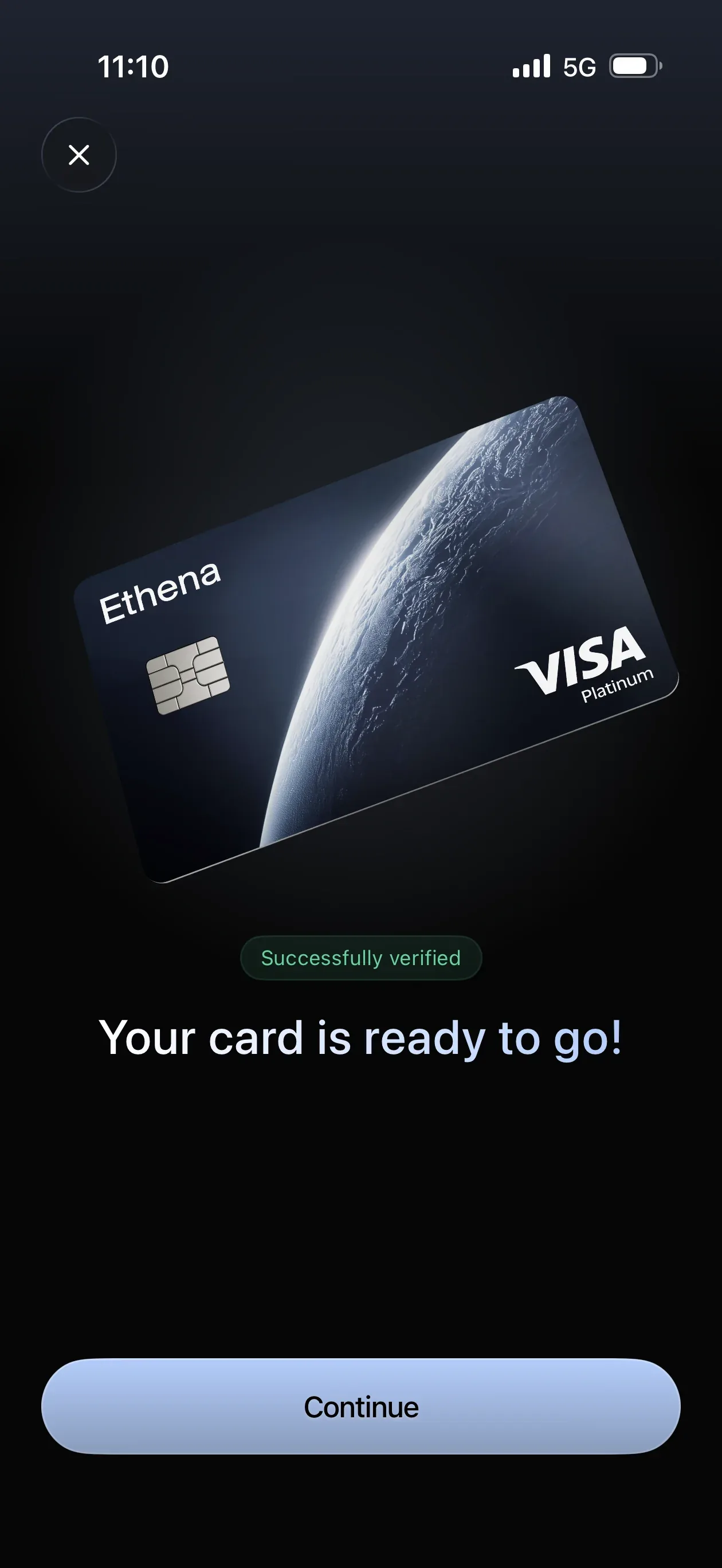
Verification complete - After identity verification and acceptance of the card terms, the app confirms that the card is ready before opening the card dashboard.
Applicants must be at least 18. The card is not available to US persons and is not currently offered in the US, EU, UK, or Canada. The live country list covers 48 markets across Latin America, the Caribbean, Asia, Africa, the Middle East, Australia, and New Zealand.
Projected Use Cases
These are calculations from current published terms, not customer results.
$2,000 monthly spend on Standard. All spending remains inside the 4% band, producing $80 per month or $960 per year in AVAX before token-price changes. A $4,000 average eligible balance at a 5% annualized total rate would produce about $200 over a year if the Boost remained available and the monthly-use condition was met.
$11,000 monthly spend on Pro. An eligible Pro user would earn $360 on the first $8,000, $40 on the next $2,000, and $10 on the final $1,000, or $410 for the month. Whether Pro is worthwhile depends on the actual enrollment terms and the user's comfort with any subscription, referral, or asset requirement shown in-app.
$450 monthly spend on Standard. The card would earn $18 per month in AVAX while remaining well inside the first band. This case does not need an upper tier; its main practical constraints are beta access, mobile-wallet support, and USDe exposure.
Alternatives
Hyperbeat Pay uses a similar secured-card structure and offers broader trading and borrowing features. Ethena Pay has a stronger free first-band cashback rate.
Solid Card is another self-custodial stablecoin card, built around USDC and available in the EEA. Its 3% base rate is lower, but its reserve asset and geographic fit differ materially.
RedotPay offers physical cards, wider ATM utility, and a longer track record in several overlapping countries. Its everyday reward economics are weaker, while its established payment access is stronger.
Verdict
For an eligible user, Standard is the clearest proposition: no fixed fee, 4% AVAX cashback on the first $2,500 per month, and self-custodial collateral. The card is less suitable as a primary account while Google Pay and physical cards are absent, country-level features vary, and upper-tier terms are not fully public.
The secured structure also deserves more attention than the 0% APR headline. Users are not handing custody of the wallet to Ethena Pay, but they are pledging assets against card obligations and accepting liquidation terms. Add USDe and AVAX price risk, and this is a high-reward product for informed stablecoin users rather than a simple replacement for a bank debit card.
Sources and Verification
Written by Aleksandar Dukic
FAQ
How does Ethena Pay Spend Card cashback work?
Your rate depends on tier and how much you have spent that month, applied like tax brackets. Standard earns 4% on the first $2,500 of monthly spend, then 1% to $4,000, then nothing; Pro starts at 4.5% on the first $8,000; VIP starts at 5% on the first $20,000. Crossing a band only changes the rate on further spending, never on what you already earned. Rewards are credited in AVAX a few days after each transaction settles, and refunded purchases give you both the cashback reversal and your band position back.
Is the Ethena Pay card really 0% FX?
Ethena Pay itself adds nothing: no FX fee, no cross-border fee, no conversion markup. What remains is Visa's own conversion fee on non-USD purchases, which is passed through at cost and typically runs around 1% depending on the currency. Purchases in US dollars carry no conversion cost at all. The company publishes this distinction openly rather than advertising a flat zero.
What happens if my collateral falls short?
The Spend Card is a secured product: charges are backed by assets in your own linked wallet. If a Liquidation Event occurs, outstanding charges, any late or returned-payment fees, gas costs, and any dollar shortfall can be deducted from that collateral, with valuations taken from stablecoin redemption values, exchange prices, or oracles. Liquidations are processed by a third party; Ethena Pay never takes custody of the collateral.
Do I need the card to earn the 6% on my balance?
Yes, at least minimally. The Daily Boost that lifts eligible balances to 5% at Standard or 6% at Pro and VIP requires one qualifying card transaction per calendar month. Without it, the balance earns only the market-driven USDe base rate. The Boost applies up to $5,000, $100,000, or $1,000,000 by tier, pays daily in USDe, and is discretionary rather than guaranteed interest.
Can I get an Ethena Pay card in the US or EU?
Not currently. Ethena Pay is live in 48 countries across Latin America, the Caribbean, Asia, the Middle East, Africa, and Oceania. The US, EU, UK, and Canada are listed as coming later, while the Spend Card is not offered to US persons regardless of rollout. Registration requires being at least 18.
You retain custody of your funds until the moment of spending. Your balance is not exposed to provider insolvency risk.
Fees shown above are the card's disclosed fees. Additional costs may apply: Visa/Mastercard network spread (typically 0.5-0.9%), crypto-to-fiat conversion spread at point of sale, and blockchain gas fees for on-chain top-ups.
Found any issues?
User Reviews
Reviews are moderated and may take a moment to appear.