
Key findings
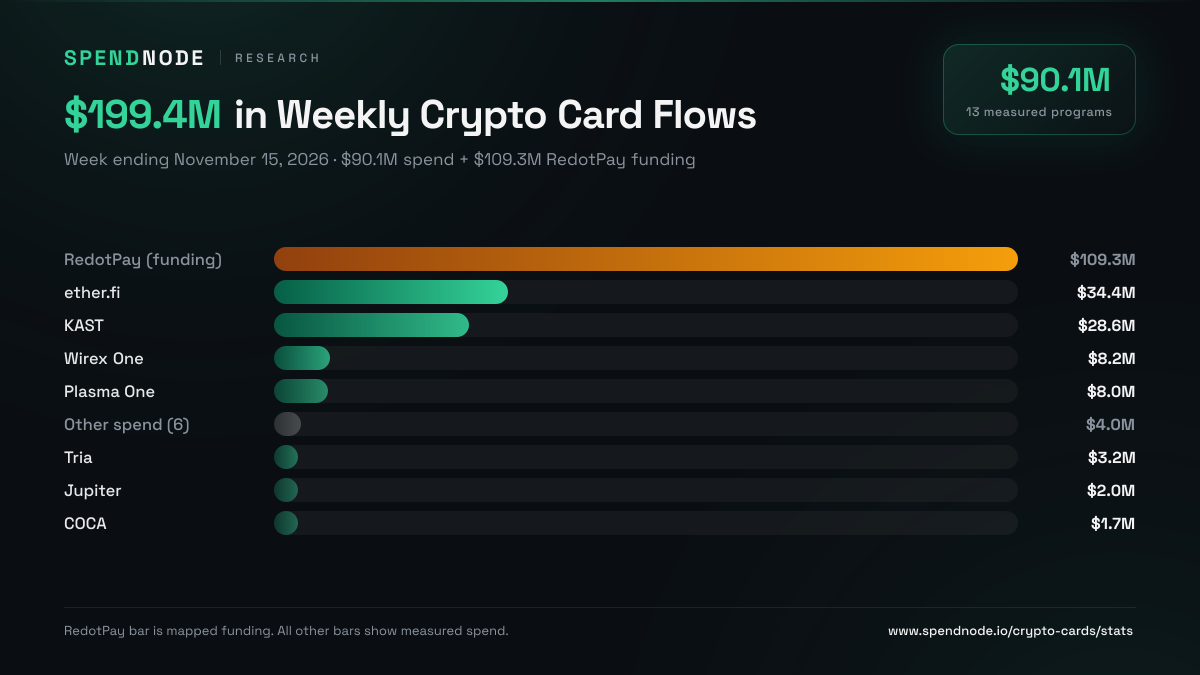
- SpendNode observed $199.43 million across two onchain crypto-card ledgers in the seven days through November 15: $90.13 million in measured card spending and $109.31 million in RedotPay account funding.
- The measured-spend ranking expands from 11 to 13 programs this week with COCA and Solid. On the same 11-program basis used a week ago, spending rose 2.0% to $88.25 million.
- KAST increased 11.0% to $28.62 million and Plasma One rose 14.2% to $7.97 million. Ether.fi remained the largest measured program at $34.44 million, down 0.5%.
- COCA enters the ranking at $1.70 million in observed program-issuer settlements. Solid starts at $168,970 across its two mapped settlement lanes.
- RedotPay mapped funding declined 10.2% to $109.31 million. It remains a top-up proxy, not card purchase volume.
- Plasma One replaced Lite and Core with Standard and Premium. Bybit introduced a card welcome offer, Cashi and Avici ran London cashback promotions, and MEXC Global Card entered temporary maintenance.
Two onchain ledgers reached $199.43 million
SpendNode recorded $90,125,807 of measured card spending across 13 mapped programs and $109,306,293 of recognized-asset funding sent to RedotPay's mapped collectors between November 9 at 00:00 UTC and November 16 at 00:00 UTC.
Those figures measure different stages. The spending ledger follows purchase-level wallet debits, program settlement events or issuer settlement batches, depending on the program. RedotPay's separate ledger follows money entering mapped accounts before it may be spent.
The combined number is observed onchain card flow. It is not payment volume for the whole crypto-card market. RedotPay stays outside the measured-spend ranking and every spending growth calculation.
SpendNode observed $199.43 million across two onchain crypto-card ledgers: $90.13 million in measured spend and $109.31 million in RedotPay funding.
RedotPay recorded $109.31 million in mapped funding
RedotPay received 159,298 mapped top-ups worth $109.31 million during the closed week, down 10.2% from $121.67 million.
Tron remained the largest route at $55.20 million. BNB Chain supplied $28.67 million and Ethereum added $16.94 million. Together, those three chains carried 92.2% of mapped funding.
| RedotPay funding chain | Weekly funding | Mapped top-ups |
|---|---|---|
| Tron | $55.20M | 41,808 |
| BNB Chain | $28.67M | 89,180 |
| Ethereum | $16.94M | 16,583 |
| Solana | $4.25M | 7,392 |
| Arbitrum | $2.14M | 2,659 |
| Base | $1.70M | 595 |
| TON | $388K | 1,063 |
| Polygon | $18K | 18 |
The series covers recognized EVM, Solana, TON and Tron assets sent to verified collectors. Bitcoin and unidentified funding routes remain outside the proxy. Wallet totals are withheld because the same person can fund through more than one network.
Measured spending rose 2.0% on a matched basis
This week's full measured total is $90.13 million across 13 programs. COCA and Solid add $1.87 million of newly published coverage, so comparing that full number directly with last week's 11-program total would mix growth with a wider dataset.
The clean comparison uses the 11 programs present in both weeks. They produced $88.25 million, up $1.73 million or 2.0% from the corrected November 8 close.
This is a one-week transition. COCA and Solid are already part of the current total and ranking. The next report will compare all 13 programs against this $90.13 million baseline.
Four of the matched programs increased and seven declined. KAST added $2.83 million, Plasma One added $991,139, Tria gained $81,962 and Peanut added $7,674. Those moves outweighed declines at xPlace, Avici, Wirex One, Gnosis Pay, ether.fi, Jupiter and MetaMask.
Only 4 of 13 currently tracked crypto card programs grew in the week ending November 15. Measured spending still increased 2.0% across the original 11-program matched set, led by KAST's $2.83 million gain and Plasma One's 14.2% rise.
| Weekly market breadth | Increased | Declined |
|---|---|---|
| Original 11-program matched set | 4 | 7 |
| All 13 current programs, including comparison backfills | 4 | 9 |
COCA declined 6.3% from a backfilled $1.82 million, while Solid declined 29.8% from $240,676. These earlier values provide row-level comparisons only and were not added to the published November 8 market total.
Ether.fi stayed first as KAST gained 11%
Ether.fi recorded $34.44 million, down 0.5%. Observed spend events increased 3.6% to 462,081, but average value per event fell from $77.58 to $74.54. Ether.fi still supplied 38.2% of the expanded measured-spend total.
KAST rose 11.0% to $28.62 million across eight issuer settlement batches. Solana carried $20.12 million, Ethereum $8.31 million and Base $185,478. These are aggregate issuer settlements, not eight card purchases.
The two largest programs produced $63.06 million between them, or 70.0% of measured spending. Ether.fi was nearly flat, so KAST accounted for most of the pair's weekly gain.
Plasma One reached $7.97 million after its membership reset
Plasma One increased 14.2% to $7.97 million. Settlement entries rose 5.7% to 67,251 and observed accounts increased 6.2% to 14,194. Average value per entry climbed from $109.71 to $118.58.
The product changed during the same week. Plasma replaced Lite and Core with Standard and Premium for new applicants. Premium now starts at 2% cashback, includes $200 a year in AI spending credit and offers 0% FX through $3,000 of monthly card spending. SpendNode tested a foreign-currency purchase after the change and observed the mid-market rate with no spread or FX fee.
The chain data does not prove that the membership reset caused the higher settlement volume. It does put a sizeable product change beside Plasma One's strongest weekly total in the current series.
COCA and Solid join the measured ranking
COCA enters at $1.70 million across 27,992 observed program-issuer settlement events and 4,122 wallets on Base. The mapping follows the Wirex-issued COCA program, including merchant, ATM, fee and other typed debit events. It is labelled program-issuer settlement because the rail is broader than a pure merchant-purchase feed.
Solid starts at $168,970 across 4,126 mapped settlement events. Its weekly total came from the Wirex lane. The Rain lane settled no value inside this particular seven-day window because that program closes on a monthly billing cycle.
Both programs are included now, rather than held outside the report until a future comparison becomes convenient. Their first published week establishes the baseline used from the November 22 close onward.
Wirex declined while Tria moved higher
Wirex One declined 5.8% to $8.24 million. Merchant card-debit events increased 4.3% to 130,280 and active wallets rose to 14,594, but average value per event fell from $70.08 to $63.27. No unsupported Wirex currency codes appeared in the closed window.
Tria increased 2.6% to $3.21 million across 22,848 program-scoped settlement events and 7,242 observed accounts. Arbitrum supplied $2.38 million. Solana added $297,994, with Base, Optimism, Polygon and BNB Chain carrying the remainder.
Tria's current methodology attributes activity through program-specific Rain coordinators and the verified Solana program. Shared Rain treasury destinations are used only as controls, not as vendor identifiers.
xPlace and Avici posted the largest declines
xPlace fell 39.4% to $1.63 million. Events declined 10.6% to 15,201, while average observed value dropped from $158.28 to $107.32. Active wallets declined from 1,787 to 1,377.
The xPlace collector also caught a signer rotation during the close. The old signer stopped on November 7 and a new signer began 30 seconds later under the same Solana program and instruction pattern. SpendNode verified the continuity before including the week, so the decline is not an artificial zero caused by the rotation.
Avici declined 30.1% to $486,200 across 2,663 accepted Solana settlements. The monitored EVM routes produced no qualifying current-program settlements. Its unidentified retired route remains outside coverage.
Gnosis Pay fell 18.2% to $911,944. Jupiter eased 0.9% to $1.98 million, MetaMask declined 0.7% to $725,230, and Peanut rose 25.2% from a small base to $38,166.
Optimism and Solana carried 65.9% of measured spend
Optimism remained the largest measured chain at $34.63 million, or 38.4% of the expanded total. Solana followed at $24.74 million, or 27.4%. Their combined share fell from 76.5% a week ago because KAST routed a larger settlement through Ethereum and the dataset added COCA on Base.
| Observed settlement chain | Weekly volume | Share |
|---|---|---|
| Optimism | $34.63M | 38.4% |
| Solana | $24.74M | 27.4% |
| Ethereum | $8.31M | 9.2% |
| Arc | $8.24M | 9.1% |
| Plasma | $7.97M | 8.8% |
| Arbitrum | $2.42M | 2.7% |
| Base | $2.40M | 2.7% |
| Gnosis | $912K | 1.0% |
| All other mapped chains | $503K | 0.6% |
These are routing shares for the 13 measured programs. They are not blockchain market-share estimates, and they exclude RedotPay funding.
Card rewards ranged from 5% to 20%
Bybit announced a new card with up to 26 USDT in welcome rewards. Users unlock the bonus by completing welcome tasks.
Nexo offered 10% back in NEXO on the first purchase at the PlayStation Store or Microsoft Store, with the promotion running through December 31. It also promoted zero-interest credit against BTC, ETH, SOL or XRP, positioning borrowed cash or USDC as an alternative to selling holdings.
Pulsar Money advertised up to 8% cashback for Pro members at ASOS, Farfetch, Intersport, SuperStep and Foot Locker during the week. BitPay added a 5% boost on Expedia gift cards bought in its app, excluding Hawaii, Louisiana and New York.
Cashi promoted 2% annual yield on balances up to $100,000. It also launched 20% cashback on Uber rides, capped at $25 through November 20, as part of its Breakpoint campaign in London. The yield concerns money held in the account and is separate from both the Uber promotion and Cashi's regular 3-2-1 card cashback schedule.
Avici activated 5% cashback on London purchases. Breakpoint attendees who found RamXBT and said hello could receive 10% instead.
Funding and account tools moved closer to spending
Kraken launched fee-free scheduled bank deposits for U.S. users. Users can choose an amount and schedule, then pause or cancel it. The feature does not change Kraken Card rewards, but it reduces the manual work needed to keep the account funded.
RedotPay highlighted merchant QR payments in Peru, letting users scan supported merchant codes and pay from their crypto balance. It also introduced lower fees on in-app USDT and USDC purchases made with a saved payment card. Its mapped funding fell during the report window, but the onchain data cannot connect that decline to either update.
Ether.fi added direct minting for more than 1,500 tokenized stocks on Optimism through xStocksFi. The assets can be held or used as collateral inside the same account that houses ether.fi's card. The release broadens the account around the card; it does not change the card's cashback or fee schedule.
MEXC card maintenance followed wider transfer restrictions
MEXC placed MEXC Global Card into temporary maintenance on November 14, citing service adjustments by its third-party card issuer. MEXC said all card transactions and deposits would be declined during the maintenance period. Users with a remaining card balance could move it back to their Fiat Account through the card page's withdrawal function.
The interruption followed a separate restriction earlier in the week. Binance said it would reject transfers involving MEXC, its affiliates and related entities after FinCEN designated MEXC a primary money-laundering concern. Binance said direct and indirect transactions could be reviewed and affected accounts or funds could be temporarily restricted.
Gate added licenses as Solid prepared new referral terms
Gate.io said it now holds MiCA and payment-institution licenses in Europe plus VARA approval in Dubai. The announcement covers the wider Gate business. Card availability and local card terms still depend on the product's own regional rollout.
Solid announced a new referral structure due to start after the report window. It said users could earn up to $2,000 per referred friend through ongoing spending and tier upgrades, rather than a single signup action. Referrals made before November 17 remain under the existing rules.
Binance said it had completed coverage of assets affected by its security incident and published a new proof-of-reserves snapshot. It separately warned users about an iOS vulnerability that could expose local files across apps, including seed phrases and login credentials, when malicious or untrusted apps are installed. The warning was about iOS rather than a Binance-only flaw.
Measurement notes
This report covers a closed seven-day UTC period. It combines purchase-level wallet debits, settlement events and issuer settlement batches only where each program's method identifies the basis. Event counts are useful inside one program, but they are not interchangeable across settlement designs.
RedotPay account funding remains separate from measured spending. Its mapped $109.31 million is included in the combined observed-flow headline, then excluded from the spending total, ranking and growth rate.
The 2.0% weekly growth figure uses the same 11 programs in both periods. The $90.13 million current total and ranking already include COCA and Solid. Starting next week, all 13 programs form the comparison set.
Later offchain refunds and chargebacks may not return through the same onchain route, so several series are gross rather than net. KAST's eight transactions are issuer settlement batches. MetaMask's identified Monad rail, Avici's unidentified retired route and RedotPay Bitcoin funding remain outside coverage.
The downloadable CSV, JSON and chart files use the frozen weekly dataset. Program-specific methods and limitations travel with the data.
Suggested citation: SpendNode Research, "$199.43M in Weekly Crypto Card Flows, Including $109.31M in RedotPay Funding," published November 16, 2026, https://www.spendnode.io/crypto-cards/stats/weekly/2026-11-15/.