
Best Crypto Cards in Venezuela (2026)
Venezuela is one of the clearest stablecoin-spending markets in the world, but that does not mean every crypto card actually fits. This guide compares the cards that still work once hyperinflation, USDT dominance, FX reality, and issuer availability are aligned with the data.
Verified for Venezuela
2 crypto cards available
Local currency: VES
If you already think in dollars, save in USDT, and receive money through Binance P2P or a family Zelle chain that runs from Miami to Caracas, the question in Venezuela is not whether crypto is real. It is which rail lets you spend it through a card terminal.
Venezuela built a parallel stablecoin economy before most countries understood what stablecoins were. Hyperinflation destroyed the bolivar - three redenominations (bolivar fuerte 2008, bolivar soberano 2018, bolivar digital 2021) could not stop VES from falling to roughly 476 per USD by April 2026, down from about 10 per USD in 2012.
Full-year 2025 inflation hit 475%, the world's highest. The BCV sold $330 million in late March 2026 alone trying to slow a 37% Q1 depreciation, and the parallel market still runs wider.
What replaced the bolivar was not another fiat currency. It was USDT on the Tron blockchain, circulated through Binance P2P, WhatsApp groups, and a network of comerciantes (P2P traders) that now handles over $100 million in monthly volume. According to the Chainalysis 2025 Global Adoption Index, Venezuela ranked 18th globally - 9th when adjusted for population - with an estimated $44.6 billion in digital asset inflows during the year.
Supermarket chains in Caracas accept USDT at checkout. Receipts list prices in "Binance dollars." PDVSA, the state oil company, has itself moved oil sales to USDT settlement since 2024.
Three people represent who actually uses a crypto card here. Carlos, a freelance developer in Altamira earning $1,200/month through Deel, keeps his working capital in USDC and needs a card that spends it without converting to bolivars.
Valentina, part of the 7.9 million Venezuelan diaspora in Bogota, sends $200/month home and wants the recipient to spend it directly rather than lose 8% to Western Union.
Daniela, a mid-level professional in the energy sector, needs a card from an issuer that will not reject her Venezuelan cedula during sanctions screening.
A crypto card funded with USDT or USDC provides what Venezuela's banking system cannot: reliable dollar-denominated purchasing power, international e-commerce access, and low or 0% FX fees at the interbank rate. For the diaspora, it turns a $4-5 billion annual remittance flow - currently taxed 5-12% by traditional channels - into a zero-fee stablecoin transfer with cashback on the spending end.
Banesco (largest private bank by deposits), Banco de Venezuela (state-owned, nationalized 2009), Banco Mercantil, Banco Provincial (BBVA subsidiary), and Banco Exterior issue debit cards that technically function but in a currency that loses value daily. Credit card limits denominated in VES are rendered trivial by inflation. No Venezuelan bank card offers cashback in any meaningful sense, and international use carries 3-5%+ FX markup plus the risk of unfavorable VES conversion.
Summary:
Which crypto card is best in Venezuela?
The best crypto card in Venezuela in October 2026 is Kolo Card. The detailed ranking below explains the local tax, fee, and availability trade-offs.
| Crypto card | Base reward | Net after fees | Annual fee | FX fee | Type |
|---|---|---|---|---|---|
| 1% base2% for the first 30 days, then 1%; also capped at $1/EUR 1 per transaction ($2/EUR 2 during intro) and $100/EUR 100 per month | 1% | Free | 0% | Prepaid |
Kolo is the card that genuinely lists Venezuela: 1% ongoing BTC cashback (2% for the first 30 days), capped $100/month and $1 per transaction, $0 annual fee, 0% FX, funded from offshore USDT balances, turning stablecoin spending into BTC savings where bank deposits are worthless. With SAIME passport backlogs exceeding two years and chronic cedula shortages, the practical question for a resident is which issuer accepts them at all, and Kolo is the realistic answer.
For the 7.9 million diaspora abroad, the lineup widens under host-country documents. KAST at 1.5% USD cashback on the first $2,000/month, $0 annual fee, 0.5-1.75% FX is the quickest to onboard.
Tria Signature at 4.5% on the first $1,000/month (then 1%), with a 1% FX fee and 0.5% on every payment (about 3% net on non-USD host-country spend), suits diaspora freelancers earning $500-2,000/month who break even on the $109 fee at about $303/month of spending.
Best Card For Every Need in Venezuela
Top Crypto Card in Venezuela
The card that matters most in Venezuela is not the one with the highest rewards rate. It is the one that clears KYC with a Venezuelan cedula, accepts USDT funding, and does not flag Venezuelan addresses during sanctions screening.
Kolo fills that role for residents. It lists Venezuela, accepts USDT funding, and turns every swipe into 1% ongoing BTC cashback (2% for the first 30 days), capped $100/month and $1 per transaction, at $0 annual fee and 0% FX - the savings function Banesco and Banco de Venezuela can no longer serve, in a country where the bolivar fell from 10/USD to 476/USD.
For Daniela's profile (cedula in hand, energy-sector employer, sanctions-screening concern), an issuer that accepts Venezuelan residents at all matters more than the rewards rate. Tax implications are negligible - SENIAT enforcement on individual crypto holdings does not functionally exist.
The 7.9 million diaspora abroad reach more cards on host-country documents. KAST's lighter onboarding and non-US issuance are the fastest route for displaced Venezuelans dealing with both SAIME-expired documents and sanctions-cautious US platforms like Coinbase.
Tria Signature fits diaspora remote workers who clear its roughly $303 monthly break-even point. ether.fi Core pays stepped ETHFI rewards and supports direct stablecoin or optional collateral-backed spending for users with qualifying residence abroad.
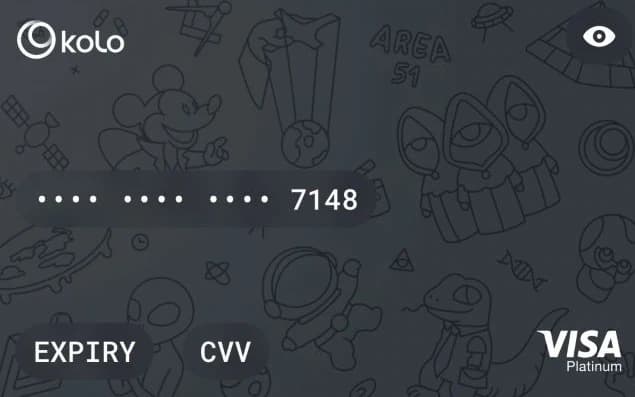
1. Kolo Card
Earn Bitcoin on Purchases: 2% for 30 Days, Then 1% (Capped) + Visa Platinum + 170+ Countries
Complete list:
All 2 crypto cards available in Venezuela in October 2026
This table includes every crypto card we currently track for Venezuela. Rows marked Top pick are ranked and reviewed above.
| Crypto card | Max rewards | Annual fee | FX fee | Type | Custody |
|---|---|---|---|---|---|
1 Kolo CardTop pick | Up to 2% rewards | Free | 0% | Prepaid | Custodial |
| none | Free | 1% | Prepaid | Self-custody |
Crypto Card Regulation in Venezuela
The Political Transition
Nicolas Maduro was captured by US forces in January 2026 (Operation Absolute Resolve). Vice President Delcy Rodriguez was sworn in as interim president under a state of emergency. Opposition leaders Maria Corina Machado and Edmundo Gonzalez are the likely figures in any transition government. The situation remains fluid.
For crypto card users, the practical impact is that sanctions policy is uncertain, the regulatory apparatus is leaderless, and the stablecoin economy operates without clear government oversight. None of the payment infrastructure described on this page has changed. What may change is who regulates it.
The Regulatory Timeline
2018: Maduro launched the Petro (PTR), a state-issued cryptocurrency allegedly backed by oil reserves. The government mandated Petro acceptance for passport fees, tax payments, and university registration, and attempted to use it for international trade to evade US sanctions. Adoption was minimal outside forced government use, the oil backing was unverifiable, and the Petro was effectively abandoned by 2023-2024.
2018: SUNACRIP (Superintendencia Nacional de Criptoactivos y Actividades Conexas) was established by Decreto Presidencial No. 3.604 to regulate crypto activities. The agency imposed fees on crypto remittances (up to 15% in 2020, later reduced to 2-3% by 2022), required miners to register with a government pool, and periodically cracked down on unregistered mining operations. Enforcement was always inconsistent.
2023: SUNACRIP was paralyzed by a corruption scandal. Chief Joselit Ramirez was arrested alongside dozens of officials after authorities alleged that billions in PDVSA oil revenues were siphoned through crypto wallets. The agency was suspended. As of April 2026, it has not resumed operations, and the corruption investigation remains unresolved. Venezuela has no functional crypto regulator.
2024-2025: PDVSA began settling oil sales in USDT. With roughly 85% of Venezuelan oil shipments going to China, PDVSA required new clients to use digital wallets and make payments in Tether for spot deals. The state oil company was using the same stablecoin infrastructure that ordinary Venezuelans built for groceries and rent - but for billion-dollar commodity trades.
The Atlantic Council documented this shift as resembling sanctions-evasion patterns observed in Iran and Russia.
January 2026: Maduro captured. Interim government under Rodriguez. Sanctions status uncertain - OFAC designations targeted the Maduro government, PDVSA, and specific SDN-listed individuals. Whether and how fast those designations are modified under a transition government is unknown.
What This Means for Card Users
The BCV does not recognize private crypto as legal tender but has tolerated crypto trading, recognizing its critical role in remittances and dollar substitution. The BCV publishes an official exchange rate (roughly 476 VES/USD in April 2026) but the parallel market rate is what most Venezuelans actually use.
US sanctions (OFAC) remain the primary compliance concern for card issuers. Sanctions have generally targeted government entities and officials, not private citizens. Many international exchanges still serve Venezuelan individuals, but a number of major card issuers (Crypto.com, Tria, KAST, ether.fi, RedotPay, xPlace) do not list Venezuelan residents; Kolo and Payy are the cards that do.
But some platforms - notably Coinbase and certain US-based services - restrict or flag Venezuelan accounts out of compliance caution. This makes Kolo (which lists Venezuela) the important option for residents, with KAST and Tria available to the diaspora applying with host-country documents.
The post-Maduro transition creates genuine uncertainty. A recognized transition government could lead to sanctions relief, which would open US-based platforms. It could also lead to new crypto regulation replacing the SUNACRIP vacuum. Neither has happened yet. For now, the practical situation is unchanged: crypto card usage by individuals is tolerated, effectively unregulated, and practically essential.
Tax Treatment of Card Rewards in Venezuela
Venezuela's tax system has been distorted beyond recognition by hyperinflation. The SENIAT (Servicio Nacional Integrado de Administracion Aduanera y Tributaria) administers taxation, but VES-denominated brackets are disconnected from economic reality.
Income Tax (ISLR)
The Impuesto Sobre la Renta (ISLR) uses progressive rates from 6% to 34%, denominated in Unidades Tributarias (UT). The UT value is periodically adjusted for inflation but consistently lags actual purchasing power. At 475% annual inflation in 2025, the VES-denominated brackets have almost no relation to dollar-equivalent income.
A freelancer earning $1,200/month in USDC - a comfortable income by Venezuelan standards - would owe tax only on whatever fraction SENIAT can observe and convert to VES at the official rate.
SUNACRIP Fees (Suspended)
SUNACRIP imposed fees on crypto transactions through regulated platforms - up to 15% on crypto remittances in 2020, reduced to 2-3% by 2022. With SUNACRIP suspended since the 2023 corruption scandal and no replacement regulator in place, these fees exist on paper but lack an enforcement body. Most users bypass SUNACRIP-regulated channels entirely through Binance P2P.
The Practical Reality
The informal dollarized economy - approximately 60-70% of retail transactions in Caracas are now in USD or USDT - operates largely outside the formal tax system. SENIAT has never published specific crypto tax guidance. The administrative apparatus to track and enforce crypto taxation does not exist in meaningful form.
What this means for Carlos: He earns $1,200/month in USDC through Deel, spends $800/month through a crypto card, and saves the rest in USDT. His effective tax burden on this activity is near zero in practice. Not through evasion, but because SENIAT has no mechanism to observe, calculate, or collect tax on stablecoin income spent through an offshore card issuer, even though a formal income-tax obligation can still exist on paper. The formal system cannot see the informal economy, and the informal economy is where 70% of Caracas now transacts.
A transition government could change this. New crypto regulation, a revived SUNACRIP or successor agency, or integration with the formal banking system would create tax obligations that do not currently exist in practice. Users should track their transactions in case retrospective reporting requirements emerge.
| Cashback Type | Tax When Received | Tax When Spent/Sold | Optimal Strategy |
|---|---|---|---|
| BTC/ETH cashback | Unclear (likely untaxed) | Unclear (hyperinflation distorts) | Hold in stablecoin |
| Stablecoin cashback (USDC) | Not taxed (rebate) | Near-zero gain | Spend anytime |
| Points/token cashback | Unclear (likely untaxed) | Unclear (no guidance) | Convert to stablecoin |
Fund with stablecoins. Venezuela's hyperinflation history makes VES-denominated tax calculations meaningless. USDT/USDC funding creates near-zero taxable gain (loading or spending stablecoins could still count as a disposal under a future formal regime) and preserves dollar purchasing power, which is the entire point of using a crypto card in Venezuela.
How to Apply from Venezuela
Crypto card applications from Venezuela require the Cedula de Identidad (CI), issued by SAIME (Servicio Administrativo de Identificacion, Migracion y Extranjeria). The CI is mandatory for Venezuelan citizens (V-number) and foreign residents (E-number). CI renewal and issuance have been plagued by severe backlogs - wait times of months to years, corruption in expediting, and document shortages are well-documented.
Venezuelan passport (Pasaporte de la Republica Bolivariana de Venezuela), also issued by SAIME, suffers even worse backlogs. Passport issuance has been a major crisis: blank booklets are frequently unavailable, processing times can exceed 2 years, and the passport itself costs a large share of average monthly income.
This ID scarcity is a major reason why Kolo (which lists Venezuela) is the realistic route to a working card for residents; the diaspora can reach KAST and the wider lineup with host-country documents.
Proof of address via utility bills from Corpoelec (electricity, state-owned), Hidroven/Hidrocapital (water), or telecom bills from Movistar, Digitel, or Movilnet. Bank statements from Banesco, Banco de Venezuela, Banco Mercantil, or Banco Provincial technically work but are VES-denominated and may confuse international issuers.
For the 7.9 million diaspora (UNHCR, December 2025), using host-country documents is strongly recommended: Colombian cedula de extranjeria, Peruvian carnet de extranjeria, Chilean RUT, Spanish NIE/TIE, US state ID/driver's license. These provide broader issuer access and avoid potential sanctions-related friction. Valentina in Bogota should apply with her Colombian cedula de extranjeria, not her Venezuelan passport.
Spending Tips for Venezuela
How Money Arrives
Venezuela has five functioning on-ramp channels. Understanding which one feeds the card determines which card to choose.
1. Freelance income in stablecoins. Carlos earns $1,200/month through Deel, which deposits USDC to his wallet. As a Caracas resident he loads a Kolo card directly. Zero conversion, zero intermediary, 1% ongoing BTC cashback (2% for the first 30 days), capped $100/month, on the spending. (A Venezuelan freelancer who has relocated abroad could instead use a Tria Signature for 4.5% USDT cashback on the first $1,000/month, about 3% net after its 1% FX and 0.5% per-payment fees.)
2. Diaspora Zelle chains. Zelle has become Venezuela's de facto digital payment system for USD - paradoxically, a US domestic bank transfer app operating as the primary non-cash payment method in a sanctioned country. Venezuelans use US bank accounts held by family or friends in the diaspora. The money arrives as USD in a US bank, then gets converted to USDT through a P2P comerciante and loaded to a card.
3. Binance P2P. Venezuela's dominant crypto on-ramp, consistently among Binance's top 5 P2P markets globally. Monthly volume exceeds $100 million. Trading pairs: USDT/VES (largest), BTC/VES, USDT/USD. The market is sophisticated - established traders with reputation scores, Telegram and WhatsApp communities, and a comerciante network that functions as an informal banking system. Banco de Venezuela was removed from Binance P2P payment options in August 2023, but Banesco, Mercantil, and Provincial still work.
4. Direct stablecoin remittance. Valentina in Bogota buys $200 in USDC on a Colombian exchange, sends it to her mother's wallet on Tron (fee: under $1), and the mother loads a Kolo card in Venezuela. Total cost: under $2. Western Union would have taken $16-24 of that $200.
5. Reserve App. Designed specifically for Venezuelan and LATAM users, Reserve provides stablecoin-to-VES conversion for situations where bolivars are needed. Not a card on-ramp directly, but part of the broader infrastructure.
Where It Sits
Once money arrives, it lives in one of three places:
- USDT on Tron - the default savings vehicle. Roughly 80% of Venezuela's crypto activity is stablecoin-denominated. USDT functions as the savings account that Banesco and Banco de Venezuela can no longer provide.
- Binance wallet - for users who also trade. Binance acts as both exchange and bank for many Venezuelans.
- Card wallet (KAST, Kolo, Tria) - for spending-ready balances. The transfer from Tron wallet to card wallet takes minutes.
How It Gets Spent
Venezuela's economy has informally dollarized since approximately 2019. An estimated 60-70% of retail transactions in Caracas are in USD. By late 2025, roughly 10% of grocery transactions involved USDT directly - supermarket chains were actively implementing USDT checkout systems, and receipts in parts of Caracas list prices in "Binance dollars."
A stablecoin-funded crypto card fits into this dollar economy without friction. Load USDC/USDT, tap at POS terminal, transaction settles in USD. The VES conversion happens at the terminal's rate (typically the BCV reference), but the economic reality is dollar-in, dollar-out.
Card Selection by Use Case
- In Venezuela (resident pick): Kolo (1% ongoing BTC, 2% first 30 days, capped $100/mo + $1/txn, on cards with cashback, $0, 0% FX) - lists Venezuela; every swipe builds BTC savings
- In Venezuela (self-custody): Payy (no cashback, $0, 0% USD / 1% FX) - privacy-first self-custody card that also lists Venezuela
- Diaspora fast onboarding: KAST (1.5% USD cashback on first $2K/mo, $0, 0.5-1.75% FX, requires residence abroad) - lighter documentation for displaced Venezuelans
- Diaspora freelancer rewards: Tria Signature (4.5% on first $1K/mo, then 1%, $109/yr, 1% FX + 0.5%/payment, ~3% net, requires residence abroad) - breaks even around $303/month
- Diaspora ETHFI rewards: ether.fi Core (3% on first $2K/mo, then 1% / 0.5%, requires residence abroad)
Break-Even Math
All amounts in USD. Tax impact negligible in practice. Kolo lists Venezuela; Tria and KAST are diaspora options, available under residence abroad. Kolo figures are gross (0% FX) and hold for purchases of $100 or less, above which its $1-per-transaction cap trims the rate; the Tria column is net of its 1% FX fee and 0.5% per-payment fee on non-USD host-country spend.
KAST figures are gross: beyond its 0.5-1.75% FX on non-USD spend, its 1.5% is locked for 14 days, redeemed manually, and spendable only toward a later card purchase rather than withdrawable.
| Monthly Spend | Kolo (1% BTC ongoing, capped $100/mo, free) | Tria Sig (4.5% to $1K/mo, then 1%, $109/yr, 1% FX + 0.5%/payment) | KAST (1.5% USD, $2K/mo cap, free) |
|---|---|---|---|
| $100 | $12/yr | -$73/yr | $18/yr |
| $200 | $24/yr | -$37/yr | $36/yr |
| $400 | $48/yr | $35/yr | $72/yr |
| $800 | $96/yr | $179/yr | $144/yr |
Formal sector salaries have partially recovered to $100-300/month (from a nadir of $2-10/month during peak hyperinflation). Freelancers and professionals with international clients earn $500-2,000/month.
At $100/month, Kolo's $12/year in BTC cashback is still meaningful - that is 1% of annual spending returned as the only asset class that has reliably outperformed the bolivar over any time horizon, and it is the resident pick because the higher-rate cards here (KAST, Tria) require residence abroad.
At $400/month, Tria Signature returns about $35/year once its 1% FX and 0.5% fees are netted out, and stays negative below roughly $303/month of spend.
Cost of Living by Area
Las Mercedes/Altamira/Chacao (Caracas upscale): Rent $400-1,200/month. Centro Comercial Sambil, Centro Lido, Altamira Square. Universal card acceptance at restaurants ($10-30/person), hotels (Gran Melia, JW Marriott, Eurobuilding), and formal retail. The dollar economy is most visible here - nearly every transaction is priced in USD.
El Hatillo/La Lagunita (Caracas suburban upscale): Rent $500-1,500/month. Mountain residential zone, gated communities, international schools. Strong card acceptance throughout.
Centro/La Candelaria/Catia (Caracas popular): Rent $100-400/month. Boulevard de Sabana Grande, Plaza Venezuela, Universidad Central. Mix of card and cash. Cash (USD and VES both) dominates at street level. More representative of typical Venezuelan daily life.
Maracaibo (second city): Rent $150-500/month. Oil capital, Lake Maracaibo. Card acceptance at malls (Lago Mall, CCCT). The Zulia oil economy creates pockets of higher income.
Valencia (third city): Rent $150-500/month. Industrial base. Sambil Valencia, Metropolis. Card acceptance at commercial centers.
Margarita Island (Nueva Esparta): Rent $200-600/month. Porlamar free trade zone, beach tourism. Card acceptance at hotels and tourist businesses.
The Diaspora Remittance Pipeline
Venezuela's 7.9 million diaspora (UNHCR, December 2025) represents the second-largest displacement crisis in the world after Syria. Remittance flows total $4-5 billion annually. The channels, ranked by cost:
| Channel | Cost on $200 | Speed | How It Works |
|---|---|---|---|
| USDT on Tron | Under $1 | Minutes | Sender buys USDT, sends to recipient wallet, recipient loads card or sells P2P |
| Binance P2P | $0-2 (spread) | Minutes | Sender buys USDT on local exchange, sends internally on Binance |
| Zelle chain | $0 (if you have access) | Instant | Requires US bank account held by family/friend in diaspora |
| Reserve App | Small spread | Minutes | Designed for Venezuela/LATAM, stablecoin-to-VES conversion |
| Western Union | $16-24 (8-12%) | Hours-days | Delivers VES at unfavorable rates |
| MoneyGram | $10-20 (5-10%) | Hours-days | Similar to Western Union |
The math is stark. Valentina sends $200/month from Bogota. Through Western Union, her mother receives roughly $176-184 in bolivar-equivalent value. Through USDT-to-Kolo, her mother (in Venezuela) receives $200 in card balance, spends it with 1% BTC cashback ($2/month), and the annual difference is $240-$288 kept on the remittance side instead of lost.
Mistakes That Cost Real Money
1. Sending $200/month via Western Union instead of USDT. Valentina's family loses $16-24 per transfer, or $192-288/year. Over the 7.9 million diaspora, traditional remittance fees extract hundreds of millions annually from one of the world's poorest populations. A single TRC-20 USDT transfer costs under $1.
2. Holding bolivars "just for a few days." The VES lost 37% against USD in Q1 2026 alone. At that rate, $100 in bolivar-equivalent value held for 30 days becomes roughly $88. A Banesco deposit meant for rent can lose double-digit purchasing power in a single month. USDT or a card balance preserves the dollar value.
3. Using a US-based platform with Venezuelan documents. US-based services like Coinbase are known to flag or restrict Venezuelan accounts during sanctions screening. Applications can be frozen for weeks pending manual review, and generic "unable to verify" rejections are common in Venezuelan user forums. For residents, Kolo (which lists Venezuela) processes applications without the US-platform compliance friction; the diaspora can reach KAST and Tria with host-country documents.
4. Ignoring the SAIME renewal before your cedula expires. SAIME passport backlogs exceed two years. Cedula renewals routinely take 6-12 months, with corruption in expediting. If your cedula expires before you have a card, you may not be able to apply for one until the renewal clears. Apply for cards while your documents are current.
5. Converting USDT to VES before spending. Loading a crypto card with USDT and tapping at a terminal gives you the interbank rate. Converting USDT to VES on Binance P2P first, then paying with a Venezuelan bank card, costs the P2P spread (1-3%) plus the bank's FX markup (3-5%). On $400/month spending, that is $16-32/month lost to unnecessary conversion.
Cross-Border and Online Spending
Colombia (2.5M+ Venezuelans): Cucuta-San Antonio and Maicao-Paraguachon border crossings. Many Venezuelans maintain cross-border lives. A crypto card with low FX fees works on both sides of the border. Peru/Chile/Ecuador: Major diaspora destinations. US/Miami: Flight corridor (when available). Spain: 400K+ diaspora, historic cultural connection.
Online spending is where crypto cards provide access Venezuelan bank cards cannot. Amazon (via forwarding services), Netflix ($7-17/month, widely shared), Spotify, and other digital services require international card payment. VES-denominated credit limits on Venezuelan bank cards are rendered trivial by inflation.
Local Payment Infrastructure
Biopago (government biometric payment system) and Pago Movil (interbank mobile transfer, BCV-regulated) handle VES transactions. Patria (government platform) distributes bonos (social welfare payments) in VES. These are the bolivar economy rails - functional but denominated in a currency that loses value daily.
Apple Pay and Google Pay may work where a foreign issuer provisions the card to the wallet; local rails remain Pago Movil, Biopago, USD cash, and card POS. Cash USD circulates widely (bills often in poor condition, $100 bills preferred). Outside Caracas, card acceptance exists at major retailers in Maracaibo, Valencia, and Barquisimeto, but street-level commerce remains cash (USD and VES).
Supported Exchanges & Wallets in Venezuela
This guide covers the cards that matter for Venezuela. The stablecoin-first economy - USDT accounts for roughly 80% of crypto activity - and informal dollarization mean crypto cards are not a new behavior here. They are the last-mile bridge from an infrastructure Venezuelans already built into the Visa/Mastercard network.
Which Card for Which Venezuelan
Kolo is the card for residents inside Venezuela: it lists the country and fills the savings role. 1% ongoing BTC cashback (2% for the first 30 days), capped $100/month and $1 per transaction, at $0 annual fee and 0% FX turns daily spending into BTC accumulation. In a country where Banesco savings accounts lost 99.99%+ of their value and the bolivar fell from 10/USD to 476/USD, converting spending into BTC is not speculation - it is the only store-of-value mechanism accessible to someone earning $200/month.
For Daniela's profile (cedula in hand, energy-sector employer, sanctions-screening concern), an issuer that accepts Venezuelan residents matters more than the rewards rate.
For the 7.9 million diaspora abroad, host-country documents unlock the wider set. KAST's lighter onboarding and non-US issuance are the fastest route for displaced Venezuelans facing both SAIME-expired documents and sanctions-cautious US platforms.
Tria Signature returns about $239 per year at $1,200 per month of spending after its FX, payment, and annual fees, fitting diaspora remote workers who value the USDT payout. ether.fi Core offers stepped ETHFI rewards and optional collateral-backed liquidity for eligible ETH holders.
What Comes Next
Venezuela did not wait for regulation, institutional approval, or a functioning central bank to build a stablecoin economy. Thirty million people figured it out under hyperinflation, sanctions, government corruption, and a banking system that failed them. USDT on Tron became the savings account. Binance P2P became the exchange. WhatsApp groups became the trust network. Supermarket receipts started listing prices in "Binance dollars."
Now Maduro is gone, a transition government is forming, and the question is whether formal institutions will catch up to what already exists or try to replace it. A transition government aligned with the opposition could pursue sanctions relief, which would reopen US-based platforms and services. It could also revive or replace SUNACRIP, which would create formal crypto regulation for the first time since 2023. Neither has happened yet.
What is already true: a crypto card in Venezuela is not a fintech experiment. It is the Visa/Mastercard on-ramp to an economy that already runs on stablecoins. The infrastructure is built. The question is what kind of government inherits it.
Written by SpendNode Editorial
Frequently Asked Questions
Which crypto cards work in Venezuela?
Inside Venezuela, Kolo (1% ongoing BTC, 2% for the first 30 days, capped $100/mo and $1/txn, $0, 0% FX) is the card that genuinely lists the country (Payy too, for self-custody spenders). Tria Signature, KAST, and ether.fi do not serve Venezuelan residents directly; they are options for the 7.9 million-strong diaspora using country-of-residence documents, who can also send USDT home to a relative's Kolo wallet. Card acceptance inside Venezuela is concentrated in Caracas and Maracaibo at formal merchants.
Is cryptocurrency legal in Venezuela?
Crypto is legal but the regulatory landscape is uncertain. SUNACRIP was established in 2018 but was paralyzed after the 2023 corruption scandal (SUNACRIP chief Joselit Ramirez arrested, agency suspended). The Petro cryptocurrency failed. Private crypto trading, primarily on Binance P2P, is widespread and tolerated. USDT on Tron is the dominant cryptocurrency.
How is crypto taxed in Venezuela?
The ISLR (income tax) applies progressive rates from 6-34%. SUNACRIP imposed fees on crypto transactions but enforcement has been erratic since the 2023 scandal. Binance P2P commissions may incur 16% IVA as intermediation services. In practice, crypto taxation enforcement for individuals is minimal given SENIAT's limited capacity.
Why is crypto adoption so high in Venezuela?
Hyperinflation destroyed the bolivar's purchasing power. Venezuelans adopted crypto as a dollar substitute - USDT accounts for 80%+ of crypto activity. Binance P2P Venezuela consistently ranks among the platform's top markets globally. An estimated 10%+ of the population has used crypto for savings, remittances, or payments.
Other Countries
View all 112 countries →


Latest Page Changes to the Best Crypto Cards in Venezuela Guide
- RedotPay removed from the recommended cards as it does not serve Venezuela
- SUNACRIP corruption scandal added: Chief Joselit Ramirez arrested 2023, agency suspended, regulatory vacuum. USDT 80%+ of crypto activity. Binance P2P 16% IVA on commissions