
Disclaimer: SpendNode is for informational purposes only and is not a financial advisor. Some links on this site are affiliate links - we may earn a commission at no extra cost to you. This does not affect our data or rankings. Affiliate DisclosureView Policy
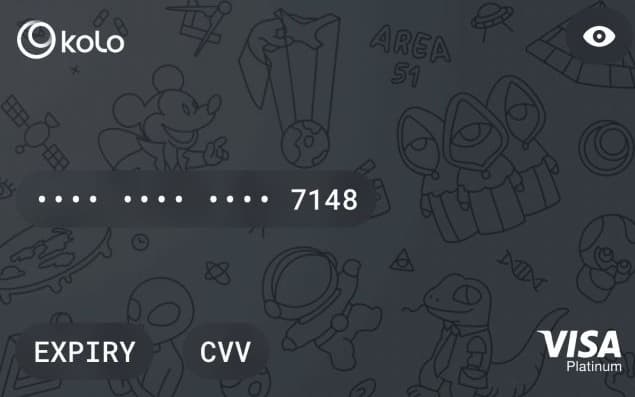
Kolo Card Review 2026 Card Art

Kolo Card Review 2026

Visa Platinum virtual card earning 5% BTC cashback on every purchase. Zero annual fee, zero FX on stablecoins, 7 blockchain networks, Apple Pay and Google Pay. 170+ countries.

Apply Now
5% BTC cashback Visa Platinum with zero annual fee and free activation.
Custodycustodial
NetworkVISA
Annual FeeFree
FX Fee0%
ATM FeeTBD
RewardsUp to 5%
RegionsGLOBAL

Issued by Kolo

Cashback

CASHBACK

Verified Benefit

No Annual Fee

NO ANNUAL FEE

Verified Benefit

💱

NO FX FEE

Verified Benefit

Our Official Verdict

Earn Bitcoin on Every Purchase: 5% BTC Cashback + Visa Platinum + 170+ Countries

The Kolo Card delivers 5% cashback in Bitcoin on every purchase with Free annual fee. With 0% FX on stablecoins and Visa Platinum acceptance in 170+ countries, it is purpose-built for users who want to accumulate Bitcoin through everyday spending. The $5 per-transaction cap and $200 monthly cap favor frequent moderate purchases over large single transactions.

✓5% BTC cashback on every purchase (capped $5/txn, $200/mo)
✓Zero annual fee, zero monthly fee, zero inactivity fee
✓0% FX markup on USDT, USDC, and EURC spending
✓Apple Pay and Google Pay with Visa Platinum global acceptance

Fees & Charges

Annual Fee

Free

FX Fee

0%

ATM Fee

TBD

Requirements

Supported Regions

GLOBAL

Spendable Assets

USDT, USDC, DAI, EURC, EURI, BTC, ETH, SOL, BNB, LTC, DOGE, TRX, ARB, PEPE

Kolo Card Review

The Kolo Card is a custodial virtual prepaid Visa Platinum card that pays 5% cashback in Bitcoin on every purchase, with zero annual fee, zero FX markup on stablecoins (USDT, USDC, EURC), and availability in 170+ countries. Issued by Third National via Raincards, operated by Hardline Holdings Ltd and BURVIX SP. Z O. O. (Poland). Supports 14+ crypto assets across 7 blockchain networks.

Kolo card activation screen showing 10 USD activation fee with strikethrough and 100% cashback: the fee is instantly returned as spendable card balance, making the card effectively free to activate

Card activation: $10 - 100% cashback. Kolo charges a 10 USDC activation fee but instantly returns the full amount as spendable card balance. Your card is effectively free from the moment you activate it.

Earn Bitcoin on Every Purchase You Make

SpendNode's 2026 review of the Kolo Card covers the one thing no other zero-fee crypto card matches: 5% cashback in actual Bitcoin on every single purchase. Not points. Not a proprietary token. Bitcoin.

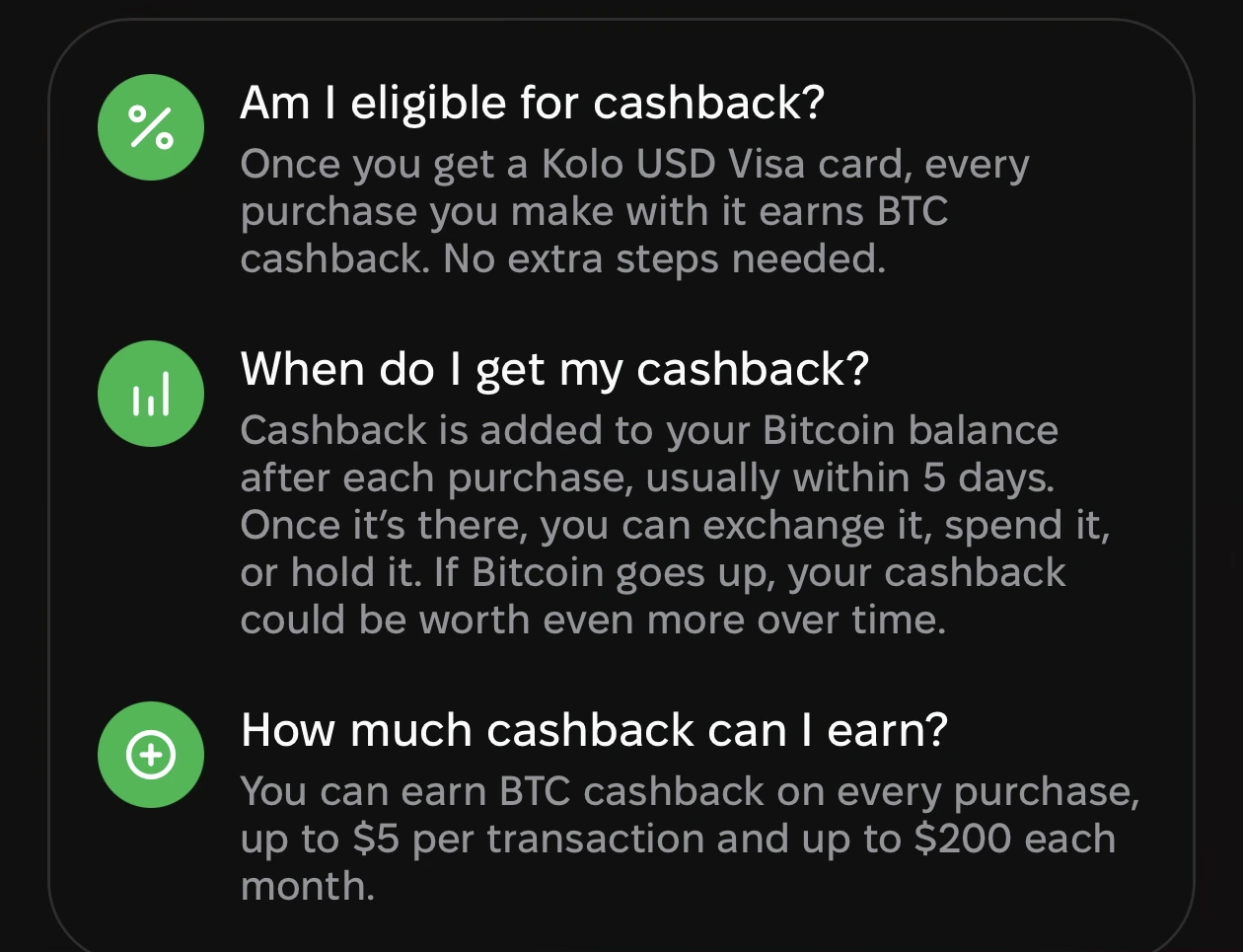
Load USDT, USDC, or any of 14+ supported crypto assets. Tap your phone at any merchant that accepts Visa (online, in-store, in-app). Your crypto converts to local currency at the point of sale. Within 5 days, 5% of the purchase amount appears in your Bitcoin balance. Repeat.

The 5% rate comes with caps - $5 per transaction and $200 per month - which means the card rewards frequent moderate spending rather than occasional large purchases. A $50 grocery run earns $2.50 in BTC. A $100 dinner earns the maximum $5. A $500 electronics purchase still earns only $5. The sweet spot is transactions of $100 or less where the full 5% rate applies.

No other card in 2026 offers this combination at zero annual fee: Crypto.com Obsidian matches 5% but requires a $400,000 CRO stake. KAST Pengu offers higher rates but through a points system. Bleap offers 2% in USDC but caps at $120/year. Kolo caps at $2,400/year - twenty times higher.

Card Specs: What You Are Actually Getting

Physical and Virtual Cards

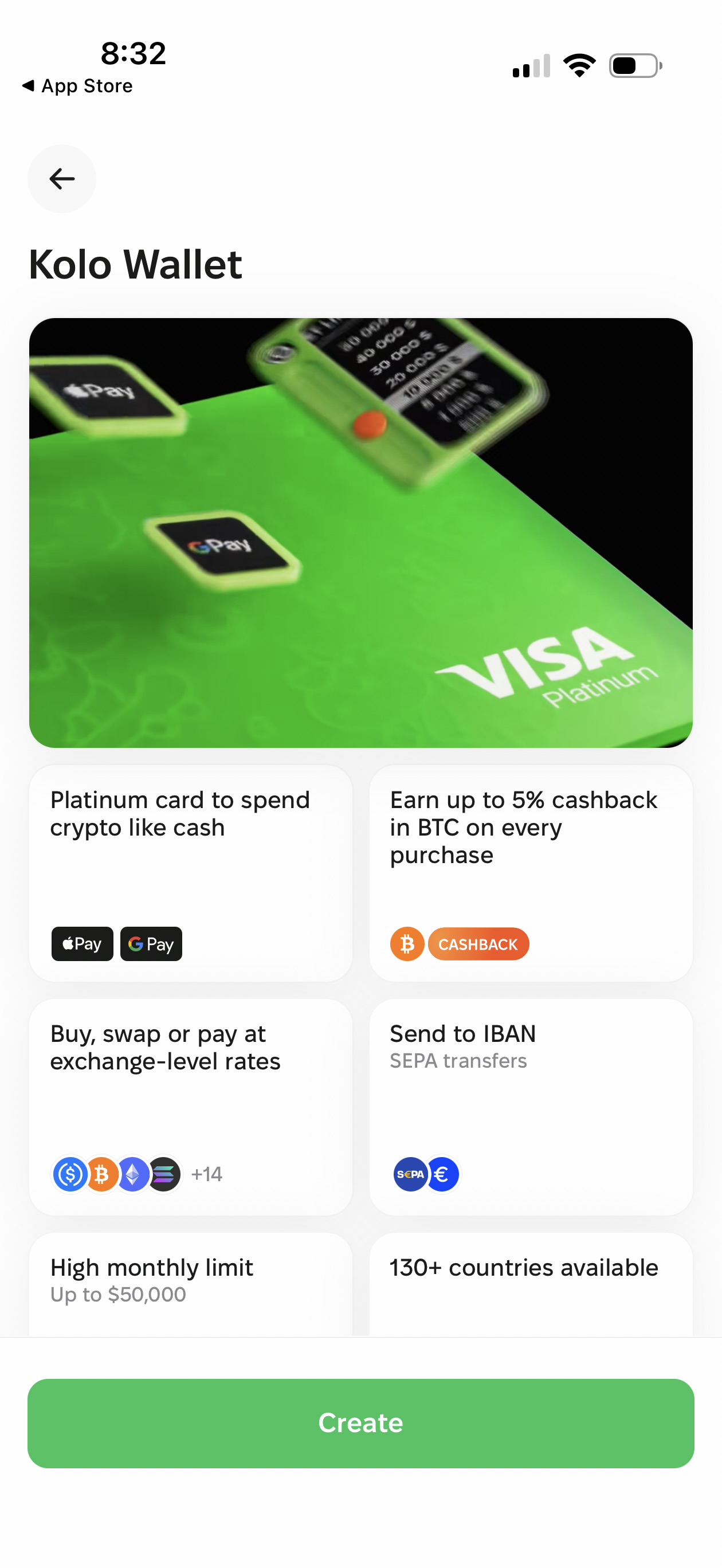
Kolo Wallet card creation screen showing Visa Platinum card with Apple Pay and Google Pay badges, 5% BTC cashback, exchange-level rates, SEPA transfers, $50,000 monthly limit, and 130+ countries
  • Format: Virtual card only (no physical card available)
  • Issuance: Instant after KYC completion (under 2 minutes via Telegram bot or iOS/Android app)
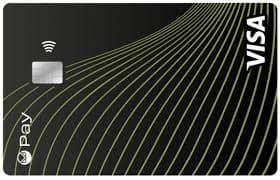
  • Designs: Three choices - Bitcoin (dark with crypto icons), Conspirology (dark with Kolo branding), To The Moon (green with meme art)
  • Activation fee: 10 USDC (100% cashback - instantly returned as spendable balance)
  • Card validity: 4 years

Payment Network

  • Network: Visa Platinum
  • Acceptance: All Visa merchants worldwide (online, in-store, in-app, contactless)
  • Mobile wallets: Apple Pay and Google Pay (manual card details entry - one-tap provisioning coming soon)
  • Issuer: Third National via Raincards Ltd (UK)
  • BIN: 45492406

Security Features

  • 2FA: Two-factor authentication on login and withdrawals
  • Fraud Shield: Real-time AML screening on every transaction
  • Card controls: Lock/unlock card, terminate card from app
  • KYC: Sumsub-powered (government ID + live selfie, 1-minute process)
  • Compliance: MiCA-ready, Travel Rule aligned

How Spending Works: Transaction Flow

Kolo card management screen showing virtual Visa Platinum card ending in 7148 with Spend From selector showing 29+ supported tokens including USDC, EURC, BTC, ETH, SOL, and more

Example: $45 grocery purchase at a supermarket in Berlin

Step 1: Choose your spending asset. In the Kolo app, tap "Spend from" and select EURC (Euro Coin). You can also let Kolo auto-select from your available balances.

Step 2: Pay at the terminal. Open Apple Pay or Google Pay, tap your phone. Kolo instantly converts your EURC to EUR at zero markup. The merchant receives EUR, you see the transaction in your app within seconds.

Step 3: Cashback calculation. 5% of $45 = $2.25 in BTC. This is within the $5 per-transaction cap, so you earn the full 5% rate.

Step 4: Bitcoin credited. Within 5 days of transaction settlement, $2.25 worth of Bitcoin is added to your BTC balance in the Kolo wallet. You can hold it, swap it to another asset, or spend it through the card on your next purchase.

What if you spent ETH instead of EURC? Same flow, but Kolo's Swap engine converts ETH to EUR at approximately 0.3-1% spread (aggregated from CEX and DEX sources), plus Visa's processing-date FX rate from USD to EUR. Total effective cost: approximately 0.5-1.5%. The 5% cashback still more than covers this cost.

Fee Deep Dive: What You Actually Pay

FeeAmount
Annual fee$0
Monthly fee$0
Inactivity fee$0
Activation fee10 USDC (100% cashback)
USDT/USDC/EURC conversion0%
Other crypto conversionApproximately 0.3-1% spread
FX fee (non-USD purchases)Visa network rate (no Kolo markup)
ATM withdrawalN/A (virtual card)

Net Returns at Different Spending Levels

Monthly SpendOptimal CashbackAfter Conversion Costs (stablecoin)After Conversion Costs (BTC/ETH)
$500/mo$25 (if 5+ transactions)$25 net$22-24 net
$1,500/mo$75$75 net$67-72 net
$3,000/mo$150$150 net$135-144 net
$4,000/mo$200 (cap)$200 net$180-192 net

Break-even: Immediate. There is no annual fee, so any cashback is pure profit from the first transaction. The 10 USDC activation fee is refunded instantly.

Optimal strategy: Load stablecoins (USDC, USDT, EURC) to minimize conversion spreads. Keep individual transactions at or under $100 to maximize the 5% rate. At $4,000/month spending with proper transaction sizing, you hit the $200 monthly cap.

BTC Cashback: The Appreciation Angle

Unlike USDC or fiat cashback, Bitcoin cashback has asymmetric upside. Here is the math:

At the $200 monthly cap, you accumulate approximately 0.003 BTC per month at $65,000/BTC. Over 12 months:

ScenarioBTC AccumulatedValue at Year-End
BTC flat ($65K)0.037 BTC$2,400
BTC +50% ($97.5K)0.037 BTC$3,600
BTC +100% ($130K)0.037 BTC$4,800
BTC -30% ($45.5K)0.037 BTC$1,680

Even in the -30% scenario, your cashback is worth $1,680 - you still earned free value on a zero-fee card. In the +100% scenario, your $2,400 in cashback doubles to $4,800. No stablecoin cashback card offers this upside.

Risk: The downside scenario is real. If BTC drops 50%, your $2,400 in cashback becomes $1,200. But since it cost you nothing to earn, the effective risk is limited to opportunity cost versus a stablecoin cashback card like Bleap (2% USDC, capped at $120/year). At any BTC price above $0, Kolo's cashback value exceeds Bleap's cap.

Foreign Exchange: Advertised vs Reality

Kolo claims "0% mark-ups on USDT, USDC, EURC" and "no hidden charges." SpendNode confirmed the 0% stablecoin spread by verifying against official issuer terms - here is the full breakdown:

Test case: $100 USD purchase from USDC balance

  • Kolo markup: 0%
  • Visa processing fee: 0% (domestic USD-to-USD)
  • Total cost: $0.00 - The claim holds.

Test case: 85 EUR purchase in Berlin from USDC balance

  • Kolo markup: 0%
  • Visa FX rate: processing-date rate, typically 0.3-0.5% off mid-market
  • Total cost: approximately $0.26-0.43 on an $85 equivalent purchase

Test case: 3,500 THB purchase in Bangkok from ETH balance

  • Kolo crypto-to-USD spread: approximately 0.5-1%
  • Visa FX rate: approximately 0.3-0.5%
  • Total cost: approximately 0.8-1.5% - still below the 5% cashback rate

Comparison with competitors:

CardFX FeeCrypto SpreadTotal Cost (EUR purchase)
Kolo (USDC)0% Kolo + Visa rate0%0.3-0.5%
Kolo (ETH)0% Kolo + Visa rate0.3-1%0.6-1.5%
RedotPay1.2%1%2.2%
Wirex Standard0% (in-plan)1%1%
Bleap0%0% (stablecoins)0%

Kolo's stablecoin spending is competitive with the best in class. For volatile crypto, the spread is fair but not zero.

Limits and Restrictions

Spending Limits

LimitAmount
Monthly spendingUp to $50,000
Daily spendingDynamic (set by Kolo)
Per-transactionDynamic (set by Kolo)
ATM withdrawalN/A (virtual card only)
Cashback per transaction$5
Cashback per month$200

Dynamic limits warning: Kolo states that spending limits "may be modified at any time, including reduction to $0 without notice." This is unusual - most card programs give advance notice of limit changes. In practice, users report stable limits, but the contractual flexibility is a risk factor.

Restricted Transactions

Kolo blocks cash-like transactions including:

  • Cryptocurrency purchases via the card
  • Money orders and wire transfers
  • Lottery and gaming transactions
  • Peer-to-peer account funding
  • Certain third-party bill payments

These restrictions are standard across crypto card programs and reflect Visa network policies.

What Happens If Kolo Goes Bankrupt?

Kolo app showing Your Card is Ready screen with Cashback Completed notification showing +10 USD, confirming the activation fee refund as card balance

Card balance (fiat side): Held by Third National (the card issuer), not Kolo directly. If Kolo ceases operations, Third National would manage the wind-down. However, card balances are not protected by deposit insurance (FDIC, FSCS) or EU e-money safeguarding. Recovery depends on Third National's own solvency and processes.

Crypto wallet balance: Assets in your Kolo wallet are held in omnibus blockchain addresses controlled by Kolo. Legal title remains with you per the terms, but Kolo holds the private keys. In a bankruptcy scenario, recovering assets from omnibus wallets would require legal proceedings. This is identical to the risk of holding funds on any custodial exchange.

Pending BTC cashback: Up to 5 days of unsettled cashback could be lost. Maximum exposure: approximately $33 (5 days at the $200/month cap rate).

Mitigation strategy: Keep only spending balances in Kolo. Transfer any BTC cashback earnings to a self-custodial wallet periodically. Do not use Kolo as a long-term storage wallet.

Compared to alternatives: This risk profile is identical to RedotPay, KAST, and other custodial cards. For reduced counterparty risk, consider Bleap (account abstraction), Tria (self-custodial AA), or Ready (self-custodial on Starknet).

Real User Scenarios

Scenario 1: Sofia (Remote Designer, Lisbon, $2,200/month)

Setup: Registers via Telegram bot (or downloads the Kolo Wallet app). Completes KYC in 90 seconds. Deposits 2,500 USDC from Arbitrum (gas: $0.02). Activates card for 10 USDC (instantly refunded). Adds to Apple Pay.

Monthly spending pattern:

  • Coffee (22 transactions x $4.50): $99 - cashback $4.95
  • Groceries (8 transactions x $65): $520 - cashback $26 (capped at $5 per transaction on $65 purchases = $3.25 each x 8 = $26)
  • Coworking space: $150 - cashback $5 (capped)
  • Restaurants (8 x $30): $240 - cashback $12
  • Subscriptions (Netflix, Spotify, etc.): $45 - cashback $2.25
  • Online shopping: $350 - cashback $17.50 (spread across 5+ transactions)
  • Transport: $120 - cashback $6
  • Miscellaneous: $676 - cashback approximately $33

Monthly result: Approximately $107 in BTC cashback. Annual: approximately $1,284 in Bitcoin. FX cost: 0% (USDC to EUR via EURC conversion, Visa rate approximately 0.3%). Verdict: "I switched from Revolut. The BTC cashback alone is worth more than any bank rewards program."

Scenario 2: Kofi (Freelance Developer, Accra, $800/month)

Setup: Receives USDT payments on BNB Smart Chain. Deposits to Kolo. Activates card.

Monthly spending pattern:

  • Groceries and daily essentials (30 transactions x $15 average): $450 - cashback $22.50
  • Mobile data and utilities: $50 - cashback $2.50
  • Online services: $80 - cashback $4
  • Transport: $120 - cashback $6
  • Dining: $100 - cashback $5

Monthly result: Approximately $40 in BTC cashback. Annual: approximately $480 in Bitcoin. FX cost: Visa network rate (GHS is non-USD), approximately 0.3-0.5%. Verdict: "My local bank charges 3.5% on international purchases. Kolo charges nothing plus gives me Bitcoin."

Scenario 3: Takeshi (Power User, Tokyo, $5,000/month)

Setup: Loads mix of USDC and ETH. Heavy spender across multiple categories.

Monthly spending pattern:

  • Runs into the $200/month cashback cap by week 3
  • High-value single transactions ($200-500) only earn $5 each (diluted rate)
  • Effective cashback rate across full spend: $200 / $5,000 = 4%

Monthly result: $200 in BTC (cap hit). Annual: $2,400 in Bitcoin. ETH conversion cost: Approximately $25-50/month (0.5-1% on ETH portion). Net benefit: Approximately $150-175/month after conversion costs. Verdict: "The cap limits value at high spend. I use Kolo for daily purchases under $100 and Crypto.com Jade for larger transactions."

How Kolo Card Compares

For stablecoin spenders wanting BTC exposure: Kolo is the clear winner. Zero FX on stablecoins, 5% back in BTC, zero annual fee. Bleap offers self-custody but only 2% back in USDC (capped at $120/year). RedotPay offers zero cashback. The tradeoff is custodial risk, which stablecoin-focused users may accept for the BTC upside.

For global travelers: Kolo works in 170+ countries with Visa Platinum acceptance and Apple Pay. Compared to RedotPay (50+ countries, higher limits) or Wirex (EEA + UK focus), Kolo has broader acceptance but lower spending limits and no physical card for hotel/rental deposits.

For US residents: Kolo is not available. Consider Gemini (4% cashback, US only), Coinbase (4% back), or Avici (48 countries including US).

For self-custody advocates: Kolo is custodial. If you need self-custody, Bleap (account abstraction, EEA), Tria (AA, global), or Ready (Starknet, EEA) are the alternatives. You trade cashback rate for custody control.

Kolo's unique value: The highest flat-rate BTC cashback on any zero-annual-fee card. No staking, no token locks, no tiers. Just 5% back in Bitcoin on every purchase.

The Bottom Line: Is Kolo Card Worth It in 2026?

Use Kolo Card if:

  • You want to accumulate Bitcoin passively through everyday spending
  • You spend stablecoins and want genuinely zero-fee conversion
  • Your typical transaction is under $100 (maximizes the 5% rate)
  • You live outside the US and need a card that works in 170+ countries
  • You are comfortable with custodial risk for spending balances
  • You value simple onboarding (register via Telegram or iOS/Android, 2 minutes to card)

Skip Kolo Card if:

  • You are a US resident (not available)
  • You need self-custody of your funds (Kolo is custodial)
  • You primarily make large purchases over $100 (the $5/txn cap dilutes the rate)
  • You need ATM cash withdrawals (virtual card only)
  • You need a physical card for hotel deposits or car rentals
  • You are uncomfortable with a card issuer under a testing regulatory regime
  • You spend over $4,000/month and want uncapped rewards

Kolo Card is the most efficient Bitcoin accumulation tool disguised as a payment card. For moderate daily spenders who want exposure to BTC without buying on an exchange, it converts routine purchases into a systematic savings plan - $200/month in Bitcoin, every month, at zero cost. The regulatory immaturity and custodial model are real risks, but for spending-sized balances, the risk-reward is compelling. Keep your savings in self-custody. Use Kolo for spending and let the Bitcoin accumulate.


Sources and Verification

All card specs, fees, and limits verified from:

Cashback caps ($5/txn, $200/mo) verified from in-app screenshots. Supported networks and assets verified from in-app deposit screens. Activation fee refund confirmed from in-app card issuance flow.

Last verified: February 26, 2026

User scenarios are composite illustrations based on typical spending patterns. Individual results depend on transaction frequency, asset mix, and market conditions.

FAQ

How do you choose Kolo Card crypto cards?

We compare verified issuer sources, fees, and eligibility. Availability can change, so confirm with the issuer before applying.

Do all cards in this list offer the same benefits?

No. Each issuer defines its own program terms. Review the sources on each card profile.

Are these rankings or recommendations?

No. Lists are filtered views of cards in our database and do not imply rankings.

This is a prepaid card. Merchants that require pre-authorization holds (gas stations, hotels, car rentals, toll booths) may decline it. Fund only what you plan to spend.

Your funds are held by Kolo. If the provider faces insolvency, your balance may be at risk. This card does not offer self-custody protection.

Fees shown above are the card's disclosed fees. Additional costs may apply: Visa/Mastercard network spread (typically 0.5-0.9%), crypto-to-fiat conversion spread at point of sale, and blockchain gas fees for on-chain top-ups.

Last verified: Feb 26, 2026 · Data sourced from official Kolo documentation. · Methodology