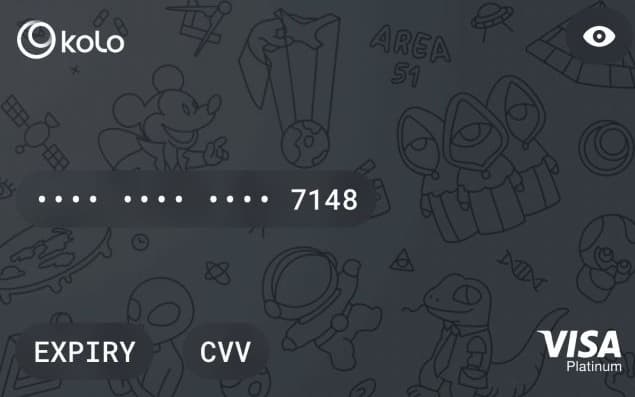


SpendNode Vendor Rating
Kolo is interesting because the proposition is clear and easy to like, but the issuer still feels much smaller than the names it competes with on headline value.
The card concept works. The issuer score is held back more by scale and market depth than by the core product idea itself.
Issuer Snapshot
Editorial vendor score stays separate from user reviews. Methodology
Product Quality
3.5
Trust & Custody
3.4
Fee Transparency
3.5
Operational Reliability
3.1
Market Relevance
3.2
On This Page
What Is Kolo?
Kolo is a custodial crypto card platform offering a Visa Platinum virtual prepaid card with zero annual fee, zero FX markup on stablecoins, and broad global availability outside the US and sanctioned jurisdictions. Kolo's own homepage cites 10 million users worldwide. The product runs through a Telegram mini-app and iOS/Android app flow with Sumsub KYC.
The important correction is the rewards headline. Kolo's current public homepage now markets 2% cashback in BTC, not the older 5% positioning that appeared in earlier app captures and on our site. Kolo's Terms of Use (v2.1, 31 December 2025) also make clear that the cashback program can be modified, suspended, or terminated at any time without notice, and reward rates and limits are set at Kolo's sole discretion. The safest public figure to use now is the current 2% headline.
Who runs Kolo, and under which regulator
Kolo is operated jointly by Hardline Holdings Limited (Kazakhstan, registered with the Astana Financial Services Authority) for the website/app layer and card services, and BURVIX SP. Z O. O. (Poland) for crypto-asset services. The Terms explicitly note a regulated-service-provider migration: Cryppo UAB, a Lithuanian VASP, provided crypto-asset services up to and including 31 December 2025. From 1 January 2026 onwards, those services are provided by BURVIX SP. Z O. O. under Polish law.
Card services themselves are issued in collaboration with Signify Holdings Inc. and run on Raincards rails. Kolo is marketed as MiCA-ready and Travel Rule aligned, which matters for EEA users who want a compliance story that lines up with the current EU framework.
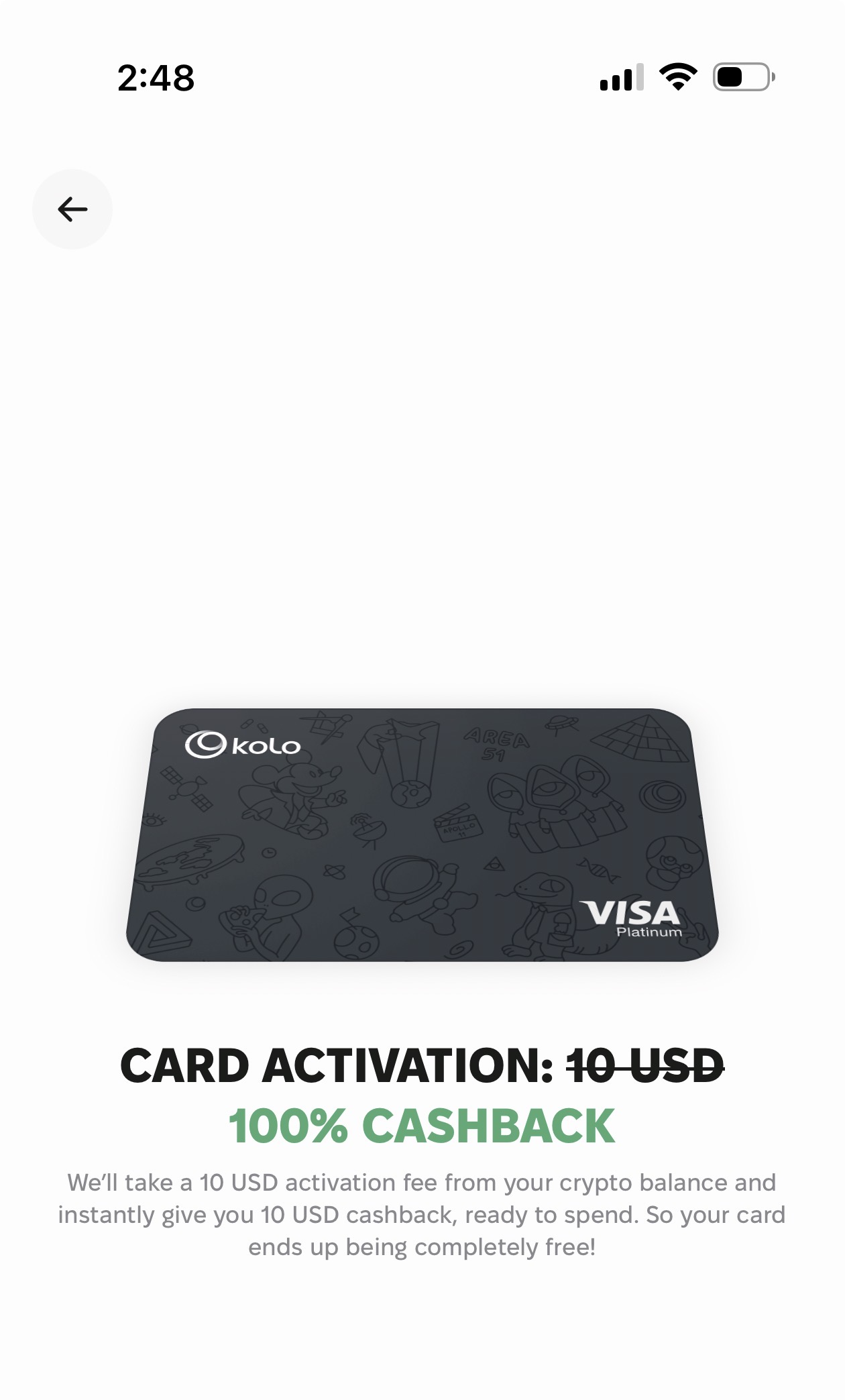
SpendNode app screenshot
Card activation: 10 USDC, then refunded back to balance. Kolo still presents activation as effectively free because the fee is returned to the card balance.
What Still Looks Solid
- Current homepage reward claim: 2% cashback in BTC
- Annual fee: $0
- Stablecoin spend: 0% markup on USDT, USDC, and EURC
- Coverage: 170+ countries outside the US and sanctioned markets
- Wallet rails: 7 supported networks across Ethereum, BNB Chain, Arbitrum, Base, Solana, Stellar, and Polygon
- Apple Pay and Google Pay: supported at Visa/Mastercard contactless terminals
- Direct SEPA bank send: crypto-to-fiat transfers straight from the Kolo wallet to Revolut, Wise, N26, or any SEPA bank account without routing through an exchange
- Regulatory story: MiCA-ready, Travel Rule aligned, Sumsub KYC, Polish VASP from January 2026
The SEPA send feature is worth calling out separately. At a free 2% cashback rate Kolo is no longer the headline BTC accumulator it used to be, but being able to send EUR directly from a crypto wallet to a European bank account without touching a separate exchange still has real value for EEA users and for anyone sending money back to relatives in euro-bank countries.
Where the Caution Is
Kolo is a good example of why reward pages need fresh verification. Older internal captures showed a richer cashback setup with explicit caps and a higher headline rate. The current homepage is simpler and lower: 2% BTC cashback. That does not mean the card stopped working. It means the public-facing reward story changed, and older comparisons built around 5% were no longer reliable.
One other note on marketing: Kolo's current homepage still uses the slogan "THE BIGGEST BTC CASHBACK" above its 2% rate. That is a marketing claim, not a factual comparison against other cards in the category. Several free crypto cards pay BTC or BTC-equivalent rewards at or above 2%, so the "biggest" line should be treated as Kolo's own positioning rather than an independent benchmark.
Fees and Spend Economics
Kolo's strongest claim is still the same one it had before: stablecoin spending is cheap.
| Spending Method | Current Positioning |
|---|---|
| USDT / USDC / EURC | 0% Kolo markup |
| Other crypto | Exchange-level conversion with spread risk |
| Non-USD purchases | Network FX rate still applies |
| Annual fee | $0 |
| Activation | 10 USDC returned to balance |
If you are spending from USDC or EURC, Kolo still looks structurally cleaner than many prepaid competitors that stack a conversion spread on top of FX. That is the main reason the card remains relevant even after the cashback downgrade.
Rewards and Cashback
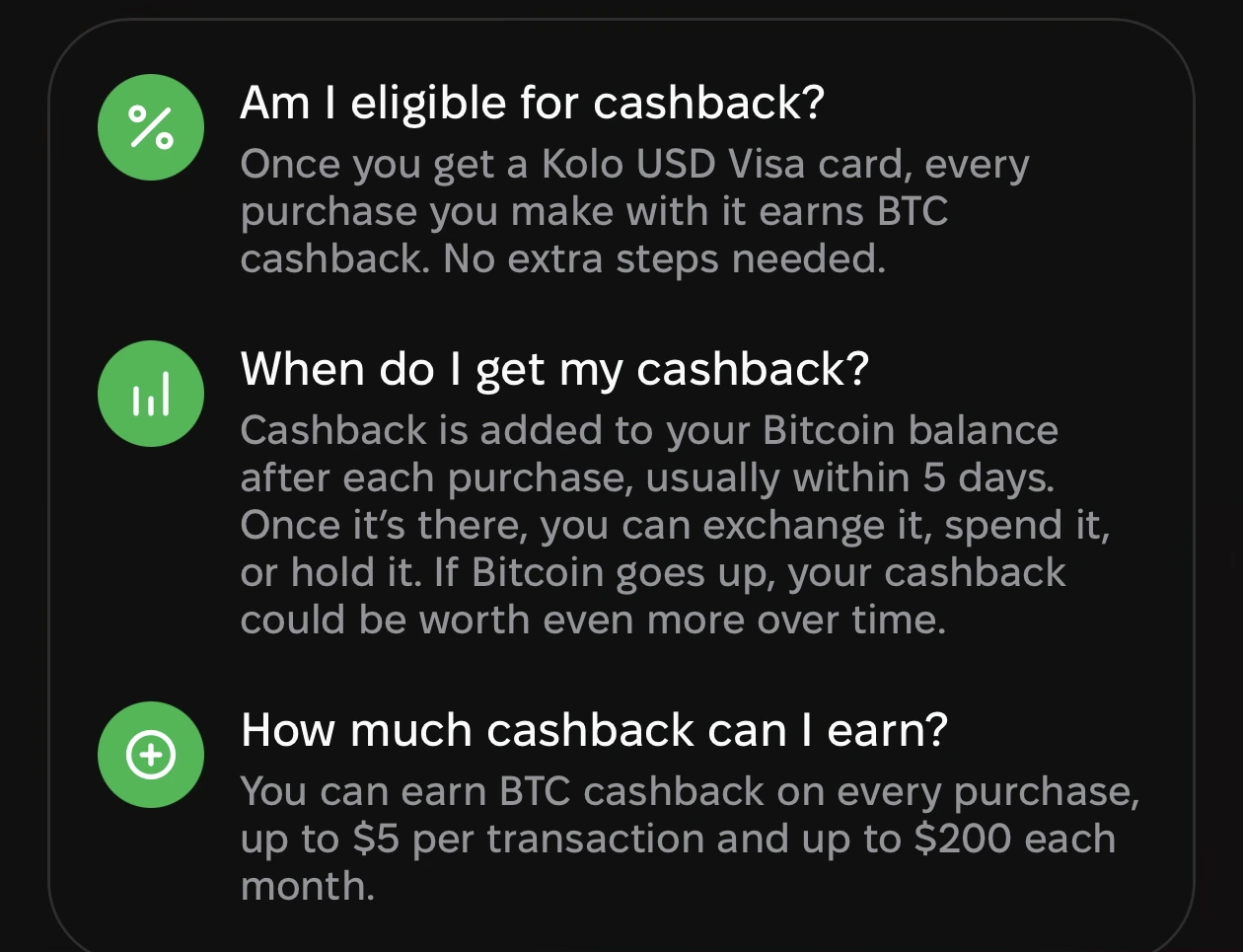
SpendNode app screenshot
Legacy app capture, not current homepage authority. Earlier internal app captures showed a more generous cashback structure than the live homepage now does.
The safest current editorial reading is:
- Public homepage now says: 2% BTC cashback
- Terms say: Kolo can change reward rates, eligible transactions, and limits at its discretion
- Older internal captures showed: a richer capped model that should no longer be treated as the default public claim
So the right way to describe Kolo now is not "5% BTC cashback card." It is:
a zero-fee global prepaid crypto card that currently markets 2% BTC cashback and still looks strongest when used for stablecoin-funded spending.
Kolo vs Other Cards
- vs Bleap: Bleap remains stronger for users who prioritize self-custody and clearer reward semantics. Kolo is broader geographically and simpler to start with.
- vs Crypto.com: Crypto.com's stronger tiers still depend on CRO commitment. Kolo is simpler and cheaper to start, but the current 2% headline is much less differentiated than the old 5% story.
- vs KAST: KAST stays more points-driven and region-specific in some use cases. Kolo's edge is wider availability and straightforward stablecoin spend.
- vs RedotPay: RedotPay still wins on some practical prepaid use cases, but Kolo's BTC reward angle remains more attractive if you want Bitcoin exposure rather than a pure payment rail.
Who Should Use Kolo?
Use Kolo if:
- You want a low-friction global prepaid crypto card
- You mostly spend stablecoins and care about low conversion drag
- You want BTC-denominated rewards without paying an annual fee
- You are comfortable with a custodial setup for spending balances
Avoid Kolo if:
- You want self-custody
- You need a physical card or ATM access
- You want a reward program whose public rules have stayed stable over time
- You are relying on older 5% cashback references you saw elsewhere
Is Kolo Safe?
The core risk profile has not changed:
- custodial wallet model
- smaller operator than the biggest exchange-card brands
- card program depends on third-party issuer rails
- terms give Kolo wide discretion over rewards and operational changes
That does not make it unusable. It does mean Kolo should be treated as a spending tool, not a long-term asset storage venue.
Bottom Line
Kolo still has a real place in the market, but the thesis is different now.
It is no longer safe to treat it as a verified 5% BTC cashback card. The current public claim is 2% BTC cashback, and that should drive comparisons until Kolo publishes or shows something different more clearly inside the live product.
What remains appealing is the combination of:
- $0 annual fee
- wide availability
- stablecoin-friendly spending
- BTC-denominated rewards
That is still useful. It is just not the same story we had in the database before.
Sources and Verification
- Kolo Official Site
- Kolo Terms of Use
- Internal homepage and app captures reviewed on April 10, 2026
Frequently Asked Questions
Is the Kolo Card activation fee really free?
Yes. Kolo charges a 10 USDC activation fee but instantly returns the full amount as spendable card balance. The net cost is zero. You need at least 10 USDC in your Kolo wallet to activate.
How does BTC cashback work on Kolo?
Kolo's current public homepage markets 2% cashback in Bitcoin. Earlier internal captures documented a richer capped structure, but Kolo's terms allow the cashback program to change at any time. Treat the live 2% headline as the safest current figure unless the app shows a different rate on your account.
Is the Kolo Card available in the United States?
No. Kolo is available in 170+ countries but excludes the United States and sanctioned jurisdictions (Russia, Cuba, Iran, North Korea, Syria, Crimea). US residents should consider Gemini, Coinbase, or Avici as alternatives.
User Reviews
Reviews are moderated and may take a moment to appear.
Recent Updates to Kolo
- Corrected the stale Kolo reward framing to the current public 2% BTC cashback headline instead of the older 5% positioning
- Rewrote the page around current public claims and terms language, removing unsupported 'highest free cashback' assumptions