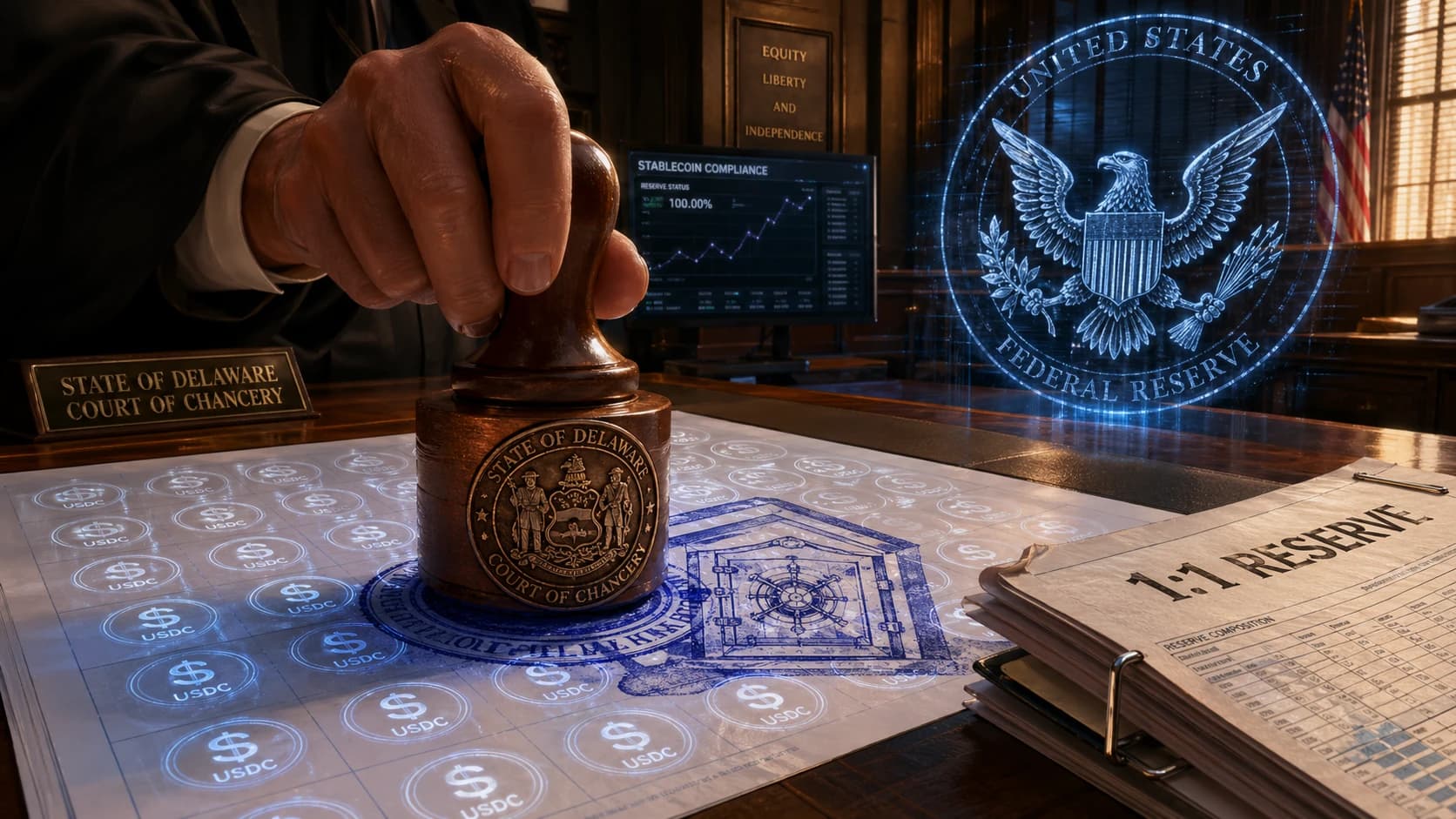
Delaware's Senate passed the Delaware Payment Stablecoins Act on Thursday by a 20-1 vote, creating a state-level licensing regime for dollar-pegged tokens. The bill requires any licensed issuer to back tokens 1:1 with reserves and to comply with anti-money-laundering rules. The vote was reported by BitcoinNews on April 25, 2026.
The timing matters. Federal stablecoin legislation has been stuck in Congress for months, with the CLARITY Act markup slipping into mid-May. States are no longer waiting. Delaware now joins a small group writing its own rulebook while Washington negotiates.
The bill mandates 1:1 reserves and AML programs
The Payment Stablecoins Act sets out conditions for any company that wants a Delaware license to issue a payment stablecoin. The two headline requirements:
- Tokens must be backed 1:1 with reserves. The bill text leaves the exact composition (cash, T-bills, repos) to follow-on rule-making, but the principle is hard-coded.
- Issuers must run a Bank Secrecy Act-style AML program, with customer identification, transaction monitoring, and suspicious activity reporting.
Both mirror what New York's BitLicense regime and the proposed federal GENIUS Act ask for. The novelty is jurisdictional, not technical: Delaware is the corporate home of more than two-thirds of Fortune 500 companies, and a Delaware stablecoin charter could become a default option for issuers that already domicile there.
The 20-1 margin is wider than most observers expected for a crypto bill. Only one senator voted against it, and the floor debate was reportedly short.
States stopped waiting on Washington
Stablecoin issuers have been operating in legal grey space for years. Tether is offshore. Circle holds a New York BitLicense and a federal trust charter application that has stalled. Paxos works under New York supervision. Smaller issuers route through state money transmitter licenses that were never designed for tokenised dollars.
A federal framework would resolve the patchwork. The CLARITY Act and the GENIUS Act both contemplate a uniform regime, but neither has cleared committee. Treasury Secretary Bessent publicly urged Congress this week to pass digital asset legislation, but the calendar keeps slipping.
States have read the room. New York moved first with its BitLicense expansion. Wyoming has its SPDI charter. Texas has been refining its money transmitter rules around stablecoins. Delaware, by setting up a clean licensing track now, is positioning itself to attract issuers who want to be regulated somewhere before they have to be regulated everywhere.
Issuers gain a cheap, defensible US foothold
For an established issuer like Circle, a Delaware license is incremental. For a newer entrant, it could be the cheapest legitimate US foothold. State licensing is faster and less politically charged than waiting for a federal trust charter, and Delaware's corporate court is familiar to crypto general counsels who already file there.
There is also a defensive logic. If the federal bill eventually passes with a different definition of "payment stablecoin" or a different reserve composition, issuers that already hold a state license at least have a regulator to talk to during the transition. Holding nothing is the worst position to be in.
The bill will now move to Delaware's House of Representatives, with no public timeline for a vote.
Stablecoin card users gain compliance breathing room
Stablecoins are the rails behind a growing share of crypto card spending. Cards issued by Crypto.com, Coinbase, and self-custody options like Gnosis Pay all settle in stablecoins at some point in the flow. Clearer state rules around reserves and AML reduce the risk that a stablecoin issuer freezes balances on short notice or fails reserve attestation.
For users in the United States who use stablecoin-funded cards, the practical effect is a slow tightening: more compliant issuers, fewer offshore options, and stricter onboarding at the issuer level rather than the card level. That has been the trajectory since the GENIUS Act was first floated.
Overview
Delaware's Senate has voted 20-1 to pass the Delaware Payment Stablecoins Act, requiring licensed issuers to hold 1:1 reserves and run AML programs. The bill now moves to the House. With federal stablecoin legislation stuck, Delaware joins New York, Wyoming, and Texas in writing its own rulebook. For stablecoin issuers, a Delaware charter could become a default US foothold, especially for companies already domiciled there.