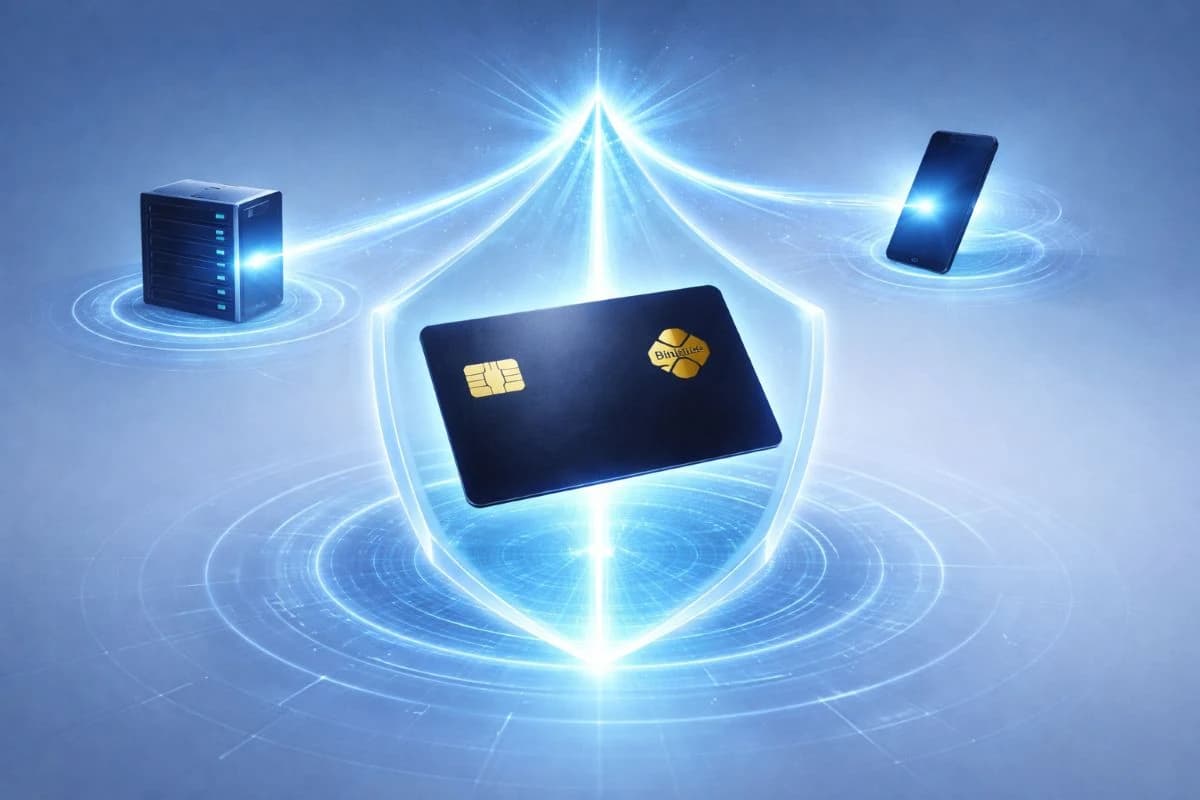
Binance has published an educational post highlighting MPC (Multi-Party Computation) wallet technology, emphasizing how it enhances custody through cryptographic key sharing. The announcement on January 31, 2026, comes amid growing demand for custody solutions that balance security with usability, particularly relevant for Binance Card users managing significant balances.
What Binance Announced
Binance's post focused on MPC wallets as a custody technology that eliminates single points of failure. Private keys are never whole in any single location. Instead, keys are split into multiple "shards" using advanced cryptography, so even if one shard is compromised, funds remain safe. The user experience also improves because there is no need to manage complex seed phrases manually.
This signals growing interest in advanced custody solutions as the industry matures beyond traditional "12-word seed phrase" models.
Why MPC Matters for Crypto Card Users in 2026
The custody dilemma for crypto card users comes down to a tradeoff between convenience and control.
Traditional custodial cards (Binance, Coinbase, Bybit) offer easy password recovery and familiar UX for beginners, but carry exchange bankruptcy risk (FTX and Celsius taught us this) and funds can be frozen for compliance.
Traditional self-custodial cards (MetaMask, Solflare) provide true ownership and censorship resistance, but losing a seed phrase means losing everything, and the UX is complex for average users.
MPC wallets offer a middle ground: self-custodial security (keys never centralized), recovery mechanisms (social recovery, guardian networks), and user-friendly onboarding (no seed phrase to write down). The tradeoff is that you must trust the MPC implementation and choose guardians carefully.
How MPC Wallets Work: The Technical Breakdown
MPC (Multi-Party Computation) uses threshold cryptography to split your private key into multiple encrypted shards.
Traditional Single-Key Model
You have 1 private key -> Anyone with that key owns your funds
If the key is stolen, funds are gone. If the key is lost, funds are locked forever.
MPC Multi-Shard Model
Your key is split into 3 shards:
- Shard 1: Your mobile device
- Shard 2: Binance secure server
- Shard 3: Cloud backup or guardian

To sign transactions: 2 of 3 shards must collaborate
If a hacker gets Shard 1 (your phone), they cannot steal funds (needs 2/3). If you lose Shard 1, you can recover with Shards 2 + 3. If Binance fails, your phone + cloud backup still work.
The Cryptographic Detail
MPC does not just "split" your key into pieces (which would be insecure). Instead, the full private key never exists in any single location during key generation. When you need to sign a transaction (like tapping your card), the shards perform collaborative computation to produce a valid signature. Each shard holder never learns the full key, even when signing.
This is the same technology used by Tria (MPC wallet + Account Abstraction), Fireblocks (institutional custody), and Zengo (consumer MPC wallet).
MPC vs. Multi-Sig: What Is the Difference?
Many confuse MPC wallets with Multi-Signature wallets (like Gnosis Pay). They solve similar problems differently.
| Feature | Multi-Sig (Gnosis Pay) | MPC (Binance, Tria) |
|---|---|---|
| Key Storage | Multiple complete keys held by different parties | Single key split into encrypted shards |
| On-Chain Visibility | Visible (you see N-of-M signature structure) | Invisible (looks like a single-key wallet) |
| Transaction Speed | Slower (requires gathering N signatures) | Faster (shards compute locally) |
| Gas Costs | Higher (more on-chain operations) | Lower (single signature output) |
| Recovery | Requires M-of-N signers to approve | Threshold access (e.g., 2 of 3 shards) |
| Best For | DAOs, teams, transparent governance | Solo users, consumer apps, speed |
Why Binance likely chose MPC over Multi-Sig: lower gas fees (single signature = cheaper transactions), better UX (users don't see complexity), privacy (wallet structure not revealed on-chain), and speed (critical for point-of-sale card transactions).
Binance Card + MPC: What This Could Mean
While Binance's post is educational (not an official product launch), integrating MPC into Binance Card would be significant.
The current Binance Card model is custodial: your funds sit in Binance's exchange wallet, Binance controls the keys, and if Binance faces regulatory action or a hack, your card funds are at risk.
A hypothetical Binance Card + MPC model would keep your funds in an MPC wallet with keys split between your device, Binance's server, and a cloud backup. Even if Binance failed, you would retain access via your shards. This would position Binance Card as more secure than pure custodial cards (Coinbase, Crypto.com) and more user-friendly than pure self-custodial cards (MetaMask, Solflare), making it competitive with hybrid models from Tria and ether.fi.
The Security vs. Convenience Tradeoff
MPC solves the "seed phrase problem" but introduces new considerations.
On the positive side: no seed phrase to lose or expose, social recovery replaces 12 words, single point of compromise is survivable, and non-technical users get a familiar experience.
On the risk side: bugs in MPC code can be catastrophic, weak guardian choices create recovery attack vectors, MPC shards are often non-portable between providers, and side-channel attacks on shard computation are a newer threat.
Real-world MPC incidents include Fireblocks disclosing an MPC vulnerability in 2023 (patched before exploit) and ZenGo successfully migrating users to a new MPC protocol after a security audit in 2024. MPC is more secure than custodial but requires audited implementations. Binance's scale means they can afford proper security review.
How Binance MPC Compares to Competitors
| Provider | Custody Model | Card Available | Self-Custodial? | Recovery Method |
|---|---|---|---|---|
| Binance | Custodial (MPC in development?) | Yes, Global | No (Custodial) | Password reset |
| Tria | MPC + Account Abstraction | Yes, Global | Yes | Social recovery |
| Gnosis Pay | Multi-Sig (Safe) | Yes, Europe | Yes | Guardian approval |
| Coinbase | Custodial | Yes, US | No (Custodial) | Email/Phone |
| MetaMask | Single-Key + MPC (Snaps) | Yes, Global | Yes | Seed phrase |
Binance's potential advantage is ecosystem integration: MPC wallets could connect to Binance Earn, Staking, and Trading. Instant top-ups from exchange to MPC wallet and Binance's brand trust (despite FTX fallout, Binance has survived 6+ years and major audits) add to the appeal.
Tria's current edge is true self-custody through a fully decentralized MPC implementation, programmable spending limits via Account Abstraction, and no exchange risk since it is not tied to a centralized exchange.
Should Binance Card Users Care About MPC?
If you hold under $5,000 on Binance Card, the current custodial model is probably fine. Convenience outweighs security risk for small balances.
If you hold $5,000-50,000, MPC would be a significant upgrade. It protects against exchange failure while maintaining usability. Consider splitting between Binance (custodial) and a self-custodial option like Tria or Gnosis Pay.
If you hold $50,000+, self-custody is not optional. At this level, exchange risk is unacceptable. Use Gnosis Pay (multi-sig) or Tria (MPC) for the bulk of your holdings and keep only spending amounts on custodial cards.
The 2026 Custody Shift
Binance's MPC announcement reflects a market-wide shift. From 2021-2023, the consensus was "custodial is fine, exchanges are safe." After FTX and Celsius collapsed, 2024-2025 swung to "self-custody or die." In 2026, MPC is presenting a middle path.
Adoption data from February 2026: 56% of Gen Z prefer non-custodial solutions, MPC wallets are growing 300% year-over-year, and self-custodial cards are processing $180M+ monthly. The drivers are regulation (MiCA 2.0 pushes responsibility onto users), trust erosion (FTX, Celsius, BlockFi taught painful lessons), tech maturity (MPC implementations are production-ready), and the UX breakthrough of no more seed phrases.
How to Prepare for MPC Adoption
If Binance Card integrates MPC wallets, you should understand shard distribution first: where each shard is stored, who has access, and what the threshold is (2 of 3? 3 of 5?).
Choose guardians carefully. Use trusted individuals or services, avoid single points of failure (do not use 3 email accounts you own), and test the recovery flow in a sandbox environment.
Verify the MPC implementation by checking for third-party audits (Trail of Bits, OpenZeppelin), reading security disclosures, and starting with small amounts.
Plan a migration strategy: gradually move from custodial to MPC wallet, keep a "hot spending balance" separate from "cold storage," and document your recovery process.
Alternatives to Consider Now
For maximum security today, Gnosis Pay offers battle-tested Safe multi-sig infrastructure in Europe, and hardware wallets provide cold storage for assets you are not spending.
For MPC today, Tria combines MPC with Account Abstraction for true self-custody, and ZenGo Wallet (no card yet) has a proven MPC implementation since 2018.
For hybrid security, ether.fi Cash lets you earn yield while maintaining card access, and Solflare Card provides SPL token custody with Solana wallet integration.
Overview
Binance's MPC wallet announcement signals the maturation of crypto custody beyond the false choice of centralized convenience versus self-custodial complexity. MPC splits private keys into encrypted shards using threshold cryptography so no single device ever holds the full key, enabling self-custodial security with a consumer-friendly experience. For Binance Card users, MPC integration would dramatically improve security without sacrificing usability. For security-conscious users holding significant balances, MPC is a proven technology (Fireblocks processes $4T+ annually with it), but it is not perfect and requires trust in the implementation. The practical takeaway: if you hold more than $5,000 on a custodial card, start splitting balances between custodial and self-custodial solutions now rather than waiting for Binance's product roadmap.