



Jupiter Global is the real-world payments arm of Jupiter, Solana's dominant DEX aggregator (not a credit card). Launched January 2026, it combines a virtual Visa Infinite and Visa Platinum debit card issued by Rain or DCS (depending on region), QR Pay at mid-market rates with zero fees, and fiat remittance via virtual USD/EUR named bank accounts supporting 22+ currencies. USDC deposits convert 1:1 to USD. Card balance held in USD. Two issuers: Rain (Americas, Africa, Middle East, APAC, supported US states; 1% FX, no spending limits) and DCS (Singapore, South Korea, Japan, Vietnam, Malaysia, Taiwan, Australia, Thailand, Philippines; 1.8% FX, $50K daily limit).
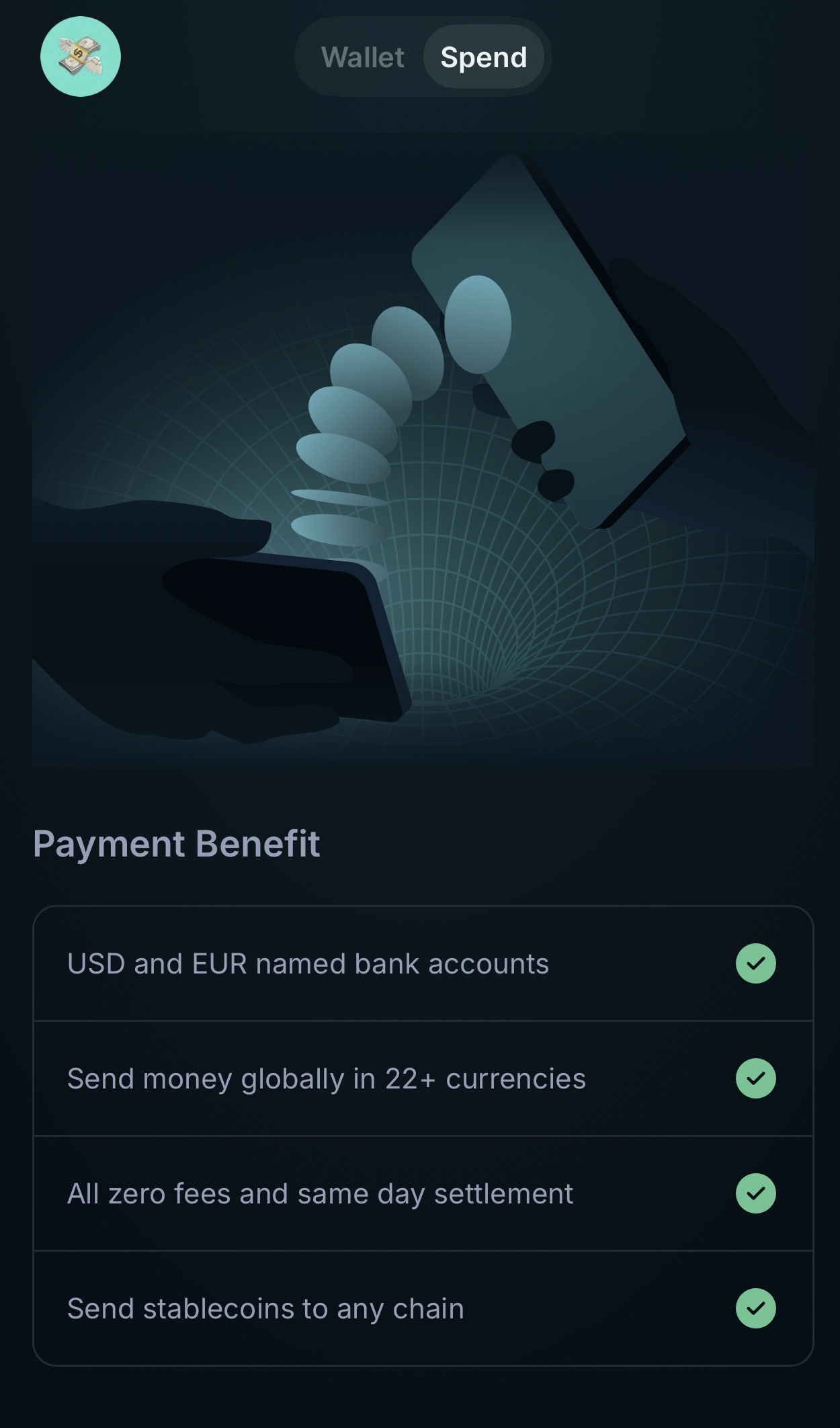
Solana's Biggest DEX Aggregator Enters Real-World Payments
Jupiter processes more swap volume on Solana than any other protocol. The Jupiter app has a 5.0 App Store rating. And in January 2026, the team launched Jupiter Global - a virtual Visa card and payment platform that lets you deposit USDC 1:1 to USD and spend at any Visa merchant worldwide.
The card is issued by two regulated partners depending on your country of residence. Rain covers the Americas (including supported US states), Africa, Middle East, and parts of APAC - with a 1% FX fee on non-USD payments and no spending limits. DCS covers Singapore, South Korea, Japan, Vietnam, Malaysia, Taiwan, Australia, Thailand, and the Philippines - with a 1.8% FX fee and a $50,000 daily limit. Payments made in USD have zero fees on both issuers. We verified these rates directly from Jupiter's published fee schedule.
Beyond the card, Jupiter Global includes QR Pay (scan-to-pay in APAC at mid-market rate with zero fees for both parties) and fiat remittance (virtual accounts in USD, GBP, and EUR with SWIFT transfers to 200+ countries). This is a full payments platform, not just a card.
The Ecosystem
Jupiter Global Card - Free virtual Visa Infinite/Platinum debit card. Deposit USDC 1:1 to USD. 0% on USD payments. 1% FX (Rain) or 1.8% FX (DCS) on non-USD. Apple Pay and Google Pay. No spending limits on Rain cards.
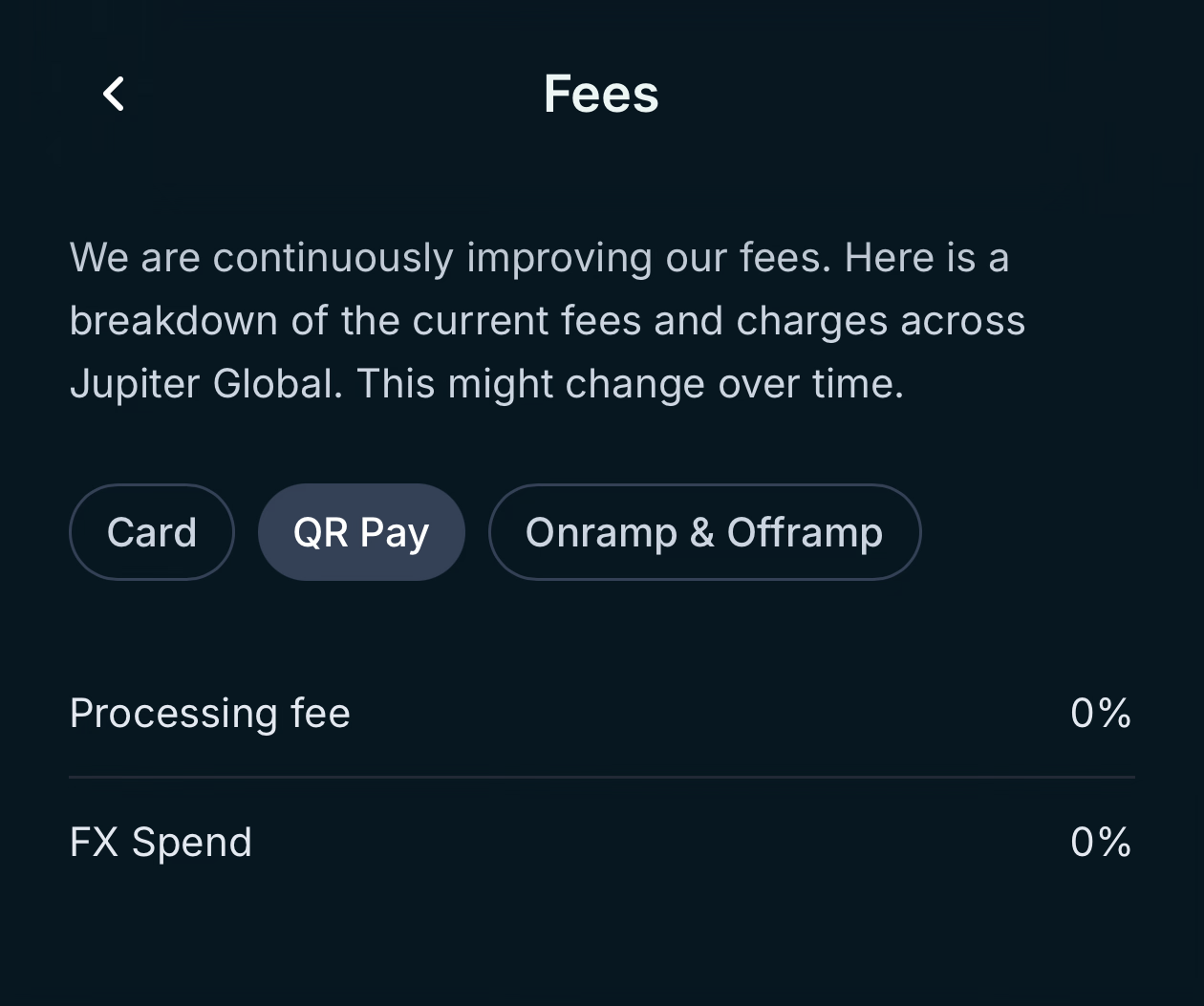
QR Pay - Scan-to-pay at merchants in APAC (Singapore, South Korea, Japan, Vietnam, Malaysia, Taiwan, Australia, Thailand, Philippines). Zero fees for payer and merchant. Mid-market rate with no spread. Daily limit: $5,000. Also supports peer-to-peer transfers.
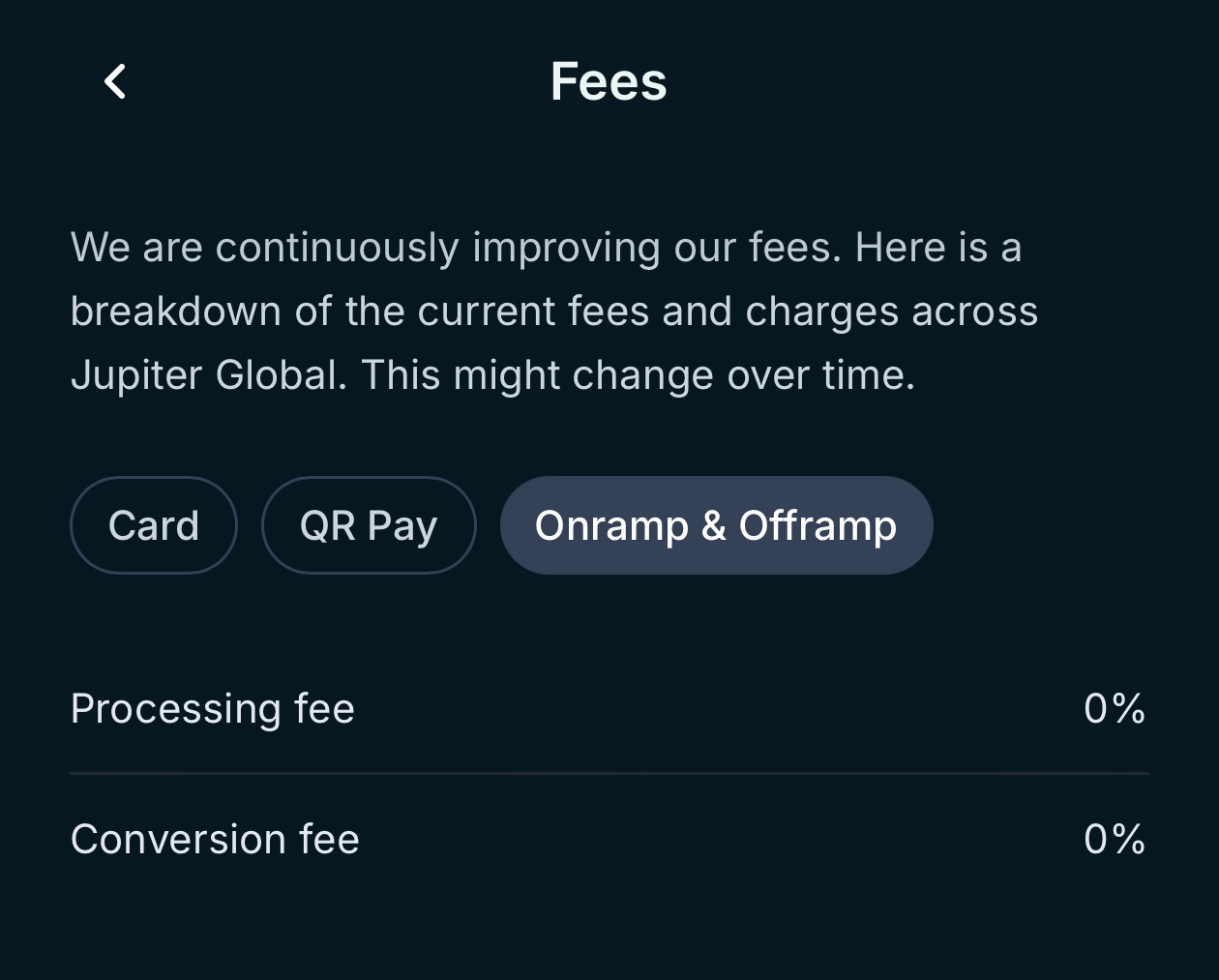
Fiat Remittance - Virtual accounts in USD, GBP, EUR. SWIFT transfers to 200+ countries. Local payouts in 22+ currencies. No fees on transfers. Mid-market rate with no spread. Per-transfer limit: $10,000.
Fee Structure: Two Issuers, Different Rates
| Fee | Rain | DCS |
|---|---|---|
| Annual fee | $0 | $0 |
| USDC deposit | 0% (1:1 to USD) | 0% (1:1 to USD) |
| USD payments | 0% | 0% |
| Non-USD payments (FX) | 1% | 1.8% |
| QR Pay | 0% (mid-market) | 0% (mid-market) |
| Remittance transfers | 0% (mid-market) | 0% (mid-market) |
Key insight: Your card balance is held in USD, not USDC. Conversion from USDC to USD happens at the moment of deposit, not at the point of sale. This means there is no real-time conversion risk when you spend. The only fee is FX conversion when you pay in a non-USD currency.
Our fee review confirms that for USD spending, Jupiter is genuinely free. For non-USD spending, the Rain 1% rate matches Solflare and is lower than the DCS 1.8% rate. Neither issuer charges a transaction fee, which makes Jupiter cheaper than xPlace (1% FX + 1% transaction fee) for all non-USD spending.
Spending Limits
| Limit | Rain | DCS |
|---|---|---|
| Daily spending | No limit | $50,000 |
| Annual spending | No limit | $990,000 |
| QR Pay daily | $5,000 | $5,000 |
| Remittance per transfer | $10,000 | $10,000 |
Rain's lack of spending limits is notable. Most crypto cards cap at $30,000-$50,000/month. Rain-issued Jupiter cards have no published daily, monthly, or annual cap.
Technology: Dual-Mode Architecture
Jupiter Global runs two modes:
Pure DeFi Mode - Fully self-custodial. Your Solana wallet is independent of Jupiter Global. Trade, swap, DCA, limit orders - all on-chain with your own keys. Jupiter does not touch your wallet funds.
Secure Global Mode - Enables the Visa card, QR Pay, and fiat remittance. You deposit USDC which converts to USD in your card account. Card balances are managed by the issuing partner (Rain or DCS). Your on-chain wallet remains separate and self-custodial.
KYC via Jupiter ID: Open the Jupiter app, switch to Global mode, complete identity verification (government ID + selfie, 2-4 minutes via SumSub). APAC regions also require proof of address. Jupiter ID is reusable across Jupiter products but cannot be deleted once verified.
Real User Scenarios
Scenario 1: Marcus (US-Based Developer, Rain Issuer, $3,000/month)
Setup:
- Jupiter Global card (Rain, free)
- Holds USDC from freelance income
- Mostly USD spending
Monthly math:
- USDC deposit: 1:1 to USD ($0 cost)
- USD payments: 0% fee
- Net monthly cost: $0
His verdict: "I already use Jupiter for swaps every day. The card adds a free off-ramp. Zero cost for USD spending - I stopped withdrawing to my bank account. Rain issuer means no spending limits either."
Scenario 2: Yuki (Tokyo, DCS Issuer, JPY 350,000/month)
Setup:
- Jupiter Global card (DCS, free)
- All spending in JPY (non-USD)
Monthly math:
- USDC deposit: 1:1 ($0)
- FX fee: 1.8% on JPY spending = approximately $45/month
- Net annual cost: approximately $540
Her verdict: "The 1.8% DCS rate is higher than Rain's 1%. I use QR Pay where available (0% fee, mid-market rate) to reduce costs. For merchants that accept QR Pay, the savings are significant. For Visa card payments, 1.8% is still competitive with traditional cards."
Scenario 3: Ana (Sao Paulo, Rain Issuer, $1,500/month mixed USD/BRL)
Setup:
- Jupiter Global card (Rain, free)
- 40% USD online purchases, 60% BRL local spending
Monthly math:
- USD portion ($600): 0% fee
- BRL portion ($900): 1% FX = $9/month
- Net annual cost: approximately $108
Her verdict: "The split is great. My USD subscriptions and online shopping are free. The 1% on BRL spending is lower than my bank's 3.5% FX markup. Plus I use the fiat remittance to receive USD freelance payments into my virtual account."
What Happens If Jupiter Global Fails?
Your USDC in Pure DeFi mode:
- Self-custodial. Your Solana wallet seed phrase works independently. Import into Phantom, Backpack, or any Solana wallet.
- Expected recovery: 100%
Your USD card balance in Secure Global mode:
- Held by Rain or DCS (regulated issuers), not by Jupiter directly. If Jupiter ceases operations, the issuer manages the wind-down. Card balances are not covered by deposit insurance (FDIC, FSCS).
- Visa chargeback protections apply to disputed transactions.
Your fiat account balances:
- USD/GBP/EUR balances depend on the regulated partner's wind-down process.
Risk level: Very low for on-chain assets (self-custodial). Low-to-moderate for card and fiat balances (issuer-dependent). Jupiter's position as Solana's largest DEX provides operational stability, but the Global payments arm launched January 2026.
How Jupiter Global Compares
For Solana USDC holders:
- Solflare: 1% FX on all non-USD, raffle rewards, EEA/UK only. Same FX as Jupiter Rain but limited to Europe.
- Jupiter Global (Rain): 1% FX, 0% on USD, no spending limits, global (Americas, Africa, Middle East, APAC, US). Wider reach, same FX rate.
- xPlace: 1% FX + 1% transaction fee (2% total on non-USD). Jupiter is strictly cheaper at 1% total.
- KAST: 0.5-1.75% FX, 2% cashback + 4% MOVE. Better net returns if you are not in the US.
For US residents specifically:
- Jupiter (Rain) is one of the few Solana-native cards available in the US. Gemini is the main alternative (credit card, 4% cashback). KAST serves some US users. Most other Solana cards (Solflare, xPlace, Gnosis Pay) are not available in the US.
For APAC users:
- Jupiter QR Pay at 0% fees and mid-market rate is unmatched. DCS-issued card has 1.8% FX (higher than Rain's 1%), but QR Pay bypasses this entirely where accepted.
Who Should Use Jupiter Global in 2026?
Ideal user profile:
- Solana-native user already in the Jupiter ecosystem
- Holds USDC and wants to spend it without an exchange withdrawal
- US-based and needs a Solana spending card (Rain issuer, supported states)
- Values zero fees on USD spending
- APAC-based and wants QR Pay at mid-market rate with no fees
- Needs fiat remittance (USD/GBP/EUR virtual accounts, SWIFT to 200+ countries)
Who should avoid:
- Users who need cashback today (not launched - use KAST or xPlace for rewards)
- Users who need a physical card or ATM access (virtual only)
- DCS region users who want the lowest FX rate (1.8% is higher than Solflare's 1% or Gnosis Pay's 0%)
- Users who need a proven card with years of track record (launched January 2026)
The verdict: After reviewing the full platform, Jupiter Global is the most complete Solana payments platform in 2026. The card itself competes on cost (1% FX for Rain, 0% on USD) and availability (including supported US states - rare for a Solana card). QR Pay at zero fees and mid-market rate is unique. Fiat remittance adds utility no other Solana card offers. The main weakness is no cashback yet - when yield-funded rewards launch from jupUSD, the economics improve. For existing Jupiter users, the activation is frictionless. For US-based Solana users, this may be the best option available.
Fees and ROI Framework
$0 annual fee. USDC deposits 1:1 to USD with no fee. 0% on USD payments. FX on non-USD: 1% (Rain) or 1.8% (DCS). QR Pay: 0% at mid-market rate. Remittance: 0% at mid-market rate. No cashback live (yield-funded cashback from jupUSD planned, rate TBA). At $2,000/month non-USD spending: -$240/year (Rain) or -$432/year (DCS). At $2,000/month USD spending: $0/year. QR Pay users in APAC can reduce costs significantly by using QR where accepted (0% vs 1.8% card FX).
Competitor Comparison
- vs Solflare: Solflare charges 1% FX on all non-USD with raffle rewards (EEA/UK only). Jupiter Rain matches the 1% FX but serves a wider geography (Americas, Africa, Middle East, APAC, US). Jupiter also offers 0% on USD (Solflare charges 1% on everything non-USD). Jupiter wins on availability and USD economics; Solflare wins on European track record.
- vs xPlace: xPlace charges 1% FX + 1% transaction fee (2% total on non-USD) with 0-2% tiered cashback. Jupiter charges only 1% FX (Rain) with no transaction fee and no cashback. Jupiter is cheaper for non-USD spending at Standard tier; xPlace wins if you reach Gold/Platinum cashback tiers.
- vs KAST: KAST offers 0.5-1.75% FX with 2% cashback + 4% MOVE. Net positive returns on spending. Jupiter offers 1% FX + 0% tx fee with no cashback. KAST wins on net economics due to cashback. Jupiter wins on US availability and zero USD-payment fees.
Availability and Compliance Notes
Two issuers by region. Rain: Americas (including 34 US states), Africa, Middle East, parts of APAC. 1% FX. No spending limits. DCS: Singapore, South Korea, Japan, Vietnam, Malaysia, Taiwan, Australia, Thailand, Philippines. 1.8% FX. $50K daily, $990K annual. KYC required via Jupiter ID (SumSub, 2-4 min). Visa network. Virtual card only. Apple Pay and Google Pay. USDC-only deposits. QR Pay: APAC only, $5K daily. Remittance: SWIFT 200+ countries, $10K per transfer.
Sources and Verification
Frequently Asked Questions
How do I fund the Jupiter Card?
Deposit USDC through the Jupiter app. USDC is converted 1:1 to USD at deposit time with no fee. No other tokens or currencies are supported for deposits.
Does the Jupiter Card offer cashback?
Not yet. Jupiter has confirmed yield-funded cashback (from jupUSD balances) is planned, but no rates or launch date have been announced.
Is the Jupiter Card a physical or virtual card?
Currently digital only, accessible through the Jupiter app. A physical card is planned once operational processes are in place.
What are the Jupiter Card fees?
No annual fee. No fee on USDC deposits. No fee on USD payments. FX fee on non-USD payments: 1% for Rain-issued cards (Americas, Africa, Middle East, APAC, supported US states) or 1.8% for DCS-issued cards (Singapore, South Korea, Japan, Vietnam, Malaysia, Taiwan, Australia, Thailand, Philippines).
What features are coming soon to Jupiter Card?
Jupiter's roadmap includes cashback (yield-funded from jupUSD), travel lounge access, insurance, eSIMs, shopping offers, and bank deposit funding. No launch dates have been announced.
Is the Jupiter Card a credit card?
No. The Jupiter Card is a Visa debit card, not a credit card. You fund it with USDC from your Solana wallet and spend your own balance - there is no credit line, no APR, and no credit check. For crypto-backed credit card options, see our reviews of Gemini, ether.fi, Nexo, and Avici.
App Store (56 ratings)
Source: Apple App Store - Updated Feb 2026