One in 17 Workers Broke the Glass on Their Retirement
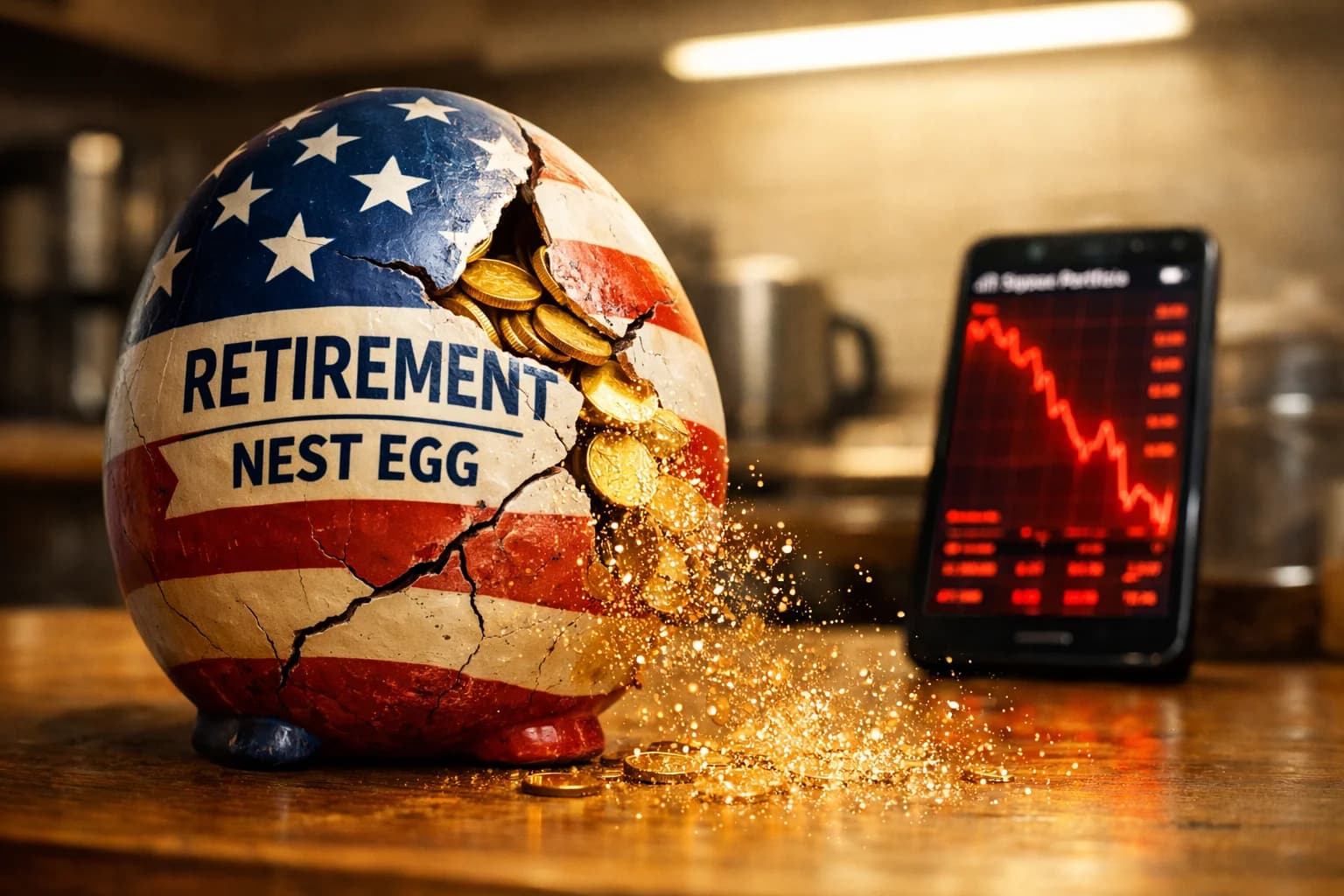
Vanguard's 2026 "How America Saves" report dropped a number that should make anyone paying attention uncomfortable: 6% of 401(k) participants took hardship withdrawals in 2025, the highest rate the firm has ever recorded. That is triple the roughly 2% pre-pandemic baseline and up from 4.8% in 2024.
The median amount withdrawn was $1,900.
Not $19,000. Not $190,000. Nineteen hundred dollars. People are cracking open their retirement accounts for what amounts to a month of groceries or a car repair. As of March 11, 2026, Bitcoin trades at $70,012 (+2.2% in 24 hours) while the Fear & Greed Index sits at 25, deep in "Fear" territory. The traditional financial system and the crypto market are both flashing the same signal: stress.
Why the Number Tripled in Five Years
Three forces pushed the hardship withdrawal rate from 2% to 6% between 2019 and 2025.
Legislative access. The Bipartisan Budget Act of 2018 removed the requirement that workers first exhaust 401(k) loan options before taking a hardship withdrawal. Then the SECURE 2.0 Act of 2022 added new penalty-free distribution categories: up to $1,000 for emergencies once per year, distributions for domestic abuse survivors, and federally declared disaster relief up to $22,000 per event. Congress made the door wider, and more people walked through it.
Persistent cost-of-living pressure. Foreclosure prevention, eviction avoidance, and medical bills remain the top stated reasons for hardship withdrawals. Housing costs have not meaningfully retreated from their 2023 peaks in most metro areas, and the February 2026 jobs report showed the U.S. economy lost 92,000 jobs with another 161,000 revised away from prior months.
Behavioral normalization. Each year that the withdrawal rate climbs, the stigma drops. When one in 17 coworkers is doing it, it no longer feels like a last resort.
The paradox: average 401(k) balances actually rose 13% to a record $167,970 in 2025. The people who are staying invested are doing well. The people who are not can barely cover $1,900. That gap tells you more about American financial health than any single macro indicator.
What This Has to Do With Crypto
At first glance, retirement fund stress and crypto seem like separate conversations. They are not.
Capital that leaves retirement does not vanish. When someone pulls $1,900 to avoid eviction, that money goes to a landlord, a hospital, or a mechanic. It exits the investment pool entirely. Multiply that by the millions of Vanguard participants alone (the firm manages roughly $9.3 trillion), and the aggregate capital drain from long-term savings into short-term survival spending is not trivial. Less capital in traditional investment vehicles means less passive demand for equities, bonds, and by extension, crypto ETFs held within retirement accounts.
The Fear & Greed Index correlation is not a coincidence. Bitcoin's Fear & Greed reading of 25 as of March 11 reflects a broader risk-off posture. When households are stressed enough to raid retirement, discretionary allocation to volatile assets collapses. The Bitfinex Alpha report published the same day projects BTC to remain range-bound between $63,000 and $72,000 absent a pivot in ETF flows. Financial stress keeps retail sidelined.
Stablecoins are becoming the emergency savings account that 401(k)s were never designed to be. SECURE 2.0 created the concept of "Sidecar" emergency savings accounts linked to 401(k) plans, capped at $2,600 per year. That is a step in the right direction, but the cap is too low and adoption is slow. Meanwhile, stablecoins like USDC and USDT already function as instant-access, borderless savings vehicles with no withdrawal penalty. Stablecoin transfer volume hit a record $1.8 trillion in a single month earlier this year. Some of that volume is institutions. But a growing share is individuals who want dollar-denominated savings without the friction of a traditional bank, and without the six-month delay of a 401(k) hardship application.
The $1,900 Median and the Crypto Onramp Problem
The median hardship withdrawal of $1,900 is important because it is small enough to solve with almost any financial product except a 401(k). A credit card. A personal loan. A HELOC. The fact that people are choosing the 401(k) anyway, with its tax penalties (10% if under 59.5 plus income tax) and permanent loss of compound growth, suggests those other options are either maxed out or unavailable.
This is where crypto cards and stablecoin spending tools become relevant. A worker who holds $1,900 in USDC on a self-custody wallet with a linked spending card can access those funds instantly, with no early withdrawal penalty, no tax withholding, and no impact on their retirement trajectory. The trade-off is yield: a 401(k) with a target-date fund might return 7-9% annualized, while USDC yields roughly 4-5% on most lending platforms. But for the $1,900 emergency, that yield difference is irrelevant. The person needs the money now, and the 401(k) is the worst possible place to get it from.
Cards from providers like Coinbase, Crypto.com, or newer stablecoin-native options like KAST already allow users to spend from stablecoin balances directly. The gap is awareness: most Americans who raid their 401(k) for $1,900 have never considered that a stablecoin balance with a Visa or Mastercard attached could have solved the same problem without the retirement damage.
Retirement Stress in a Range-Bound Market
The macro backdrop makes this worse. BTC at $70,012 is 24% below its November 2025 all-time high. ETH at $2,037 is down over 50% from its cycle peak. SOL at $86 is off roughly 65%. Fear & Greed at 25 has been below 30 for most of the past month. The market is not crashing, it is grinding, which is psychologically harder for retail than a sharp drop followed by a bounce.
For the subset of retail crypto holders who also have 401(k) accounts, the combination is punishing: their retirement accounts feel untouchable (or they have already been tapped), their crypto portfolios are underwater, and their cost of living has not dropped. The February jobs report only adds to the pressure.
The bull case is that financial stress eventually forces the Federal Reserve to cut rates, which historically drives risk-asset rallies. But the Vanguard data suggests that for millions of workers, the timeline between "stress" and "rate cuts provide relief" is too long. They need $1,900 today, not a portfolio recovery in Q4.
What Comes Next
The trend line is clear: hardship withdrawals have risen every year for six consecutive years. Nothing in the current macro environment suggests 2026 will break the pattern. If anything, a softening labor market and persistent housing costs will push the rate above 6%.
For the crypto industry, this creates both a challenge and an opportunity. The challenge: stressed households do not allocate to volatile assets. The opportunity: stablecoin-based savings and spending tools are a direct answer to the problem that is driving people into their 401(k)s in the first place. The question is whether the infrastructure reaches the people who need it before they break open the one asset they should never touch early.
BTC at $70,012. Fear & Greed at 25. Hardship withdrawals at 6%. The numbers are all telling the same story.
Overview
Vanguard's 2026 report reveals that 6% of 401(k) participants took hardship withdrawals in 2025, a record high and triple the pre-pandemic rate. The median withdrawal was just $1,900, pointing to acute short-term financial stress rather than large-scale retirement liquidation. This data arrives as Bitcoin trades at $70,012 with the Fear & Greed Index at 25, reflecting a broader risk-off environment where retail participation in volatile assets remains depressed. The parallel rise of stablecoin usage, which hit $1.8 trillion in monthly transfer volume earlier this year, suggests that crypto-native savings and spending tools may address the exact liquidity gap that drives workers to raid their retirement accounts.