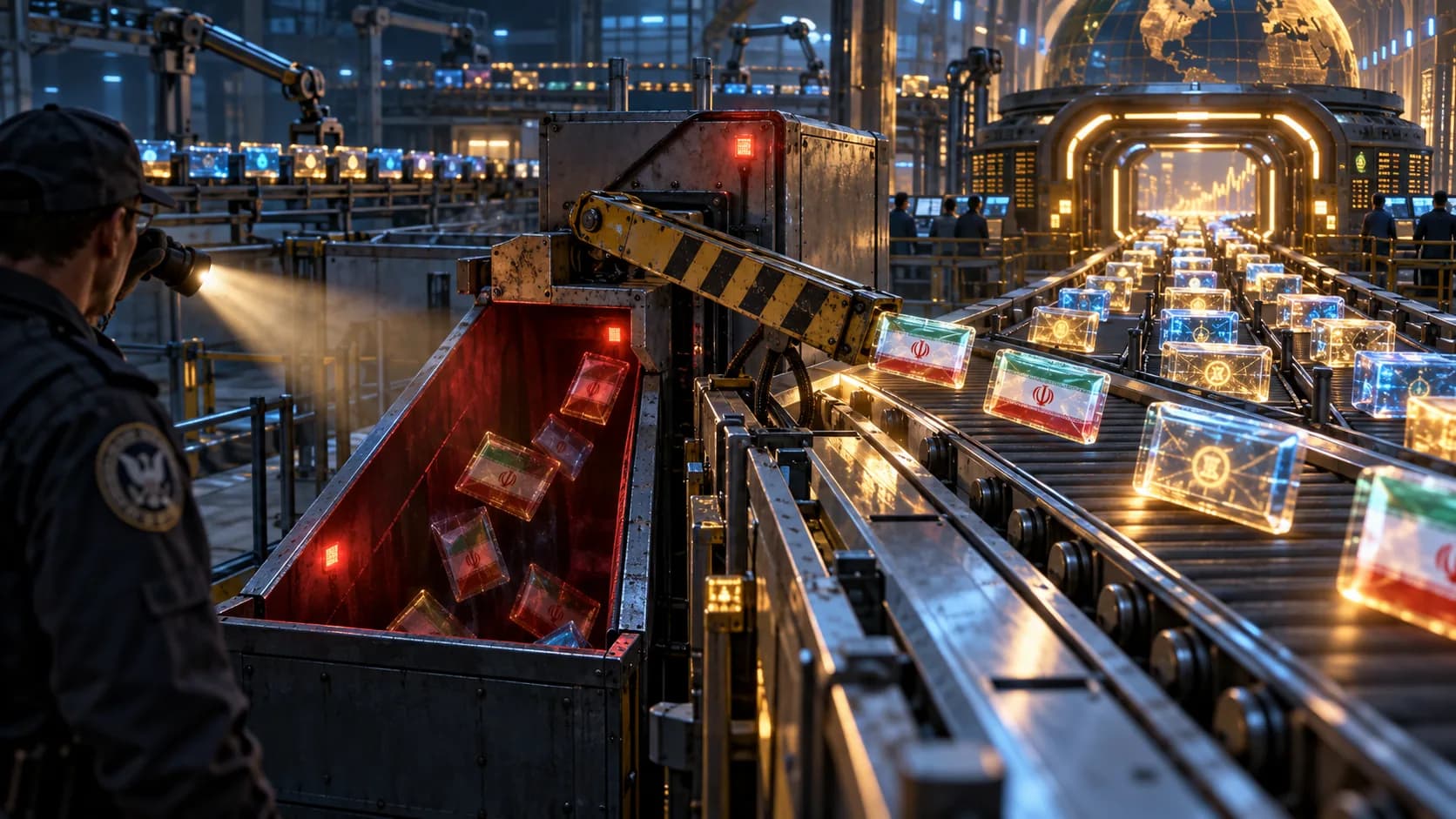
The US Treasury Department has sanctioned two cryptocurrency exchanges it accuses of helping Iran's Islamic Revolutionary Guard Corps (IRGC) launder billions of dollars, according to an August 8, 2026 report from Cointelegraph citing the Treasury announcement. The action targets the digital-asset infrastructure that Iranian state actors have used to move value outside the reach of the traditional banking system.
The designations name the exchanges as facilitators of sanctions evasion rather than incidental service providers. Treasury's Office of Foreign Assets Control (OFAC) framed the two platforms as knowing conduits for IRGC-linked funds, a distinction that carries heavier legal weight than a passive-compliance failure.
The mechanics behind the designation
Sanctioned entities lose access to the US financial system. For a crypto exchange, that cuts deeper than it sounds. Dollar on-ramps, correspondent banking relationships, stablecoin issuers, and US-domiciled infrastructure providers are all now off-limits. Any American person or company that transacts with the two exchanges risks civil or criminal penalties, and non-US firms face secondary-sanctions exposure that can sever them from US markets entirely.
OFAC typically publishes specific wallet addresses alongside these designations. Once an address is on the Specially Designated Nationals (SDN) list, compliance software at major exchanges, stablecoin issuers, and analytics firms flags it automatically. Funds that pass through a flagged address can be frozen downstream, even several hops later, which is where ordinary users occasionally get caught by association.
The market did not react. As of August 8, 2026, Bitcoin traded at $64,881, up 1.0% on the day, with Ether at $1,913 (+0.8%) and the Fear & Greed Index sitting at 40, or neutral. Enforcement actions against specific bad actors rarely move prices, since they remove illicit flows rather than legitimate demand.
A pattern of state-level enforcement
This is not an isolated move. OFAC has steadily expanded its crypto-designation program, adding mixers, over-the-counter desks, and exchanges tied to Iran, North Korea, and Russia over the past several years. The through-line is consistent: regulators now treat crypto rails as a primary vector for state-level sanctions evasion, not a fringe concern.
The IRGC angle sharpens the stakes. The Guard Corps is itself a designated entity in the US, so any exchange knowingly processing its funds is not merely lax on compliance but actively servicing a sanctioned military organization. That framing gives Treasury a stronger legal footing and signals to the wider industry that "we didn't know" is a shrinking defense.
For the broader exchange sector, the message is about screening depth. Platforms that rely on light know-your-customer checks or that operate in jurisdictions with weak oversight become attractive to exactly the flows OFAC is hunting. Regulated venues have been tightening transaction monitoring for years, and each new designation raises the baseline expectation.
Consequences for everyday crypto users
Most people spending or holding crypto have no connection to sanctioned exchanges, but the second-order effects still touch the mainstream. Compliance-driven de-risking tends to widen after high-profile designations. Exchanges freeze more accounts on suspicion, withdrawal reviews lengthen, and users in higher-risk regions face more friction even when they have done nothing wrong.
This is one of the structural arguments for spending from your own wallet. Custodial platforms sit inside the regulatory perimeter, which means a provider can freeze balances to satisfy a compliance obligation or in response to an enforcement action. Self-custodial setups shift that counterparty risk onto the user, though they do not exempt anyone from sanctions law. Screening still applies at the point where crypto meets a card network or a fiat off-ramp.
For anyone comparing where to hold funds, custody design matters as much as rewards. A crypto card linked to a custodial exchange inherits that exchange's regulatory exposure. That trade-off, convenience versus control, is worth weighing before parking a large balance anywhere.
Overview
The US Treasury sanctioned two cryptocurrency exchanges on August 8, 2026 for allegedly laundering billions on behalf of Iran's IRGC, cutting the platforms off from the US financial system and exposing any counterparty to secondary sanctions. The action fits a multi-year pattern of OFAC targeting crypto rails used for state-level sanctions evasion. Prices held steady, with Bitcoin at $64,881, but the designation raises the compliance bar across the exchange sector and is a reminder that custodial balances carry regulatory as well as counterparty risk.