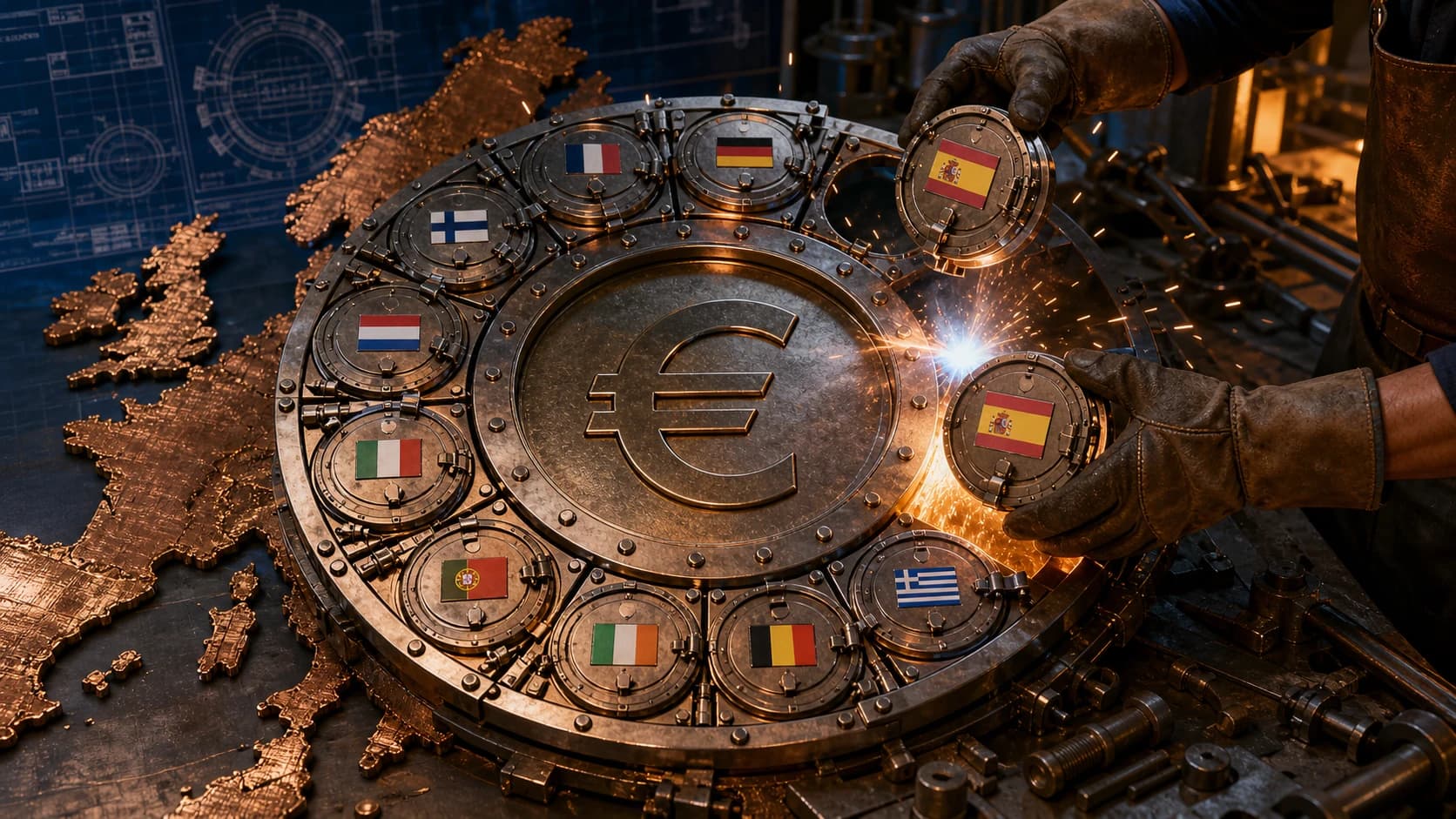
Spanish lenders Banco Sabadell and Bankinter are preparing to join the bank-led European stablecoin consortium, according to a Reuters report on May 5, 2026 citing Spanish daily Expansion. Their participation would lift the group to 11 European banks coordinating on a euro-denominated stablecoin under the MiCA regime.
The consortium was first publicly outlined in late 2025 by a group of nine institutions, including ING, UniCredit, KBC, Danske Bank, DekaBank, SEB, CaixaBank, Banca Sella and Raiffeisen Bank International. The plan is to issue a regulated euro stablecoin through a jointly owned entity supervised in the Netherlands, with reserves held at participating banks. Sabadell and Bankinter would be the second and third Spanish lenders in the group, joining CaixaBank.
A bank-issued euro coin under MiCA
MiCA, in force across the EU since the end of 2024, treats fiat-referenced stablecoins as e-money tokens and requires authorized issuers, full reserve backing, daily redemption at par, and capital buffers. The bank consortium's pitch is direct: regulated euro-area lenders are already authorized credit institutions, so they can issue under MiCA without standing up a new license stack from scratch.
That distinguishes the project from the dominant private issuers operating in Europe today. Circle's EURC and Societe Generale-Forge's EURCV have circulated under MiCA, but neither is a multi-bank effort. The consortium is positioning its token as a settlement instrument across European retail banking rather than a trader-focused asset on a single chain.
Reuters cited the Expansion report; details on the issuer entity, target chains, redemption mechanics and target volumes for the Spanish additions were not disclosed. The consortium had previously indicated that initial issuance is planned for the second half of 2026.
Three of Spain's larger commercial banks land alongside CaixaBank in the consortium
Adding Sabadell and Bankinter gives the group three of Spain's larger commercial banks, alongside CaixaBank. Spain has been one of the more active markets for crypto onboarding in continental Europe, with BBVA opening crypto trading to retail clients earlier this year and Spanish merchant acceptance of stablecoin rails growing through providers serving the Spanish market.
A Spanish-heavy consortium also aligns with the country's enforcement of MiCA through the CNMV and the Bank of Spain. If the eventual euro stablecoin gains traction in Spanish retail and SME payments, the local supervisory relationships at issuer banks will matter for distribution.
There is a competitive backdrop. Circle moved its European operations under MiCA from France in 2024 and runs EURC as a public-chain token. The bank consortium's strategy is closer to the model Tetra Trust laid out in Canada with CADD, where a regulated trust entity issues a stablecoin directly tied to a domestic banking rail.
H2 2026 issuance targets bank-to-bank settlement
The European consortium's timeline is slower than what Western Union announced this week, when it launched USDPT on Solana for remittance corridors. The bank effort is not chasing crypto-native flows. It is targeting institutional cash management, intra-bank settlement and eventual retail use through existing banking apps.
The friction point will be reach. Even with 11 banks, the group still covers a fraction of European deposits. ING, UniCredit and CaixaBank are sizable, but the largest banks in Germany, France and the Netherlands are not in the lineup yet. The Spanish additions are incremental rather than structural.
For consumers, the practical question is whether the eventual euro stablecoin will plug into existing card and wallet rails, or remain a wholesale instrument. SpendNode tracks the consumer side of that question through stablecoin-spending cards where USDC and USDT settlement is already common; a regulated euro coin from a bank consortium would give European users a direct local-currency option if it eventually reaches retail wallets.
Sabadell and Bankinter stakes, target chains, and reserve mechanics stay undisclosed
Expansion's report, as relayed by Reuters, does not specify when Sabadell and Bankinter formally sign on, what stake they take, or whether either is contributing reserve assets at launch. The original consortium announcement indicated a Dutch-supervised issuer entity, but the operational details, including which blockchains the token will run on, have not been confirmed publicly.
Until the issuer entity is named and a launch date is set, the news is a signal of momentum rather than a market event. The euro stablecoin market remains small in absolute terms compared to USD stablecoins; CoinGecko data shows euro-pegged tokens in aggregate are well under 1% of total stablecoin market cap.
Overview
Banco Sabadell and Bankinter are reportedly preparing to join a bank-led European stablecoin consortium, taking the group to 11 European lenders. The project plans a MiCA-regulated euro stablecoin issued through a Dutch-supervised entity, with launch previously targeted for the second half of 2026. The Spanish additions deepen the consortium's footprint in one of Europe's more crypto-active retail markets but do not change the launch timeline. Operational details, including chains and reserve mechanics, remain undisclosed.