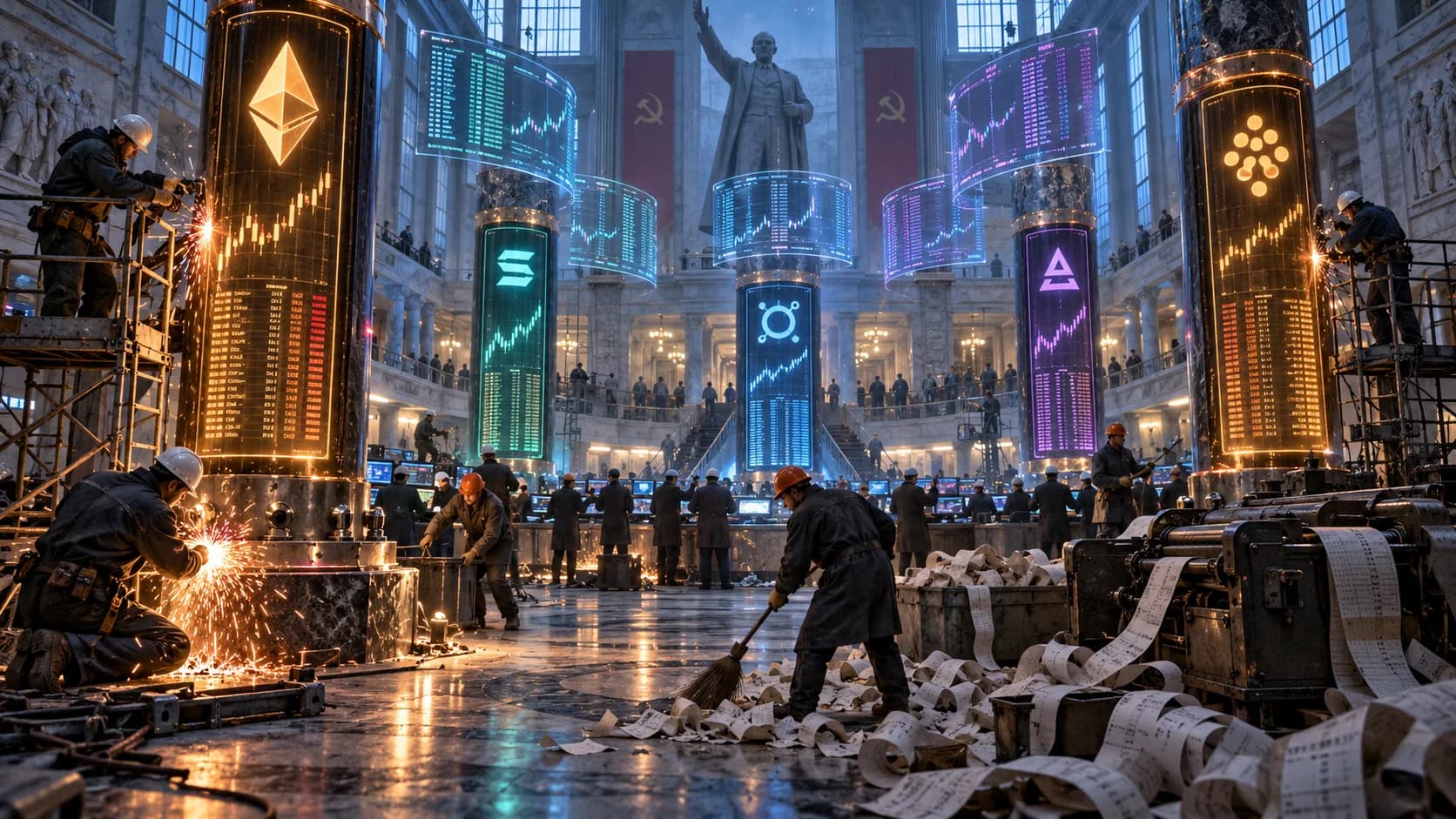
Moscow Exchange, Russia's largest stock exchange, plans to launch crypto perpetual futures covering Bitcoin, Ethereum, Solana, XRP and TRX, according to a September 17 report from crypto news outlet WuBlockchain citing the exchange's move. The listing would put perpetual contracts, one of the most traded products in crypto, inside a regulated national venue rather than an offshore exchange.
The plan lands in a market where prices have been flat to slightly higher. As of September 17, 2026, Bitcoin traded at $76,323, up 0.6% on the day, with Ethereum at $2,437 (+1.4%) and Solana at $99.53 (+2.6%), per CoinMarketCap's market snapshot. XRP sat at $1.30 and TRX was not in the snapshot's price set. The CoinMarketCap Fear and Greed index read 63, in "Greed" territory, so the news arrives against a calm rather than panicked backdrop.
The product, not just the tickers
Perpetual futures are contracts with no expiry date. Traders hold a leveraged position and pay or receive a periodic funding rate that keeps the contract price tethered to the underlying spot price. They dominate crypto trading volume globally, and until now that volume has largely lived on offshore exchanges outside the reach of most national regulators.
A national exchange listing the same product changes where that activity can happen and who can supervise it. For an exchange the size of MOEX, offering perpetuals on five of the largest tokens by market value is a decision to compete for order flow that Russian traders currently send elsewhere.
The choice of assets is worth reading closely. Bitcoin and Ethereum are the obvious inclusions. Adding Solana, XRP and TRX signals that the listing is aimed at active derivatives traders who already trade those pairs on global venues, not just at institutions seeking two blue-chip benchmarks.
The funding-rate mechanism is also what makes perpetuals risky for less experienced traders. A position can stay open indefinitely, but a sharp move against a leveraged trade triggers liquidation, and funding payments accumulate the whole time a position is held. Listing the product on a mainstream national exchange widens access to that risk profile, not just to the upside.
Institutional access inside a sanctioned market
The wider context here is Russia's position as a heavily sanctioned economy with restricted access to Western financial rails. A regulated domestic derivatives market gives Russian institutions and retail traders a way to gain crypto exposure without routing through foreign platforms that may block or freeze them. That is analysis rather than a stated goal of the exchange, but it is the practical effect a domestic listing tends to have.
It also fits a broader pattern of national and near-national exchanges moving into crypto derivatives. Singapore's exchange has prepared crypto perpetual futures for US institutions, and traditional banks have started building crypto custody for institutional clients. MOEX joining that group extends the trend into a market that Western venues cannot easily serve.
The gap between derivatives and spending
For everyday crypto users, a futures listing is not the same as easier crypto spending. Perpetuals are a trading instrument, not a payment tool, and leveraged positions carry liquidation risk that has nothing to do with holding or spending crypto. A trader who wants exposure through MOEX still faces the same question every crypto user faces at the point of sale: converting holdings into something a merchant accepts.
That separation matters in a sanctioned market especially. Access to a regulated exchange does not automatically translate into access to international card networks or self-custody spending options, which remain constrained for Russian residents by both sanctions and card-issuer policies. Derivatives volume can grow on a domestic venue while the practical path from crypto balance to a coffee purchase stays narrow.
Overview
MOEX, Russia's largest stock exchange, plans to list crypto perpetual futures on BTC, ETH, SOL, XRP and TRX, bringing a high-volume derivatives product into a regulated national venue. Prices were steady at the time of the report, with Bitcoin near $76,300 and the market in "Greed." The clearest read is structural: a sanctioned economy building domestic infrastructure for crypto exposure that offshore venues can no longer reliably provide. The listing does not change how Russian users spend crypto day to day, where sanctions and issuer restrictions still bind.