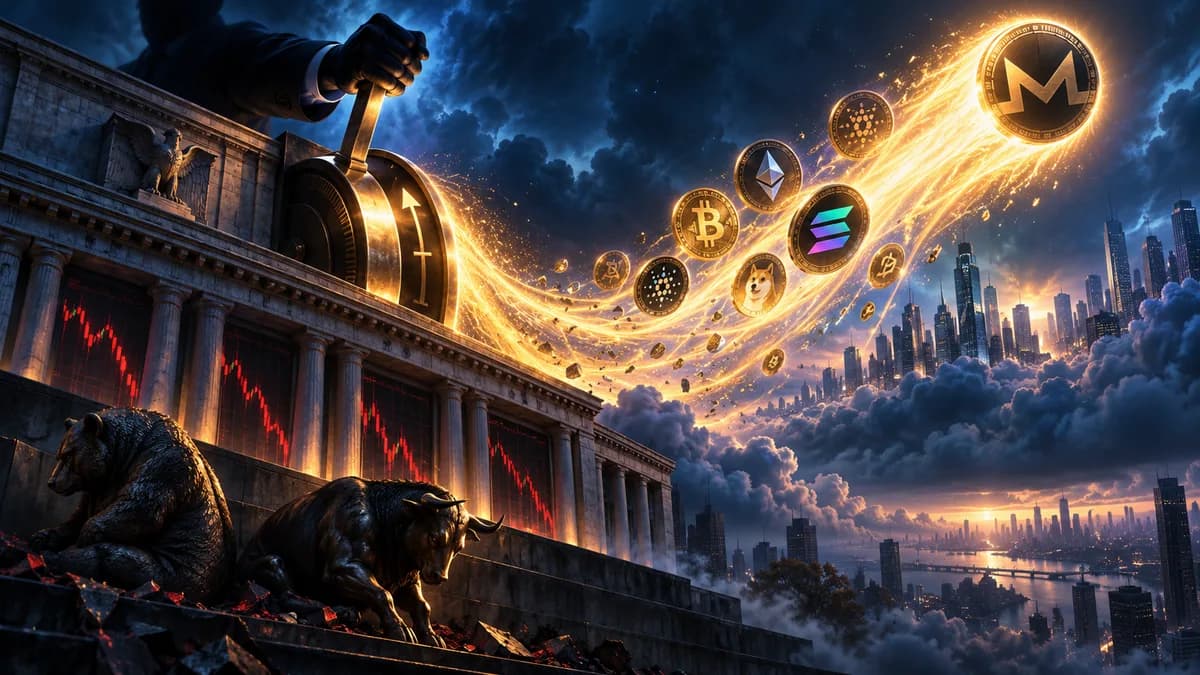
The Federal Reserve raised interest rates for the first time since 2023, and crypto did the opposite of what the textbook predicts. Bitcoin and the major tokens rose into the decision rather than falling, and Zcash jumped 23% on the day, according to CoinDesk's market coverage on September 17, 2026.
Higher policy rates usually pull money out of risk assets. Cash and short-dated government debt start paying more, so speculative positions get repriced lower. This time the reaction ran the other way, and that divergence is the actual story.
The tape on hike day
As of September 17, 2026, Bitcoin traded at $76,377, up 0.8% over 24 hours but still down 2.45% on the week. Ether sat at $2,436, up 1.4% on the day. Solana led the majors at $99.61, gaining 2.5%. BNB held $724.25, up 1.4%, while XRP lagged at $1.30, down 0.3% on the day and off 6.6% over seven days.
Zcash was the standout. A 23% single-day move in a token this size is not a quiet drift higher, and it came on the same session that a rate hike would normally cap upside across the board.
Sentiment matched the price action. CoinMarketCap's Fear and Greed index read 64, in "Greed" territory, on a day that carried an obvious excuse to turn defensive. Traders were leaning in, not stepping back.
A market pricing its own scenario
Two readings explain a rally into a hike, and they are not mutually exclusive.
The first is that the hike was already in the price. Fed decisions rarely surprise on the day. When an increase is widely expected, the drawdown tends to happen in the weeks before, on the anticipation, not on the announcement. Bitcoin being down 2.45% on the week while up on the day fits that pattern: the pain got taken earlier, and the confirmation cleared the overhang.
The second is that crypto is trading on a different macro thesis than the one the Fed is signaling. A rate hike after a long pause is usually a response to inflation that will not cool on its own. If buyers treat that as a reason to hold a fixed-supply asset like Bitcoin, or privacy-focused assets like Zcash, then hawkish policy becomes a bullish input rather than a bearish one. That is a bet on debasement, not on the Fed's comfort.
Neither reading is confirmed by a single day of candles. Both are consistent with what the tape showed on September 17.
The takeaway for crypto spenders
For anyone holding stablecoins or funding a card off a crypto balance, the practical takeaway is about volatility, not direction. A market that shrugs off a rate hike can reverse just as sharply on the next data print, and a 23% single-name move in either direction is a reminder of how fast the ground shifts.
That is the case for keeping spending balances in dollars rather than tokens. A stablecoin-funded card insulates day-to-day purchases from exactly this kind of swing, so a hawkish Fed headline does not change what your grocery run costs. It also removes a tax event on every transaction in jurisdictions that treat crypto disposals as taxable, which matters more in a volatile tape where balances move a lot.
If you would rather stay in volatile assets and spend from them directly, the trade-off is real exposure at the point of sale. The token you swipe today can be worth noticeably less by the time it settles, and the disclosed card fee is not the full cost. Network spread and the crypto-to-fiat conversion at checkout stack on top of it. That gap widens on days when the underlying is moving several percent.
The read to hold
The signal here is not that a rate hike is bullish for crypto. It is that the correlation between Fed tightening and falling token prices broke on September 17, at least for one session. Zcash up 23%, Bitcoin green on the day, and a Greed reading on the sentiment index all point to a market that is not taking its cue from the Fed's playbook right now. The next test is whether that holds through the follow-on data, or whether hike day was the local top before the anticipation trade unwinds.
Overview
The Fed raised rates for the first time since 2023, and crypto rose instead of falling. Bitcoin held $76,377 as of September 17, 2026, Ether and Solana gained, and Zcash jumped 23%. The move suggests either that the hike was already priced in over the prior week or that crypto buyers are treating tightening as a debasement bet rather than a reason to sell. For spenders, the lesson is volatility management: stablecoin balances shield everyday purchases from swings that a single macro headline can trigger.