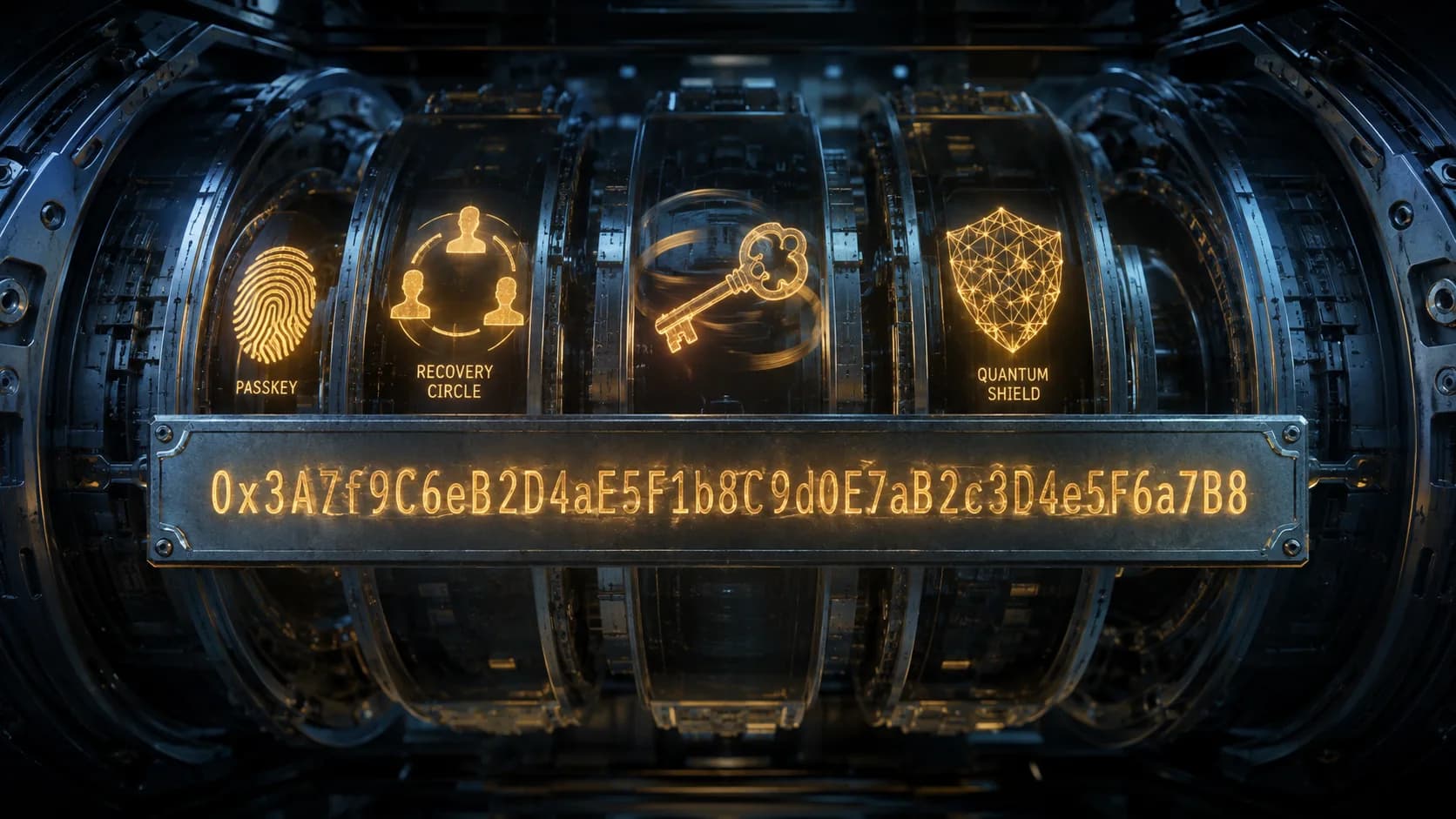
Monad developers have put forward a proposal to make account authentication upgradeable, letting a wallet change how it verifies transactions without changing its on-chain address. The plan, shared by Cointelegraph on August 25, 2026, covers passkeys, social recovery, key rotation, and post-quantum signature schemes under a single account model.
The core idea is a split between an account's identity and the method used to prove control of it. Today, most wallets tie the two together: the address is derived directly from a private key, so losing that key means losing the account, and there is no clean way to switch signing schemes later. Monad's proposal decouples them, so the address becomes a stable anchor while the authentication logic sitting behind it can be replaced.
The address stays put while the lock changes
The practical consequence is that a user could rotate keys after a suspected compromise, add a passkey for phone-based signing, or wire up social recovery, all without migrating funds to a new address or updating every service that knows the old one.
That matters more than it sounds. Address changes are one of the quieter sources of loss and friction in crypto. Contacts save the wrong address, allowlists go stale, and recurring payments break. Keeping the address fixed while the security model underneath evolves removes a class of migration risk that has existed since the earliest wallets.
Key rotation is the part with the most immediate security value. If a private key is exposed, the standard advice today is to move everything to a fresh wallet as fast as possible, racing whoever holds the leaked key. Under this model, an account could instead rotate to a new signer and invalidate the old one, keeping the same address and history intact.
Passkeys and social recovery aim at the onboarding wall
Passkey support leans on the same WebAuthn standard that phones and laptops already use for biometric and hardware-backed login. For a new user, that can mean approving a transaction with a fingerprint or face scan instead of writing down a seed phrase, which remains the single biggest drop-off point in self-custody onboarding.
Social recovery addresses the other end of the lifecycle: what happens when access is lost. Rather than a single seed phrase whose loss is permanent, an account can nominate trusted parties or devices that can collectively restore control. The concept is not new, since smart-contract wallets on Ethereum have offered versions of it for years, but folding it into the base account model rather than bolting it on as a separate contract type is the notable design choice here.
These features move wallet ergonomics closer to what mainstream users expect from a bank app, without handing custody to a third party. That balance is the recurring tension in self-custody design, where the freedom of holding your own keys has always come paired with the burden of never losing them. The same trade-off shapes how minimal-verification onboarding is built, since reducing friction cannot mean reducing the user's control over their own funds.
Post-quantum signing is a longer bet
The proposal also includes support for post-quantum signature schemes. Current wallets rely on elliptic-curve cryptography, which a sufficiently powerful quantum computer could eventually break. No such machine exists today, and estimates for when one might arrive vary widely, so this is a forward-looking provision rather than a response to a present threat.
Building the ability to swap signature schemes into the account model now means an account created today could adopt quantum-resistant signing later without abandoning its address. For a chain positioning itself for long-lived accounts and institutional use, designing that flexibility in early is cheaper than retrofitting it under pressure.
The broader wallet-security field has been moving in the same direction. Hardware makers keep tightening the signing step itself, with recent work from Ledger on real-time transaction screening, and smart-account standards on other chains continue to expand what an account can do beyond holding a key. Monad's contribution is to treat authentication as a modular, upgradeable layer from the start rather than a fixed property set at account creation.
Practical caveats
This is a proposal, not a shipped feature. Details around how recovery guardians are chosen, how rotation is authorized, and how wallet software such as MetaMask and others would expose these controls will determine whether the design holds up in practice. Recovery systems in particular carry their own risk: a poorly configured guardian set can become an attack surface rather than a safety net.
The security value is also only as strong as the weakest authentication method an account enables. Adding a passkey does not help if the underlying key remains exposed, and social recovery does nothing if the nominated parties can be compromised or coerced. Flexibility cuts both ways, and each option a user turns on is another thing to configure correctly.
Overview
Monad developers proposed making account authentication upgradeable, so a wallet can adopt passkeys, social recovery, key rotation, and post-quantum signing without changing its address. The design separates an account's stable identity from the method used to control it, which removes the migration risk of switching security models and closes the gap between self-custody and the login experience mainstream users expect. It remains a proposal, and its real-world safety will depend on how recovery and rotation are implemented and surfaced in wallets.