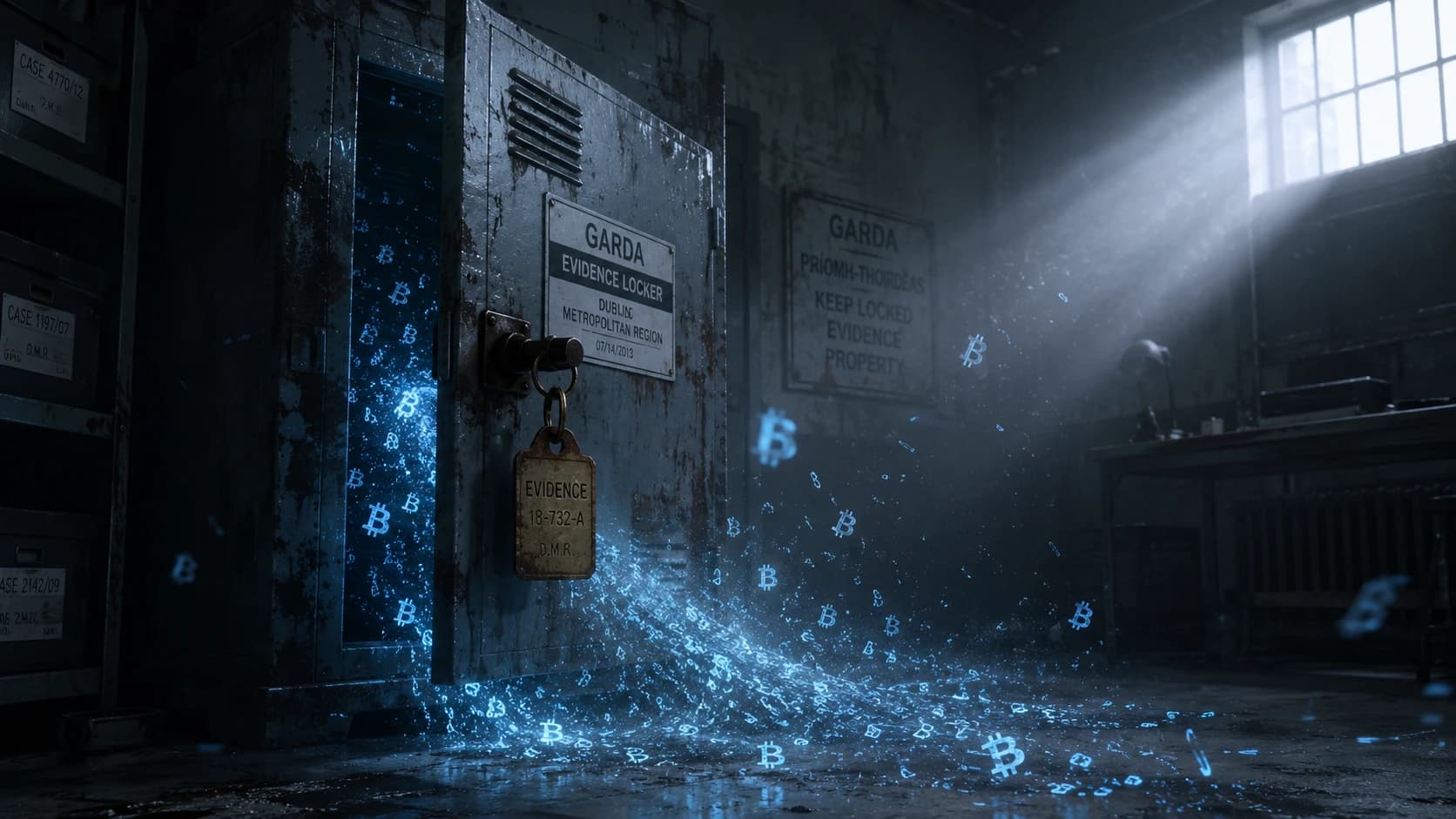
Irish authorities have recovered a long-dormant Bitcoin wallet holding 500 BTC connected to Clifton Collins, the convicted drug dealer whose missing crypto fortune became one of the most-told cautionary tales of the last cycle. Cointelegraph posted the update on May 18, 2026, citing the seizure as a fresh chapter in a case that Irish police have been chasing since 2017.
At today's spot price of $76,927 per BTC, as of May 18, 2026, the recovered wallet is worth roughly $38.46 million. Bitcoin is down 1.4% on the day and 4.7% on the week, with the broader market reading 39 on the Fear and Greed index, so this is a seizure landing on a soft tape rather than a euphoric one.
The Collins backstory
Collins is a name that crypto compliance teams have known for years. He was arrested in Ireland in 2017 after police found cannabis in his rented property, and during the subsequent investigation officers discovered he had moved much of his life savings into Bitcoin. The Irish Criminal Assets Bureau has spent the better part of a decade trying to track those coins across wallets and exchanges.
The folk-tale version, that Collins lost access to thousands of BTC after a landlord threw out a piece of paper holding his seed phrase, has been retold so many times it became shorthand for self-custody risk. The story usually skips the law enforcement side: the coins were never abandoned by the state, just unreachable. The 500 BTC surfacing now suggests at least part of the trail has gone cold less than people assumed.
A different kind of recovery
This is not a private-key brute force or a wallet drain. The framing in the original report is that authorities recovered the wallet itself, meaning they located coins associated with Collins and brought them under state control. That is materially different from a chain-analysis breakthrough on lost keys.
For Irish taxpayers the implication is straightforward. Proceeds-of-crime seizures in Ireland flow through the Criminal Assets Bureau and ultimately into state coffers, with disposal typically handled through court-supervised liquidation. Past CAB Bitcoin seizures have been sold at public auction once legal claims are extinguished.
Market and policy context
A $38.5M state seizure does not move the spot market in either direction. But timing matters for two adjacent stories. First, Bhutan's disputed $1B Bitcoin drawdown is still being argued out in public, and the Irish recovery is a reminder that sovereign Bitcoin balances are not always under the control everyone assumes. Second, US discussions around a strategic Bitcoin reserve continue to drag in questions about what governments should do with seized coins once they hold them.
Ireland has historically chosen to liquidate. The UK, by contrast, has held seized coins for years in some cases, and the United States has rotated between auction and direct sale via the US Marshals Service. None of these governments has openly adopted a hold-as-reserve policy yet, even as the political pressure builds.
Risk lessons that still apply
The Collins case will keep getting cited in self-custody discussions because the underlying lesson has not changed. A single point of failure on a seed phrase, paper or otherwise, ends the same way every time. Multisig setups, encrypted backups, and inheritance planning all exist precisely because this story repeats.
The flip side is also worth naming. Law enforcement tooling has improved enough that an old wallet sitting untouched is not safety, it is exposure. Forensic firms can patiently watch addresses for years and pounce the moment a small movement reveals control. Holders who think dormancy is privacy have the timeline backwards.
For SpendNode readers thinking about where they keep spendable balances, the takeaway is narrower: keep the float small, keep the cold storage genuinely cold, and remember that a card balance is not a vault. Custody choices on your day-to-day spending wallet are separate from how you protect long-term holdings.
Overview
Irish authorities surfaced a 500 BTC wallet linked to Clifton Collins on May 18, 2026, worth roughly $38.5M at a spot price near $77K. The case dates back to a 2017 arrest and adds a fresh entry to a long line of sovereign Bitcoin seizures. Disposal will likely flow through Ireland's Criminal Assets Bureau process, and the recovery underlines once again that dormant wallets are not the same as safe ones.