In the traditional financial world, a "premium" credit card offers 1.5% to 2% cashback. In the 2026 crypto card landscape, that's considered a failure. We have entered the era of the Rewards Optimization Meta—a tactical environment where users no longer look at cashback in isolation.
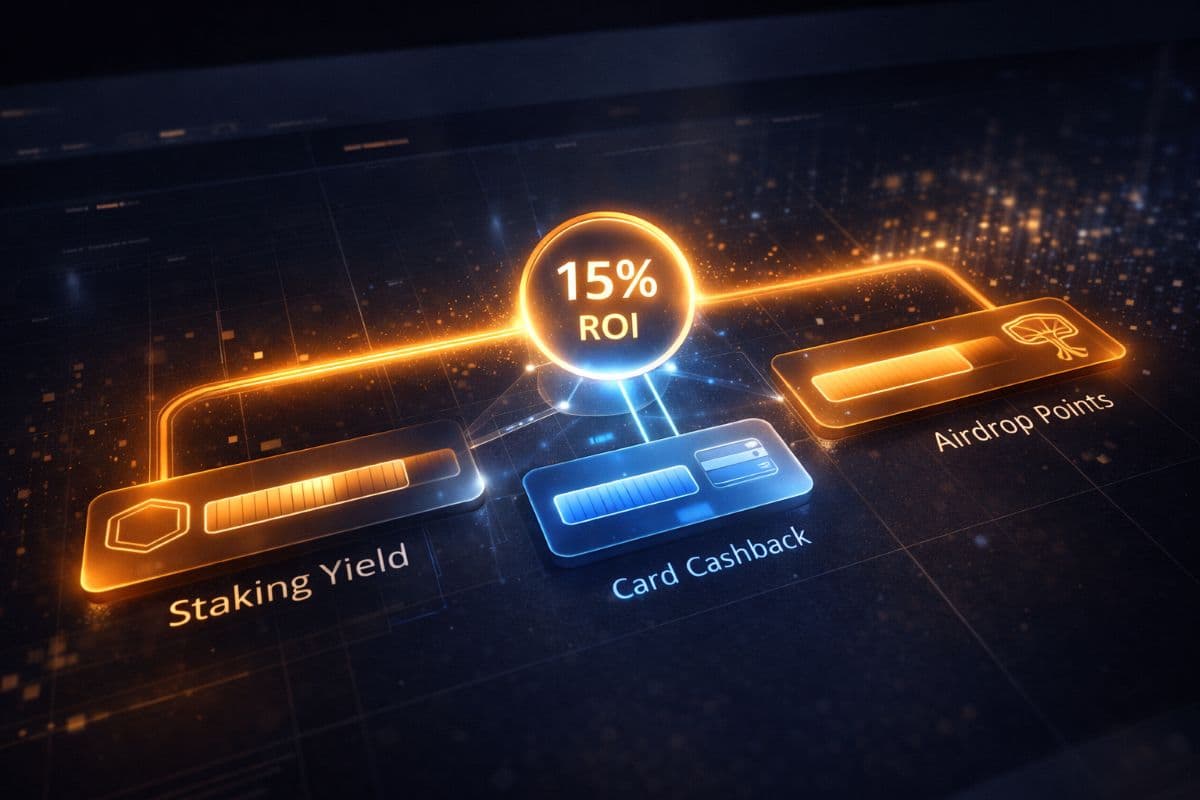
To achieve "Alpha" in 2026, you must move beyond the simple swipe. You must learn to "Stack" your capital across multiple layers of yield. By combining native restaking rewards, aggressive card cashback tiers, and speculative airdrop points, the top 5% of spenders are now hitting a 15% net ROI on their annual household expenses.
This guide breaks down the math, the ecosystems, and the "Triple Play" model required to turn your debit card into a high-performance yield engine.
1. The "Triple Play" ROI Model
To hit 15%, you cannot rely on one source of income. You must align three distinct components of value:
Component 1: Native Yield (The Foundation)
Stop holding "Dead" fiat or "Idle" stablecoins. In 2026, your spending balance should always be earning.
- Restaked ETH (eETH): By using an ether.fi card, your balance sits in a restaking pool earning ~3-4% APY until the millisecond you swipe.
- Yield-Bearing Stablecoins (USDe): Holding Ethena's USDe can provide 10%+ yield, and many 2026 cards now allow you to use this as your primary collateral.
Component 2: Base Card Cashback (The "Meat")
This is the advertised rate on the box. In 2026, the competitive floor has shifted:
- Entry Level: 1-2% (No-stake).
- Professional: 4-6% (Requires moderate staking or subscription).
- Whale/Supreme: 8-10% (Requires high-net-worth status or massive trading volume).
Component 3: Airdrop Points Value (The "Alpha")
This is the "Hidden" yield. Cards like Tria or MetaMask track your "Proof of Spend." Every transaction increases your wallet's reputation and qualifies you for future token distributions. While speculative, the "Realized Value" of these airdrops often adds an effective 2-5% to your annual ROI.
The Death of 1% Cashback: Why the Meta Shifted
In 2021, a 1% Bitcoin cashback card was a revolution. In 2026, it is a relic. The reason for this shift is the Institutionalization of Interchange. As card networks like Visa and Mastercard have opened their rails to crypto issuers, the "Customer Acquisition Cost" (CAC) has plummeted. Issuers are now willing to operate at a loss on the transaction fee to capture your "Primary Checking" relationship. This has created a "Subsidy War" where users who understand the math can extract massive value from competing VC-backed treasuries.
2. Comparing the "Big Three" Ecosystems
As of early 2026, three ecosystems dominate the optimization meta. Each requires a different capital strategy.
A. Bybit Supreme: The "Whale" Play
- Max ROI: 10% (Fixed Cashback).
- Requirement: "Supreme VIP" status ($100k+ balance or $100M+ monthly trading).
- The Strategy: This is pure cashback. If you are an active trader, the 10% rate (capped at $600/mo) is the most reliable way to subsidize your lifestyle. It doesn't rely on points or speculation—it is hard cash.
B. Tria: The "Self-Custody" Play
- Max ROI: ~12-14% (Combined).
- Requirement: Signature Tier card ($109/year) + "Proof of Spend" activity.
- The Strategy: Tria offers 6% cashback in USDC. When you combine this with the speculative value of their "Spend-to-Earn" points (which represent protocol equity), you are effectively earning a 10%+ yield while keeping your funds in your own keys via self-custody.
C. ether.fi: The "Restaking" Loop
- Max ROI: ~15% (Dynamic).
- Requirement: Holding eETH or weETH as your collateral.
- The Strategy: This is the most technically efficient stack. You earn 4% native staking yield + 4% card cashback + ether.fi loyalty points. During promotional "Dining Boosts" (which can hit 15% alone), this stack becomes the highest-yielding financial instrument in the world.
Ecosystem Deep Dive: The "Arbitrum Hub" Play
While Solana leads in transaction velocity, the Arbitrum ecosystem has emerged as the 2026 leader for institutional-grade rewards. By using a card that integrates with Arbitrum L2, users can tap into the "GMX Dividend Loop."
- The Base: Hold GLP or GMX assets in your vault.
- The multiplier: Use those yield-bearing assets as card collateral.
- The Alpha: In 2026, the Arbitrum Foundation often provides "incentive matching." Every dollar of cashback you earn on your card is matched by a small grant of $ARB tokens, effectively doubling your rewards during seasonal campaigns. This makes Arbitrum the preferred network for users who want a balance between high yield and professional-grade security.
3. The "Stable-Stack" Strategy: Maximizing USDC
Stablecoins are the bridge between your "Savings" and your "Spending." To optimize your ROI, you must never let your USDC sit at 0% yield.
- Deposit USDC into a lending vault (like Aave or Morpho).
- Use a card that supports "Lending Collateral" spending.
- The Result: You earn 5-8% on your savings, and the card only liquidates what you spend. You effectively "borrow" your own money at a net-positive rate.
Leveraged Spending: The 2026 Pro Meta
The most advanced users are now using Yield-Bearing Collateral (YBC). Instead of raw USDC, they hold weETH or PT-eETH (Pendle Principal Tokens).
- The Math: PT-eETH can offer a fixed 15-20% implied yield. By using a card that accepts Pendle tokens as collateral (like the upcoming Tria v3), you are spending against an asset that is growing faster than your debt. This is "Leveraged Living," and it is the ultimate expression of the 2026 meta.
Tax-Aware Optimization: Yield vs. Capital Gains
Optimization isn't just about what you earn; it's about what you keep. In 2026, the tax treatment of rewards varies significantly.
- Cashback (Rebates): Generally treated as a non-taxable reduction in purchase price. This is the "Cleanest" yield.
- Staking Rewards (Income): Treated as ordinary income at the fair market value when received.
- The Meta: Top-tier spenders prioritize Stablecoin Cashback (like Tria's 6% USDC) because it has no capital gains risk. They use their volatile rewards (like WXT or CRO) to "Tax-Loss Harvest" during market dips, effectively using their card rewards to lower their overall tax bill.
4. The "Airdrop Multiplier": Transaction Velocity
In 2026, airdrops are no longer about "Holding"; they are about "Using." Protocol teams want active users, not "Sybil" bots.
- Transaction Frequency: A wallet that makes 50 transactions of $10 each is often valued higher than a wallet that makes one $500 transaction.
- Merchant Diversity: Spending at a mix of "Real World" merchants (Grocery stores, Airlines, Utilities) proves you are a human. This "Humanity Score" acts as a multiplier for your points accrual.
Social Reputation & Referral Chains
2026 has introduced the "Spend Team" mechanic. Cards like MetaMask and Tria now allow you to form "referral squads."
- The Loop: If your squad collectively spends $50,000 in a month, everyone gets a 1.5x multiplier on their airdrop points. This turns rewards optimization into a social game, rewarding high-velocity communities over isolated whales.
Governance Token Alpha: Spending as a Vote
A new trend in 2026 is Spend-to-Vote. Protocol DAOs are starting to allocate governance power based on "Economic Activity." By using a protocol-native card (like the Gnosis Pay card), your spending volume translates into "Governance Reputation." This doesn't just give you airdrops; it gives you early access to private seed rounds and higher multipliers on future protocol incentives. Your card is no longer just a payment tool—it is your VIP pass to the protocol's future.
5. Risk vs. Reality: The Volatility Trap
A "10% Reward" is only 10% if the reward token holds its value.
The "Net Profit" Formula:
- Net ROI = (Reward Rate x Token Price at Sale) - (Conversion Fees + FX Markup + Subscription Fees).
If you earn 8% in a platform token, but the token drops 50% before you can sell it, your real reward is only 4%. To hit a consistent 15%, you must prioritize cards that pay out in Stablecoins or Blue Chips (BTC/ETH), or you must be prepared to "Auto-Swap" your rewards into USDC daily.
The "Auto-Swap" Automation: A Technical Requirement
To protect your ROI in 2026, you must automate your exit. Pro users use Webhook-based Swaps. Every time a reward is credited to their account, a trigger fires on a DEX aggregator (like CoW Protocol) to instantly convert that volatile reward token into USDC. This locks in the "Net ROI" and prevents the "Volatility Leak" from destroying your annual gains.
6. The Multi-Card Workflow: Managing the Rotation
To hit 15%, you cannot be loyal to one brand. The 2026 meta requires a Rotation Workflow.
- The Primary (Yield Focus): Your base capital sits in an ether.fi card for the 4% restaking yield.
- The Tactical (Blitz Focus): When a card like Bybit launches a 10% "BTC Blitz," you move 50% of your monthly spending volume to that card until the promo cap is hit.
- The Residual (Point Focus): Small, daily "Humanity Score" transactions (like coffee or transit) go through your Tria or MetaMask card to keep your airdrop eligibility active. This rotation requires a central "Fintech Hub" app to track your total net ROI and upcoming caps, but the 5-7% gain in net yield makes the 10 minutes of weekly management worth thousands of dollars.
7. Why Banks Can't Compete with the Meta
Traditional banks are burdened by "Legacy Drag." They have thousands of physical branches, 1970s mainframe software, and massive compliance overhead. This consumes nearly all of the 3% interchange fee they collect from merchants. Crypto card issuers, by contrast, are "Lean Rails." They have no branches and their compliance is automated by code. This allows them to pass 90% of the transaction value back to you in the form of rewards and yield. In 2026, the gap between a 1% bank rebate and a 15% crypto stack is the "Efficiency Gap," and it is the primary reason why the bankless lifestyle is winning.
8. History of Reward Blitzes: Why 15% Exists
Users often ask: "How is 15% sustainable?" The answer is it isn't—for the issuer. These high rates are Customer Acquisition Blitzes.
- The Logic: An issuer like ether.fi or MEXC calculates that a user who tries their card during a 15% promo has a 60% chance of becoming a long-term user. The "Loss" they take on your 15% dining cashback is simply a marketing expense.
- The Meta: The smartest users rotate their "Primary Card" every 3-6 months to follow these blitzes, effectively living on a permanent VC subsidy.
9. Whale Strategy vs. Retail Strategy
The path to 15% depends on your net worth.
The Whale Path ($100k+ Collateral)
- Priority: Stability and Caps.
- The Stack: Bybit Supreme (Fixed 10%) + Ethena USDe Base (10% Yield).
- The Result: A reliable, low-effort 20% ROI on annual spend.
The Retail Path (Under $5k Collateral)
- Priority: Multipliers and Speculation.
- The Stack: Tria Signature (6% USDC) + Solflare Points Loop (Speculative Airdrops).
- The Result: A high-upside 10-50% ROI, depending on token launch performance.
10. The 2026 ROI Calculator Template
To track your meta performance, use this weekly audit:
| Capital Layer | Asset | Current Yield |
|---|---|---|
| Base Asset | eETH / USDe | 4.2% |
| Card Cashback | Bybit / Tria | 6.0% |
| Points (Est.) | Loyalty Points | 4.8% |
| Total Stack | 15.0% |
11. The Psychology of the Optimized Spender
The final layer of the meta is psychological. To maintain a 15% net ROI consistently, you must transition from "Passive Consumer" to "Active Capital Allocator." This requires the mental discipline to track snapshots, rotate cards during promotional blitzes, and manage your collateral health daily. It turns personal finance into a high-stakes strategy game where the prize is your own financial independence. In 2026, the wealthiest users aren't just those who earn the most; they are those who spend the smartest.
Actionable Takeaways: Building Your Stack
- Step 1: Choose your Base. Move your spending capital into a yield-bearing asset like eETH (via ether.fi) or USDe.
- Step 2: Tier Up. If your monthly spend is >$2,000, it is almost always mathematically worth paying for a Premium/Signature tier card. The higher cashback rate usually "pays for the card" in 3 months.
- Step 3: Automated Liquidity. Use a card with Just-In-Time (JIT) recall. Do not manually sell crypto for fiat; let the card engine do it to maximize your yield duration.
- Step 4: Form a Team. Join or create a "referral squad" to unlock the 1.5x multiplier on your protocol points.
12. The 2026 Overview
Rewards optimization in 2026 is a game of layers. By stopping the "Idle Capital" leak and stacking native yield with high-tier cashback and protocol points, you turn your cost of living into a capital-accrual event. The 15% ROI goal isn't just a number—it's the reward for moving your financial life from the "Banked" world into the "Optimized" on-chain world.