
PlasBit Prepaid Card Review 2026
Discontinued July 31, 2026 and no longer available. The PlasBit Prepaid Card was a non-reloadable virtual card in 8 fixed denominations from $25 to $10,000, bought with crypto. Historical terms: issuance $2.50-$500, 0% loading, no monthly fee, 2% FX, Apple Pay and Google Pay, no 3D Secure.

SpendNode Rating for PlasBit Prepaid Card
No longer available. PlasBit has closed its prepaid card program; the reloadable PlasBit Debit Card remains the platform's active card. When live, these were eight fixed-balance virtual cards from $25 to $10,000, bought with crypto and clearly priced before purchase, with Apple Pay and Google Pay.
PlasBit has closed the prepaid program. When live, the prepaid line was unusually clear in-account: each denomination showed its balance, issuance fee, total price, loading fee, and monthly fee on one screen, and the fixed balance suited controlled budgets. Its roughly 5% issuance premium, 2% FX outside USD, and lack of 3D Secure were visible product terms rather than hidden costs. Users who want a PlasBit card can use the reloadable debit card instead.
How It Competes
Cost Efficiency
3.6
Product Utility
4.2
Custody & Trust
3.8
Reliability & UX
2.8
Transparency
4.4

VIRTUAL CARD
Verified

APPLE PAY
Verified
GOOGLE PAY
Verified
PlasBit Prepaid Card Overview
PlasBit's former prepaid line: fixed-balance virtual cards bought outright with crypto, spent through Apple Pay or Google Pay. No longer available.
The PlasBit Prepaid Card was a fixed-balance virtual card bought outright with crypto in eight denominations from $25 to $10,000, like a denominated gift card that worked wherever the card networks reach. PlasBit has closed the prepaid program; the card is no longer available to new buyers. Its reloadable PlasBit Debit Card remains the platform's active card. The details here are kept for reference.
Fees & Charges
Annual Fee
Free
FX Fee
2%
ATM Fee
TBD
Requirements
Supported Regions
TBD
Spendable Assets
USDT, USDC, BTC, ETH, SOL, TRX
On This Page
The PlasBit Prepaid Card was a non-reloadable virtual card sold in eight fixed denominations from $25 to $10,000, purchased with cryptocurrency from the PlasBit wallet. PlasBit discontinued the prepaid card program on July 31, 2026, and it is no longer available. Issuance fees scaled from $2.50 to $500, the cards supported Apple Pay and Google Pay but not 3D Secure, and unspent balances could not be transferred back out.
Update (August 2026): The PlasBit Prepaid Card is no longer available. PlasBit has closed its prepaid card program and now focuses on its reloadable PlasBit Debit Card. The details below are kept for reference; existing cardholders can contact PlasBit support with any questions.
A Gift Card for the Card Networks, Bought with Crypto
Almost every product in our catalog is a reloadable account with a card on top. The PlasBit Prepaid Card is the other thing: a sealed envelope of money. You pick a denomination between $25 and $10,000, pay for it in crypto from your PlasBit wallet, and receive a virtual card holding exactly that balance. Spend it down and the card is finished. There is no reload, no top-up, and no way to pull the balance back out.
That shape is the feature. PlasBit's own free Debit Card is the daily driver; the prepaid line is the specialist tool you mint for a job. As a budgeting instrument or a hard cap on a spending category, it does something no reloadable card in our catalog does: the balance is the boundary, enforced by the card itself.
We opened a PlasBit account ourselves in July 2026 and verified the prepaid line in-account: eight denominations, issuance fees exactly as published, 0% loading, and no monthly fee showing on any card.
Fees and Rates
| Denomination | Issuance fee | Total price | Fee as % |
|---|---|---|---|
| $25 | $2.50 | $27.50 | 10% |
| $50 | $2.50 | $52.50 | 5% |
| $100 | $5 | $105 | 5% |
| $250 | $10 | $260 | 4% |
| $500 | $25 | $525 | 5% |
| $1,000 | $50 | $1,050 | 5% |
| $5,000 | $250 | $5,250 | 5% |
| $10,000 | $500 | $10,500 | 5% |
Read the last column before buying: the issuance premium is roughly 5% across the line (10% on the smallest card, with the $250 card the mild bargain at 4%). That is the price of the sealed-envelope structure, and it is real money at the top denominations: the $10,000 card costs $500 to mint. Anyone whose goal is cheap spending should use the free debit card instead; the premium only earns its keep when the fixed balance itself is the point.
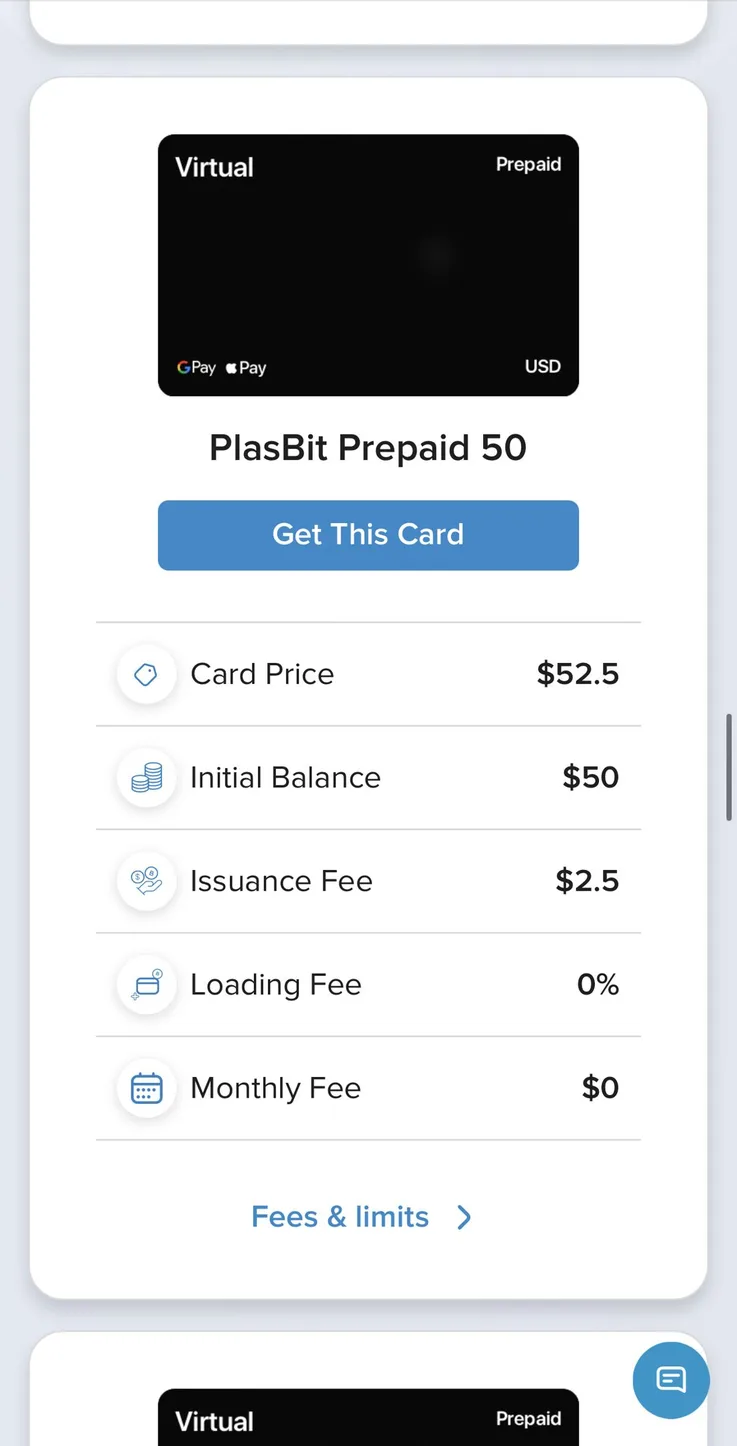
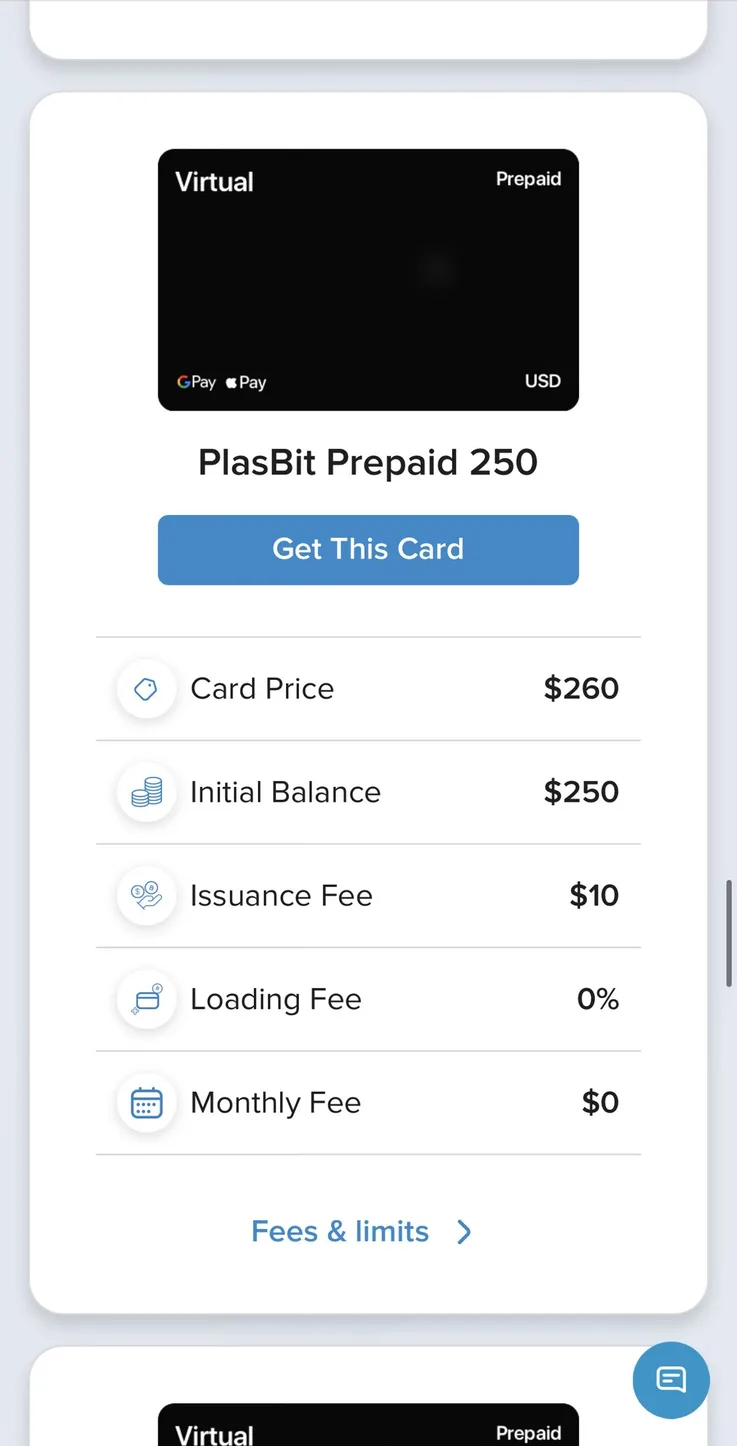
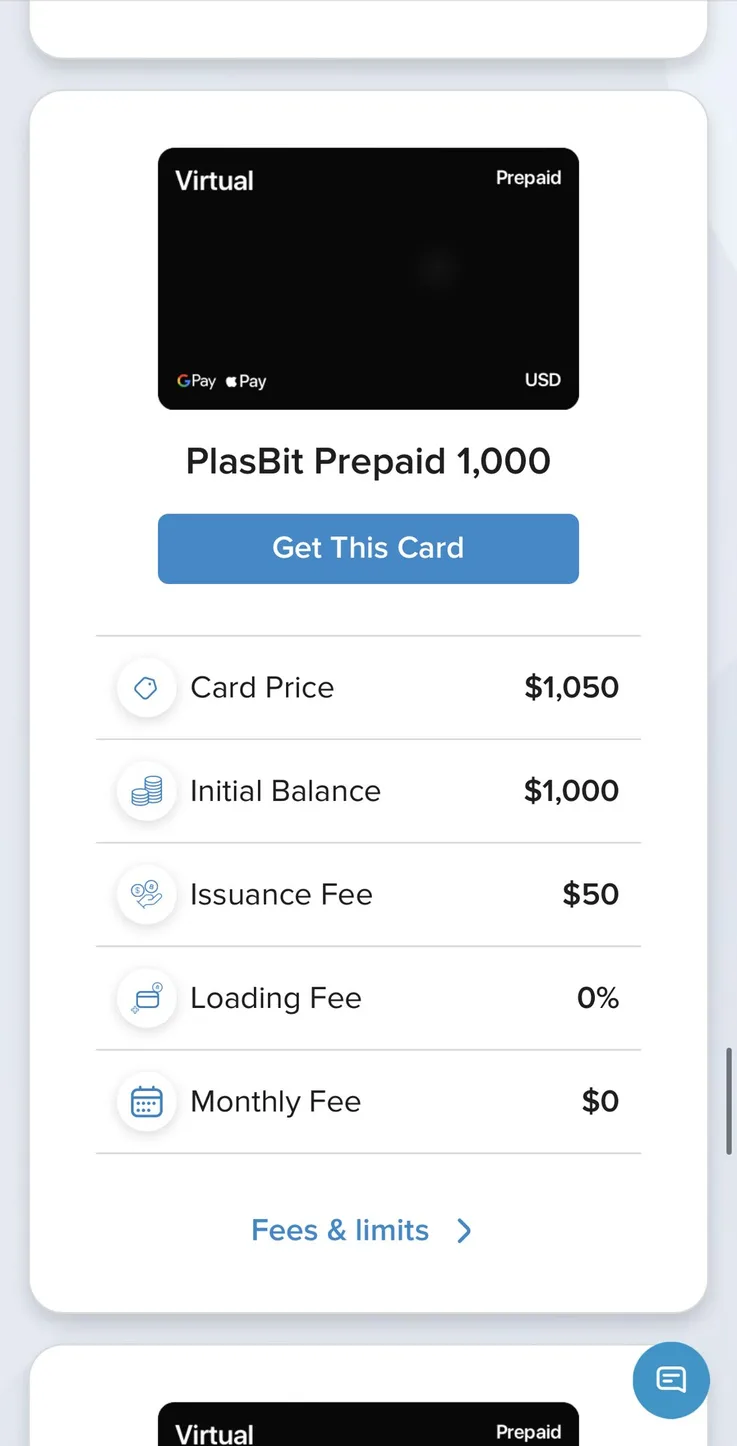
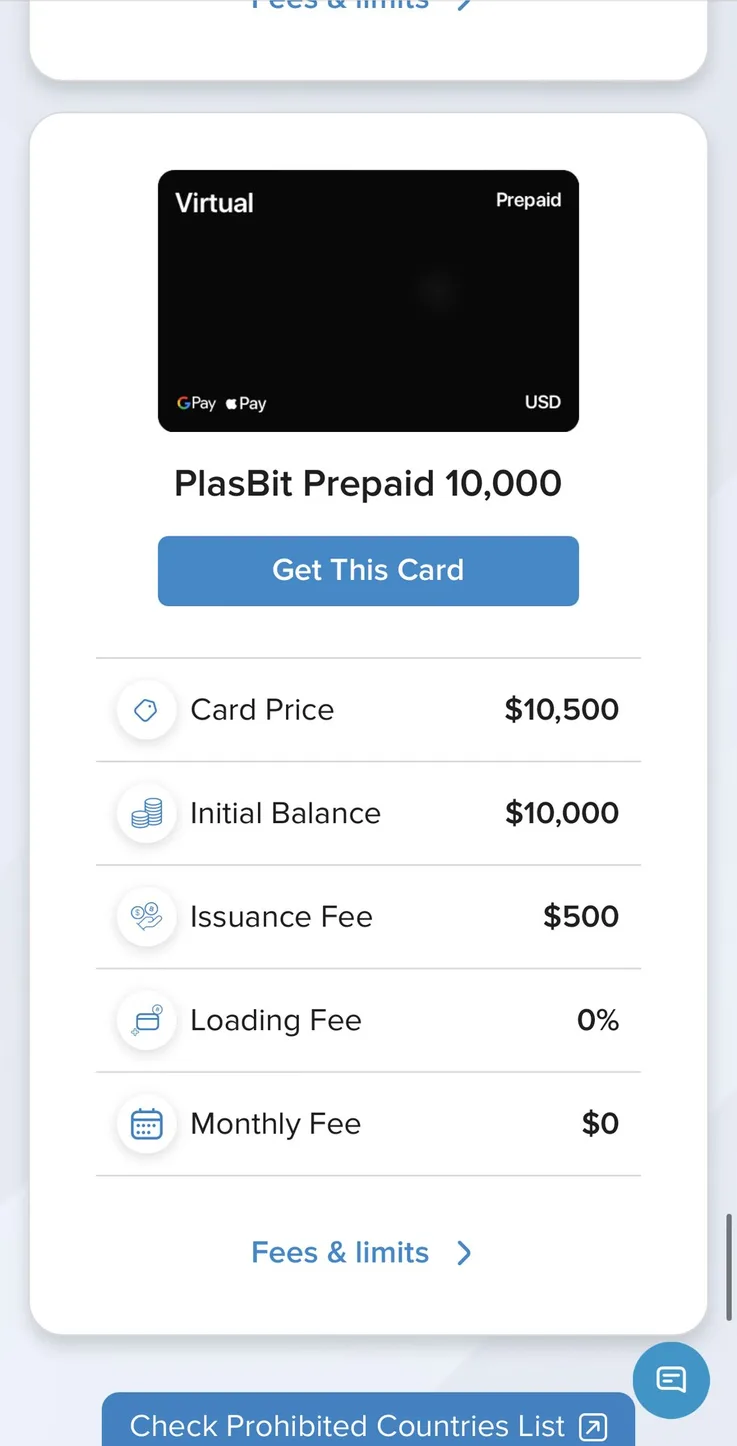
Four points on the denomination ladder in-account, July 2026: $50, $250, $1,000, and $10,000, each with 0% loading and no monthly fee.
Card Specs: What You Are Actually Getting
Form and Wallets
- Virtual only: no physical version, delivered to your account shortly after purchase
- Network: Mastercard, confirmed in-account in July 2026
- Apple Pay and Google Pay: supported, and printed on the card art, so the virtual card taps in stores through your phone
- USD denomination (the account shows the prepaid line in USD)
What It Does Not Have
- No 3D Secure. Online merchants that require 3DS authentication, which under European SCA rules is most of them, may decline the card. In practice this pushes the prepaid card toward in-store tap payments via Apple Pay and Google Pay and non-3DS online checkouts.
- No reloading, no unloading. The balance moves in one direction.
- No ATM access, no PayPal linking on this line.
- A named issuer. PlasBit's FAQ attributes its prepaid card partnership to an Estonian licensed financial institution it does not identify, separate from the Wirex arrangement disclosed on the reloadable line. We have asked PlasBit for the issuer's name and will update this page.
How Spending Works
Example: a $100 card behind your online subscriptions
Step 1: Deposit crypto to your PlasBit wallet (USDT, USDC, BTC, ETH, SOL, TRX, or any of the 48 supported assets).
Step 2: Buy the PlasBit Prepaid 100 from the Cards tab: $105 total, paid from the wallet. Full KYC is required on the account; the prepaid line is not an anonymity product.
Step 3: Provision the card to Apple Pay or Google Pay on your phone, or use the card number at checkout.
Step 4: Spend to zero. Purchases in USD carry no conversion fee; spending in another currency costs 2%. When the balance is gone, the card is done, and any renewal that hits it afterward simply fails.
Travelers should price in the 2% FX fee: it is higher than the debit card's 1.5%, and combined with the ~5% issuance premium, a prepaid card spent entirely in foreign currency costs about 7% all-in. Use the denomination in its own currency and the all-in cost stays at the issuance premium alone.
The Sealed-Balance Playbook
Sealed budgets. A $250 card for online subscriptions caps that spending category at $250, with no account behind it to overdraw. When trial subscriptions renew silently, they hit a card that eventually has nothing left.
Merchant isolation. For checkouts you do not fully trust, a low-denomination card limits the blast radius of a leaked card number to whatever balance remains, and the missing reload rail means a compromised number cannot drain anything beyond it.
One-off large payments. The $5,000 and $10,000 cards exist for single large purchases paid from crypto without exposing a reloadable card's ongoing limits. The 5% premium is steep at that size ($250-500); a wire from PlasBit's bank rails at 1% is usually the better tool unless the payee only takes cards.
The audience it does not serve: anyone seeking anonymous spending. The account behind the card is fully KYC'd (ID, liveness video, proof of address), and the card is a spending instrument on a verified account, not a privacy tool.
Limits and Restrictions
PlasBit does not publish separate spending limits for the prepaid line; the denomination is the practical limit, and the account-level prohibited-country rules apply (57 barred jurisdictions including the US, Japan, Brazil, Pakistan, and Bangladesh; the official list governs).
The missing 3D Secure narrows online acceptance, especially in the EEA, as covered above. Cards cannot be reloaded, unloaded, or converted back to crypto, so buy denominations you will actually spend.
Is the PlasBit Prepaid Card Safe?
The platform behind it is the same custodial stack we assess on the PlasBit hub: FINTRAC MSB registration C100000920, Bank of Canada PSP registration RPS0014438, PCI DSS certification, 1:1-backed balances with cold-storage emphasis.
Registrations are not deposit insurance, and the prepaid card adds one structural wrinkle of its own: because balances cannot be unloaded, the money on a prepaid card is committed the moment you buy it. Treat the purchase as spending, not storage, and the card's risk profile shrinks to the remaining balance on it.
The missing 3DS cuts both ways on security: it removes an authentication layer online, but the fixed balance and the inability to reload bound the worst case at the card's remaining value.
Real User Scenarios
Scenario 1: Ana (Subscription manager in Buenos Aires, ~$40/month)
Setup: Buys a $100 prepaid card ($105 with the $5 issuance fee) about once a quarter and routes her streaming and AI subscriptions through it via non-3DS checkouts and app-store billing. Results after 6 months: two cards minted, $10 in issuance fees, and one forgotten trial that renewed twice before dying against an empty card instead of billing indefinitely. The failed renewals alone covered the fees. Verdict: "The card cancels the things I forget to."
Scenario 2: Karim (One-off buyer in Dubai, single $1,000 purchase)
Setup: Holds USDT, wants to buy a laptop without exposing a reloadable card to the merchant. Mints a $1,000 prepaid ($1,050), provisions it to Apple Pay, taps in-store. Results: $50 issuance premium, or 5%, on a purchase where his alternative was an exchange off-ramp plus bank transfer taking days. The card was live the same afternoon and the residual $0 balance is the security model. Verdict: "I paid 5% for same-day and zero exposure. Fine trade."
Scenario 3: Mateo (Trial-heavy shopper in Mexico City, ~$25/month)
Setup: Mints $50 cards ($52.50) as disposable numbers for merchants he does not fully trust, spending each down through Google Pay and non-3DS checkouts. Results after a year: roughly $15 in issuance fees across six cards, no compromised primary card, and a hard cap on every experiment. Verdict: "Fifty dollars is the most any bad checkout can ever cost me."
Scenarios are composite illustrations at published rates, not customer accounts.
PlasBit Prepaid Card vs Other Cards
-
vs PlasBit Debit Card: The house comparison, and for most users the debit card wins: currently free to issue and hold, reloadable, 1.5% FX against 2%, 3D Secure, ATM access on plastic. The prepaid line justifies its ~5% premium only when the sealed fixed balance is itself the feature: allowances, capped budgets, isolation. Both lines carry Apple Pay and Google Pay, so the choice comes down to whether the balance should be sealed or reloadable.
-
vs RedotPay: RedotPay's reloadable card costs $8-10 once and then behaves like a normal account card with mobile-wallet support. If you want an ongoing spending card, RedotPay is the better instrument in overlapping markets. The PlasBit prepaid answers a different question: RedotPay cannot mint a hard-capped $100 that expires when spent.
-
vs gift-card platforms (Bitrefill and similar): Crypto-bought retailer gift cards lock value to one merchant; the PlasBit prepaid works across the card networks. The trade is the ~5% issuance premium against gift cards' typically 0-2% pricing, but with universal acceptance instead of a single store.
PlasBit Prepaid Card unique value: the only product in our catalog that turns crypto into a fixed-balance, network-accepted card with a hard spending ceiling built into the instrument itself.
Who Should Use the PlasBit Prepaid Card?
Buyers with a bounded job for it: subscribers who want a self-limiting card behind online billing, crypto holders making a one-off purchase who want no reloadable account exposed, and anyone whose budgeting works better when the envelope is literal. It pairs naturally with the free PlasBit Debit Card on the same account: the debit card as the daily rail, prepaid cards minted for the jobs that want walls around them.
Price the ~5% issuance premium consciously, spend the denomination in its own currency where possible, and route anything 3DS-gated through another card.
Sources and Verification
- PlasBit cards page (denominations, fees, terms)
- PlasBit prohibited countries list
- PlasBit registrations
Denominations, issuance fees, Mastercard network, and mobile-wallet support verified in a live PlasBit account in July 2026. The prepaid issuer's legal identity remains pending confirmation from PlasBit.
Written by Aleksandar Dukic
FAQ
Can I still get the PlasBit Prepaid Card?
No. PlasBit discontinued the prepaid card program on July 31, 2026, and it is no longer available to new buyers. PlasBit now offers only the reloadable PlasBit Debit Card. Existing cardholders can contact PlasBit support with any questions. The details below are kept for reference.
How was the PlasBit Prepaid Card different from the debit card?
The prepaid card was a one-shot instrument: you bought a fixed denomination ($25 to $10,000) with crypto, spent it down, and discarded it. It could not be reloaded and the balance could not be moved back out. The debit card is reloadable with no fixed balance and remains PlasBit's active card. Both lines supported Apple Pay and Google Pay; the debit line adds 3D Secure, ATM access on plastic, and currently zero issuance cost.
What did the PlasBit Prepaid Card cost?
The issuance fee scaled with denomination: $2.50 on the $25 and $50 cards, $5 on $100, $10 on $250, $25 on $500, $50 on $1,000, $250 on $5,000, and $500 on $10,000. As a percentage that was 10% on the $25 card and roughly 5% on every denomination above it. There was no monthly fee in our July 2026 account check, and a 2% FX fee applied outside the card currency. The card is no longer available.
Could the PlasBit Prepaid Card be used in stores?
Yes, while it was available. The prepaid cards provisioned to Apple Pay and Google Pay for tap payments. They were virtual cards, so there was no physical plastic to insert or swipe, and they could not withdraw cash at ATMs. The prepaid program has since been discontinued.
This is a prepaid card. Merchants that require pre-authorization holds (gas stations, hotels, car rentals, toll booths) may decline it. Fund only what you plan to spend.
Your funds are held by PlasBit. If the provider faces insolvency, your balance may be at risk. This card does not offer self-custody protection.
Fees shown above are the card's disclosed fees. Additional costs may apply: Visa/Mastercard network spread (typically 0.5-0.9%), crypto-to-fiat conversion spread at point of sale, and blockchain gas fees for on-chain top-ups.
Found any issues?
User Reviews
Reviews are moderated and may take a moment to appear.