
Solflare vs Xplace
Side-by-side comparison of Solflare and Xplace crypto cards. Data sourced from official issuer documentation and verified by SpendNode.
Comparing 2 Cards
Side-by-side comparison of features and benefits
| Attribute | 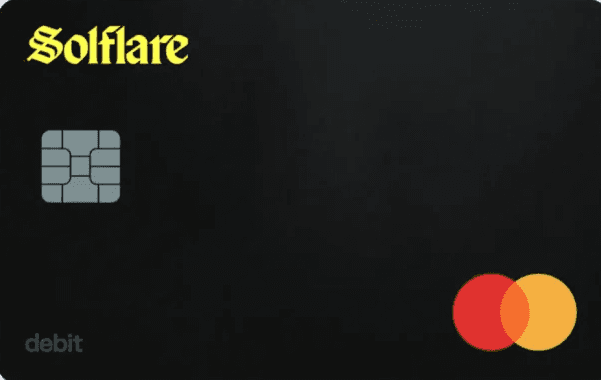 |  |
|---|---|---|
| Max Cashback | TBD | 2%Highest |
| Annual Fee | FreeBest | $5000 |
| FX Fee | 1% | 1% |
| Custody Model | Custodial | Custodial |
| Network | MASTERCARD | VISA |
| Regions | EEAUK | GLOBAL |
| Supported Assets | 1+ assets USDC | 2+ assets USDCSOL |
| Cashback | No | Yes |
| Staking | No | No |
| Points | No | No |
| Airdrops | Yes | Yes |
| Lounge access | No | Yes |
| Subscription rebates | No | No |
| Metal card | No | Yes |
| Virtual Cards | Yes | No |
| Physical Cards | No | No |
| Visa | No | No |
| Mastercard | No | No |
| Apple Pay | No | Yes |
| Google Pay | Yes | Yes |
| Self-custody spend | Yes | Yes |
| Stablecoin spend | No | No |
| No annual fee | Yes | No |
| No FX fee | No | No |
| ATM free allowance | No | No |
| No KYC | No | No |
| Virtual vs Physical | Yes | No |
| Debit vs Prepaid | No | No |
| Best For | Best for No Annual Fee | Best for Cashback |
Note: All data verified as of February 2026. Rewards and fees may vary based on your spending tier and region. Check each card's detailed page for complete terms.
Solflare vs Xplace: Key Differences
Two Solana-native [self-custodial](/crypto-cards/self-custody/) cards with different cost structures, different geographic reach, and different approaches to rewards. [Solflare](/crypto-cards/solflare-card/) charges 1% FX only (no transaction fee) with speculative raffle-based rewards in EEA and UK. [xPlace](/crypto-cards/xplace-standard-card/) charges 1% FX plus 1% transaction fee on every purchase but offers tiered [cashback](/crypto-cards/cashback/) (0.5-2%), up to 16% APY yield potential, XP ecosystem rewards, and global availability. Both spend USDC from your Solana wallet. Both maintain true self-custody. The comparison: lower costs with limited reach (Solflare) versus higher costs with global access and yield (xPlace).
The right choice depends on your priorities: cashback rates, regional availability, custody model, and which ecosystem you already use. Below, we break down who should choose each card.
Solana Ecosystem Cards with Different Economics
Both cards are built natively on Solana, targeting USDC holders who want self-custodial spending without leaving the ecosystem. But the cost structures are fundamentally different.
Solflare: Mastercard, EEA and UK only, USDC only, 1% FX on cross-currency, 0% transaction fee, 2% ATM, $30,000/month spending limit, $500/day ATM, Google Pay only (no Apple Pay), no annual fee. Rewards through "The Benefits" platform (raffle entries, ecosystem points). Direct cashback listed as "coming soon." App Store rating: 4.8 stars from 9,226 reviews.
xPlace: Visa, global availability, USDC and SOL, 1% FX on cross-currency plus 1% transaction fee on ALL purchases, Apple Pay and Google Pay. Four tiers:
| Tier | Annual Fee | Cashback | XP | Monthly Limit | Perks |
|---|---|---|---|---|---|
| Standard | $0 | 0% | 0.5x | $5,000 | Virtual card |
| Silver | $200 | 0.5% USDC | 1x | $15,000 | Physical plastic |
| Gold | $1,000 | 1% USDC | 3x | $50,000 | Metal card |
| Platinum | $5,000 | 2% USDC | 10% | $750,000 | Metal card, concierge, 1,400+ lounges |
The critical difference: xPlace charges a 1% transaction fee on every single purchase at every tier. This flat tax on all spending doubles the cost relative to Solflare before any cashback applies.
Net Returns After All Fees
Both cards lose money or break even on spending when all fees are calculated. Neither is a cashback-positive experience at realistic tiers without significant spending volume.
| Scenario | Solflare (domestic) | Solflare (cross-currency) | xPlace Standard (domestic) | xPlace Standard (cross-currency) | xPlace Gold (domestic, after $83/mo sub) |
|---|---|---|---|---|---|
| Casual ($1,000/mo) | $0 | -$10 | -$10 | -$20 | -$83 (0% net, sub eats all) |
| Active ($2,000/mo) | $0 | -$20 | -$20 | -$40 | -$83 |
| Power ($3,000/mo) | $0 | -$30 | -$30 | -$60 | -$83 |
| Annual ($3,000/mo) | $0 | -$360 | -$360 | -$720 | -$1,000 (sub cost, 0% net cashback) |
SpendNode's fee breakdown shows Solflare costs $0 on domestic same-currency spending while xPlace Standard costs 1% ($360/year on $3,000/month). This is the clearest comparison: identical self-custodial USDC spending on Solana, with Solflare costing nothing and xPlace costing 1% per transaction.
On cross-currency spending, Solflare costs 1% while xPlace costs 2%. The FX fee is identical (1%), but xPlace's additional 1% transaction fee doubles the total. A European traveler spending $3,000/month across currencies pays $360/year on Solflare versus $720/year on xPlace - a $360/year difference.
xPlace Gold at $1,000/year with 1% cashback minus 1% transaction fee nets 0% on domestic spending - the cashback exactly offsets the transaction fee. But the $1,000 annual subscription means you never break even from cashback alone. On cross-currency spending, Gold nets -1% (1% cashback minus 1% FX minus 1% tx fee), plus the subscription.
xPlace Platinum at $5,000/year with 2% cashback minus 1% tx fee nets +1% on domestic spending ($360/year at $3,000/month). After the $5,000 subscription, the break-even is $41,667/month ($500,000/year) in domestic spending. On cross-currency, Platinum nets 0% (2% cashback minus 2% fees), meaning the $5,000 subscription is pure cost at any cross-currency volume.
Global Reach vs European Focus
xPlace serves users globally. This is its primary advantage. For Solana users in Asia, Latin America, Africa, the Middle East, or any non-European market, xPlace is the only self-custodial Solana spending card available.
Solflare is limited to EEA and UK. There is no workaround - users outside Europe cannot access the card.
Within Europe, both are available and the comparison is purely economic (Solflare wins on costs). Outside Europe, xPlace is the only option regardless of its fee structure.
xPlace also scales to significantly higher limits: $750,000/month at Platinum versus Solflare's $30,000/month cap. For institutional-grade spending, treasuries, or high-net-worth individuals, xPlace's infrastructure handles volumes that Solflare cannot accommodate.
Yield and Ecosystem Rewards
Neither card competes on cashback economics. The value proposition for both is ecosystem-specific upside.
Solflare's "The Benefits" platform runs rotating rewards. The headline promotion was a Porsche 911 GT3 raffle (through February 14, 2026) where every transaction earned draw entries. Future rounds may include airdrops, partner deals, and the announced-but-unlaunched direct cashback feature. For SOL ecosystem participants, the card maintains activity that may qualify for future token distributions.
xPlace's XP system accumulates points toward the upcoming $XPLACE token generation event (TGE). Standard earns 0.5x XP, Silver 1x, Gold 3x, Platinum 10% XP cashback. The value of XP is entirely undefined until the TGE happens. For users farming token launches, higher xPlace tiers multiply future allocation per dollar spent.
xPlace additionally offers up to 16% APY on card balances through integrated Solana yield protocols. At 16% APY on a $10,000 balance, that generates approximately $1,600/year in passive returns - potentially enough to offset transaction fees for moderate spenders. A user with $10,000 earning 16% APY and spending $3,000/month domestically on Standard loses $360/year to the tx fee but earns $1,600 in yield - a net positive of $1,240/year. Solflare does not offer yield on card balances. For users who maintain significant USDC balances, xPlace's yield can make the transaction fee economically rational.
What People Get Wrong
Subscribing to xPlace Gold ($1,000/year) for the 1% cashback without calculating the transaction fee offset. Gold's 1% USDC cashback minus the 1% transaction fee nets exactly 0% on domestic spending. The $1,000 annual fee buys you a metal card, 3x XP multiplier, and $50,000/month limit - but zero net cashback returns. On $3,000/month domestic spending, Gold returns $0 in net cashback while costing $1,000/year. Solflare returns $0 in cashback and costs $0 in fees and subscription. The $1,000 difference buys XP rewards (speculative), a higher limit, and a metal card - not improved spending economics. How to avoid it: If your primary goal is cost-efficient Solana self-custodial spending in Europe, Solflare at $0 total cost beats xPlace Gold at $1,000 cost with identical 0% net cashback. Only subscribe to Gold if the 3x XP multiplier, $50,000 monthly limit, or metal card have specific value to you beyond cashback.
Dismissing xPlace because of the 1% transaction fee without considering the yield component. The 1% tx fee costs $360/year on $3,000/month spending. But a $10,000 balance earning 16% APY on xPlace generates $1,600/year - more than offsetting the fee by $1,240. A Solflare user with the same $10,000 in USDC earns $0 in yield and pays $0 in transaction fees - netting $0 total. The xPlace user nets +$1,240/year after fees. How to avoid it: If you maintain significant USDC balances ($5,000+) and the yield rates are genuinely achievable (verify current rates before committing), xPlace's yield can more than compensate for the transaction fee. Calculate your expected yield versus expected fee cost before deciding. If your balance is small and spending is moderate, Solflare's zero-fee model is simpler.
The Fast Answer
For European Solana users wanting the lowest spending costs: Solflare with $0 domestic cost and 1% cross-currency cost. Half the price of xPlace on every transaction.
For global Solana users outside Europe: xPlace Standard is the only option. Accept the 1% tx fee as the cost of global self-custodial Solana spending.
For yield seekers with significant USDC balances: xPlace with up to 16% APY can offset the transaction fee and generate net positive returns for users maintaining $5,000+ balances.
For XP/token farmers: xPlace's tiered XP system rewards higher spending volume and higher tiers with proportionally more allocation toward the $XPLACE TGE.
For high-volume institutional spending: xPlace Platinum at $750,000/month limit with concierge and 1,400+ lounges serves enterprise-grade needs that Solflare's $30,000 cap cannot accommodate.
For users who want self-custody with guaranteed cashback and zero fees: consider MetaMask (1% cashback, 0% fees, 50+ countries) or Gnosis Pay (1-5% GNO cashback, 0% fees, EEA/UK) as alternatives to both.
Outlook: Both cards are early in their reward programs. Solflare's direct cashback launch will transform this comparison - a 1%+ rate with no transaction fee would make it strictly superior to xPlace Standard on European spending economics. xPlace's $XPLACE TGE will determine the value of XP rewards accumulated by cardholders. The yield component remains xPlace's structural advantage - if Solflare adds yield features to its wallet, it would compete more directly. Watch for Solflare's cashback rate announcement and xPlace's TGE timeline.
Fee Breakdown
| Fee | Solflare | Xplace |
|---|---|---|
| FX Fee | 1% | 1% |
| Annual Fee | Free | $5000 |
| ATM Fee | 2% | TBD |
Fees pulled from issuer documentation. Verify on the official site before applying.
Who Should Choose Solflare
The Solflare Card is best suited for users who:
- Prefer a card with no annual fee
- Are based in EEA, UK
Who Should Choose Xplace
The Xplace Platinum Club Card is best suited for users who:
- Want up to 2% cashback on spending
- Are based in GLOBAL
Our Verdict
**SpendNode's cost-at-spend model confirms Solflare costs half as much as xPlace on every transaction - but earns nothing in guaranteed cashback.** xPlace Standard's 1% transaction fee on all purchases means every swipe costs 1% more than Solflare before FX applies. On cross-currency spending, Solflare costs 1% (FX only) while xPlace costs 2% (FX + tx fee). But xPlace's higher tiers offer real USDC cashback (Silver 0.5%, Gold 1%, Platinum 2%), yield potential (up to 16% APY on balances), XP rewards toward the upcoming $XPLACE token generation, and global availability beyond Europe. For European Solana users who simply want the cheapest self-custodial spending, Solflare wins. For global users, yield seekers, or high-volume spenders who can justify xPlace Gold or Platinum economics, xPlace provides infrastructure Solflare cannot match.
Frequently Asked Questions
Which has better cashback, Solflare or Xplace?
Compare the rewards section above for the latest cashback rates from both issuers.
Which card has lower fees?
Both charge 1% FX fee. Solflare has no annual fee while Xplace charges $5000.
Is Solflare or Xplace better for self-custody?
Both use custodial models. If self-custody is important, consider providers like Gnosis Pay or ether.fi.
Which card is available in more regions?
Solflare is available in 2 regions (EEA, UK) compared to Xplace's 1 region (GLOBAL). Always verify eligibility on the issuer's website.