Elon Musk's X Money has moved from closed testing to an external beta this week, and the first screenshots from users reveal a product that looks less like a crypto experiment and more like a full-service digital bank account. The platform offers a metal Visa debit card, 6% annual percentage yield on deposits, cashback on purchases, and FDIC insurance up to $250,000 per depositor through Cross River Bank, as of March 5, 2026.
William Shatner, the 94-year-old actor who played Captain Kirk in Star Trek, became the most visible beta tester after Musk sent him $42. Shatner turned the moment into a charity fundraiser, auctioning 42 beta invites at $1,000 each, with each winner receiving a $25 welcome gift card. A second auction followed with 166 additional invites at the same price. The stunt generated attention, but the product details in Shatner's screenshots are what matter for anyone watching the payments space.
6% APY and a Metal Card From a Social Media Company
The yield stands out immediately. At 6%, X Money would sit well above the national average for savings accounts (roughly 0.5%) and above most high-yield savings accounts from online banks, which hover between 4% and 5% as of early 2026. The deposits are held by Cross River Bank, a New Jersey-based institution that already serves as the banking partner for companies like Coinbase, Uphold, and several crypto card issuers.
FDIC insurance up to $250,000 per person applies, which means the product carries the same depositor protections as a traditional bank account. This is a meaningful distinction from most crypto yield products, where depositors face counterparty risk and have no government backstop if the platform fails. The collapse of FTX, Celsius, and BlockFi demonstrated what happens when yield products operate without deposit insurance.
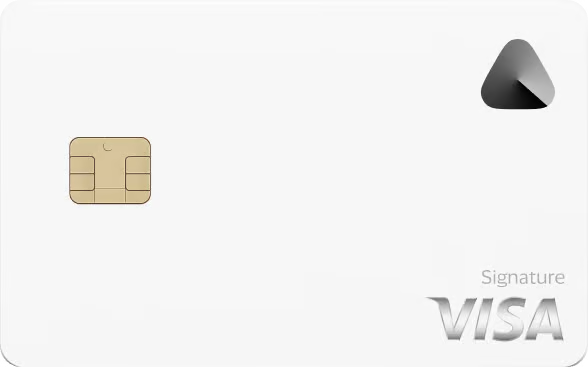
The metal Visa debit card displays the user's X handle, a branding choice that ties spending activity directly to the user's social identity. Partnership with Visa gives X Money access to the same merchant network that every other Visa card connects to, roughly 100 million merchant locations globally.
Forty States, One FinCEN Registration
X has secured money transmitter licenses in more than 40 US states and registered with FinCEN, the Financial Crimes Enforcement Network. This licensing footprint suggests X Money is being built as a peer-to-peer payments platform first, with the debit card and yield as retention features.
Forty-plus state licenses is a heavy lift. PayPal, Venmo, and Cash App all hold similar licenses, but crypto-native competitors have struggled with state-by-state compliance. Kraken recently became the first crypto firm to access the Federal Reserve's payment system, but most crypto card issuers rely on banking partners rather than holding their own transmitter licenses. X appears to be building the regulatory infrastructure in-house rather than leasing it.
The beta is restricted to US residents aged 18 and older with an X account in "good standing," though X has not publicly defined what good standing means in this context.
The Crypto Question Remains Open
Musk has called X Money "the place where all money is. The central source of all monetary transactions." That language echoes his long-stated goal of turning X into an "everything app" modeled loosely on China's WeChat, which combines messaging, payments, and financial services in a single platform.
But the integration of cryptocurrency into X Money remains unclear. Despite Musk's public affinity for Dogecoin and his history of moving crypto markets with tweets, the beta screenshots show no crypto wallet, no token balances, and no blockchain-based features. The product, as it exists today, looks like a conventional neobank account with a social media wrapper.
This matters because X has roughly 500 million monthly active users globally, and even a small conversion rate into X Money accounts would create one of the largest fintech platforms in the world overnight. If crypto integration does arrive, the distribution advantage is enormous. If it does not, X Money competes directly with PayPal, Venmo, Cash App, Apple Pay, and Google Pay on traditional rails.
What This Means for Crypto Card Users
For users already carrying crypto-linked cards, X Money introduces a new comparison point. The 6% yield competes with staking rewards offered by cards like Crypto.com (up to 12% on CRO staking for Obsidian holders) and Nexo (up to 16% on stablecoin deposits), but without requiring users to hold volatile tokens. There is no staking lockup, no token price risk, and no smart contract exposure.
The cashback feature has not been detailed beyond its existence. If X Money offers 1-2% cashback on a Visa debit card with no annual fee, it would sit alongside cards like Kolo (5% BTC cashback with a $5 per transaction cap) and Coinbase (up to 4% in select crypto) in the no-fee, reward-bearing debit card category. The difference is that X Money's cashback likely pays in US dollars, not crypto.
The FDIC insurance angle is worth noting for users who currently park stablecoins on custodial platforms to fund their stablecoin-linked cards. Those deposits carry counterparty risk that X Money's bank-held structure avoids entirely. Of course, X Money deposits do not earn the 6-12% yields that DeFi lending or staking can generate, and they do not give users ownership of any crypto asset.
The Everything App Enters the Card Wars
X Money's beta launch lands in a market where the line between social platforms, fintech apps, and crypto wallets is collapsing. Visa's partnership with Bridge and Stripe is bringing stablecoin-linked cards to 100+ countries. MetaMask launched a self-custody Mastercard across 49 US states. And now X is wrapping a bank account, a debit card, and yield into a social media feed.
The question is whether X Money stays a dollar-denominated neobank or evolves into something that bridges fiat and crypto. Musk has the distribution (500 million users), the regulatory groundwork (40+ state licenses), and the banking partner (Cross River Bank, which already knows how to handle crypto flows). The pieces are in place. Whether they connect depends on decisions that have not been made public yet.
For now, X Money is a US-only beta with a 6% carrot, a metal card, and a famous first user. The crypto angle is speculation. The neobank angle is real.
FAQ
Is X Money available outside the United States? Not yet. The beta is restricted to US residents aged 18 and older. Musk has mentioned plans for a worldwide rollout after the beta phase, but no timeline has been given.
Does X Money support cryptocurrency? Not in the current beta. Despite speculation about Dogecoin integration, the screenshots show no crypto wallet, token balances, or blockchain features. X Money operates as a dollar-denominated account with a Visa debit card.
Is the 6% yield guaranteed? X has not disclosed whether the 6% APY is a promotional introductory rate or a permanent feature. High-yield rates from neobanks frequently change based on the interest rate environment.
How is X Money different from crypto debit cards? X Money deposits are held by Cross River Bank with FDIC insurance up to $250,000. Most crypto card balances sit in custodial wallets without government deposit insurance. X Money does not expose users to token price volatility, but it also does not offer crypto rewards or DeFi yield.
How do I get into the X Money beta? Beta access has been distributed through Shatner's charity auctions and direct invitations. There is no public waitlist or open enrollment at the time of writing.
Overview
X Money has launched its external beta with a metal Visa debit card, 6% APY on deposits held by Cross River Bank with FDIC insurance up to $250,000, and cashback on purchases. The product is US-only, requires an active X account, and shows no crypto integration in its current form. With 40+ state money transmitter licenses and FinCEN registration, X is building the regulatory foundation for a full payments platform. Whether crypto features arrive later depends on Musk's roadmap, which remains undisclosed.
Recommended Reading
- Visa and Bridge Will Bring Stablecoin-Linked Cards to 100+ Countries by Year-End
- MetaMask Launches Its Self-Custody Mastercard Across 49 US States
- Kraken Becomes the First Crypto Firm to Access the Federal Reserve Payment System