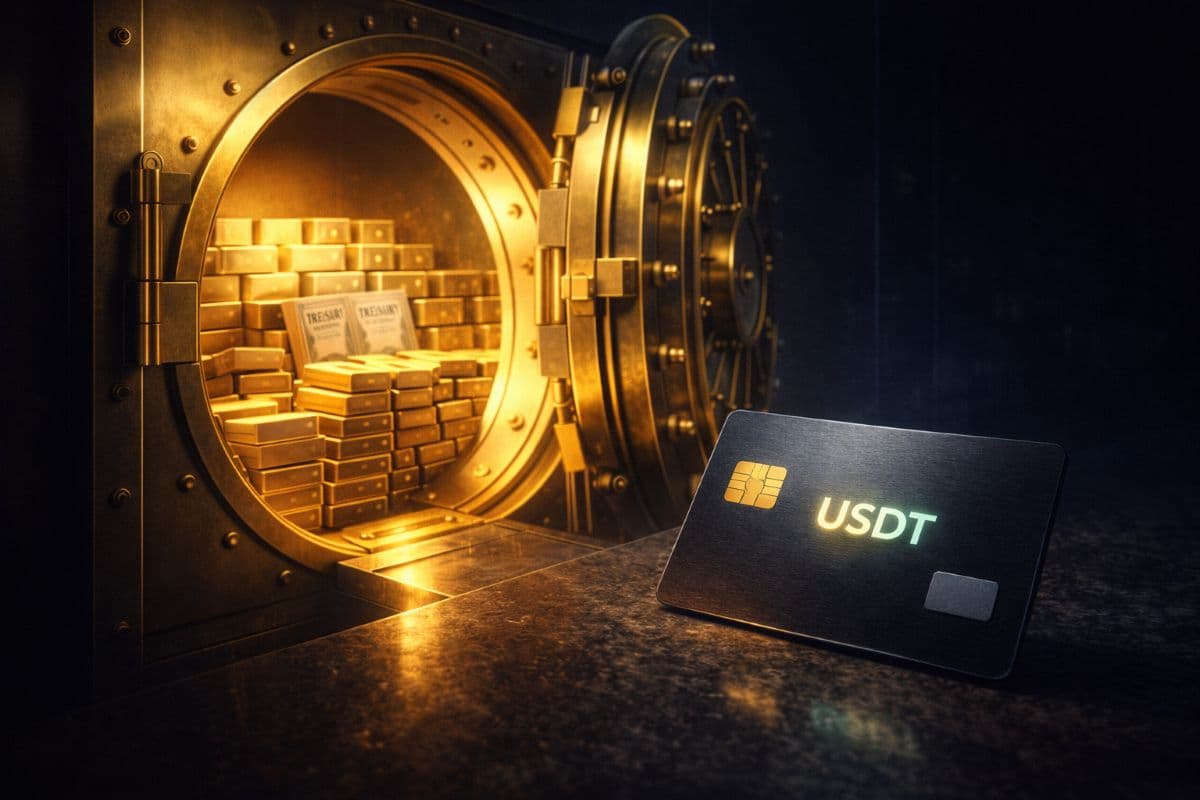
Tether, the company behind USDT (the world's largest stablecoin by market cap), reported over $10 billion in net profit for 2025 and revealed their reserves now include $17.4 billion in gold holdings. With USDT supply reaching $186.5 billion in circulation and a $6.3 billion excess reserve buffer, Tether's financial position has major implications for the millions of crypto cardholders who rely on USDT-backed spending solutions. The company is acquiring physical gold at approximately two tons per week, potentially exceeding $1 billion per month in purchases, while maintaining $122 billion in direct U.S. Treasury holdings.
Tether Reports $10B Profit and $17.4B Gold Reserve Position
On January 30, 2026, Tether released its 2025 financial report showing record profitability and a significantly diversified reserve portfolio. Key highlights:
- Net profit: Over $10 billion for 2025
- USDT supply growth: Increased by $50 billion, reaching $186.5 billion in circulation
- Excess reserves: $6.3 billion buffer over liabilities
- Gold holdings: $17.4 billion (up significantly from previous periods)
- Bitcoin holdings: $8.4 billion
- Direct Treasury holdings: $122 billion
- Total Treasury exposure: $141 billion (including overnight reverse repurchase agreements)
- Investment portfolio: $20 billion (separate from reserves)
According to Bloomberg reporting, Tether is acquiring physical gold at approximately two tons per week, translating to potential monthly purchases exceeding $1 billion. This aggressive accumulation strategy positions Tether as one of the world's largest private gold buyers.
CEO Paolo Ardoino stated: "With USDT issuance at record levels, reserves exceeding liabilities by billions of dollars, Treasury exposure at historic highs, and strong risk management, Tether enters 2026 with one of the strongest balance sheets of any global company."
Additionally, Tether launched USAT, a newly regulated stablecoin designed for the U.S. market, in partnership with Anchorage Digital to establish compliant operations domestically.
USDT Backs Most Major Crypto Card Spending Solutions
USDT is the backbone of the crypto card ecosystem. Nearly every major crypto card that offers stablecoin spending options supports USDT:
- Crypto.com Visa: Direct USDT spending
- Nexo Card: USDT as collateral for credit lines
- Binance Card: USDT conversion at point of sale
- Wirex: USDT balance spending
- Revolut: USDT trading and spending
When Tether's reserves strengthen, it directly affects the safety and stability of these spending solutions. A stablecoin is only as stable as its backing, and USDT's backing now includes:
- $122 billion in U.S. Treasuries (low-risk, liquid government debt)
- $17.4 billion in gold (inflation hedge, crisis-resistant)
- $8.4 billion in Bitcoin (asymmetric upside, speculative)
- $6.3 billion excess reserves (safety buffer)
For crypto cardholders, this means USDT is less likely to depeg during volatility, reducing the risk of your spending power evaporating mid-transaction.
Gold, Treasuries, and the Too-Big-to-Fail Hedge
Nothing broke - this is positive news. But it's worth understanding the context.
The TerraUSD Collapse Shadow
The May 2022 collapse of TerraUSD (UST), an algorithmic stablecoin that lost its peg and wiped out $60 billion in value, created intense scrutiny on all stablecoin issuers. The key difference: TerraUSD was backed by nothing but algorithmic arbitrage and market psychology. Tether, by contrast, holds $186.5 billion in tangible assets against $186.5 billion in circulating USDT (with $6.3B excess on top).
The Gold Hedge Strategy
Tether's $17.4 billion gold position is a strategic hedge against multiple risks:
- Dollar debasement: If the U.S. dollar loses purchasing power through inflation, gold typically rises, preserving reserve value
- Treasury risk: While $122B in Treasuries is liquid and safe, it's subject to interest rate risk and U.S. fiscal policy changes
- Geopolitical insurance: Gold is universally recognized and cannot be sanctioned or frozen by any single government
- Crisis liquidity: Physical gold can be sold in any major market, providing emergency liquidity if traditional financial systems freeze
By buying two tons per week, Tether is essentially converting USDT profits into hard assets, diversifying away from pure dollar-denominated instruments.
The Treasury Position: Too Big to Ignore
Tether's $141 billion total Treasury exposure positions them among the world's largest holders of U.S. government debt. For context:
- Tether: $141 billion
- Many small countries: Less than Tether holds
- Implication: Tether has systemic importance to U.S. Treasury markets
If Tether ever faced a crisis requiring rapid liquidation of Treasuries, it could affect U.S. government borrowing costs. This "too big to fail" dynamic ironically makes Tether more stable - regulators have an incentive to ensure it doesn't collapse.
How $17B in Gold Affects Your USDT Card Balance
If you're using a USDT-backed crypto card, here's what Tether's strengthened position means:
Short-Term (2026)
Increased stability during volatility: With $6.3B excess reserves and diversified holdings (Treasuries, gold, Bitcoin), USDT is less likely to depeg during market crashes. This means your crypto card spending power remains stable even when Bitcoin drops 20% in a day.
Regulatory confidence: The launch of USAT (regulated U.S. stablecoin) shows Tether is proactively addressing U.S. regulatory concerns. This reduces the risk of sudden regulatory action that could freeze USDT operations.
Medium-Term (2027-2028)
Gold-backed stability premium: As Tether continues accumulating gold (potentially $12B+ annually at current pace), USDT becomes partially backed by an asset that's uncorrelated to crypto and resistant to inflation. This is unusual for a "dollar" stablecoin and creates a hybrid value proposition.
Profit-driven excess reserves: Tether's $10B annual profit allows them to continuously grow their safety buffer without issuing more USDT. This creates a virtuous cycle: more profit → larger buffer → more confidence → more USDT demand → more profit.
Long-Term (2028+)
Potential challenges:
- Tether's size makes them a regulatory target
- $141B in Treasuries creates systemic risk if they ever need to liquidate quickly
- Gold holdings, while stabilizing, introduce storage and custody risks
What to watch:
- USAT adoption (if it succeeds, Tether becomes "too compliant to ban")
- Gold accumulation pace (if they hit $50B+, they're effectively a sovereign-level gold holder)
- Regulatory treatment (if the U.S. embraces Tether, other countries may follow)
How This Relates to Crypto Cards
Every USDT-backed crypto card depends on Tether's stability. Here's how this news affects specific use cases:
Daily Spending Cards (Crypto.com, Wirex, Revolut)
These cards convert USDT to fiat at checkout. Tether's strengthened reserves mean:
- Lower depeg risk: Your $100 USDT stays $100 USD even during Black Swan events
- Merchant confidence: Payment processors are less likely to block USDT transactions if they trust the backing
Collateralized Credit Cards (Nexo)
Nexo lets you borrow against USDT holdings. Tether's gold-backed reserves mean:
- Stable collateral value: Your USDT collateral doesn't lose value during dollar inflation
- Lower liquidation risk: Excess reserves reduce the chance of USDT depegging below your collateral threshold
Cross-Border Spending
If you're using a crypto card internationally, USDT's Treasury + gold backing creates:
- Currency stability: USDT tracks USD value globally, and gold hedges dollar weakness
- Settlement confidence: Banks are more willing to accept USDT conversions when reserves are transparent
Alternative to Consider: USDC
While Tether's reserves are now stronger, Circle's USDC remains the "cleanest" stablecoin:
- 100% cash and short-duration Treasuries (no Bitcoin, no gold)
- Full attestation from top auditing firms
- Regulatory-first approach (licensed in multiple jurisdictions)
For risk-averse cardholders, USDC-backed cards (like Coinbase Card) offer maximum transparency at the cost of Tether's hybrid gold/BTC upside.
Overview
Tether's 2025 financial report shows $10 billion in profit, $186.5 billion USDT in circulation, and a reserve portfolio that now includes $17.4 billion in gold (acquired at ~2 tons per week), $122 billion in U.S. Treasuries, $8.4 billion in Bitcoin, and a $6.3 billion excess reserve buffer. CEO Paolo Ardoino describes this as "one of the strongest balance sheets of any global company." For crypto cardholders using USDT-backed spending solutions (Crypto.com, Nexo, Binance, Wirex, Revolut), this strengthens confidence in USDT's stability during volatility. The gold accumulation strategy hedges against dollar debasement and geopolitical risk, while the massive Treasury position (larger than many countries) creates systemic importance that paradoxically makes Tether "too big to fail." Additionally, Tether launched USAT, a regulated U.S. stablecoin, signaling proactive regulatory compliance. While USDC remains the "cleanest" alternative with full audits, Tether's hybrid backing (Treasuries + gold + Bitcoin) offers unique inflation protection for long-term holders. The takeaway for crypto card users: USDT-backed cards are now safer than ever, but diversification across multiple stablecoins (USDT, USDC, potentially USAT) remains the prudent approach.